
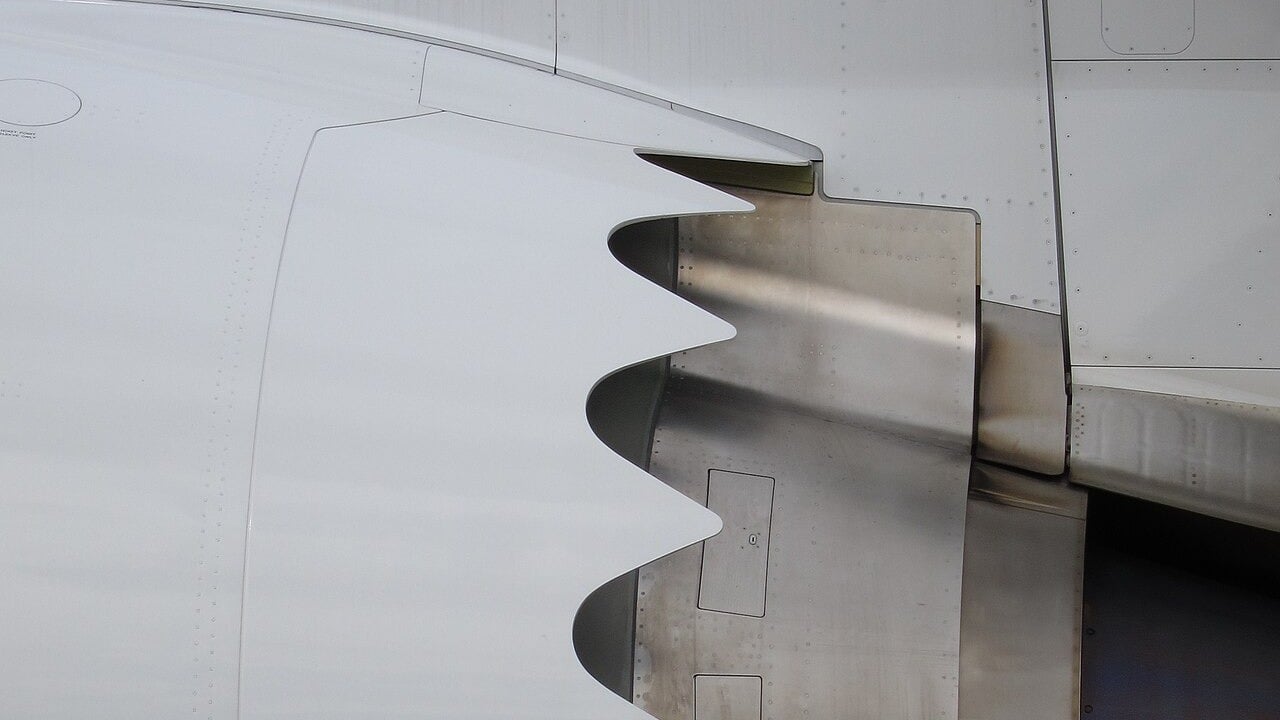
Stand at the fence at any big airport and watch a Boeing 787 taxi past. The back edge of each engine nacelle is cut into a row of neat triangular teeth, like the rim of a saw blade someone has rolled into a cylinder. Passengers assume it is styling. Occasionally someone decides it is damage.
It is neither. Those teeth are called chevrons, they came out of a NASA laboratory in Cleveland in the 1990s, and they exist to buy roughly three decibels of quiet in exchange for about a quarter of one per cent of the engine’s thrust. That is the entire trade, and it is one of the few pieces of aerospace engineering where you can see the answer from the terminal window.
What makes the chevron worth a thousand words is not that it works. It is how narrow the margin is between the version that works and the version that makes things worse.
Kurzinfo
What it is: A chevron: triangular serrations cut into the trailing edge of a jet engine’s fan or core nozzle
Where it came from: NASA Glenn Research Center, developed in the 1990s from military engine “tabs”
Measured thrust cost: 0.25 per cent in NASA’s 1998 engine tests, which the agency called negligible
Erste Flugtests: Estrella Sailport, Arizona, 26 to 28 March 2001, on a NASA Learjet 25 and a Honeywell Falcon 20
First commercial engine: The General Electric CF34-8, flown on a Bombardier CRJ900 in 2003
Airliners that wear them: Boeing 787 Dreamliner, Boeing 747-8 and Boeing 737 MAX
Flight-test benefit: Up to roughly 2 dB in the low-frequency aft arc on the Quiet Technology Demonstrator 2 programme
QTD2 partners: Boeing, General Electric, Goodrich, NASA and All Nippon Airways
From Military Tabs to a Sawtooth
The starting point was not elegant. Engineers had found that small tabs projecting into an engine’s exhaust cut the noise, by helping mix the hot air coming out of the core with the cooler air coming through the fan. Mixing the two streams faster meant the jet slowed down faster, and a slower jet is a quieter jet.
Tabs worked. They were also crude. In the 1990s, according to NASA’s own account of the programme, Glenn Research Center researcher Dennis Huff and his colleagues found that a serrated, sawtooth shape did the same job better. They called it a chevron.
What followed was years of unglamorous testing at Glenn’s Aero-Acoustic Propulsion Laboratory: extensive work in the spring of 1997, then engine tests in 1998 that ran through fourteen separate chevron designs. Those 1998 tests produced the number that made the whole idea viable. The chevron nozzle cost 0.25 per cent of thrust. NASA described the reduction as negligible, and in an industry where a tenth of a per cent of specific fuel consumption is worth arguing about, that is the highest praise an add-on can get.
Huff’s own way of describing the acoustic benefit was a three-decibel reduction, which he likened to the difference between hearing two lawnmowers and hearing one. It sounds modest. In community noise terms, around an airport, it is not.
Estrella Sailport, March 2001
A wind tunnel is not an aeroplane. To prove the chevron in the air, NASA took two aircraft to Estrella Sailport, a gliding field southwest of Phoenix, and flew them between 26 and 28 March 2001, with the first sortie on the 27th. One was NASA’s own Learjet 25, powered by a variation of General Electric’s J-85 turbojet. The other was a Honeywell Falcon 20 with turbofans.
NASA pilot Bill Rieke, then chief of Flight Operations at Glenn, flew the Learjet; an FAA pilot, Ellen Tom, was also involved in the campaign. The team behind the work, drawn from Glenn, NASA Langley and Honeywell, took an innovation award for it in 2002.
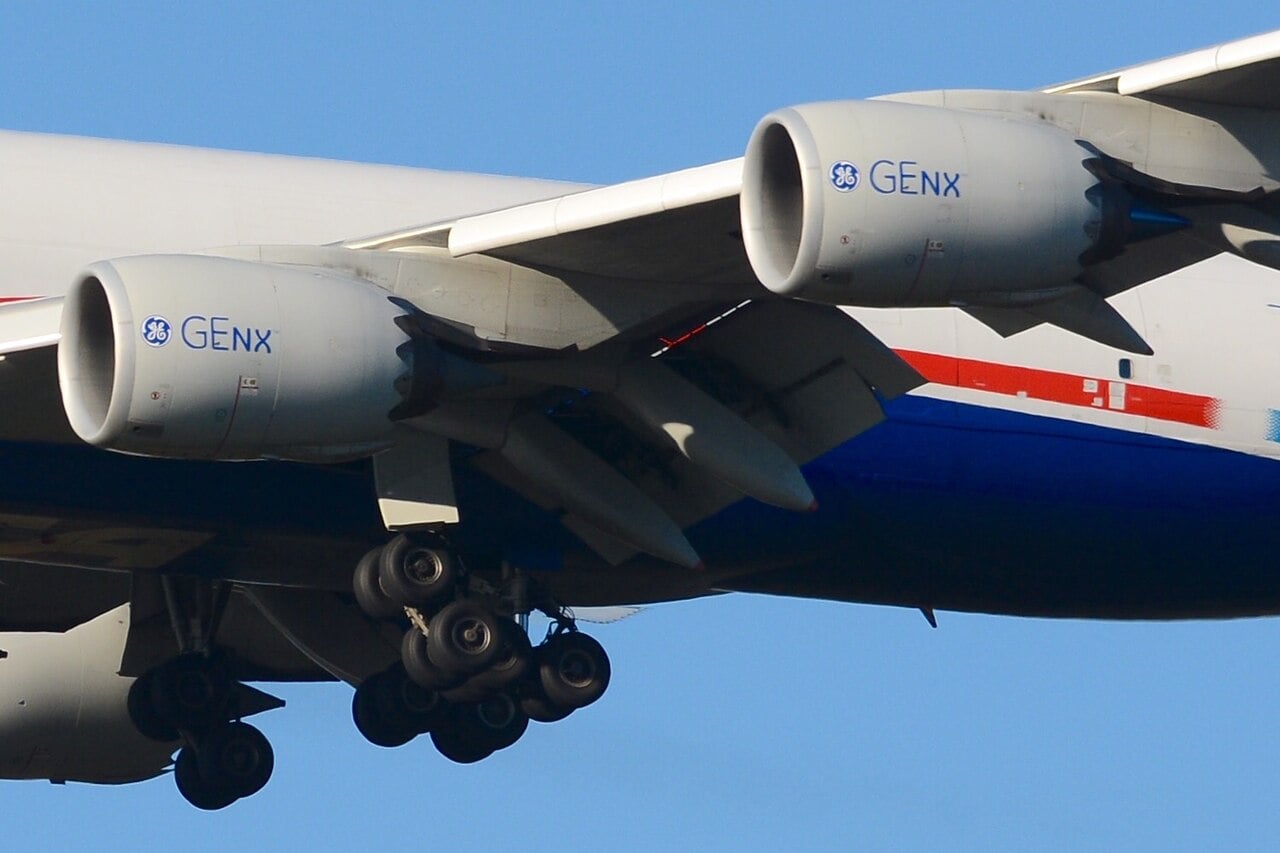
Two years later the technology was in a certificated product. The FAA began certifying General Electric’s CF34-8 as the first commercial aircraft engine to incorporate chevrons, and it flew on a Bombardier CRJ900 in 2003. A regional jet, not a flagship. Chevrons reached the 787 and the 747-8 by way of the GEnx, and the 737 MAX by way of its own nacelle, but a CRJ got there first.
What the Sawtooth Actually Does to the Jet
The clearest technical description of the mechanism comes from the flight-test paper written for Boeing’s Quiet Technology Demonstrator 2 programme, and it is worth reading slowly, because every clause is doing work.
Unpack that and the device stops being mysterious. Each tooth bends slightly inward, into the faster stream. Because the teeth alternate with gaps, the edge no longer sheds a single smooth shear layer; it sheds a ring of counter-rotating corkscrew vortices running downstream.
Those vortices promote increased mixing between the two streams. The jet plume gets shorter. The velocity along its centreline falls away sooner. And since low-frequency jet mixing noise is generated by the long, fast, turbulent column of air behind the engine, shortening that column takes the noise with it.
So far, so good. Here is the part that makes chevron design difficult rather than obvious.
Push the teeth deeper into the stream and you win more at the bottom of the spectrum and lose more at the top. A chevron is therefore not a shape you optimise; it is a shape you balance. The programme’s stated goal was to increase or maintain the low-frequency benefit while reducing or eliminating the high-frequency increase, which is a polite way of saying that earlier chevrons had been robbing one part of the spectrum to pay another.
A 777 Over Montana
The answer Boeing and its partners arrived at was to stop making the teeth all the same.
An engine hanging under a wing does not radiate noise symmetrically. The pylon, the wing above it and the flaps behind it all interfere with the jet, which is why the field has its own acronym: propulsion airframe aeroacoustics. If the installation is asymmetric, the paper argued, the fix should be too. Tailoring the chevrons to produce enhanced mixing near the pylon reduced both the installation interaction and the jet mixing noise more than conventional azimuthally uniform chevrons could.
In practice the chosen design has larger and more deeply immersed teeth close to the strut and smaller, shallower ones away from it. One nozzle, two different chevron geometries around its circumference, chosen because that combination gave the low-frequency reduction without the high-frequency penalty.
Proving it needed an aeroplane. Quiet Technology Demonstrator 2 was a Boeing-led project with General Electric, Goodrich’s Aerostructures division, NASA and All Nippon Airways, and the testbed was a Boeing 777-300ER with GE90-115B engines. The flying was done over three weeks at Boeing’s test facility at Glasgow, Montana, a place chosen largely because there is very little there to make noise of its own.
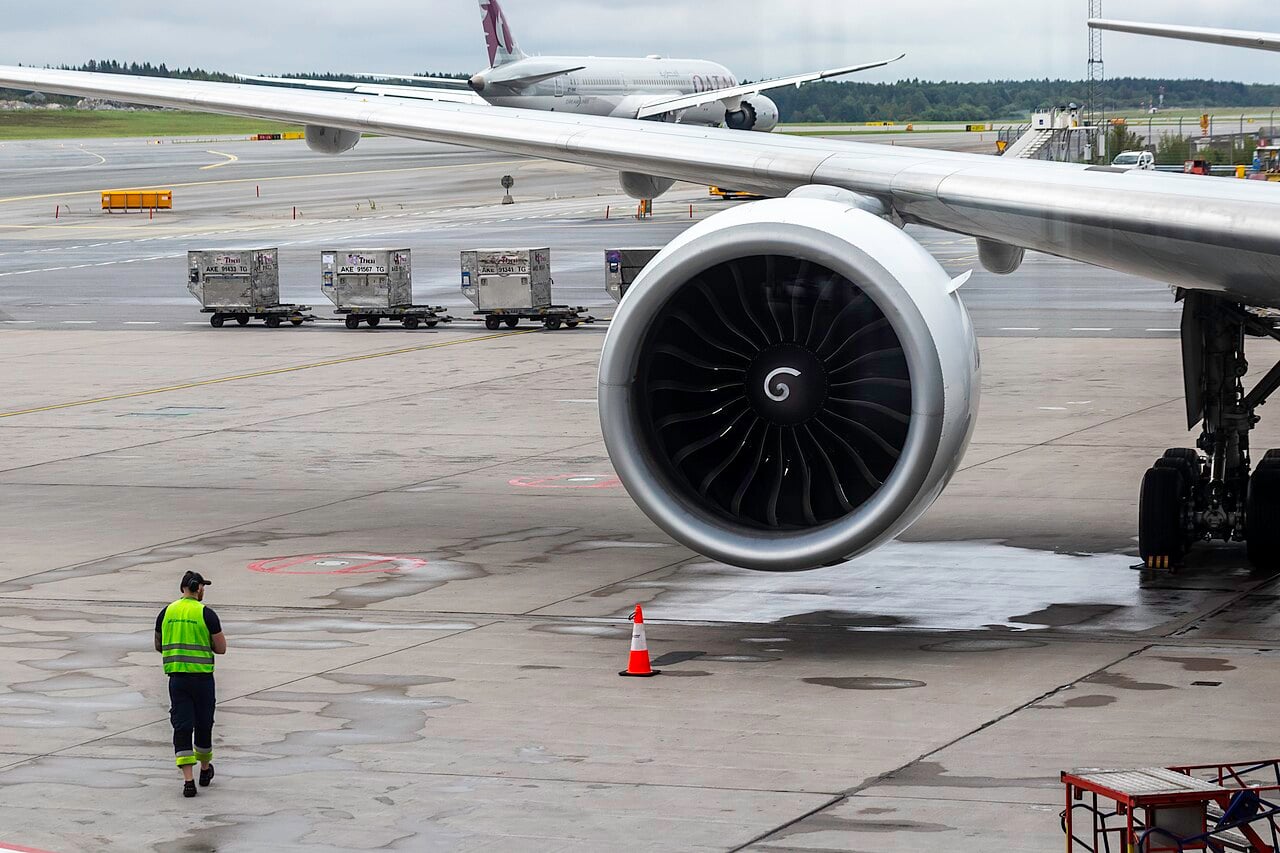
Chevrons were not the only thing on the aeroplane. GE also fitted a one-piece acoustic inlet liner running uninterrupted from the lip to the fan blades, in place of the segmented liner the GE90 normally carries, and treated the inlet lip itself rather than leaving it hard-walled.
The flight results were measured, not marketed. With the tailored fan chevrons and core chevrons fitted, the aft-arc microphones recorded a significant reduction of up to roughly 2 dB in the low frequencies, at both maximum takeoff power and the reduced cutback setting. Integrated across the aft arc, the benefit held up to and including the one-third-octave band centred near 400 Hz. The paper also notes that flight data scatter can run over 2 dB from one angle to the next, which is the sort of caveat you only find in papers written by people who expect to be checked.
On the cruise side, the abstract records hardly any impact on the cruise thrust coefficient. Which is the whole argument for the device: if the penalty were real, nobody would fly it.
Where You See Them, and Where You Do Not
Walk a modern apron and the pattern is easy to read once you know it. The 787 and the 747-8, both GEnx-powered, wear chevrons. So does the 737 MAX. Look at a Boeing 777X and its GE9X nacelles are smooth.
The reason is in the physics the QTD2 paper spells out. Chevrons attack one specific noise source: the low-frequency mixing noise of a fast jet column behind the engine. The faster that jet, the more there is to attack. Very high bypass ratio engines move far more air far more slowly, which means the exhaust leaves at a lower velocity and jet mixing noise is simply a smaller part of the total. Spend thrust fixing a problem that has already shrunk and you are paying for nothing.
That is the engineering logic, and it is sound. It is worth being honest that it is not the same thing as a manufacturer’s statement. Figures circulate online for exactly what Boeing decided the 777X chevrons were costing, and none of them traces back to a published GE or Boeing document that can be checked. The number that can be checked is NASA’s: 0.25 per cent of thrust, measured on a test stand in 1998, on the designs NASA tested. Treat anything more precise about a specific modern engine with suspicion until somebody publishes it.
A Quarter of a Per Cent, Well Spent
The chevron is a good argument against the idea that aerospace progress arrives in large pieces. Nobody redesigned an engine. Somebody cut triangles into the back of a nacelle, spent years working out how deep to cut them and in what pattern, and bought a few decibels for a fraction of a per cent.
What makes it a satisfying piece of engineering is that the penalty is visible and the benefit is audible, and the two are tied together by one variable. Cut the teeth deeper and the low rumble fades while a hiss comes up behind it. Cut them shallower and the rumble stays. The right answer is somewhere in between and it is different on every installation, which is why Boeing ended up flying a nozzle whose teeth change size as they go round.
Next time a Dreamliner rolls past and the back of the engine looks like it has been through a bandsaw, that is what you are looking at: a 1990s laboratory result, a gliding field in Arizona, three days of flight test, and a quarter of a per cent of thrust, still being spent on every departure.
Sources: NASA Glenn Research Center, “NASA’s Chevron Technology Quiets the Skies” by Robert S. Arrighi (11 March 2025); Nesbitt, Mengle, Czech, Callendar and Thomas, “Flight Test Results for Uniquely Tailored Propulsion-Airframe Aeroacoustic Chevrons”, NASA Technical Reports Server; General Electric press release, “GE and Boeing Test Quieter Jet Technologies” (10 August 2005).


0 Comments