
Every fighter engine that comes out of the repair shop has to prove itself before it goes back into a jet. That means running it at full power, afterburner included, for as long as the technicians need to check it. Do that in the open, next to a base housing area, and you will hear about it from the neighbours. So air forces do it indoors, in a building designed to swallow the noise: the hush house.
From the outside, a hush house looks like an ordinary hangar with a large tube sticking out of the back. Inside, an F-16 engine can run at 29,000 pounds of thrust while technicians watch the readings from a control room a few metres away.
Kurzinfo
- What it is: an enclosed, noise-suppressed hangar for running jet engines at full power
- What it tests: whole aircraft held back by restraints, or bare engines on thrust frames
- Key part: the augmenter tube (called a "detuner" in the UK), which mixes the exhaust with cooling air
- F110 at full afterburner: about 139 decibels, according to the US Air Force
- Outside, at 250 ft: about 80 decibels, roughly an electric shaver
- Typical test: 45 minutes to several hours per engine
- Outdoor cousin: the Ground Run-Up Enclosure, an outdoor run-up area with noise-control structures
Why Engines Need a Full-Power Run
An engine that has been taken apart and put back together cannot simply be bolted into a jet and flown. It has to be run at every power setting it will see in flight, from idle to maximum afterburner, while technicians check temperatures, pressures, vibration and fuel flow. The most common faults they find are mundane: oil and fuel leaks.
At Langley Air Force Base in Virginia, a 2010 Air Force feature described the hush houses as the only places on base where an engine may be run at maximum throttle. Staff Sgt. Cesar Delgadillo, a propulsion craftsman there, put the purpose simply: the hush houses give his team a way "to get inside the engine as close as possible to see what could happen once it's in the air."
At the 20th Fighter Wing's hush house, Tech. Sgt. Michael Sierra called the test "the last step to ensure the engine is running properly before it is put in a jet." The facility there tested seven to ten engines a month, at an average of six hours each.
How You Silence 139 Decibels
Der Nachbrenner is the problem. According to the Air Force, the F-16's General Electric F110-GE-129 produces a 139-decibel roar at full afterburner. The loudest sound considered safe even with hearing protection is 140 decibels.
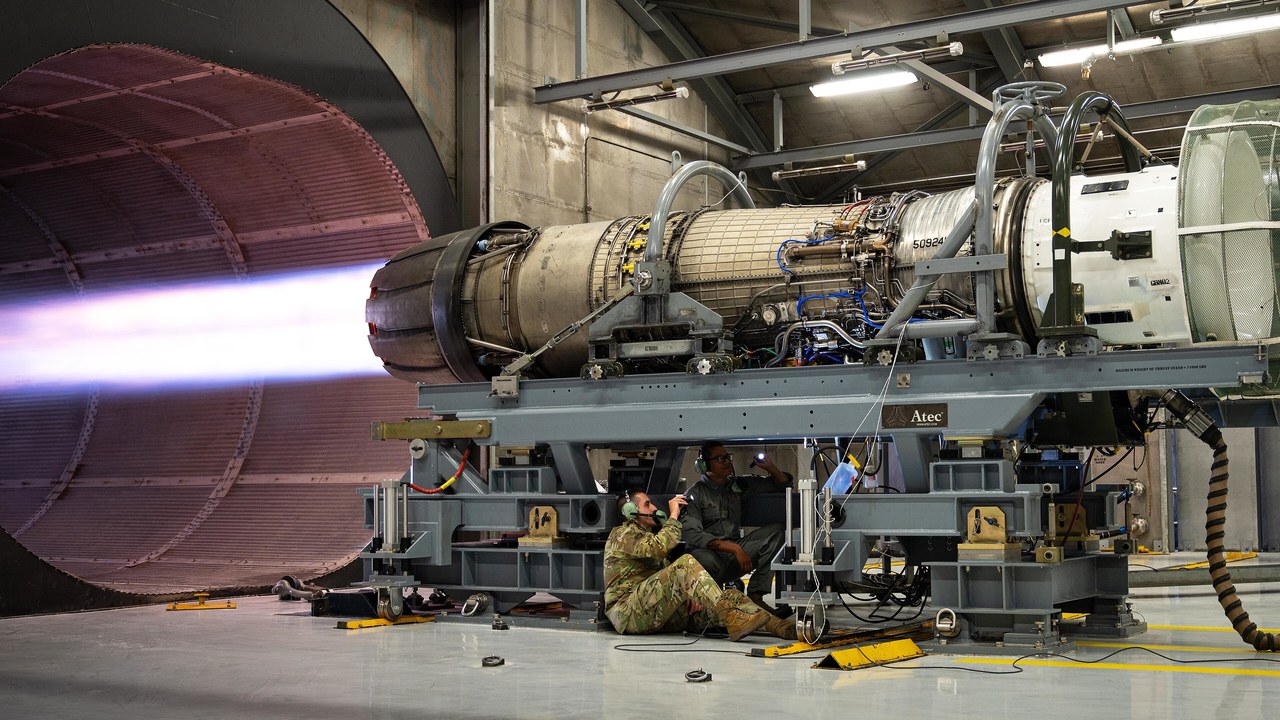
The answer is the long tube at the back. The engine fires its exhaust straight into it. As the hot jet rushes into the tube, it drags a large volume of cooler outside air in with it, the same Venturi effect that makes a paint sprayer work. That extra air cools the exhaust and slows it down, which is why the tube is called an augmenter. In Britain, the same part is usually called a detuner.
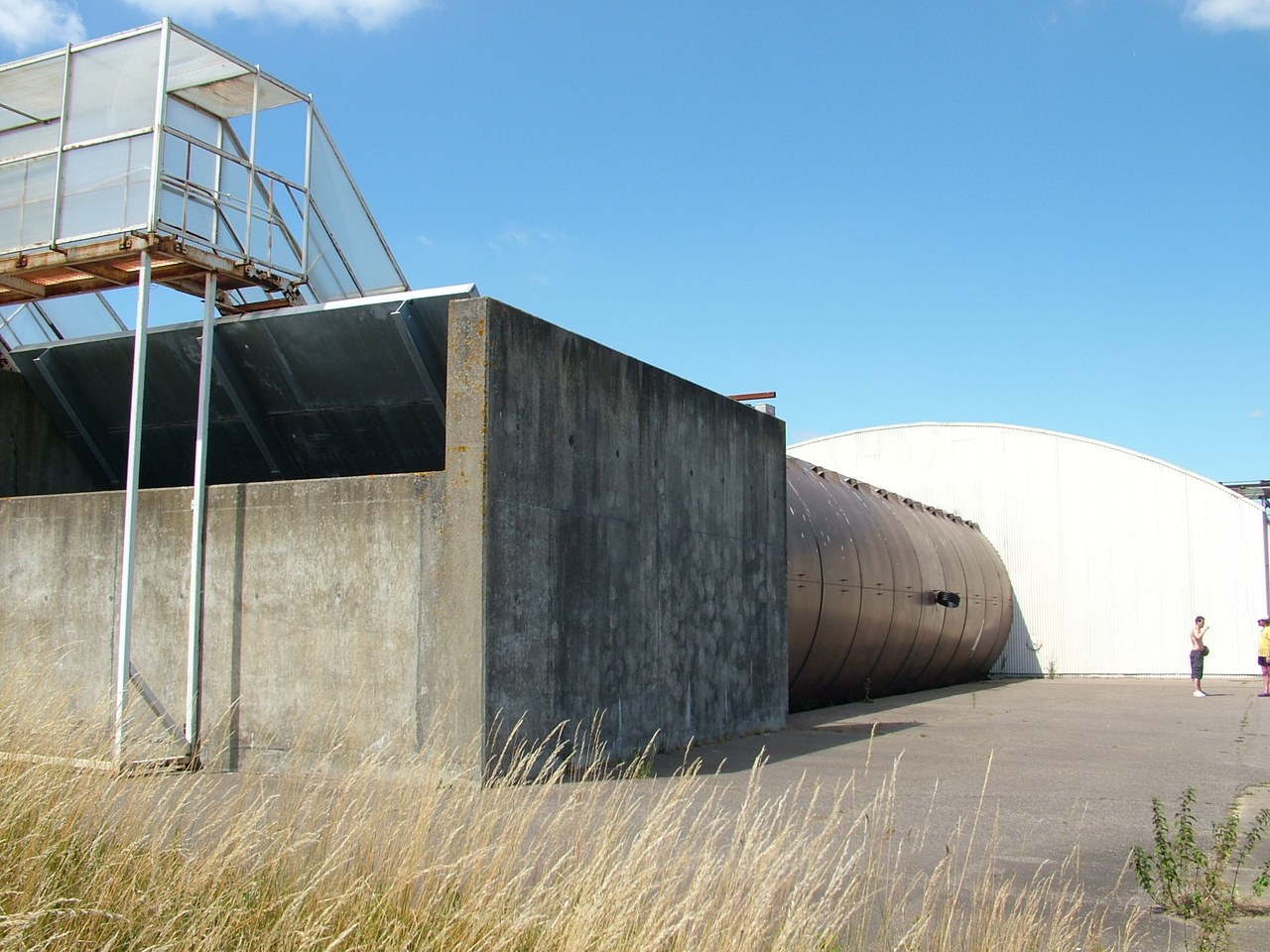
The inside of the tube and the exhaust path are lined with acoustic panels, typically fibrous insulation behind a metal mesh that stops the gas stream from tearing it apart. They soak up sound energy before it can escape. At the end, the cooled exhaust is usually sent up through a vertical stack. At the 20th Fighter Wing, the tube was 20 feet long and absorbed an afterburner flame about 30 feet long.
The result, according to the Air Force, is that a full-afterburner run heard from 250 feet outside sounds like about 80 decibels, comparable to an electric shaver. Master Sgt. Tony Hyatt, who ran the facility, saw that as the whole point.
Inside During a Run
Nobody stands next to the engine at full power. The crew runs the test remotely from a control room, the run cab, using computers linked to the engine that perform automatic or manual test sequences and flag fault codes. At Langley, four high-resolution cameras let the crew look for leaks without walking into the test area, and a three-person team works through a 20-step safety checklist before every run.

Even with the engine safely restrained, the inside of a hush house is not a calm place. "Once the jet starts running, the air being blown around inside the hangar is intense," Delgadillo said. His colleague Staff Sgt. Eric Rich agreed.
Tests can take from 45 minutes to nearly three hours at Langley, and much of that time is spent watching numbers. In 2009, the Langley crew tested 81 uninstalled engines and 49 complete jets, including engines from the Vermont Air National Guard's F-16s.
Engines on Frames, Jets on Chains
A hush house can test an engine in two ways. A bare engine, fresh from the shop, is mounted on a thrust frame, a heavy steel stand that holds it in place and measures the push it produces. That is what the photo at the top of this page shows: an F110 at Hill Air Force Base in Utah, firing its afterburner into the augmenter tube while two technicians check it from below.
Alternatively, the whole aircraft can be towed inside. It is then held in place by holdback devices strong enough to resist full thrust, so the jet's own systems, from fuel to hydraulics to electronics, can be tested together with the engine. Hush houses are large enough to take an entire fighter, and some are also equipped for other checks, such as weight and balance or night-vision lighting tests.
Where a full indoor facility is not available or not needed, some outdoor run-up areas are fitted with noise-control structures instead. These are known as Ground Run-Up Enclosures.
Why Bases Built Them
The reason is the neighbours. At Langley, engine tests once rattled the homes of nearby residents. That led to complaints and an Air Force investigation. Gary Hallmark, a base community planner at the 20th Fighter Wing, described the hush house as proof that "the Air Force knows the noise that it creates and is striving to reduce that noise."
Hush houses can also outlast the jets they were built for. The one shown earlier in this article stands at the former US Air Force base at RAF Bentwaters in Suffolk, with its augmenter tube still attached, long after the fighters left.
The video below shows an F-16 engine test at full afterburner in a hush house.
Sources: Wikipedia (Hush house); US Air Force, "Hush houses keep jet noise contained" (Joint Base Langley-Eustis, April 2010); US Air Force, "Sound of silence" (20th Fighter Wing Public Affairs); US Air Force and Wikimedia Commons photo captions (Hill AFB 2019 and 2025, Langley AFB 2015); Geograph (RAF Bentwaters hush house)


0 Comments