
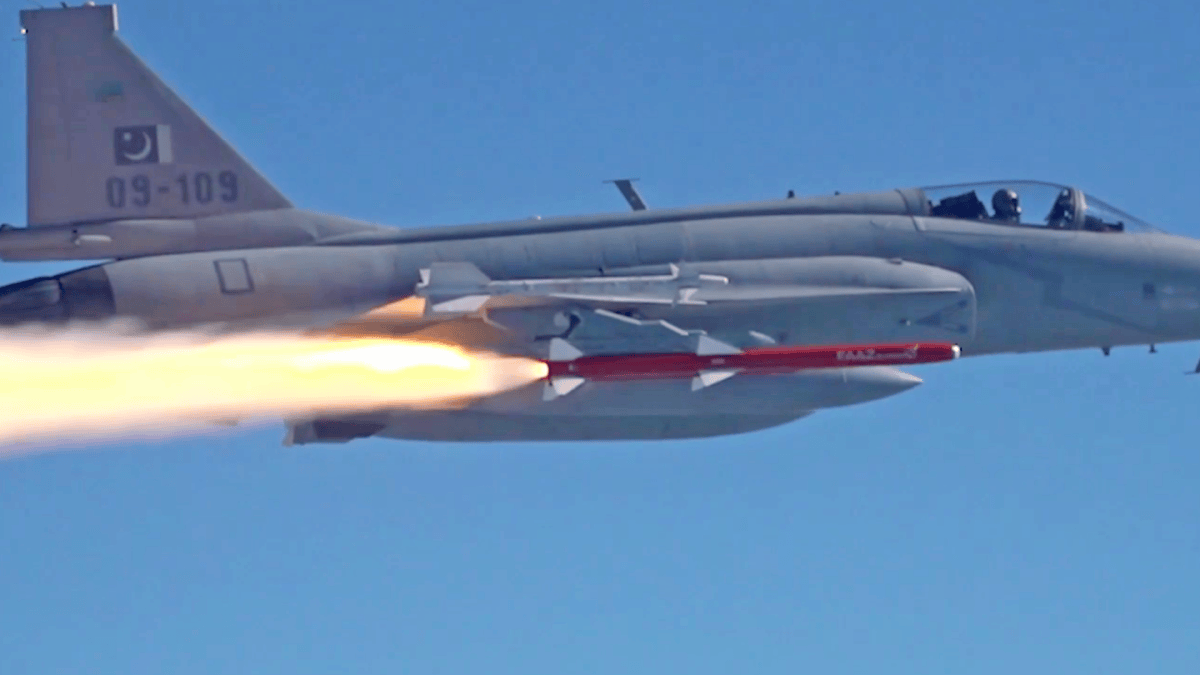
A grey JF-17 Thunder with the serial 09-109 on its tail, a bright red missile under its wing, and then a streak of flame. That is the clip the Pakistanische Luftwaffe released on Tuesday, 3 November 2026, to announce the first flight test of Fa’az, which Pakistan calls its first indigenously developed air-to-air missile.
Pakistan has fired plenty of home-built weapons from the ground and from aircraft at ground targets. Building a missile that hunts other aircraft is a different league, and only a relatively small group of countries does it. The name, Urdu for “victorious”, leaves little doubt about the ambition.
Kurzinfo
- Waffe: Fa’az air-to-air missile (variant tested: Fa’az-IIR, imaging infrared seeker)
- Test announced: Tuesday, 3 November 2026, by ISPR and the PAF press wing
- Launch aircraft: Pakistan Air Force JF-17 Thunder Block-1, serial 09-109
- Entwickler: NESCOM’s Air Weapons Complex; marketed by Global Industrial & Defence Solutions (GIDS)
- Varianten: Fa’az-IIR (imaging infrared) and Fa’az-RF (active radar)
- Advertised performance (GIDS, 2023): Range over 100 km, top speed about Mach 3.5
- First shown: Mockups at the IDEF defence fair in Turkey, 2023
What Pakistan Announced
The military’s media wing, Inter-Services Public Relations (ISPR), said the missile carries a state-of-the-art terminal guidance system and can engage targets at longer ranges. Senior officers, scientists and engineers watched the launch. President Asif Ali Zardari, Prime Minister Shehbaz Sharif and Field Marshal Asim Munir all congratulated the team.
ISPR gave no range, speed or target details, and the short video does not show an intercept. What it does show is the missile leaving a pylon under the JF-17’s wing in clear air.
An Infrared Missile With Long-Range Claims
Fa’az is not a surprise. Pakistan’s state-owned Global Industrial & Defence Solutions (GIDS) showed mockups of two versions at the IDEF defence fair in Turkey in 2023: the Fa’az-RF with an active radar seeker, and the Fa’az-IIR with an imaging infrared seeker. Quwa reports that the missile was developed by the Air Weapons Complex of NESCOM, the organisation behind the Ra’ad and Taimur air-launched cruise missiles.
The round in the video is the infrared version, painted red as a test article. At IDEF, GIDS advertised both versions as medium-range missiles with a range of more than 100 km and a top speed of around Mach 3.5, and quoted seeker detection ranges of about 25 km for the radar version and 40 km for the infrared one. Those are marketing figures. Real ranges depend heavily on the launch aircraft’s speed and altitude.
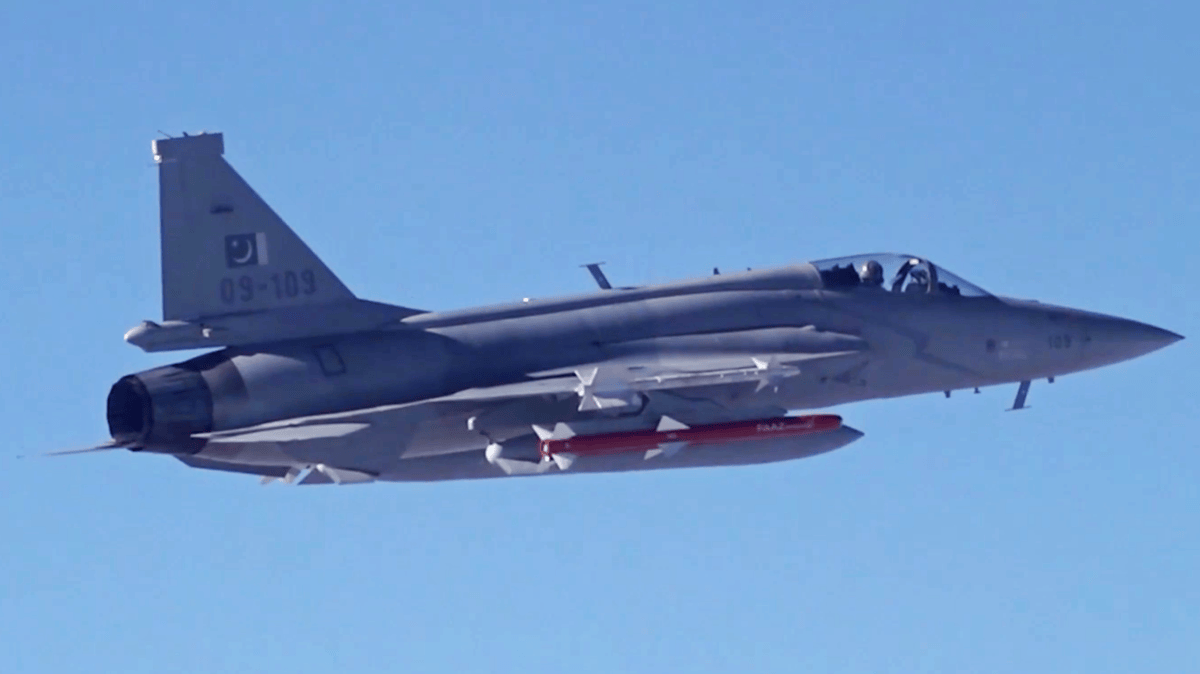
An infrared missile that flies 100 km cannot see its target from the rail. As TWZ explains, the fighter would hand the missile initial targeting data, the missile would fly out on inertial navigation, possibly with datalink updates, and only switch on its seeker near the predicted intercept point. This “lock-on after launch” approach is already used by other beyond-visual-range infrared designs.
The Chinese Question
The Fa’az has often been compared with China’s SD-10, the export version of the PL-12, which the PAF already carries. GIDS has said it developed its missiles locally and owns the intellectual property. How much Chinese technology is inside is unknown.
Douglas Barrie of the International Institute for Strategic Studies told TWZ it is possible, though unconfirmed, that the seekers come from China. If so, he does not think that would be a weakness.
Why It Matters for the JF-17
The JF-17, built jointly by Pakistan and China, is the backbone of Pakistan’s effort to run its own combat aviation industry, and it is being sold abroad. A home-grown air-to-air missile cleared on the type gives Pakistan more control over what its jets carry, and potentially another product to offer the JF-17’s export customers.
Quwa notes that 09-109 is one of the PAF’s older Block-1 aircraft, among the first to go through a major overhaul at the Pakistan Aeronautical Complex. Clearing the missile on early-model airframes would matter for a fleet that mixes several JF-17 blocks.
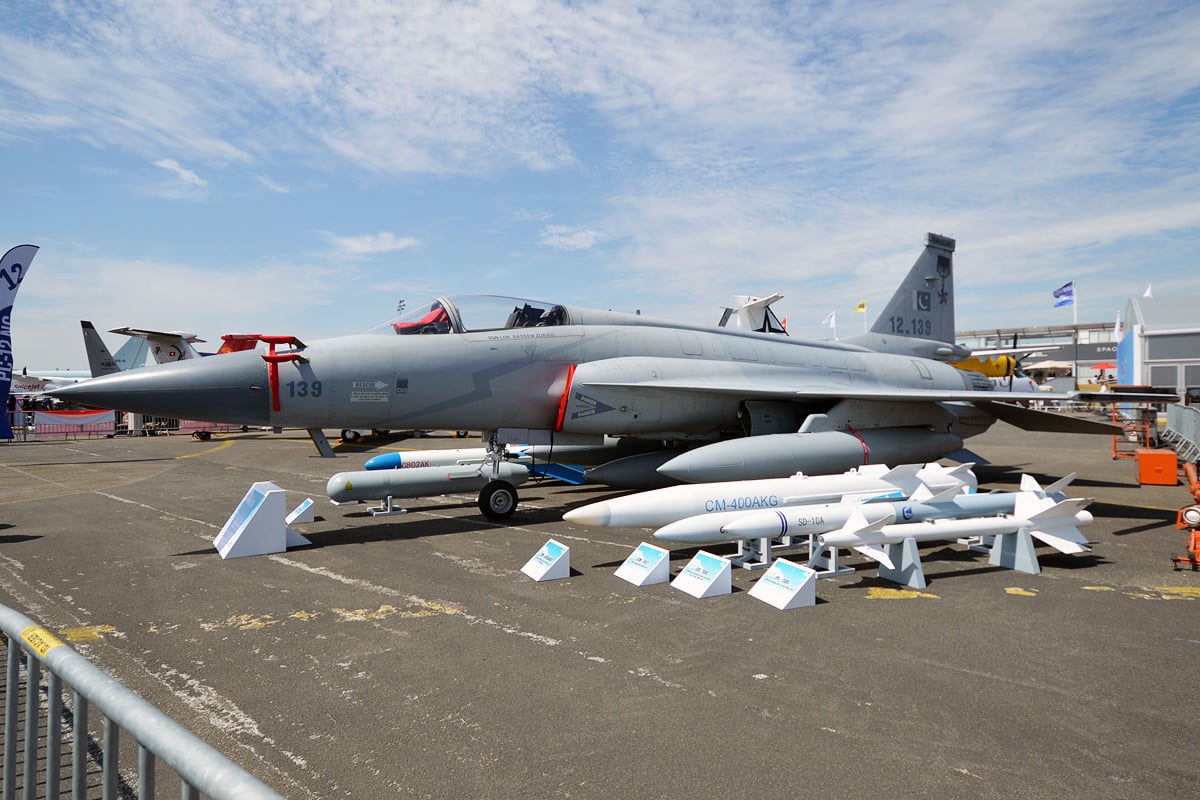
The test also caps a busy autumn for Pakistan’s missile programmes, coming after the Fatah-2 ER ballistic missile test on 13 October. One video is not an operational capability, and Pakistan has not said when Fa’az will enter service. But a red missile leaving a JF-17 under its own power is the moment the programme stopped being a trade-fair mockup.
Sources: ISPR, Pakistan Air Force DGPR, Dawn, Quwa, TWZ



0 Comments