
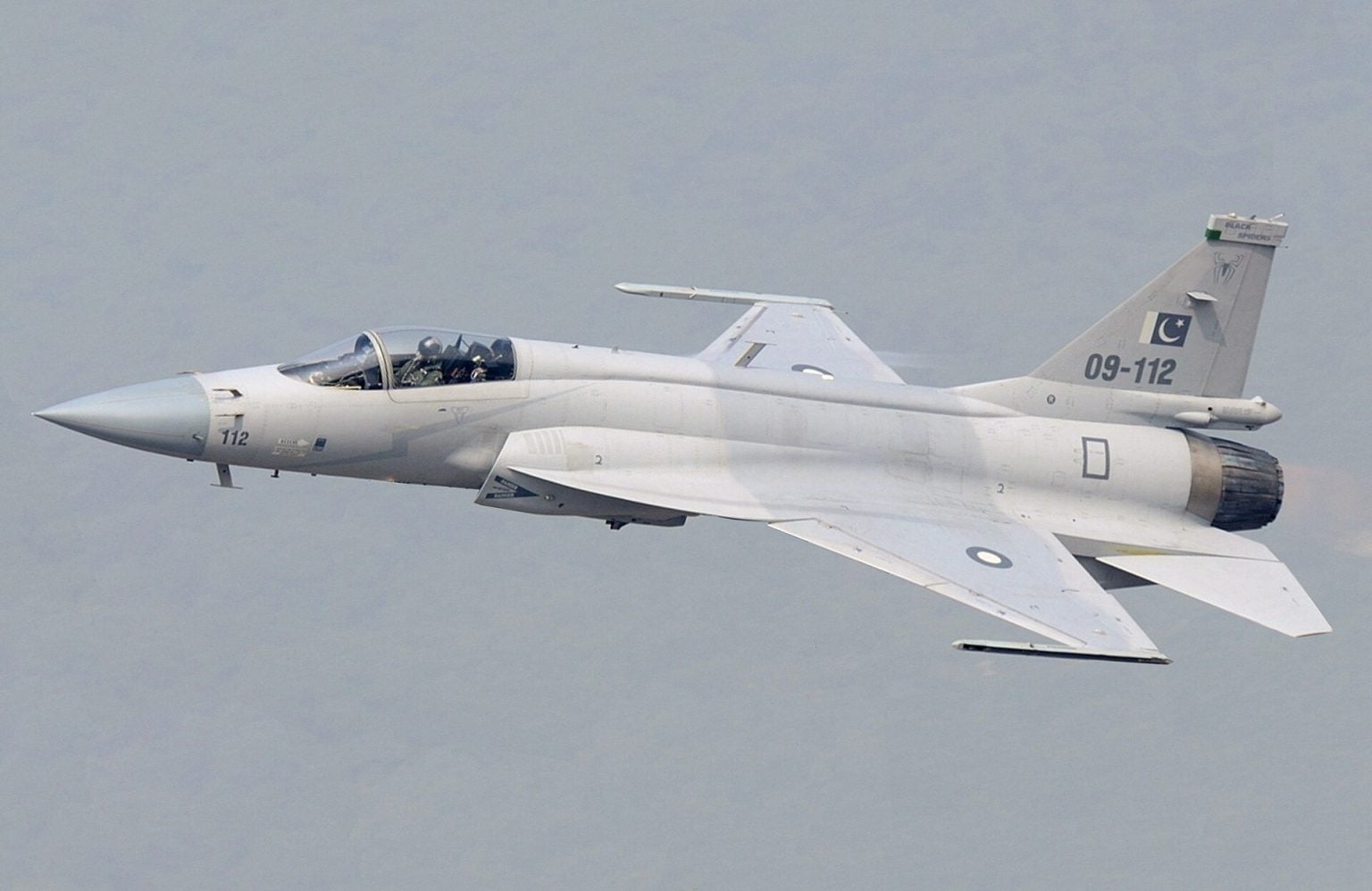
PAC / CAC JF-17 Thunder
“Xiaolong / Fierce Dragon”
A lightweight, low-cost 4th-generation multirole fighter built jointly by Pakistan and China — the jet that gave Pakistan a modern warplane it could build at home, free of Western embargoes, and that China turned into an export success from Myanmar to Azerbaijan.
The fighter Pakistan built to be free of embargoes
In 1990 the United States froze delivery of F-16s that Pakistan had already paid for, part of the sanctions that followed its nuclear programme. Islamabad was left with an ageing fleet of Mirages and Chinese F-7s and no reliable Western supplier. The lesson its air planners drew was blunt: Pakistan needed a modern fighter it could build and support at home, sourced from a partner that would not switch it off. That partner was China.
The two countries formally launched a joint fighter programme in 1999, building on an earlier Chinese design study — the “Super-7,” itself a deep redevelopment of the MiG-21 lineage — which matured into the Chengdu FC-1 Xiaolong. Chengdu Aircraft Corporation (CAC) led much of the design; the Pakistan Aeronautical Complex (PAC) at Kamra became the co-developer and co-production line. The aircraft first flew in 2003, entered Pakistani service in 2007, and Pakistan now assembles it domestically.
The JF-17 was never meant to out-fly an F-22 or a Rafale. It was meant to be cheap, numerous and good enough — a single-engine multirole fighter costing a small fraction of a Western jet, able to carry modern beyond-visual-range missiles, fly ground-attack and air-defence missions, and be maintained without anyone’s permission. That formula — and the latest Block III with its AESA radar and long-range PL-15 missiles — is exactly why a growing list of budget-conscious air forces are now buying it.
01How the JF-17 Thunder grew out of the Super-7 and Pakistan’s F-16 embargo
The JF-17’s family tree runs back through the Chengdu Super-7, a 1980s project to modernise the MiG-21/F-7 with Western avionics — a plan that collapsed when Western cooperation with China ended after 1989. China kept the airframe concept alive as the FC-1; Pakistan, embargoed on its F-16s from 1990, needed exactly such an aircraft and signed on as a partner in the late 1990s. The result is a genuinely new design that only distantly echoes its MiG-21 ancestry.
Cost-sharing was central. By pooling money and industry, Pakistan got a home-built fighter and a production line at Kamra, while China got a launch customer and a low-cost export product to offer nations that could not afford — or were denied — Western jets. Both aims have since been realised.
What makes the JF-17 Thunder special
Affordable multirole — and built at home
The JF-17’s whole point is capability per dollar. A flyaway cost commonly quoted at around US$25–32 million buys a single-engine fighter that can fly air defence, strike, anti-ship and reconnaissance. Just as important, Pakistan co-produces it at Kamra, so it can build, upgrade and support the fleet without relying on any Western supplier — the independence the F-16 embargo taught it to value.
Block III: AESA radar and the PL-15
The latest Block III is a real generational jump. It adds an AESA radar (the KLJ-7A class), a helmet-mounted sight, a holographic wide-angle HUD, a three-axis fly-by-wire system and, above all, compatibility with the long-range PL-15 beyond-visual-range missile. On paper this gives a low-cost jet a sensor-and-missile reach that only far more expensive fighters used to offer.
One RD-93 turbofan and a DSI intake
Power comes from a single Klimov RD-93 afterburning turbofan — a MiG-29-derived engine of roughly 84 kN in reheat — later marks using the uprated RD-93MA. From the fourth prototype the JF-17 adopted a diverterless supersonic inlet (DSI), a shaped bump that manages airflow without heavy moving parts, saving weight and cost. A Chinese WS-13 engine has long been studied to reduce reliance on Russian supply.
02The JF-17 Thunder’s engine problem: one Russian turbofan, and the search to replace it
The JF-17 flies on a single Klimov RD-93, a variant of the RD-33 that powers the MiG-29. Relying on a Russian engine for a jointly Chinese-Pakistani aircraft has always been a strategic vulnerability — export deliveries need Russian sign-off, and geopolitics can complicate supply. For that reason China has long developed the WS-13 (Taishan) as a home-grown replacement, with the goal of making the whole aircraft independent of Russian components. Progress has been reported for years, but the RD-93/RD-93MA has remained the operational engine across the fleet.
03From mechanical radar to AESA: how the JF-17 Thunder Block III closed the gap
Early JF-17s (Block I and II) carried a conventional mechanically-scanned radar (the KLJ-7 family) and short-to-medium-range missiles — capable, but a clear generation behind top-tier fighters. The Block III, in serial production from around 2020, changed the calculus by fitting an active electronically scanned array (AESA) radar plus the PL-15 long-range missile, a helmet-mounted display and modern electronic-warfare systems. Pakistan and China present this as giving a budget airframe much of the situational awareness and reach of far costlier jets; how it performs against a top-line adversary in practice remains largely untested in any independently verified way.
Full JF-17 Thunder specifications
Baseline note: these figures describe the JF-17 Block II as built at Pakistan Aeronautical Complex Kamra from 2013 and powered by the Russian Klimov RD-93, because that is the mark the Pakistan Air Force has flown longest, in the largest numbers and in every combat action the type has fought. Where a number is published only for the Block III — and Pakistan Aeronautical Complex’s own specification sheet is a Block III sheet — it is given as such and flagged. Deltas for the Block I of 2007 to 2013, for the Block III with its KLJ-7A active electronically scanned array radar, helmet-mounted display and PL-15E integration, and for the two-seat JF-17B are in grey. Figures reflect sources available on 3 September 2026. One warning that belongs at the top rather than in a footnote: almost every published JF-17 number traces back to a PAC or CATIC marketing brochure. There is no independent flight-test authority for this aeroplane, and several of the manufacturer’s figures do not reconcile with each other.
Dimensions & weights
- Crew
- 1 (2 in the JF-17B, which is fully combat-capable and serves as conversion trainer, lead-in fighter trainer and strike aircraft rather than as a stripped trainer)
- Length
- 14.33 m (47 ft 0 in), excluding the bolt-on air-refuelling probe. Several older tables print 14.93 m, which is the figure with the nose probe fitted.
- Wingspan
- 9.44 m (31 ft 0 in) over the wingtip missile rails (about 8.5 m / 27 ft 11 in across the structure alone)
- Height
- 4.57 m (15 ft 0 in). The JF-17B has a taller, more swept fin carrying an integral fuel tank and a deepened dorsal spine.
- Wing area
- 24.43 m² (263 sq ft), a mid-mounted cropped delta with leading-edge root extensions and no canard
- Empty weight
- 7,965 kg (17,560 lb) per the PAC Block III sheet (figures around 6,400 to 6,600 kg circulated for the Block I and II and are still widely reprinted; the two sets cannot both be right, and PAC has never explained the difference. Treat any JF-17 empty weight with suspicion.)
- Maximum take-off weight
- 13,500 kg (29,800 lb)
- Internal fuel
- ~2,449 kg (~5,400 lb; 3,000 litres, 792 US gal). The JF-17B adds integral tanks in each wing and in the fin, roughly 2,225 kg (4,910 lb) total, which is the rare case of a two-seater carrying more fuel than the single-seater
- External fuel
- One 800-litre (211 US gal) centreline tank plus two underwing tanks of 800 litres or 1,100 litres (291 US gal). A three-tank JF-17 is the normal sight on a Pakistani flight line, which tells you what the internal fuel does not do
- Hardpoints
- 7 on Blocks I and II — two wingtip rails, four underwing, one fuselage centreline. The Block III adds an eighth chin station under the starboard intake, opposite the gun, for a targeting pod (dual ejector racks are cleared on the underwing stations, so station count and store count are not the same thing)
- Maximum external stores
- ~3,400 kg (~7,500 lb) per the PAC sheet (some widely read online references give 3,400 lb, which is a unit error repeated in a great many places; 3,629 kg / 8,000 lb also appears. No JF-17 sortie on record has approached any of them.)
- Structure
- Semi-monocoque, predominantly aluminium alloy with steel and titanium in highly loaded areas; the Block II and III substitute composites for weight. Designed life 4,000 flight hours or 25 years, first overhaul at 1,200 hours (short by Western standards — an F-16 Block 50 is certified to 8,000 hours — and it is a real part of the through-life cost that the low sticker price does not show)
- Airframe work share
- 58% built in Pakistan — forward fuselage, wings, vertical stabiliser — and 42% in China, with final assembly and serial production at PAC Kamra (the split is a political number as much as an industrial one, and it excludes the engine, which is wholly Russian)
Performance
- Maximum speed
- 1,910 km/h (1,031 kt, 1,187 mph) at altitude, Mach 1.8 on the PAC Block III sheet (Mach 1.6 is the figure quoted for Blocks I and II and in most reference works, and is the more plausible number for an aircraft with fixed-geometry diverterless intakes)
- Service ceiling
- 16,916 m (55,500 ft)
- Combat radius
- ~900 km (~486 nm, ~559 miles) on internal fuel, rising to ~1,740 km (~940 nm, ~1,082 miles) with three drop tanks — PAC figures whose mission profile is not stated (no independent analyst accepts a 900 km radius on 2,449 kg of internal fuel; read these as ferry-flavoured brochure numbers, not as combat planning data)
- Ferry range
- 1,800 km (972 nm, 1,118 miles) on internal fuel; 3,482 km (1,880 nm, 2,163 miles) with external tanks
- Rate of climb
- 300 m/s (59,000 ft/min) as published by PAC (this is faster than a clean F-16C and is not consistent with the aircraft’s own thrust and weight figures. It is reproduced here because it is the only published number, not because it is credible.)
- Load factor
- +8 / −3 g, limited by the flight control system (the airframe is stressed higher; the limiter is what the pilot meets)
- Stall speed
- 150 km/h (81 kt, 93 mph) in the landing configuration, with automatic leading- and trailing-edge flap scheduling during manoeuvre
- Wing loading
- 553 kg/m² (113 lb/sq ft) at maximum take-off weight; about 430 kg/m² (88 lb/sq ft) clean with full internal fuel
- Thrust-to-weight ratio
- 1.07 on the PAC sheet, and 0.99 elsewhere in PAC material, both quoted for full internal fuel and no external stores. Worked from the published thrust and weights the figure is nearer 0.83 with the RD-93 and 0.89 with the RD-93MA (the manufacturer’s numbers imply a combat weight some 2,400 kg below its own quoted empty-plus-fuel figure; this is the clearest example of PAC’s specification sheet not closing)
- In-flight refuelling
- Bolt-on probe on the starboard forward fuselage, cleared from the Block II onwards using PAF Il-78MP tankers (the Block I had none, and it is one of the two capabilities — with the data link — that made the Block II a materially different aeroplane)
- Endurance aids
- Three wet stations and a large centreline tank; no conformal tanks and no internal growth. The Block III’s extra weight is carried on the same wing and the same fuel volume, which is the structural reason the type has never grown legs
- Safety record
- Five publicly reported losses in service between the 2003 first flight and September 2026 — 14 November 2011 near Attock, fatal; 27 September 2016 in the Arabian Sea during Exercise High Mark; 15 September 2020 near Pindigheb; 6 August 2021, a JF-17B, both crew out; 5 June 2024 in Jhang District. Across roughly 200 airframes and two decades that is a good record for a single-engine fighter, and better than the RD-93’s reputation would suggest
Propulsion & systems
- Engine
- 1 × Klimov RD-93 afterburning turbofan on Blocks I and II — a single-engine derivative of the RD-33 that powers the MiG-29, with the accessory gearbox moved from the top of the casing to the bottom to suit a belly-mounted installation (Block III: RD-93MA, with full-authority digital engine control)
- Thrust
- 84.4 kN (18,974 lbf) with afterburner, 49.4 kN (11,105 lbf) dry (RD-93MA: 91.2 kN / 20,500 lbf wet)
- The engine problem
- The RD-93 smokes visibly, which cost the aircraft a measure of visual stealth and forced the intakes to be widened after the third prototype; its certified life is 2,200 hours against 4,000 for the parent RD-33. More seriously it is Russian, and Russia sells it to Pakistan at Beijing’s discretion: an August 2007 agreement covered the re-export of 150 engines from China to Pakistan, and a 2010 Russia–China contract covered 100 engines for about US$238 million with options on 400 more. Mikhail Pogosyan, then head of MiG and Sukhoi, urged Rosoboronexport to block the sales outright on the grounds that the JF-17 would undercut the MiG-29 on the export market. India has objected at every renewal. Pakistan’s most capable combat aircraft therefore depends on a supply chain running through Moscow and Beijing, and it is the single largest strategic weakness of the programme
- The intended replacement
- The Guizhou WS-13 Taishan, under development since 2000 and itself derived from the RD-33: 56.75 kN (12,760 lbf) dry and 86.37 kN (19,420 lbf) with afterburner, certified in 2007 and in serial production from 2009, with an uprated version of around 93 to 100 kN reported. A JF-17 taxied on the WS-13 in March 2010 and flight testing was confirmed at the 2015 Paris Air Show. Eleven years later no operational JF-17 of any air force is known to fly behind one. The Block III is advertised as WS-13-compatible and is delivered with the RD-93MA
- Intakes
- Bifurcated side intakes. The first three prototypes used conventional splitter plates; from PT-04 in 2006 the aircraft adopted diverterless supersonic inlets, the bumped fixed geometry pioneered on the F-35 and applied here for weight, cost and radar-return reasons rather than for speed — which is also why the honest top speed sits nearer Mach 1.6 than 1.8
- Radar
- NRIET KLJ-7, X-band mechanically scanned planar array on Blocks I and II: 40 targets handled, ten tracked while scanning, two engaged simultaneously, with quoted detection of 105 to 150 km (57 to 81 nm) look-up and 85 to 120 km look-down against a 5 m² target. The Block III carries the air-cooled KLJ-7A active electronically scanned array, licence-built at PAC Kamra’s Avionics Production Factory, tracking 15 targets and engaging four (Myanmar’s pilots reportedly rated the KLJ-7 poorly, which is the only operator feedback on it in the public record)
- Flight control
- Quadruplex digital fly-by-wire in pitch with duplex fly-by-wire in roll and yaw on production Blocks I and II, the aircraft being relaxed-stability in pitch only. The Block III moves to three-axis digital fly-by-wire throughout
- Cockpit
- Three portrait multi-function colour displays, each 20.3 × 30.5 cm (8.0 × 12.0 in), a wide-angle holographic head-up display of at least 25° field of view, HOTAS, centre stick, and a Martin-Baker PK16LE zero-zero ejection seat — a British seat in a Sino-Pakistani fighter, chosen over a Chinese offering in 2008. The Block III adds a jointly developed Pakistani–Chinese helmet-mounted display and sight, cueing the PL-10E off boresight, and a larger thin holographic HUD of the type fitted to the J-10C and J-20
- Electronic warfare
- Radar warning receiver (BM/KJ-8602A), an electronic warfare bay in the fin-tip fairing, four Guide Infrared S740 missile approach warning sensors giving 360° optical coverage, and internal chaff and flare dispensers. Podded options include the Spanish Indra ALQ-500P and, from about 2024, the indigenous NASTP Panjnad digital radio-frequency memory jamming pod intended to replace foreign electronic-attack equipment
- Avionics architecture
- Open architecture written in C++ rather than Ada — a deliberate choice to draw on civilian programmers and keep integration cheap, and a large part of why Pakistan has been able to add its own weapons to the aeroplane without asking anyone’s permission. MIL-STD-1760 stores bus, Link-17 tactical data link of Pakistani origin, Pehchan-14 or JZ/YD 125 identification friend or foe, ring-laser gyro inertial navigation with GPS
- Sensor pods
- Aselsan ASELPOD targeting pod, integrated and tested in 2017 after Pakistan’s air staff publicly complained that the aircraft could not designate for its own weapons, with at least eight bought from Turkey; the Chinese WMD-7 day/night forward-looking infrared pod is the alternative. The Block III adds an internal infrared search and track
- Production and cost
- Joint development cost about US$500 million, split equally between Pakistan and China. Series production in China from June 2006 and at PAC Kamra from January 2008, with a nominal capacity of 20 to 25 aircraft a year; 16 were built in 2015. More than 200 have been completed, plus six prototypes. Unit costs quoted by Pakistan: about US$15 million for a Block I, about US$25 million for a Block II (the Block III has no published flyaway price. Azerbaijan’s 2025 contract for 40 aircraft at US$4.6 billion works out at US$115 million each, but that figure buys weapons, training, infrastructure and support over years and should never be quoted as an aircraft price.)
04The JF-17 Thunder’s cost: why “cheap” is the whole point
Exact prices vary with block, buyer and what is bundled in, but the JF-17 is consistently reported in the US$25–32 million range per aircraft — roughly a third to a half of a new Western multirole jet, and far below a Rafale or an F-35. That affordability, plus low operating costs and domestic Pakistani production, is the aircraft’s central selling point. Published cost and performance figures come largely from the manufacturers and operators and should be read as indicative rather than independently audited.
Armament & payload
The JF-17’s weapons are the point of the aeroplane: an open Chinese and Pakistani magazine that nobody in Washington can switch off
Pakistan did not build the JF-17 because it wanted a better fighter than the F-16. It built it because the F-16 comes with an American end-user certificate, and Pakistan has twice watched that certificate turn into an embargo. The JF-17’s armament is therefore best read as a political document. Everything on it is Chinese, Pakistani, Turkish or South African in origin, and the aircraft’s open C++ avionics architecture means Pakistan can integrate a new store without asking a foreign government. That is why the type carries the Ra’ad air-launched cruise missile, the nuclear-capable weapon Pakistan would never be permitted to hang on an F-16.
Capability by block is real and worth stating plainly. A Block I with the KLJ-7 and SD-10 was a competent beyond-visual-range shooter in 2010 terms and little more. The Block II added air-to-air refuelling, a data link and better electronic warfare, which is what turned a point-defence fighter into something that could work inside a networked air battle. The Block III, with the KLJ-7A array, a helmet-mounted sight, the PL-10E high-off-boresight missile and the PL-15E, put the JF-17 in a different weight class of engagement altogether — a 145 km-class active-radar missile on a US$25-million airframe is the single most consequential thing that has happened to this aeroplane. Weapon fits vary sharply by operator and by block. Nigeria’s three aircraft and Myanmar’s Block IIs carry a fraction of the Pakistani inventory, and no export customer has been supplied the Ra’ad. Several Pakistani weapons listed below are recent NASTP announcements whose service status has not been independently confirmed.
Gun
- One 23 mm Gryazev-Shipunov GSh-23-2 twin-barrel cannon in a fairing under the port intake
- A 30 mm GSh-30-2 is offered as a factory alternative; no operator is known to have taken it
- Ammunition capacity is not published by PAC. Figures of 200 and 250 rounds circulate; neither has a manufacturer source, and this page will not invent one
- Soviet-pattern ordnance chosen for the same reason the Indian Tejas carries the same family of gun — the ammunition is already in the national stockpile from an earlier generation of aircraft
- The gun has never been the point. No JF-17 air-to-air claim in any conflict involves it
Air-to-air
- PL-5E II short-range infrared missile — the wingtip default across all blocks and all operators
- SD-10A, the export PL-12: active-radar beyond-visual-range, roughly 70 to 100 km class, the weapon that gave the Block I its reason to exist
- PL-10E imaging-infrared high-off-boresight missile, integrated from April 2021 and cued by the Block III helmet-mounted sight
- PL-15E, the export PL-15, on the Block III: claimed 145 km, first shown publicly on a PAF JF-17 during the May 2025 fighting
- Legacy South African R-Darter on early Pakistani aircraft; the indigenous Faaz-1 and Faaz-2 have been announced by Pakistan’s National Aerospace Science and Technology Park but not independently confirmed in squadron service
Air-to-surface guided
- Ra’ad and Ra’ad-II air-launched cruise missiles — subsonic, stealth-shaped, nuclear-capable, and the reason the JF-17 matters to Pakistani strategy rather than merely to the Pakistani order of battle
- CM-400AKG supersonic stand-off missile, the weapon Pakistan says its Block IIIs fired at an Indian S-400 battery at Adampur on 10 May 2025
- C-802AK and C-705KD anti-ship missiles, plus the Pakistani Taimoor sea-skimming cruise missile; No. 2 Squadron at Masroor is the dedicated maritime-strike unit
- Anti-radiation missiles: Chinese CM-102 and LD-10, and the Brazilian MAR-1 bought in 2008 — a rare Western-hemisphere weapon on the type, whose integration status has never been publicly confirmed
- H-2 and H-4 stand-off glide weapons of South African lineage, 60 and 120 km class, carried by PAF Mirages before the JF-17 inherited them
Bombs
- Pakistani Pk-82, Pk-83 and Pk-84 general-purpose bombs and a 250 kg pre-fragmented weapon — the everyday counter-insurgency load over Waziristan and the Afghan border
- Mk 83 fitted with the Pakistani Range Extension Kit: this is the weapon two No. 16 Squadron JF-17s dropped inside Indian-administered Kashmir on 27 February 2019
- Paveway II laser-guided bombs — GBU-10, GBU-12, GBU-16 — and Chinese LT-2 and GB-series precision bombs, with the LS-6 glide bomb for stand-off release
- HAFR-1, HAFR-2 and RPB-1 anti-runway penetrators, plus the French Matra Durandal on older stocks
- Pakistani guidance and range-extension kits — Takbir, GIDS IREK, Al Battaar — which convert existing dumb bombs rather than buying new ones, a cheap and characteristic solution
Rockets
- Unguided rocket pods of 57 mm and 68 to 70 mm calibre are carried on the underwing stations
- Used in earnest during Operation Zarb-e-Azb from 2014, alongside iron bombs, against Pakistani Taliban positions in North Waziristan
- Nigeria’s three aircraft have used rockets and unguided bombs against insurgents from Makurdi, and reportedly during airstrikes in Benin in December 2025
- Rockets do not appear in any Block III publicity, and rightly so: a helmet-cued PL-10E and a rocket pod belong to different aeroplanes and different wars, and this airframe is asked to fight both
Pods & other stores
- Aselsan ASELPOD targeting pod, integrated in 2017; Chinese WMD-7 forward-looking infrared pod as the alternative. Before 2017 the aircraft could drop laser-guided bombs only on somebody else’s designation
- Indra ALQ-500P electronic support and countermeasures pod, and from about 2024 the indigenous NASTP Panjnad digital radio-frequency memory jamming pod for self-protection and escort jamming
- Drop tanks of 800 and 1,100 litres on three wet stations; a three-tank JF-17 is the normal operational configuration
- Air combat manoeuvring instrumentation pod, and a bolt-on refuelling probe from the Block II onwards
- The Block III’s eighth station under the starboard intake exists specifically so a targeting pod no longer costs a weapons pylon — a small change that says a great deal about how the first two blocks actually flew
Three typical loadouts
- Block II combat air patrol, the everyday PAF fit
- Two PL-5E II on the wingtip rails, two SD-10A on the inboard wing stations, a 1,100-litre tank under each wing and an 800-litre tank on the centreline. This is what most of the fleet looks like most days, and it is a fighter with two shots and a great deal of fuel.
- Block III beyond-visual-range sweep
- Four PL-15E under the wings, two PL-10E on the wingtips cued by the helmet sight, the KLJ-7A array searching, and one centreline tank; targeting pod on the chin station if the sortie has a secondary task. This is the configuration Pakistan displayed after May 2025, and the one that changed how other air forces price the aircraft.
- Stand-off strike, as flown and as claimed
- Two Mk 83 Range Extension Kit weapons plus two self-defence air-to-air missiles and tanks — the actual Operation Swift Retort load on 27 February 2019. The Pakistani account of 10 May 2025 substitutes two CM-400AKG for a suppression-of-air-defences run against Adampur; that mission is a Pakistani claim, and India rejects it.
Sourcing caveat: the weapons list published for the JF-17 is a catalogue of what has been offered, shown at Zhuhai or announced by a Pakistani agency, not a certified stores clearance. PAC publishes no release-to-service document. Where a weapon is described above as used, a dated engagement is on record; where it is described as integrated, a manufacturer or air-staff statement exists; where the status is unconfirmed, this page says so. Chinese export designations — SD-10A, PL-10E, PL-15E — denote downgraded variants of the domestic weapon, and their quoted ranges are marketing figures.
Variants
Three blocks and a two-seater, built by two countries that each needed the other for a different reason
The JF-17 began as Grumman’s Super-7, an American reworking of the Chinese J-7 that died with the sanctions of 1989. China restarted it alone in 1991 as the FC-1, Fighter China-1; Pakistan signed a memorandum in 1995 and a joint development contract in June 1999, splitting an approximately US$500 million bill down the middle. Mikoyan provided design support. Yang Wei, later chief designer of the J-20, led the work. The first prototype flew on 25 August 2003, and the aircraft entered Pakistan Air Force service in 2007, with No. 26 Squadron "Black Spiders" formally standing up on 18 February 2010. That is a twelve-year development for a fighter that then took another decade to become genuinely modern — which by the standards of the HAL Tejas, the KAI KF-21 or the TAI Kaan is not slow at all.
The programme’s real achievement is not the aeroplane; it is Pakistan Aeronautical Complex. Kamra went from screwdriver assembly in 2008 to building 58% of the airframe, to licence-manufacturing an active electronically scanned array radar in its own Avionics Production Factory, to integrating Turkish pods and Pakistani cruise missiles on its own authority. Pakistan now replaces its own fighters without a foreign veto. No other country of comparable means has managed that in the same period, and it is the answer to why a nation with Pakistan’s finances built a fighter at all.
What the programme has not solved is the engine. Every JF-17 ever built flies behind a Russian turbofan supplied under an arrangement Moscow could revisit and Beijing brokers. The Guizhou WS-13 was meant to end that in the mid-2010s and has not; the Block III is advertised as WS-13-compatible and is delivered with the Russian RD-93MA. Until a Chinese or Pakistani engine actually enters squadron service, the most independent fighter programme in the developing world has a Russian single point of failure.
- Super-7 / Project Sabre II (1986–1989, none built)
- Grumman’s proposed western re-engineering of the Chengdu J-7 for China and Pakistan, with a Pratt & Whitney or Rolls-Royce engine and Western radar. Killed by the post-Tiananmen arms embargo. The JF-17 exists because this did not.
- PT-01 to PT-03 (2003–2004, 3 prototypes)
- First airframe configuration, with conventional splitter-plate intakes. PT-01 rolled out 31 May 2003 and first flew on 25 August 2003; Pakistani pilots Rashid Habib and Mohammad Ehsan-ul-Haq flew it in April 2004.
- PT-04 to PT-06 (2006, 3 prototypes)
- Second configuration and the aircraft as it is recognised today: diverterless supersonic inlets, widened LERX to fix control problems found in testing, extended ventral fins, and a taller fin with an electronic warfare fairing at the tip. PT-04 first flew 28 April 2006 and did the avionics and weapons qualification work.
- JF-17 Block I (2007–2013, 50 built, ~US$15 m each)
- KLJ-7 mechanically scanned radar, no refuelling probe, no data link, seven hardpoints. Chinese production from June 2006, Pakistani sub-assembly from January 2008 and full assembly at Kamra from June 2009, the fiftieth aircraft delivered on 18 December 2013. A competent, unambitious fighter that replaced the F-7P and the A-5C.
- JF-17 Block II (2013–2020, ~62 in PAF service, ~US$25 m each)
- The mark that made the type useful: air-to-air refuelling, a tactical data link, composite substitution for weight, improved electronic warfare and greater store carriage. This is the baseline these specifications describe and the aircraft that fought in 2019.
- JF-17B Block II (2017–2020, 26 built)
- Tandem two-seater, first flight at Chengdu 27 April 2017; four built in China and 22 at Kamra. Taller swept fin with an integral fuel tank, deepened dorsal spine, more internal fuel than the single-seater. Conversion trainer, lead-in fighter trainer, strike and reconnaissance aircraft in one airframe, and being retrofitted with the KLJ-7A.
- JF-17 Block III / JF-17C (first flight 2019, production from December 2020, ~42 in PAF service)
- First flight at Chengdu 15 December 2019, serial production at Kamra from 30 December 2020, first PAF induction March 2023. KLJ-7A active electronically scanned array licence-built in Pakistan, three-axis digital fly-by-wire, internal infrared search and track, helmet-mounted display and sight, J-20-pattern wide-angle HUD, new missile approach warning, an eighth chin hardpoint, more composites, RD-93MA and PL-15E. Pakistan calls it "fourth generation plus"; that is fair.
- FC-1 Xiaolong (Chinese designation, no PLA service)
- The same aircraft under Chengdu’s own name, offered for export by CATIC. China has never operated it: the People’s Liberation Army Air Force had the J-10 and did not need a cheap single-engine fighter. This is a fighter one partner built and the other flies.
- JF-17 Block IV / PFX-Alpha (in development, no prototype flown)
- Announced under Pakistan’s Pakistan Fighter Experimental programme as an operational capability upgrade: improved radar and avionics, an indigenous passive infrared search and track, an electronic warfare suite with active-array jamming, and Pakistani weapons. A PAF officer suggested at IDEAS 2024 that it would fly within four to five years. Nothing has flown.
Combat record, stated as claim and corroboration rather than as conclusion — this is the part of the JF-17 story most heavily propagandised on both sides. 27 February 2019. Two No. 16 Squadron JF-17s struck targets in Indian-administered Kashmir with Mk 83 Range Extension Kit weapons; that is not disputed. In the interception that followed, an Indian MiG-21 Bison was shot down and its pilot, Wing Commander Abhinandan Varthaman, captured and returned on 1 March. That much is independently established. Pakistan says no F-16 was used in the operation, credits the MiG-21 to Wing Commander Nauman Ali Khan and a second claimed kill to Squadron Leader Hassan Siddiqui, and Pakistani accounts widely attribute the shot to a JF-17 firing an SD-10. India says the shot came from an F-16 firing an AIM-120C-5 AMRAAM and displayed recovered AMRAAM fragments as evidence; the JF-17 has never carried AMRAAM, which is the crux of the disagreement. India separately claimed a Pakistani F-16 shot down, which Pakistan denies and which a reported US physical count of Pakistan’s F-16 fleet did not support; Pakistan claimed a second Indian aircraft, an Su-30MKI, which India denies and for which no wreckage has been produced. An Indian Mi-17 was destroyed the same morning by an Indian SPYDER missile in a friendly-fire incident the IAF confirmed in October 2019. This page does not adjudicate between the two accounts. May 2025. On 7 May more than 110 aircraft engaged across the border in what is described as the largest beyond-visual-range air battle since 1945. Independent assessment — US officials speaking to Reuters, the French air chief, Washington Post crash-site geolocation, PL-15 debris recovered inside India — supports at least three and probably four or five Indian aircraft lost, including at least one Rafale and a MiG-29, and India’s Chief of Defence Staff acknowledged losses on 31 May 2025 without specifying types. Crucially for this page: those air-to-air kills are attributed by Pakistan itself to No. 15 Squadron flying J-10C with PL-15, not to the JF-17. The JF-17’s role in that fight was stand-off strike, including cruise-missile attacks on Indian bases and the claimed destruction of an S-400 radar at Adampur by No. 14 Squadron Block IIIs with CM-400AKG; India dismissed that claim and Prime Minister Modi visited Adampur on 13 May with the battery visible behind him. Satellite analysis reported by AirForces Monthly found ground disturbance at the site but the magazine itself concluded the episode remains a matter of interpretation. Pakistan almost certainly lost aircraft too and has acknowledged none. Treat every specific number from either government as unverified.
Operators today
Four air forces fly the JF-17, and one of them accounts for more than nine in ten of them
The JF-17 was designed for export and has been a modest export success in a market where most indigenous fighters sell nothing at all. But the numbers below are honest about scale: Pakistan is the programme, and the other three operators between them hold about 25 aircraft. Counts are of airframes actually delivered and nominally in service as of 3 September 2026, not of orders, options or memoranda — which is why Libya, Somalia, Iraq, Bangladesh, Indonesia and Morocco do not appear here despite all six being reported in negotiation or contract during 2025 and 2026.
These are estimates, and three of the four rows carry a caveat. Pakistan: about 180 airframes delivered across all blocks, of which the published block-by-block inventory accounts for roughly 130 — some 62 Block II single-seaters, 26 JF-17B and 42 Block III — with the balance being the 50 Block I aircraft completed to December 2013, whose current status is not clearly reported; eight more are on order. They equip seven squadrons plus the operational conversion unit at Bholari, Masroor, Minhas, Mushaf, Peshawar, Rafiqui and Samungli. Myanmar: 13 of 16 ordered in 2015 have been delivered and three were refused, but anti-junta reporting from November 2022 onward describes most of the fleet grounded with structural cracks, radar faults and spares starvation under post-coup sanctions, and Pakistani technical teams have been sent repeatedly since 2022; the number genuinely flyable is probably well below 13. Azerbaijan: nine Block III aircraft observed after deliveries began at Nasosnaya in October 2025, against a 40-aircraft, US$4.6 billion contract signed on 6 June 2025 that builds on a US$1.6 billion agreement of February 2024; five flew in the Baku Victory Day parade on 8 November 2025. Nigeria: three Block IIs delivered to Makurdi in March 2021 and inducted on 21 May 2021, used against insurgents since 2023 and reportedly deployed to Benin in December 2025; a follow-on order of 35 to 40 has been discussed since 2014 and never placed. Iraq is deliberately absent: its air force commander expressed interest in the JF-17C during a Pakistani air chief’s visit to Baghdad on 10 January 2026, but no contract has been signed and no aircraft delivered. Sources: Pakistan Aeronautical Complex and air-force statements, IISS The Military Balance and FlightGlobal World Air Forces; entries that could not be corroborated are omitted.
From embargo workaround to export success
The F-16 embargo
US sanctions freeze Pakistan’s paid-for F-16s, driving the search for a fighter it can build at home with a non-Western partner.
Joint programme launched
Pakistan and China formally agree to co-develop a lightweight fighter, building on Chengdu’s FC-1 / Super-7 studies.
First flight
The first prototype flies on 25 August 2003, powered by the Russian Klimov RD-93 turbofan.
Enters Pakistani service
Block I aircraft join the Pakistan Air Force, replacing older Mirage and F-7 fighters; formal induction follows in 2010.
Block II production
An improved Block II adds an air-to-air refuelling probe, better avionics and data-link, extending range and flexibility.
Combat debut
Pakistan uses the JF-17 in precision strikes against militants and reports downing an Iranian reconnaissance drone.
Block III and AESA
Serial production of the Block III begins, adding an AESA radar, helmet-mounted sight and the long-range PL-15 missile.
Exports and a contested war
Azerbaijan signs a multi-billion-dollar Block III deal, while the JF-17 features in the heavily disputed May 2025 India–Pakistan air clashes.
Twelve JF-17 Thunder stories
The embargo that built a fighter
The 1990 US freeze on Pakistan’s F-16s set the whole programme in motion.
Read the full story
Super-7 to Xiaolong
A shelved 1980s Chinese-Western project was reborn as the FC-1 and then the JF-17.
Read the full story
A fighter line at Kamra
Pakistan does not just fly the JF-17 — it builds it.
Read the full story
The single-engine gamble
One RD-93 turbofan keeps the JF-17 cheap — and tied to Russian supply.
Read the full story
A budget jet gets an AESA
The Block III added an AESA radar and the PL-15 — capability once reserved for costlier fighters.
Read the full story
First shots in anger
The JF-17’s combat debut came against militants, not other fighters.
Read the full story
The Balakot aftermath
Pakistan says JF-17s flew in the February 2019 clashes; the details remain disputed.
Read the full story
A heavily contested air war
In May 2025 both India and Pakistan made sweeping, largely unverified claims.
Read the full story
Nigeria opens Africa
In 2021 Nigeria became the JF-17’s first African operator.
Read the full story
Myanmar’s troubled fleet
Myanmar’s JF-17s showed both the appeal and the risks of a budget jet.
Read the full story
Azerbaijan’s big bet
A multi-billion-dollar order made Azerbaijan the largest JF-17 export buyer.
Read the full story
China’s “budget F-16”
The JF-17 is often cast as a cut-price alternative to the fighters others can’t buy.
Read the full story
The JF-17 Thunder in pictures
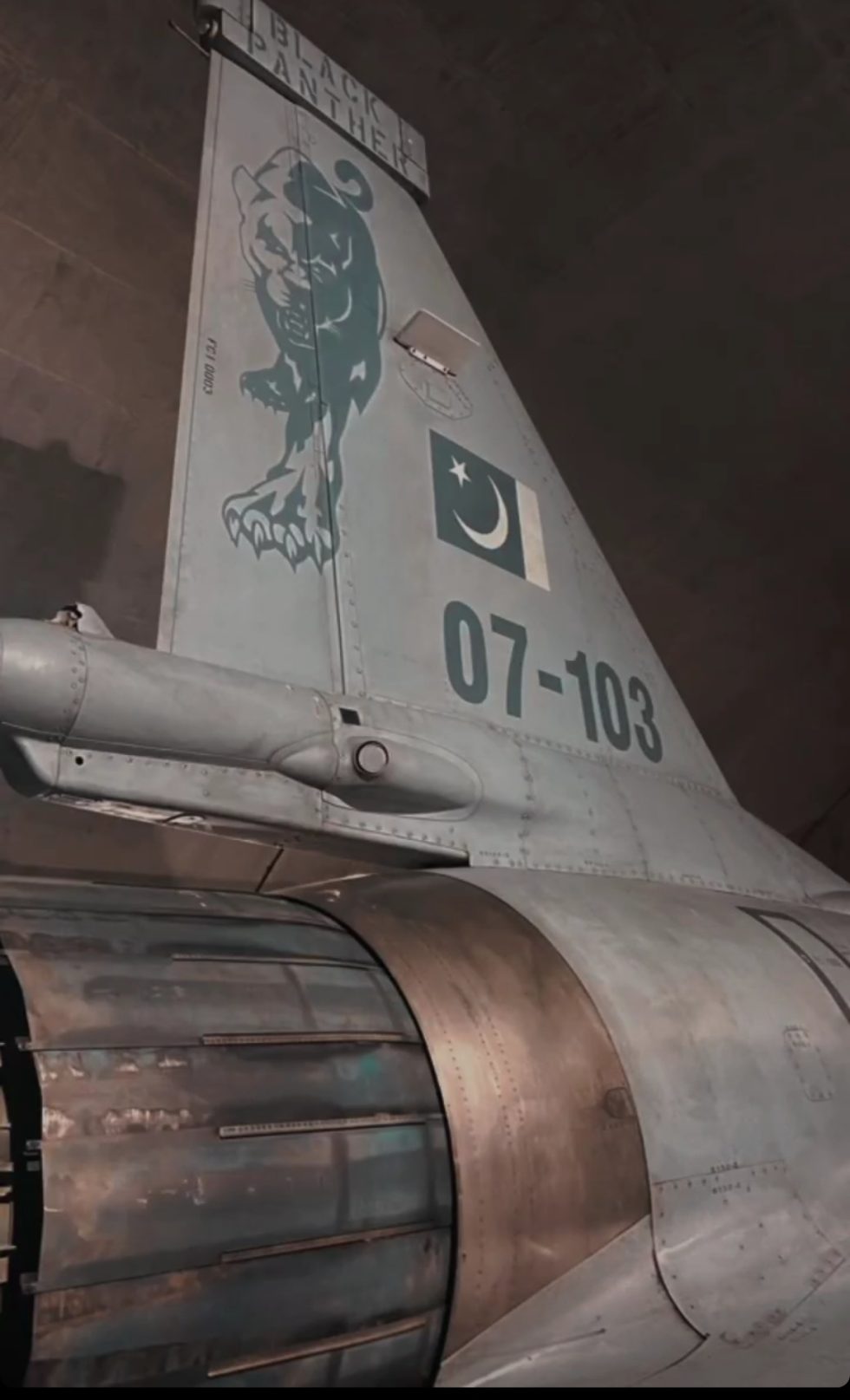
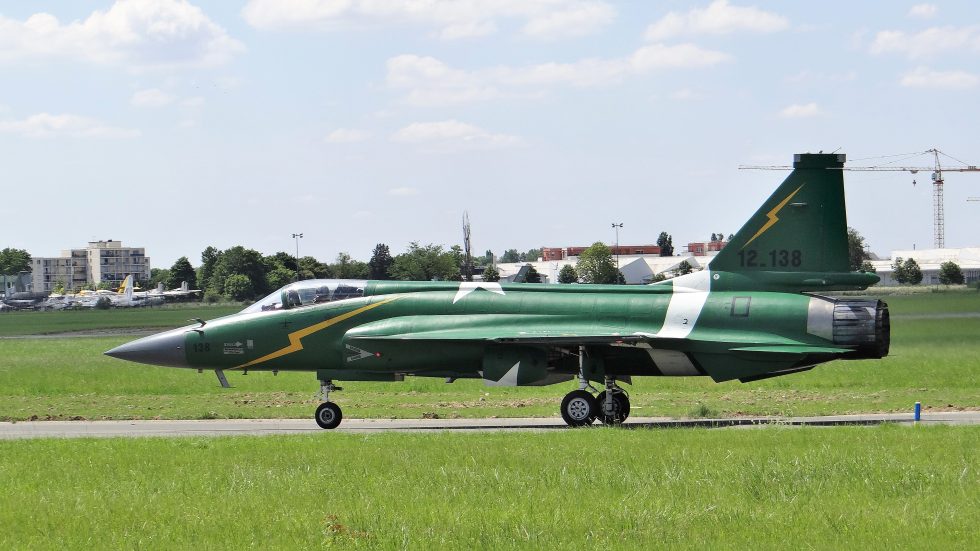
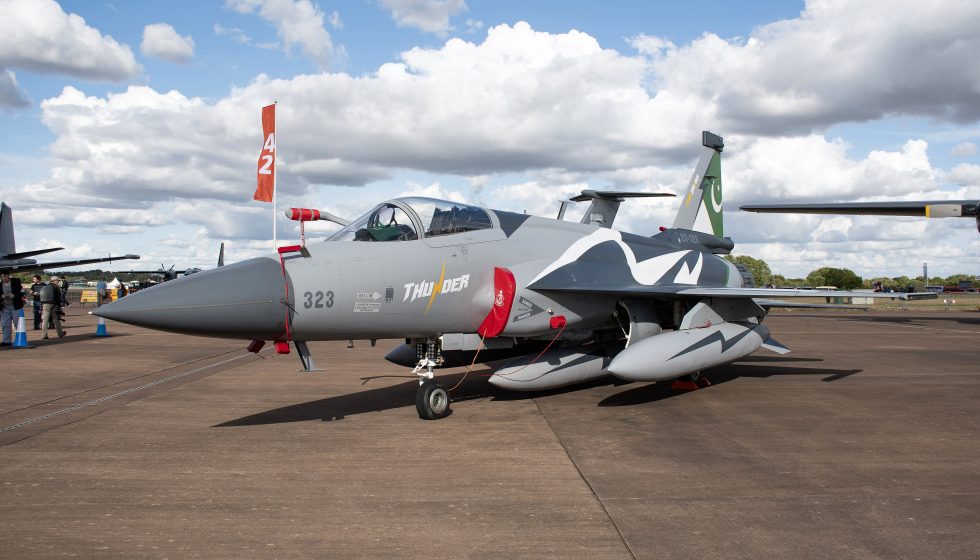
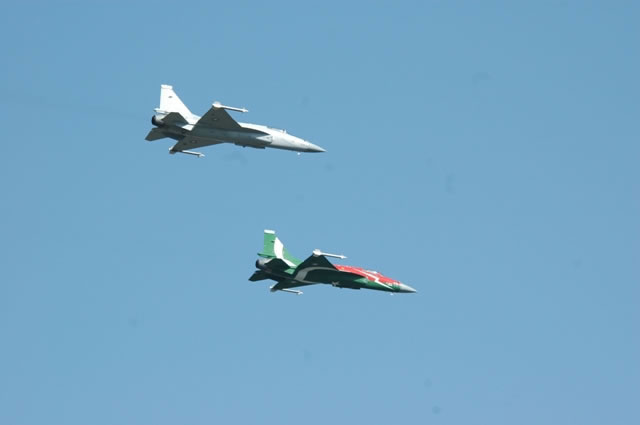
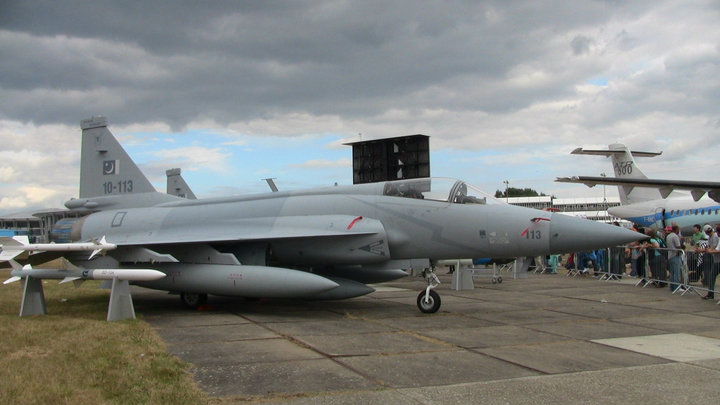
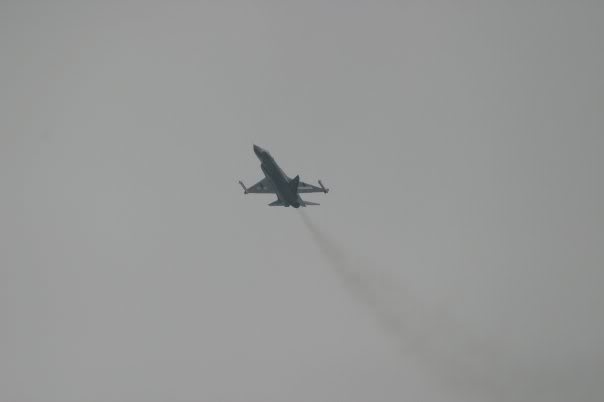
The JF-17 Thunder in motion
A dedicated JF-17 Thunder video feature is coming soon. In the meantime, explore the aircraft through the photo gallery above and the story cards, or compare it with its rivals in the related-aircraft section below.
The JF-17 Thunder in motion
History Nerd — one of the most-watched JF-17 Thunder films on YouTube.
Where the JF-17 Thunder flies
The JF-17 Thunder’s contested record
The JF-17’s combat history is genuinely hard to pin down, and we treat it that way. Its clearest, least-disputed use has been in Pakistan’s internal strikes against militants and a claimed 2017 drone shootdown. Its air-to-air record sits inside the bitterly contested 2019 and 2025 clashes with India, where both governments have made sweeping claims, independent verification is scarce, and no JF-17 kill or loss can be treated as firmly established.
For context on how contested such figures are, compare the combat record of every military aircraft. All 2019 and 2025 claims should be read as disputed. Figures as of July 2026.
Everything people ask about the JF-17 Thunder
Can I fly in a JF-17?
Who makes the JF-17 Thunder?
How much does a JF-17 cost?
What is the JF-17 Block III?
Did the JF-17 shoot down Indian jets in 2019 or 2025?
What engine does the JF-17 use?
Who operates the JF-17 Thunder?
Is the JF-17 still in production?
You can’t fly the JF-17.
These, you can.
Some legends only live in museums — others are fuelled and waiting. MiGFlug has put civilians in real military jet cockpits since 2004.
 Fly the L-39 AlbatrosThe world’s most-flown jet trainer — aerobatics included
 Fly the F-104 Starfighter“The missile with a man in it”
 Fly the MiG-21The Cold War’s most-produced jet
 Fly the T-33 Shooting StarAmerica’s first jet trainer
 Fly the DH VampireA piece of early jet history
 Fly the S.211Agile Italian jet trainer
 Fly the MB-326The classic Aermacchi jet
 Fly the MiG-15The Soviet legend of the Korean War
Continue the tour
Every fact, checked
- Pakistan Aeronautical Complex — JF-17 ThunderThe manufacturer’s own programme and specification pages (operator source, read critically).
- Quwa Defence News & AnalysisDetailed profiles of the JF-17, its blocks, avionics and the Block III standard.
- 19FortyFiveAnalysis of the JF-17 as a low-cost fighter, its engine and export role.
- Aerospace Global NewsCoverage of the disputed 2025 India–Pakistan fighter-loss claims and Operation Sindoor.
- Al JazeeraOn the JF-17 export drive to Azerbaijan, Nigeria, Myanmar and prospective buyers.
- Military FactoryReference specifications, dimensions and armament data for the JF-17.
- The AviationistReporting on the 2025 air battle, the PL-15 missile and contested Rafale claims.
- GlobalSecurity.orgBackground on the FC-1/JF-17 development, the DSI intake and Block III.