
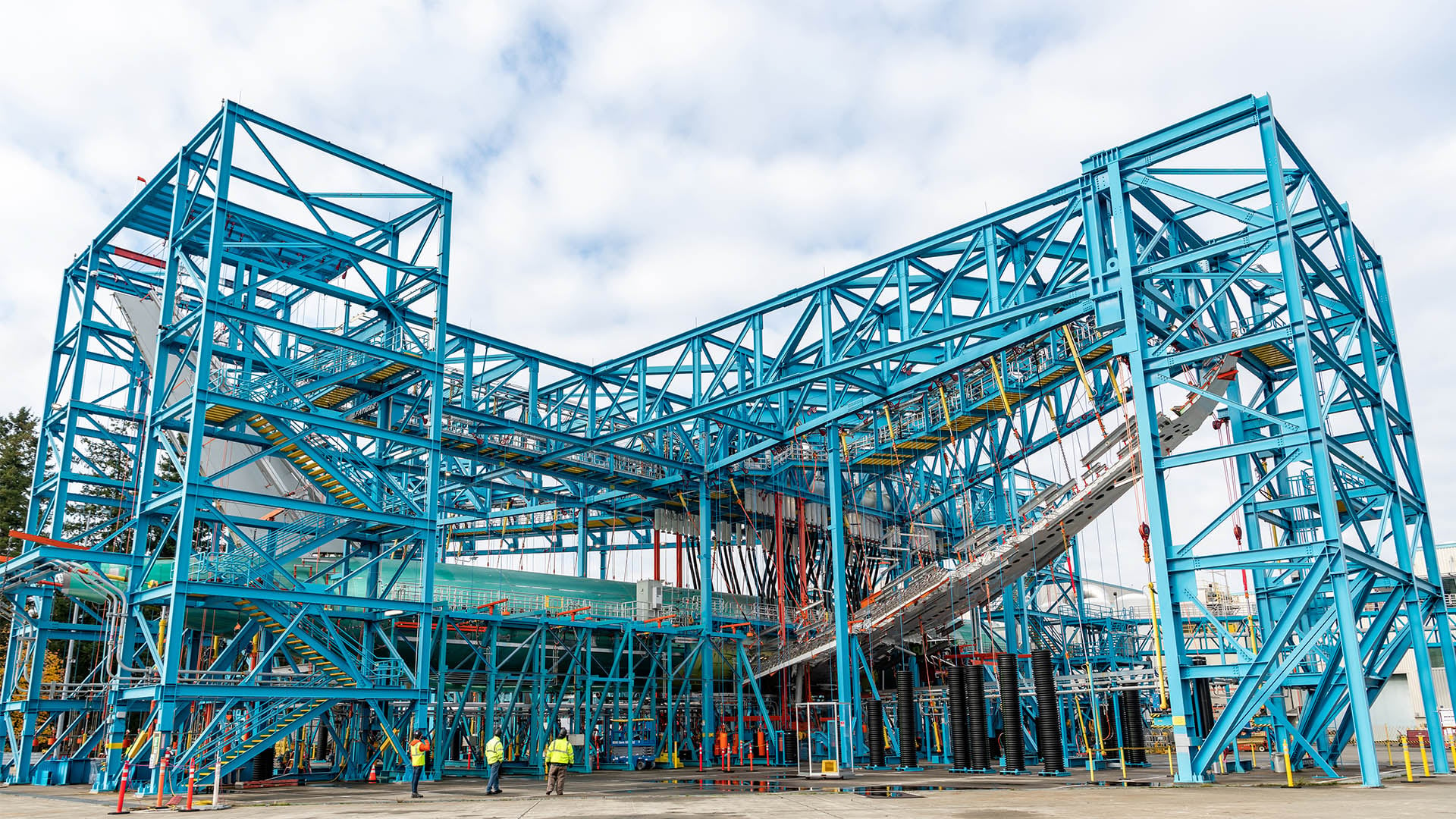
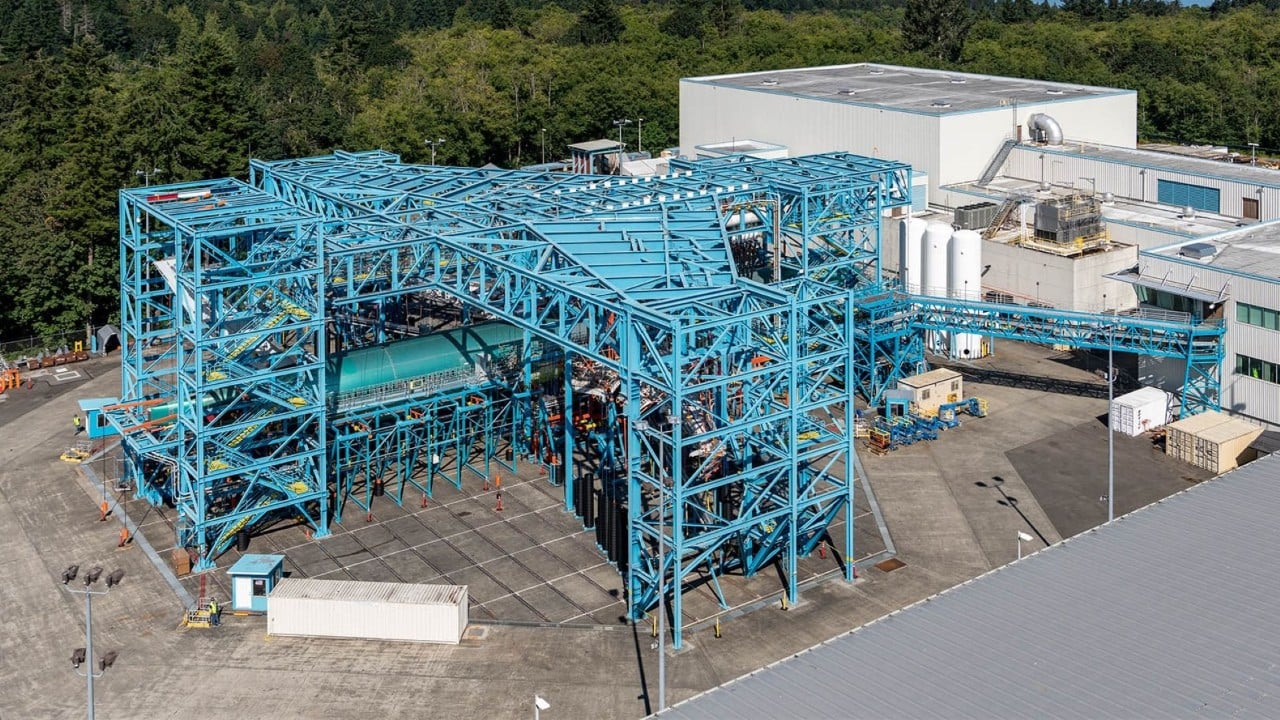
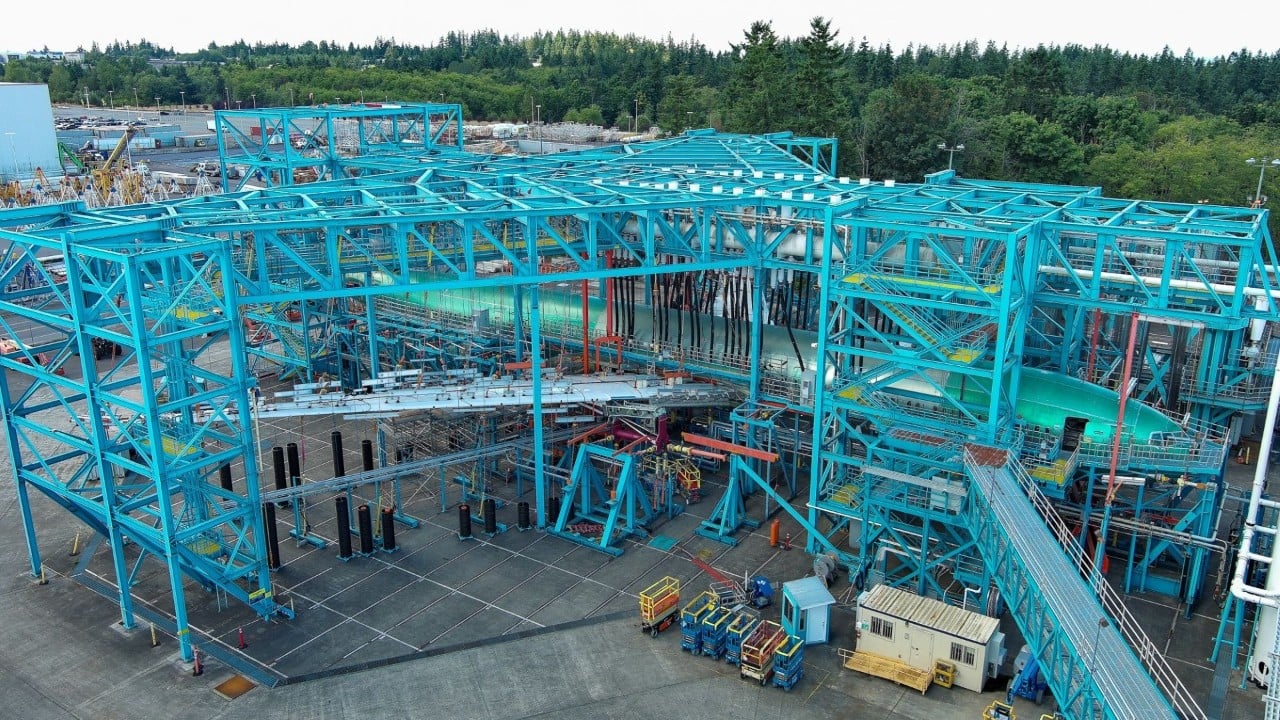
Outside a building in Everett, Washington, inside a steel cage painted a startling shade of blue, a Boeing 777-9 is flying. It will never leave the ground. It has no engines, no paint and no passengers. It is the fourth 777-9 Boeing built, and it was rolled out of the factory and straight into a rig that will spend years pretending to be the sky.
Most people know about the other test, the one that makes the news: wings bent upward until they snap, a bang, applause from engineers in high-visibility vests. That test lasts minutes and answers one question, which is how hard you can pull before something breaks. This rig answers a different and much harder one. Not how hard. How many times.
And unlike the static test, the fatigue rig is not a demonstration. Under 14 CFR 25.571(b) it is the only acceptable way to establish the number that decides how long the entire fleet may legally keep flying.
Kurzinfo
- The rule: 14 CFR 25.571(b) requires a limit of validity to be established, and states that the demonstration must be by full-scale fatigue test evidence
- The guidance: FAA Advisory Circular 25.571-1D, Damage Tolerance and Fatigue Evaluation of Structure, dated 13 January 2011
- What the LOV is: the period, in flight cycles or flight hours or both, up to which it has been demonstrated that widespread fatigue damage will not occur in the airplane structure
- The current example: the fourth Boeing 777-9 built is being cycled to 120,000 complete simulated flights, and had passed 63,000 cycles when Boeing published its account in July 2026
- Rate: the rig averages roughly 160 simulated flights in 24 hours, according to Boeing
- Safe-life scatter factor: AC 25.571-1D gives base scatter factors of BSF1 equal to 3.0 and BSF2 of 3.0 or greater for safe-life determination
- What happens afterwards: teardown inspection, in which the test article is disassembled and inspected destructively to find cracks nobody could see from outside
The problem the rig exists to solve
Fatigue damage is progressive. AC 25.571-1D puts it plainly: it begins as minute cracks, and those cracks grow under repeated stresses. It can start from normal operation and design attributes, or from a material defect, poor fabrication, a corrosion pit, a ding or a scratch. Dealt with one crack at a time, it is a maintenance problem and inspection handles it.
Widespread fatigue damage is a different animal. It is what happens when the same detail, repeated across a large area at similar stress levels, starts cracking everywhere at once. A single rivet line of a lap splice has hundreds of identical holes under identical loads. When that structure goes, it does not go at one hole. The FAA’s position on this is uncompromising, and it is the reason the whole regulatory apparatus exists: inspection methods cannot be relied on solely to ensure the continued airworthiness of airplanes indefinitely.
Which creates an unbounded problem. If the only way to prevent widespread fatigue damage forever is to keep modifying and replacing structure forever, then establishing every modification an airframe will ever need is a question with no end. The FAA’s answer was to bound it: stop asking how to keep an aeroplane flying indefinitely, and start asking how long the engineering data behind its maintenance programme can be trusted. That number is the limit of validity.
Two sentences, and the second one is why the rig is built. Not analysis. Not a similar aeroplane. Test evidence, from a full-scale article.
What the test actually does
Appendix 2 of AC 25.571-1D describes it as a laboratory test in which structure representative of the type design is subjected to loading that simulates typical service operation. The test article may be the entire airframe or a portion of it, and it should be a production article, conformed under 14 CFR 21.23, with every attribute that could affect crack initiation reproduced as closely as possible: material types and forms, dimensions, joining methods, coating and plating, faying-surface sealant, assembly processes and sequences.
Boeing’s own account of the 777-9 campaign, published in July 2026, fills in what that looks like in practice. Hydraulic actuators work the wings and the fuselage while the fuselage is pressurised, and the loads are sequenced so that the structure experiences a complete flight rather than an abstract cycle.
The flights are not identical. Boeing rates them on an A to E scale: E flights, the vast majority, are short hops in benign weather, while A flights are the most intense long hauls, written to reproduce encounters such as thunderstorms over mountain passes. The mix reflects how often the aeroplane is likely to meet each condition in service, so the spectrum tests both the ordinary and the rare.
The rig averages roughly 160 of these simulated flights every 24 hours. That is the whole trick: compressing decades of airline service into months of continuous machinery, around the clock, for years.
Boeing’s own footage of the 777X fatigue campaign, showing the rig working through its cycle.
Not the same rig as the one that breaks wings
It is worth being precise about the difference, because the two tests get confused constantly and the confusion flatters the wrong one. The static test is governed by the strength requirements of Part 25 subpart C. A factor of safety of 1.5 is applied to limit load under 14 CFR 25.303, and 14 CFR 25.305(b) requires the structure to support ultimate loads without failure for at least three seconds. One application, minutes of work, and a result that is either pass or a very loud fail. We have written about that test before.
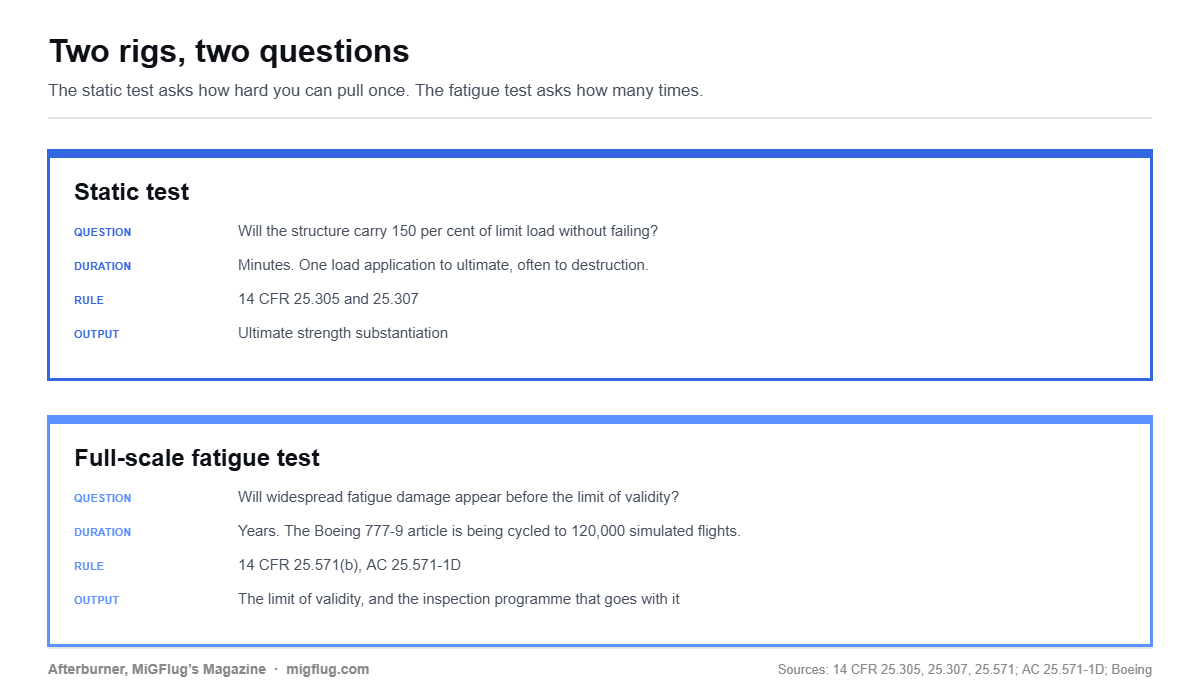
The fatigue rig never approaches ultimate load. It spends its life in the ordinary range, which is exactly the point, because that is where real aeroplanes live. Nothing dramatic happens for months at a time, and that is the result.
For contrast, the other kind of test: a 777 wing taken to 154 per cent of design limit load, with roughly 24 feet of tip deflection before it lets go. Twenty seconds of footage, and a completely different question from the one the fatigue rig is asking.
The teardown is where the answer comes from
Running the cycles is only half of it. AC 25.571-1D sets out the sequence for evaluating structure susceptible to widespread fatigue damage, and the demonstration typically entails full-scale fatigue testing followed by teardown inspections and a quantitative evaluation of any finding, or residual-strength testing, or both.
A teardown inspection, in the AC’s own definition, is the process of disassembling structure and using destructive inspection techniques, or visual methods such as a magnifying glass and dye penetrant, or non-destructive ones such as eddy current and ultrasound, to identify the extent of damage caused by fatigue, corrosion and accidental damage. In other words, the test article is cut apart, hole by hole, so that cracks too small to find on a flying aeroplane can be measured on a dead one.
The findings decide the number. Manufacturers typically set a design service goal, the period during which the structure is meant to stay reasonably free of significant cracking, and a recommended approach sets the candidate limit of validity equal to that design service goal. Whether the final LOV matches the candidate depends on how well the design objective was actually met, and on how much maintenance the manufacturer is willing to impose to preclude widespread fatigue damage up to that point.
Where a safe-life approach is used instead, under 14 CFR 25.571(c), variability is handled with a scatter factor, and AC 25.571-1D gives the base figures: BSF1 of 3.0, developed from the results of one representative test specimen, and BSF2 of 3.0 or greater where the criteria for using BSF1 cannot be met. A life-reduction factor of three is not timidity. It is an admission that one specimen cannot speak for a fleet.
Certificated first, tested afterwards
Here is the part that surprises people. The regulation does not require the fatigue test to be finished before the aircraft is certificated. 14 CFR 25.571(b) says the type certificate may be issued prior to completion of full-scale fatigue testing, provided the Administrator has approved a plan for completing the required tests.
That is not a loophole, it is arithmetic. A test that compresses three lifetimes of flying into a rig still takes years, and no manufacturer could hold a programme on the ground that long. So the aircraft enters service with an interim limitation in the airworthiness limitations section of its instructions for continued airworthiness, and the testing continues underneath the flying fleet. Boeing says every one of its aeroplanes since the 707 has been through this.
It also explains why the fatigue rig does not stop when the aeroplane is certificated, and why it does not stop when the first lifetime is reached either. To operate an aircraft beyond its limit of validity, the full-scale fatigue-test evidence and the structural maintenance programme must be re-evaluated to see whether further modifications or replacements are needed. Extending an LOV typically means going back to the rig for more evidence. The structure in Everett is not finishing an old job. It is generating the permission slip for a fleet that does not exist yet.
The same process on the 787, filmed fifteen years ago, when the composite question was new and nobody could point at decades of service history to answer it.
Why nobody films it
The static test gets the camera crews because it is a spectacle with an ending. The fatigue test has neither. It is a building full of hydraulic noise doing the same thing 160 times a day for years, watched by sensors, producing a number that eventually turns up in a maintenance manual as a line about inspection intervals.
But the static test only proves the aeroplane is strong on the day it is built. The fatigue rig is the one that decides whether it is still safe after 30 years and 60,000 landings, and it is the only evidence the regulation will accept for that. The 777-9 article had passed 63,000 simulated flights when Boeing described the campaign in July 2026, with results matching expectations, and it has another 57,000 to go. Somewhere in Everett it is still at it, flying a route that does not exist, to an airport that was never built, for the benefit of passengers who have not bought their tickets yet.
Sources: 14 CFR 25.303, 25.305, 25.307 and 25.571; FAA Advisory Circular 25.571-1D, Damage Tolerance and Fatigue Evaluation of Structure (13 January 2011), including Appendices 1 and 2; Boeing, Bending the 777-9: Inside fatigue testing for three lifetimes (July 2026).

0 Comments