

On the night of 10 March 1968, nineteen American airmen were living on top of a mountain in a country where, officially, there were no American troops at all. Phou Pha Thi rises more than a mile above northeastern Laos, with sheer cliffs on one side. On its summit sat a radar that guided US bombers to targets in North Vietnam, in any weather, day or night.
By dawn on 11 March, the mountain had been overrun. Eleven of the Americans were dead on the summit and the ledges below it, and a twelfth would die in the rescue helicopter. It was the largest single ground combat loss of US Air Force personnel in the Vietnam War, and for years the families were not even told where it had happened.
Kurzinfo
- Site: Lima Site 85, on Phou Pha Thi, northeastern Laos, about 5,580 ft (1,700 m) high
- Zweck: TSQ-81 radar bombing control system (Commando Club), guiding strikes on North Vietnam
- Operational: From November 1967 until 11 March 1968
- Americans on site: 19 USAF personnel on the night of the attack
- US losses: 12 killed or missing, including CMSgt Richard Etchberger, shot during the evacuation
- An-2 raid: 12 January 1968: North Vietnamese An-2 biplanes attacked the site; both were brought down
- Recognition: Etchberger's Air Force Cross upgraded to the Medal of Honor on 21 September 2010
- Still missing: Four airmen unaccounted for as of January 2026
A Radar Where It Could Not Officially Be
Laos was neutral under the 1962 Geneva Accords, and the US could not admit to having military personnel there. But Phou Pha Thi, only about 15 miles from the North Vietnamese border and roughly 160 miles west of Hanoi, was too valuable to ignore. A navigation beacon went up in 1966. In 1967, under a project called Heavy Green, the Air Force installed a TSQ-81, an air-transportable radar bombing control system.
The TSQ-81 could track an aircraft and calculate the exact moment to release its bombs, so F-105s, F-4s Und B-52s could hit targets through cloud and at night. Under the name Commando Club, it began directing strikes in November 1967. According to Air & Space Forces Magazine, it directed 23% of the air strikes in northern North Vietnam while it was operational.
To keep up the fiction of Laotian neutrality, the technicians were formally discharged from the Air Force and hired as civilians by Lockheed. They were protected by Hmong and Thai forces, but were themselves barely armed.

The Day Biplanes Attacked
North Vietnam knew exactly what the radar was doing. On 12 January 1968 it tried something unusual: an air attack with Soviet-built Antonov An-2 biplanes. According to Wikipedia's account, the An-2s dropped 120 mm mortar rounds and fired rockets at the site, killing four Hmong.
What happened next is one of the strangest air-to-air kills in history. An Air America Huey flown by Captain Ted Moore happened to be nearby. Moore chased the biplanes, and his flight mechanic, Glenn Woods, fired at one with an AK-47 from the cabin. Both An-2s were brought down, one after being damaged by ground fire.

The raid failed, but the message was clear. By February, North Vietnamese and Pathet Lao troops were closing in on the mountain, and a notebook taken from a captured North Vietnamese officer spelled out the plan of attack.
The Night of 10 March
The warning signs were there. Security officer Major Richard Secord wanted better protection and argued for evacuation. The US ambassador to Laos, William Sullivan, who controlled operations in the country, held back for political reasons. According to Wikipedia, he did not order the evacuation until 05:15 on 11 March, after the site had already been overrun. Sullivan later said the technicians should have been pulled out on 10 March.
At 18:00 on 10 March, an artillery barrage hit the mountain, followed by an infantry attack on the southeast slope. After midnight, North Vietnamese sappers of the 41st Special Forces Battalion did what the defenders believed was impossible: they climbed the cliffs and attacked the summit. Air & Space Forces Magazine puts the number of sappers at 33 to 35. Several of the Americans at the radar site were killed in the first minutes. Etchberger and four of his men were on a small rocky ledge on a safer side of the mountain, where they had moved after their shift.
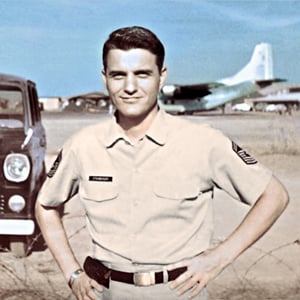
Etchberger, a radar technician with no formal combat training, spent the night on that ledge with his men. Grenades rained down. One after another, his men were killed or wounded. Etchberger fought back with an M16, and called in air strikes close to his own position to keep the enemy back.
The HeroFront Podcast on the battle of Lima Site 85 and Richard Etchberger's legacy.
Rescue at Dawn
In the morning, an Air America helicopter arrived and lowered its sling. Etchberger loaded his wounded men one by one, exposing himself to fire each time, then pulled in another airman who had hidden from the attackers through the night, and finally climbed in himself. As the helicopter pulled away, a burst of ground fire came up through the floor. Etchberger was hit, and he died before the helicopter landed.
Eight Americans were evacuated from the mountain, including two CIA officers and a forward air controller. Of the 19 Air Force men on Phou Pha Thi that night, only seven survived. Three of them, President Obama said in 2010, owed their lives to Etchberger.
The Air Force then turned its bombs on its own radar. Between 12 and 18 March, US aircraft flew 95 strike sorties against the site to destroy the captured equipment, and on 19 March an A-1 Skyraider destroyed the remaining buildings. A reconnaissance photo from 16 March shows what was left.

Forty-Two Years of Silence
Etchberger received the Air Force Cross in a private ceremony at the Pentagon. His three sons were told their father was a hero, but not where he died or why. His wife Catherine had known, but was sworn to secrecy. The mission stayed classified for years, and only after it was declassified did the family learn that he had died in Laos, not Vietnam.
A retired airman who read about Etchberger took up his case with his congressman. On 21 September 2010, President Obama presented the Medal of Honor to Etchberger's three sons in the East Room of the White House.

The official White House video of the 2010 Medal of Honor ceremony for Chief Master Sgt. Richard Etchberger.
The search for the missing has never stopped. In 2002, former North Vietnamese soldiers said the Americans' bodies had been thrown off the mountain. Recovery teams have since worked on ledges far below the summit, and several airmen have been identified, including Colonel Clarence Blanton, the site commander, in 2012, and four more airmen in 2025. According to Wikipedia, four were still unaccounted for at the start of 2026.
Sources: Wikipedia (Battle of Lima Site 85; Richard Etchberger), Air & Space Forces Magazine, The American Presidency Project (Obama remarks, 21 September 2010), Timothy N. Castle, One Day Too Long (Columbia University Press, 2000)


0 Comments