
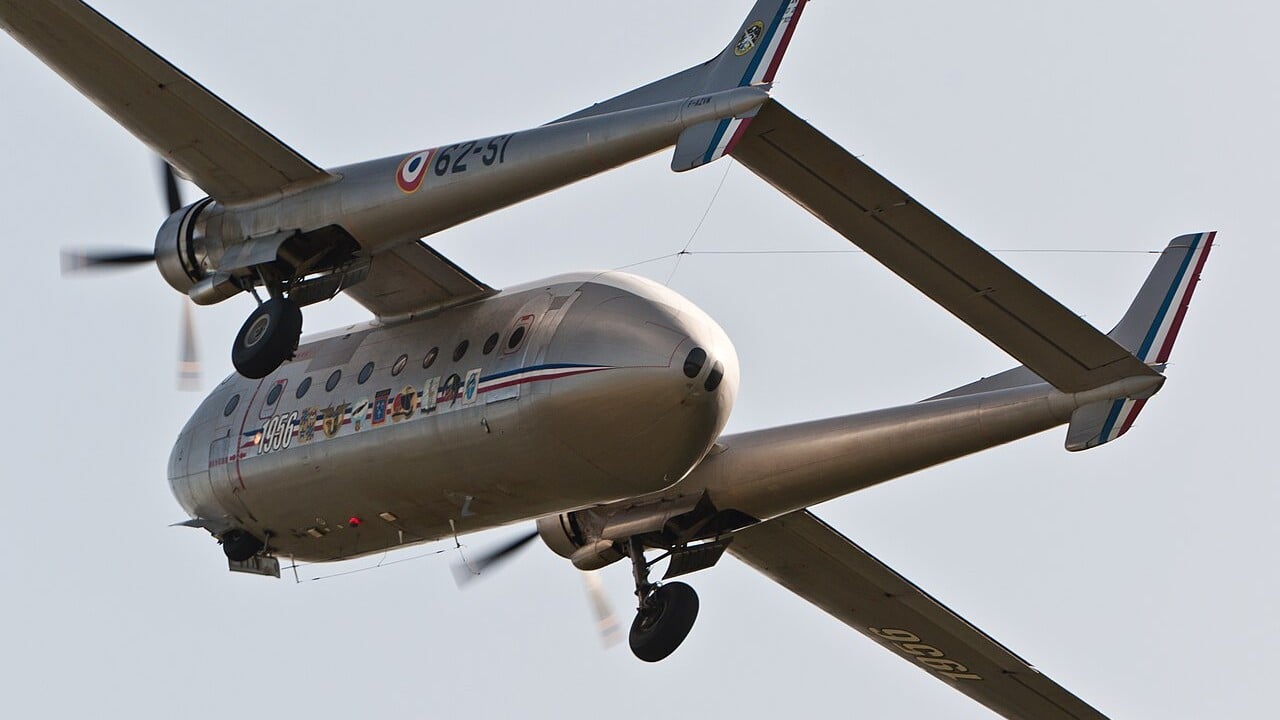
Look at a Nord Noratlas from below and it hardly seems like one aeroplane. A fat, rounded cargo pod hangs from a long, straight wing. Two slender booms run back from the engines to a pair of tail fins joined by a tailplane. Between the booms, where most transports have a tail, there is nothing but a set of clamshell doors and a lot of air.
That strange shape carried French paratroopers into Suez in 1956, hauled freight across Algeria and flew in large numbers for West Germany’s new Luftwaffe. And according to the French defence ministry’s research institute IRSEM, the Noratlas marked the first industrial coming-together of France and Germany after the war.
Not bad for an aeroplane its own crews nicknamed after its paint.
Kurzinfo
- Typ: Twin-engine, twin-boom military transport
- Hersteller: Nord Aviation (SNCAN), France; licence production in West Germany
- Erster Flug: 10 September 1949 (Nord 2500); Nord 2501 on 20 November 1950
- Motoren: 2 × SNECMA-built Bristol Hercules radials, 2,040 hp each
- Laden: About 7 tonnes of freight, 45 troops or around three dozen paratroopers
- Gebaut: 425, production ended 1961; 208 for the French air force
- Spitzname: La Grise (the grey one)
- Retired in France: End of the 1980s; last Gabriel ELINT aircraft in 1989
Replacing the Ju 52
In 1945 the French air force, the Armée de l’Air, had a transport problem. Its workhorses were the German Junkers Ju 52, which France kept building for a while after the war, and the American Douglas C-47. Both were reliable. Both were tailwheel designs that sat nose-up on the ground, with small side doors and limited payloads.
In 1947 the state’s technical directorate, the DTI, asked industry for a modern, versatile medium transport. The nationalised northern manufacturer SNCAN, better known as Nord, answered with the Nord 2500: a twin-engined, twin-boom, high-wing design whose rear clamshell doors let trucks back straight up to the cargo hold. The layout owed something to Fairchild’s C-119 Flying Boxcar in America.
AP Archive footage of French Noratlas transports dropping paratroopers and a Jeep in Algeria around 1960.
The first prototype took off from Melun-Villaroche on 10 September 1949. It flew, but on two Gnome-Rhône 14R radials of 1,600 hp it was simply too slow. Nord’s answer was more power: SNECMA-built Bristol Hercules radials of 2,040 hp each, driving four-bladed propellers. The re-engined aircraft became the Nord 2501, which, according to IRSEM, first flew on 20 November 1950.
Development was not painless. In July 1952 a prototype crashed at Lyon, and among those killed was Maryse Bastié, the record-breaking French aviator of the 1930s. The programme pressed on, and in 1953 the type, now christened Noratlas, entered French service.
“La Grise” goes to war
The Armée de l’Air eventually received 208 of them. The design was built for rough airstrips, with widely spaced landing gear and big low-pressure tyres, and it could carry about seven tonnes of freight, or 45 troops, or around three dozen paratroopers who jumped from the doors between the booms.
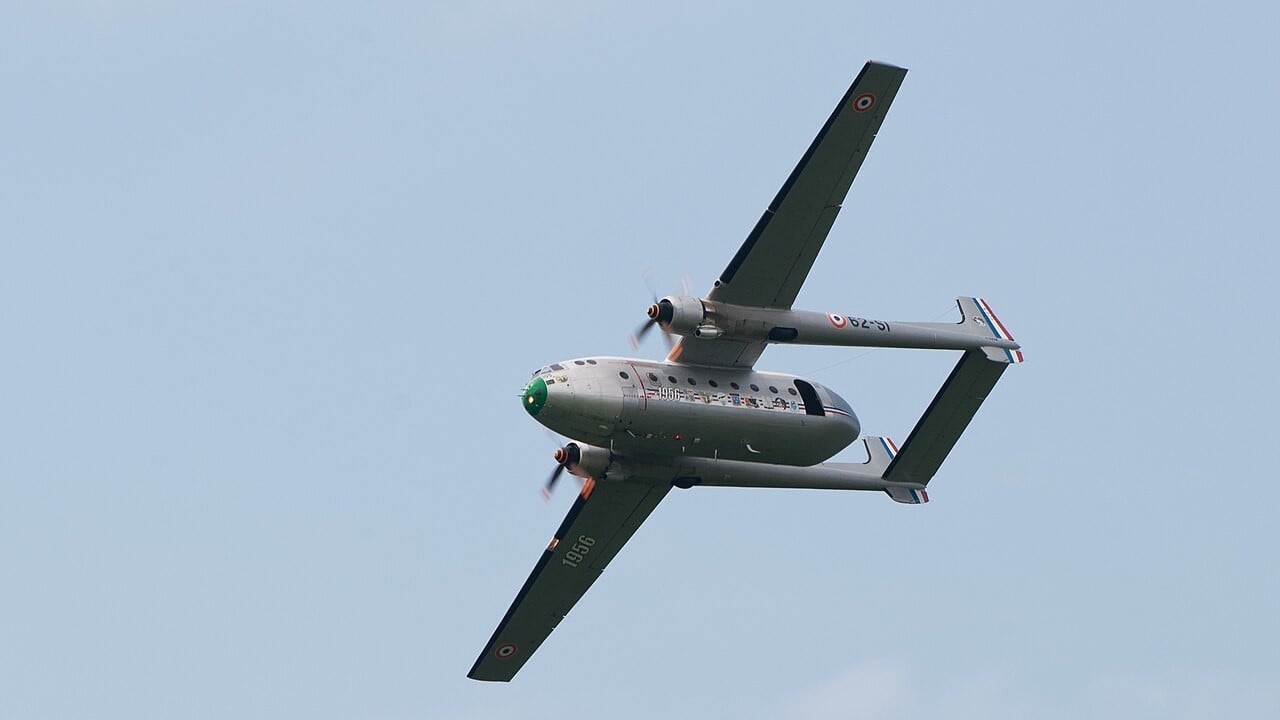
Crews called the aircraft la Grise, the grey one, after its silver-grey finish. They soon had plenty of work. The Noratlas served throughout the Algerian War from 1954 to 1962, and during the Suez Crisis in November 1956 it dropped French paratroopers onto key points around Port Said and Port Fouad in Egypt.
The twin-boom layout had a catch, though. IRSEM notes that it made loading freight a delicate business, and from 1967 the French air force preferred the new Transall C-160, whose cargo went in over a proper rear ramp.
Paradrops became the type’s signature. Long after the Transall took over the main transport role, IRSEM notes, the Noratlas stayed busy carrying student paratroopers for the airborne school at Pau from the 1970s.
The French Air Force’s Orléans-Bricy air base filmed the preserved Noratlas No. 105 dropping paratroopers for the 80th anniversary of the 601st and 602nd Air Infantry Groups.
A French aircraft for the new Luftwaffe
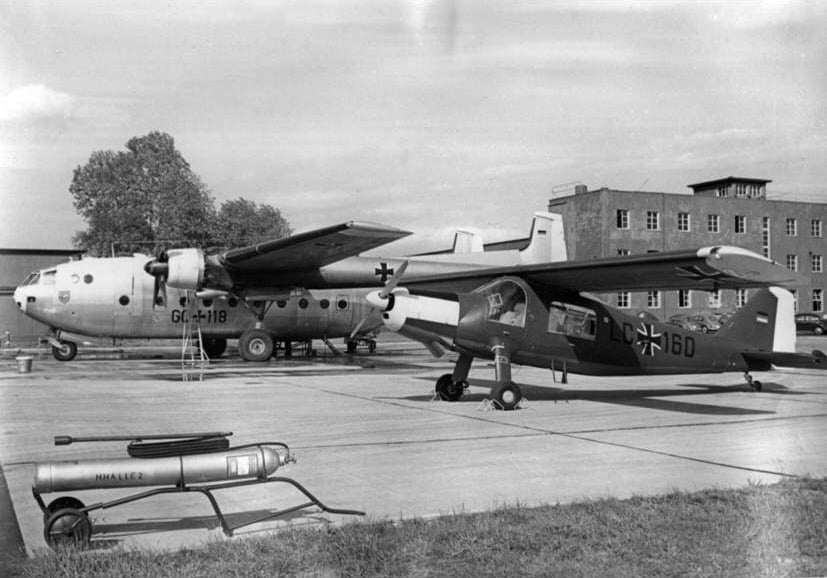
Across the Rhine, the new West German air force had the same problem France had faced in 1945, and it chose the same answer. From 1956 the Luftwaffe ordered the Noratlas in large numbers.
The first aircraft came from France. Most of the rest were built under licence in Germany, by the West German company Flugzeugbau Nord, which had designed and built most of the fuselage from early in the programme. The Noratlas was the company’s first post-war aviation project.
IRSEM, writing for the French armed forces ministry, sums up why that mattered in a single line.
Put plainly: the Noratlas marked the first industrial rapprochement between Germany and France. Little more than a decade after the war, German factories were building a French aircraft for German crews. It worked well enough that in 1958 the two countries formed a joint consortium for its successor, the Transall C-160, a partnership that points straight to today’s European airlifters.
The German fleet also did some unusual flying. Bundeswehr archive film from 1967 shows a Luftwaffe Noratlas putting down on a stretch of highway, a reminder of how rugged the big twin-boom transport was.
Bundeswehr archive film from 1967 of a West German N-2501D Noratlas landing on a highway.
The last Grise in the sky
As Transalls arrived, Germany began selling its Noratlases on, and they spread across the world. The Israeli Air Force, Die Hellenic Air Force und die Portuguese Air Force all flew the type, along with several African air arms. In all, 425 were built before the production line closed in 1961.
France kept its Noratlases flying longer than anyone expected. The last ones left the Armée de l’Air at the end of the 1980s, the final examples being the electronic-intelligence Gabriel aircraft retired in 1989.
One of them refused to stay retired. Aircraft No. 105 first flew in 1956 and joined the transport squadron ET 1/61 Touraine, spending its career hauling freight and troops for the Armée de l’Air.
After it left service it sat derelict for nine years. In 1993 the preservation association Le Noratlas de Provence bought it, with its Hercules engines removed from the wings and seized solid. Then the volunteers went to work.
Now registered F-AZVM, the old Grise has appeared at air shows in France and Germany and in 2017 dropped paratroopers again at the French Air Force base at Orléans-Bricy for a unit anniversary. Other Noratlases survive in museums, from Berlin-Gatow and Speyer in Germany to the Israeli Air Force Museum at Hatzerim and the Museu do Ar in Portugal.
The Noratlas was never fast, never pretty and never famous outside Europe. But it carried an army’s paratroopers, gave two old enemies their first shared aircraft programme, and opened the road to the Transall and the European airlifters that followed. For a strange twin-boomed thing nicknamed after its paint, that is quite a legacy.
Sources: Wikipedia (Nord Noratlas; Maryse Bastié), IRSEM / CERPA (French Ministry of the Armed Forces), Flight Daily News (1997), Base aérienne 123 Orléans-Bricy, AP Archive, Bundeswehr archive
0 Comments