
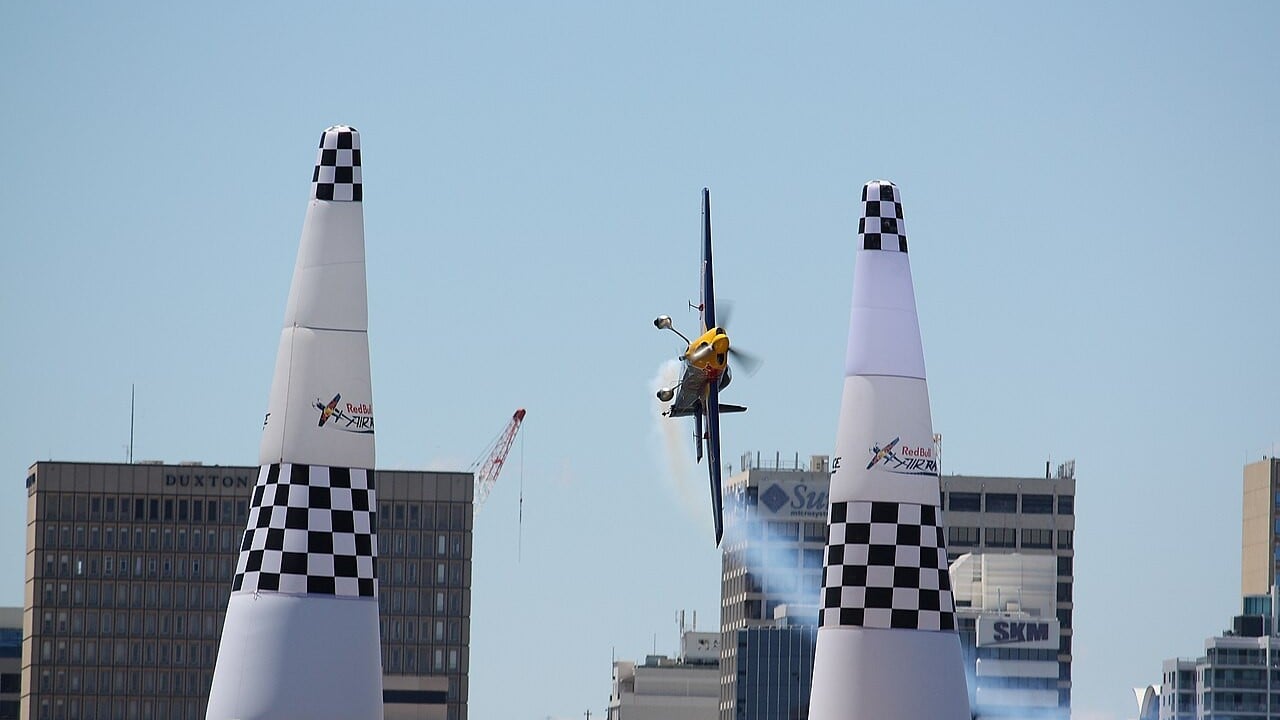
Picture a race track with no tarmac and no walls. Its corners are inflatable cones 25 metres tall, anchored to barges on a river in the middle of a city. A single-seat aerobatic aircraft dives into the course at close to 200 knots, slices between two pylons in level flight, then pulls a turn hard enough to approach ten g. The clock runs to the thousandth of a second.
For sixteen years that was the Red Bull Air Race, the closest thing aviation ever had to Formula One. It drew enormous crowds to the Danube, the Douro and Tokyo Bay, made stars of a handful of aerobatic pilots and then, in 2019, it simply stopped. Here is how the pylon-racing series was born, how it worked, and what has happened to air racing since.
Kurzinfo
- Was: Red Bull Air Race (later Red Bull Air Race World Championship), pylon air racing series
- Created: Conceived 2001 by Red Bull; first race at Zeltweg, Austria, in 2003
- Format: Solo timed runs through inflatable air gates about 25 m tall
- Flugzeug: Mainly Zivko Edge 540, MXS-R and Corvus Racer 540, Lycoming-powered
- Pause: No races 2011-2013; returned in Abu Dhabi on 28 February 2014
- Most titles: Paul Bonhomme (UK): 2009, 2010, 2015
- Last champion: Matt Hall (Australia), Chiba, 8 September 2019
- Status (Nov 2026): Ended after 2019; successor AIR RACE X runs a remote, data-linked format
An idea from an energy-drink think tank
The Red Bull Air Race was conceived in 2001 inside Red Bull’s sports think tank. The goal was a race that rewarded precision and skill rather than raw speed. The Hungarian aerobatic champion Péter Besenyei, often described as the series’ brainchild, flew the first test runs through prototype air gates.
The first official race took off at Zeltweg in Austria in 2003, with a second near Budapest the same year. Besenyei won that two-race inaugural series. By 2005 it had grown into a proper world series, and by 2007 it ran ten races across the globe, including the first in South America, in Rio de Janeiro.
Gates that tear on purpose
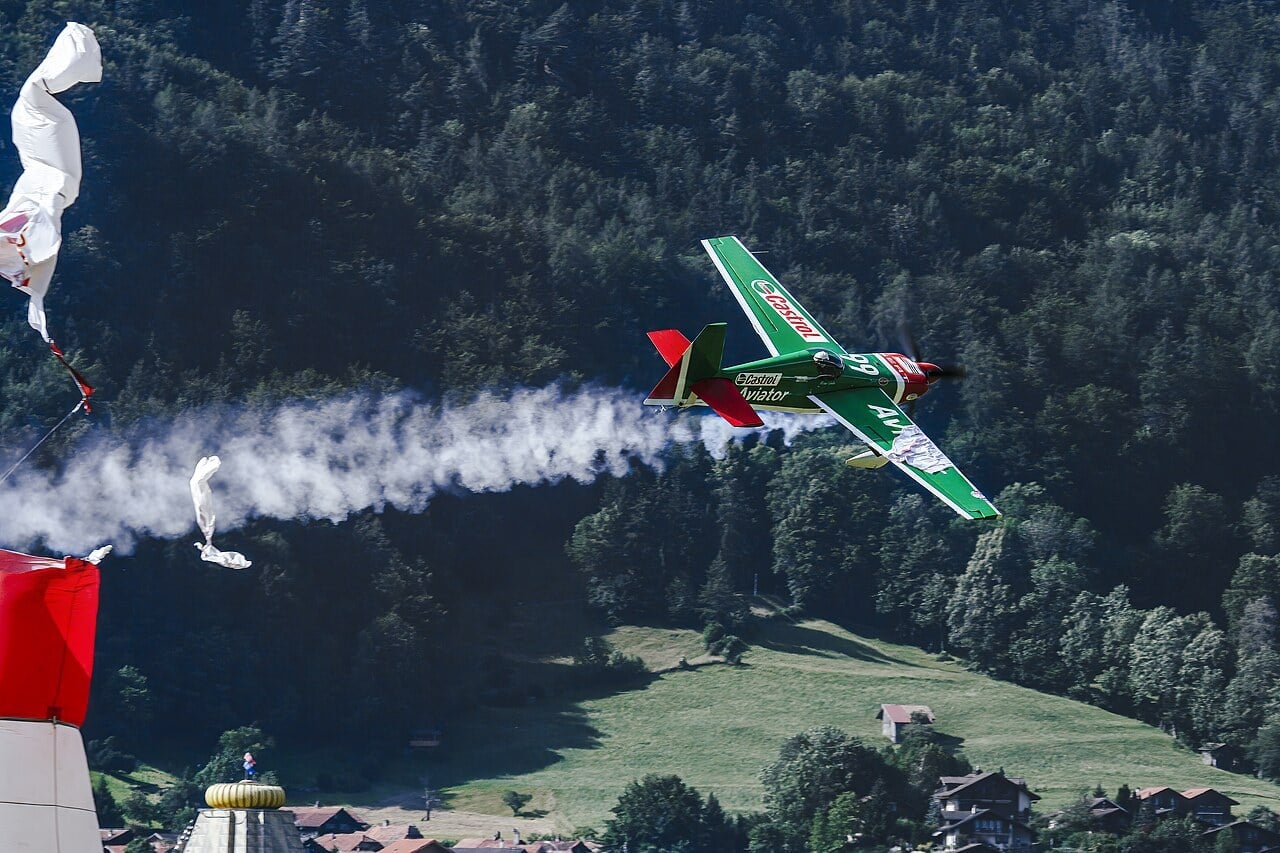
The key invention was the air gate. According to Wikipedia, engineers at Austrian firm Bellutti Protection Systems settled on spinnaker ripstop nylon, the material of racing-yacht sails, so a pylon would rip apart the instant a wing touched it. Early cylindrical gates proved too unstable in wind, and in 2004 the familiar cone shape arrived, kept rigid by blowers.
A hit cost a penalty, not an aircraft. Crews nicknamed “air gators” could replace a shredded pylon in minutes. The rules were strict: double-cone gates had to be crossed in level flight, single cones at a 90-degree bank, and pulling more than 10 g for more than 0.6 seconds meant a did-not-finish.
The Red Bull Air Race’s own history of the series, from the first test flights through the air gates.
The aircraft and the champions
The racers flew modified aerobatic monoplanes, mainly the Zivko Edge 540, the MXS-R and the Corvus Racer 540, all with Lycoming engines and wingspans under 7.6 metres. Their top speeds were in the region of 400 km/h.
Americans dominated the early years: Kirby Chambliss took the title in 2004 and 2006, and Mike Mangold in 2005 and 2007. Austria’s Hannes Arch won in 2008. Britain’s Paul Bonhomme became the most successful pilot in the series’ history, champion in 2009, 2010 and 2015.
A three-year pause and a comeback
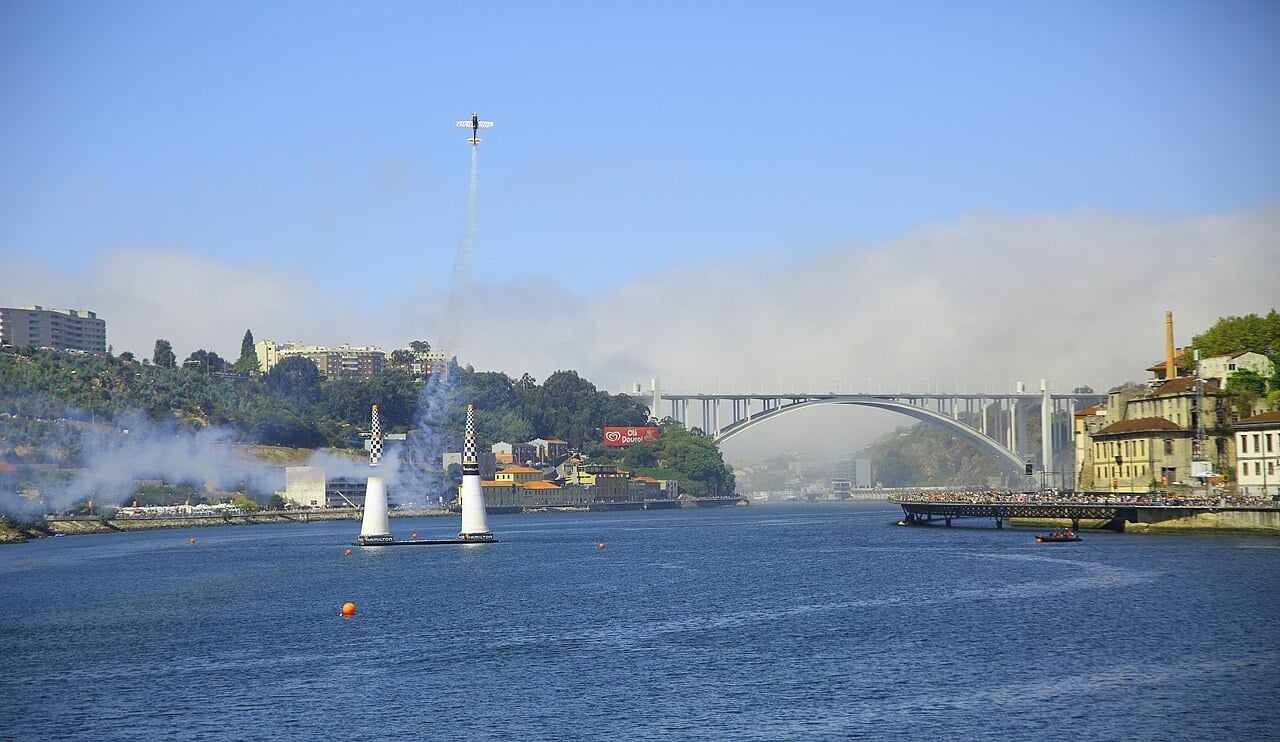
The 2010 season brought safety scares. During training in Perth, Brazilian pilot Adilson Kindelmann crashed into the Swan River and was quickly rescued without serious injury, and at Windsor, Canada, Matt Halland in Windsor, Canada, Matt Hall touched the water during a run and recovered.rsquo;s aircraft hit the water during a run. Red Bull decided it was time for a rethink.
In July 2010, Red Bull cancelled the 2011 season to restructure and introduce new safety measures. The 2012 and 2013 seasons were cancelled too. When the series returned in Abu Dhabi on 28 February 2014, it was sanctioned by the FAI, the World Air Sports Federation, standardised engines had been introduced, and a Challenger Class had been added to bring through younger pilots.
The comeback years produced new champions. Britain’s Nigel Lamb won in 2014, Bonhomme again in 2015, Germany’s Matthias Dolderer in 2016, Japan’s Yoshihide Muroya in 2017 and the Czech pilot Martin Šonka in 2018. But crowds, as AOPA later put it, never fully recovered after the pause.
The end, announced in May 2019
At the end of May 2019, Red Bull announced that the World Championship would not continue beyond the 2019 season. The calendar was cut to four races and the planned Indianapolis round in October was cancelled. AOPA counted 90 races since 2003.
The pilots were stunned. Defending champion Šonka told the Czech site iDnes, as reported by AOPA, that the audience was clearly there.
The final race was held at Chiba, Japan, on 8 September 2019. Australia’s Matt Hall, who had finished second in three of the previous four seasons, needed only a clean final run to clinch the title in front of Muroya’s home crowd. He did it, becoming the last Red Bull Air Race world champion.
Official footage of Matt Hall clinching the 2019 title at Chiba, the last Red Bull Air Race world championship.
After Red Bull: revival attempts and AIR RACE X
Air racing did not give up. In February 2021, the FAI announced a new promoter and a new World Championship Air Race, planned to start in 2022 with an eye on sustainable fuels and electric aircraft. The 2022 season was cancelled before a single race was flown.
The series that did take off was AIR RACE X, launched by former champion Muroya. Its first event, in Tokyo’s Shibuya district in 2023, was digital. Pilots fly identical courses from their own home airfields, flight data units record every metre, and the times are corrected for air density and combined into one race. A three-round championship followed in 2024, won by Muroya, and South Africa’s Patrick Davidson took the 2025 title.
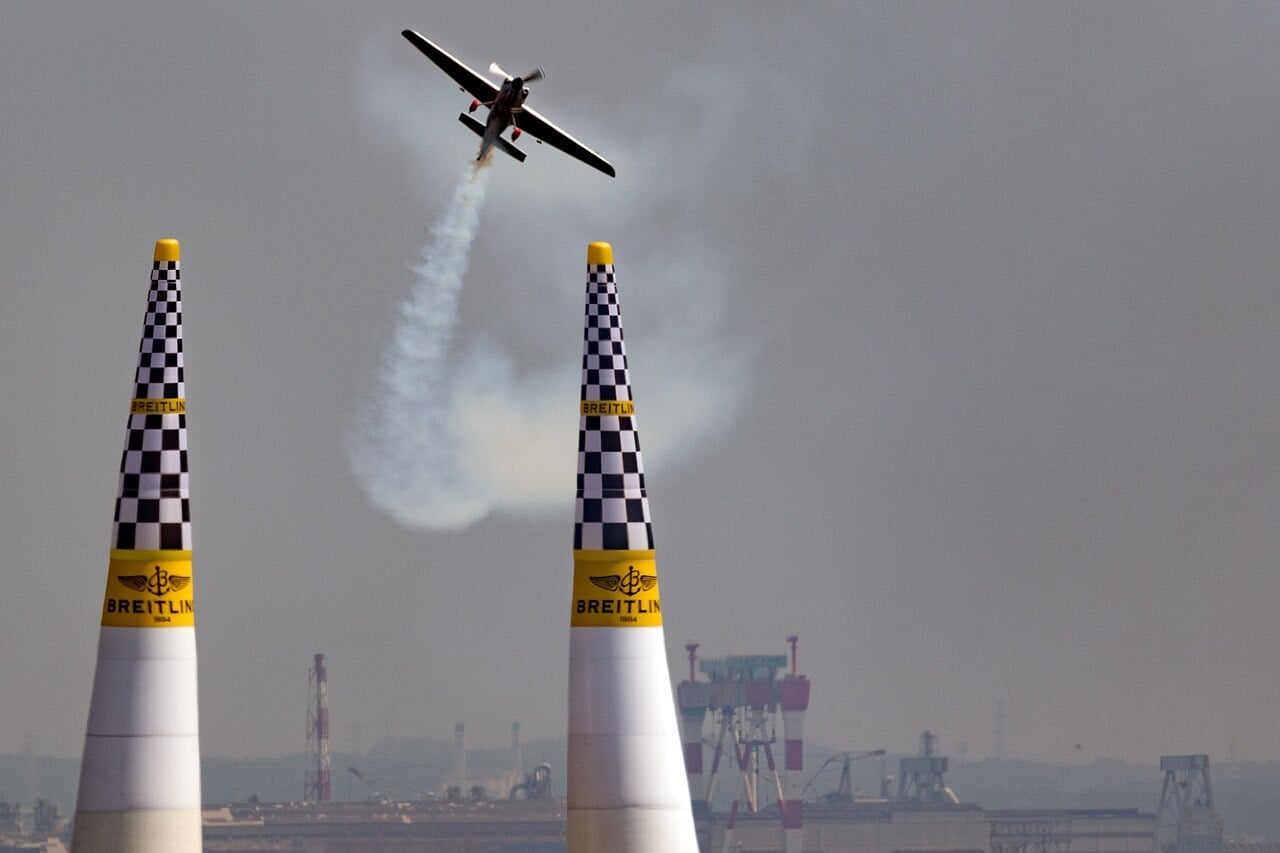
The 2026 season ran over four rounds from June to September, with Australia’s Aarron Deliu winning the opener and Šonka and Muroya both on the grid. South African media reported in September 2026 that Davidson had retained his title. The aircraft still fly at around 250 mph and pull up to 12 g, but the crowds now watch on screens rather than from a riverbank.
AIR RACE X’s recap of the first round of its 2026 season, flown remotely with pilots racing from their home airfields.
As of November 2026, the Red Bull Air Race itself has not returned. Its pylons are packed away, its champions race each other by telemetry, and the image of an Edge 540 knifing between two chequered cones over the Danube belongs to aviation history. For sixteen years, though, it was the fastest show in town.
Sources: AOPA, Australian Flying, AVweb, FAI, Wikipedia (Red Bull Air Race World Championship; List of Red Bull Air Race World Championship winners)
0 Comments