
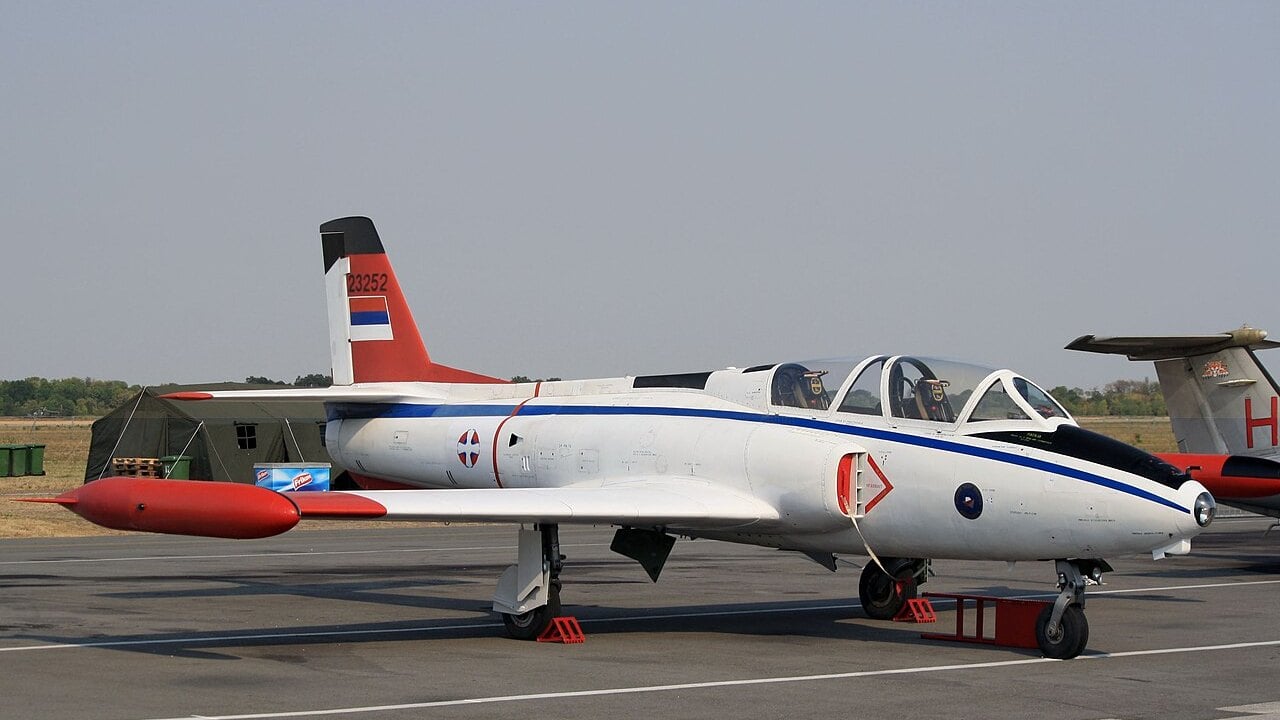
In June 1963, visitors to the Paris Air Show at Le Bourget found an unfamiliar jet parked among the French, British and American hardware. It was small, straight-winged and painted in drab green, with tip tanks on its wings and Yugoslav markings on its tail. Its name was written in script on the nose: Galeb, Serbo-Croatian for seagull.
It was the first jet trainer designed in Yugoslavia to go into series production, and for the next two decades the Soko G-2 Galeb would teach a whole generation of Yugoslav military pilots to fly jets. Pilots called it, fondly, the “Old Galeb”.
Kurzinfo
- Typ: Two-seat jet trainer and light attack aircraft
- Designer: Aeronautical Technical Institute (VTI), Žarkovo
- Bauherr: Soko, Mostar
- Erster Flug: 3 July 1961 (G-1 prototype, Ljubomir Zekavica)
- Im Einsatz: 30 July 1965 (first Yugoslav Air Force aircraft registered)
- Gebaut: 248 by mid-1983, 132 for the Yugoslav Air Force
- Motor: One Rolls-Royce (Bristol Siddeley) Viper turbojet
- Rüstung: Two 12.7 mm machine guns; up to 500 kg of bombs or rockets
- Höchstgeschwindigkeit: 780 km/h at 6,200 m (museum data)
A trainer from Žarkovo
In the 1950s, Tito’s Yugoslavia sat between the blocs, buying aircraft from the West while building its own aviation industry. Its air force trained jet pilots on the American Lockheed T-33, and it wanted a home-grown replacement.
The design came from the Aeronautical Technical Institute (VTI) at Žarkovo near Belgrade. According to the Aeronautical Museum in Belgrade, work on the project ran from 1957 to 1959. The first of two prototypes, designated G-1, took off on 3 July 1961 with test pilot Ljubomir Zekavica at the controls. The second was slightly changed in construction, was designated G-2, and became the pattern for the production aircraft.
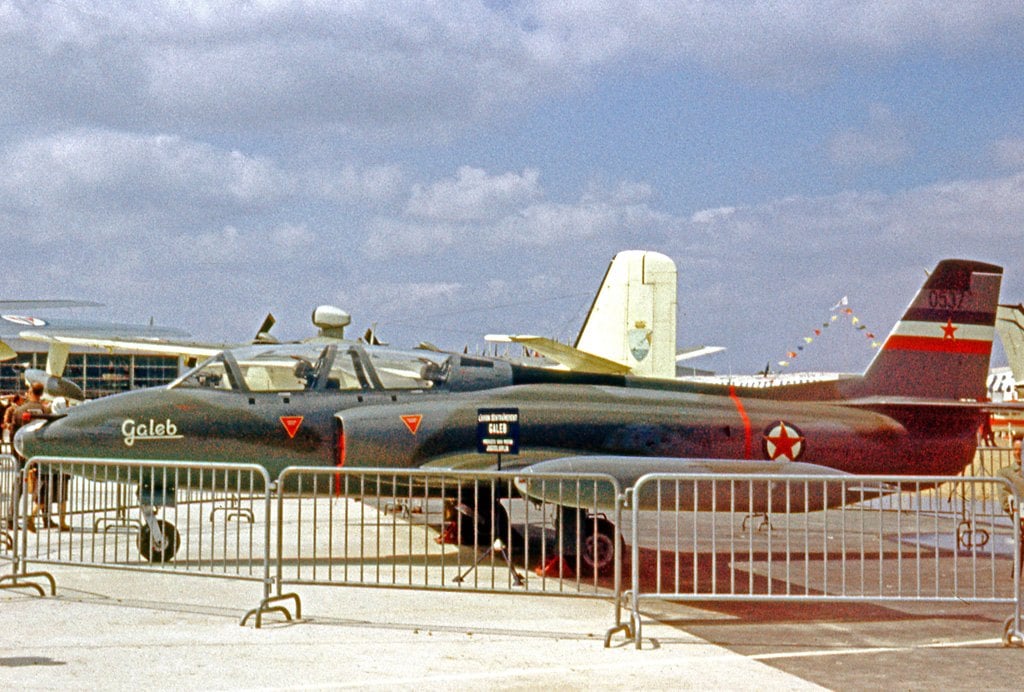
Production went to the Soko factory in Mostar, in today’s Bosnia and Herzegovina. The Galeb was a thoroughly practical machine: a two-seat tandem trainer of all-metal construction, with a straight wing, wingtip tanks and an undercarriage that retracted into the wings rather than the fuselage.
British heart, Yugoslav brain
For an aircraft from a non-aligned socialist state, the Galeb had a strongly British accent. Its engine was the Rolls-Royce (Bristol Siddeley) Viper turbojet, and Flight International noted in 1968 that much of its equipment came from British suppliers.
The Viper was chosen for good reasons. The Belgrade museum points out that its first compressor stage was made of steel, which made it tolerant of the dust and grit a jet swallows when operating from rough strips, and the Galeb was designed to take off and land on grass.
Unusually for a trainer of its class, it carried a fixed armament: two 12.7 mm Colt Browning machine guns in the nose with 80 rounds each, plus underwing racks for up to 500 kg of bombs or rocket pods. Students could learn gunnery and ground attack in the same aircraft they learned to fly in. Its museum data gives a top speed of 780 km/h at 6,200 metres and a range of 970 km.
A short flight with a cockpit view in the civil-registered Soko G-2 Galeb 9A-BOS.
Twenty years of students
The first production Galebs entered Yugoslav Air Force service on 30 July 1965, and the last was delivered on 6 January 1981. Production continued for export until the middle of 1983, by which time Soko had built 248 Galebs, 132 of them for the Yugoslav Air Force, according to the Belgrade museum.
Most of them served with the Air Force Academy, flying cadets through their jet training. They were built to last. The Galeb on display in Belgrade, serial 23108, served for 20 years and made 9,783 flights before its final landing at the airport where the museum stands.
The Galeb also gave Soko a combat jet. Delete the rear cockpit, fill the space with avionics and strengthen the airframe, and you had the single-seat J-21 Jastreb ground-attack aircraft. The trainer line continued with the very different G-4 Super Galeb, which took over the advanced training role from the 1980s.
Export and war
An export version, the G-2A-E, had a pressurised cockpit and went to the air forces of Zambia and Libya. The Belgrade museum adds that one Galeb was delivered to Indonesia in 1990, and one was bought by the American film star John Travolta.
When Yugoslavia broke apart in the early 1990s, Galebs were used in the fighting, and the remaining military aircraft ended up in the air force of the rump Federal Republic of Yugoslavia. The last of them were officially written off in mid-1999. In Libya, Galebs were reportedly still in service when the 2011 civil war began, and it drew one last burst of headlines when French jets enforcing the no-fly zone struck a Libyan aircraft near Misrata.
The seagull keeps flying
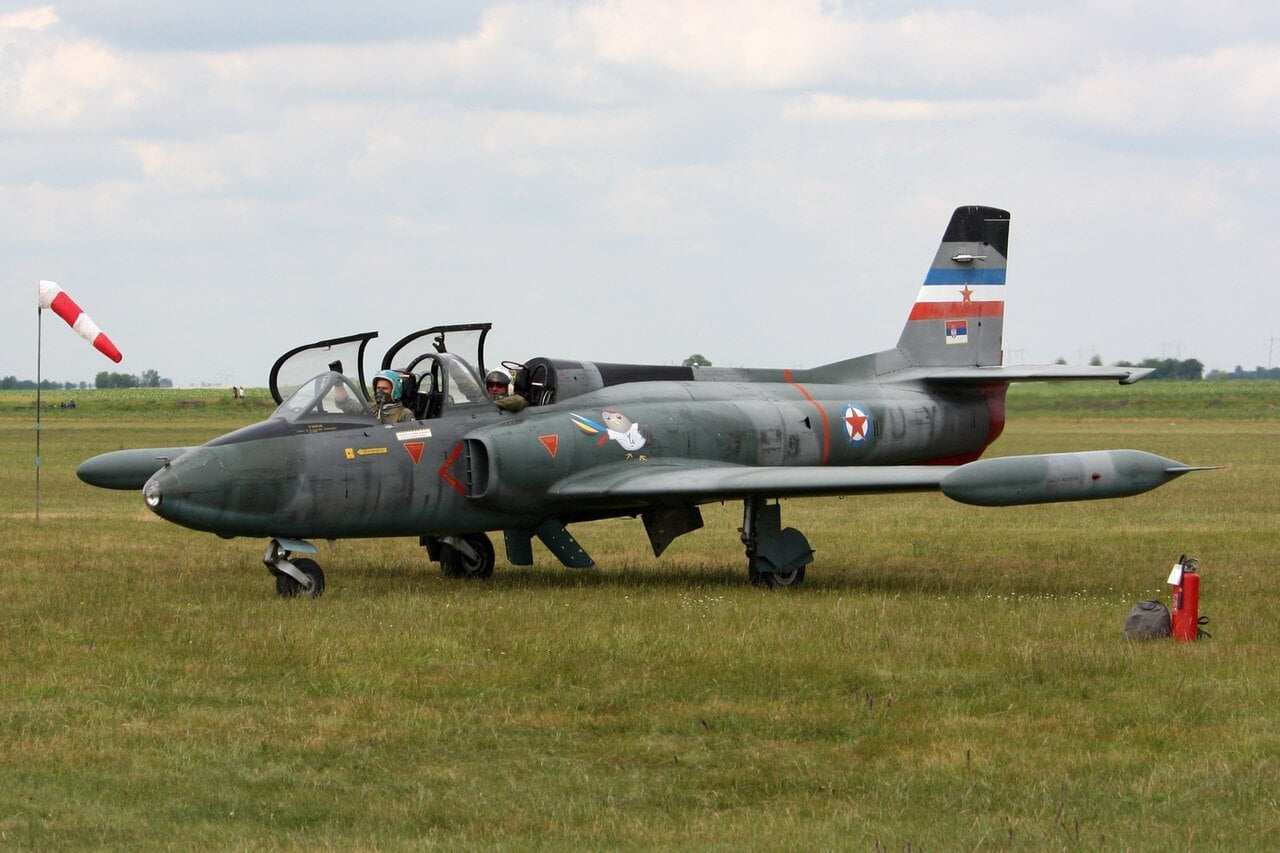
The Galeb never really retired. One example remains with the Serbian Armed Forces’ flight-test centre and appears at air shows, as our featured photo from Batajnica in 2012 shows. Many more have found new lives as civilian warbirds in Serbia, Croatia, Slovenia, the United States, Australia and New Zealand.
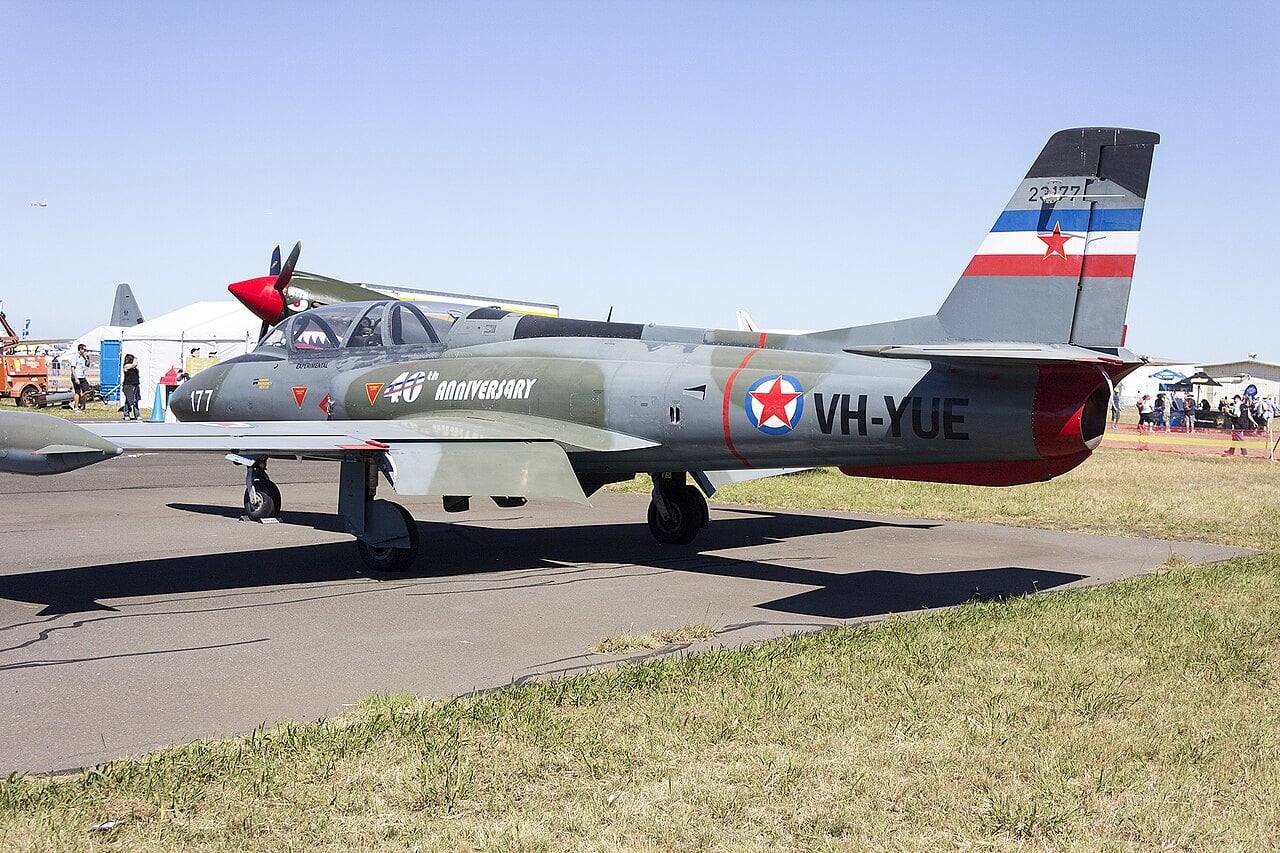
In Serbia, a group of enthusiasts bought four ex-military G-2A Galebs, restored them and formed a display team called the Stars (Zvezde). According to Flight International, the team made its international debut at the AIR BORNE 2007 air show at Rakičan in Slovenia, flown by active Serbian Air Force pilots from its home airfield at Čenej near Novi Sad.
Vintage Soko G-2 Galebs flying a formation aerobatic display.
It is a fitting afterlife for an aircraft that was always more than the sum of its parts. Built in Mostar around a British engine and designed in Žarkovo, the Galeb trained the pilots of a country that no longer exists, and still flies over the airfields where they learned.
Sources: Aeronautical Museum Belgrade, Flight International (28 November 1968; 29 June 2007; 25 March 2011)
0 Comments