
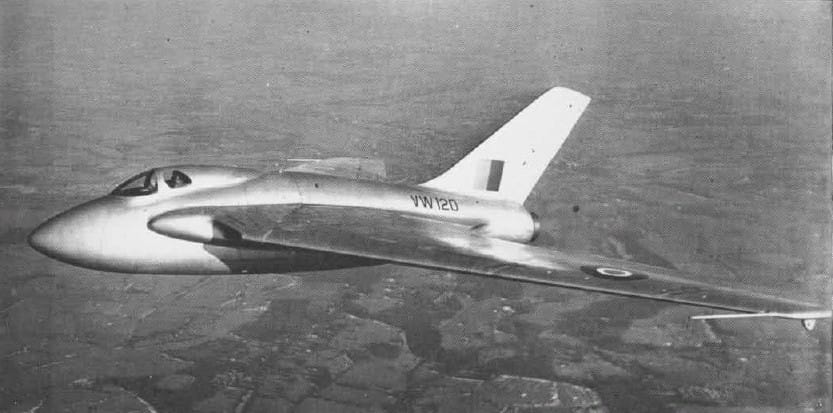
Three de Havilland DH.108 Swallows were ever built. Each one, in turn, killed the man flying it. That is not a curse or a legend — it is simply the record of one of the most beautiful and lethal experimental aircraft Britain ever put into the air.
The Swallow was a sleek, tailless, swept-wing jet built to chase the sound barrier at a time when nobody fully understood what happened to an aircraft as it got there. What happened, it turned out, could tear the wings off in seconds — and it did, three times.
Why build a tailless jet at all
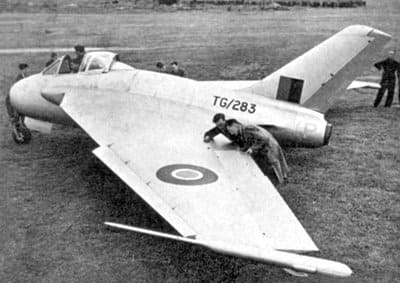
In 1944 de Havilland was sketching a radical jet airliner, the DH.106 Comet, and one early idea was to make it tailless with swept wings. Before betting an airliner on that layout, the company needed data. So designer John Frost took the fuselage and Goblin engine of the de Havilland Vampire fighter, bolted on a longer nose and 43-degree swept wings with a single fin and no tailplane, and produced a flying laboratory. The Ministry of Supply called it the Swallow; de Havilland never officially used the name.
The Comet soon went conventional. But the Swallow was too useful to abandon: it was the first British swept-wing jet and the first British tailless jet, and it could probe speeds almost nothing else could reach. Three were built to explore that frontier — low speed, high speed, and finally the edge of the sound barrier.
27 September 1946: the first death
The second prototype, TG306, was the fast one — a 45-degree wing, built to attack the World Air Speed Record. Its pilot was Geoffrey de Havilland Jr., the company's chief test pilot and the founder's son. On the evening of 27 September 1946 he took off from Hatfield, flew out over the Thames Estuary, and pushed the Swallow into a high-speed dive from 10,000 feet.
At around 5,000 feet the aircraft reached roughly Mach 0.88. Shock waves formed along the wing leading edges, the airflow broke down, and the jet snapped into a violent pitching oscillation — a NASA study later called it "an undamped violently divergent longitudinal pitching oscillation." The loads cracked the main spar; both wings failed. TG306 fell into Egypt Bay off Gravesend. De Havilland's body was found ten days later. He had died of a broken neck, his head hurled against the canopy by the frequency of the oscillation.
Aeronave: de Havilland DH.108 "Swallow" — tailless, swept-wing experimental jet
Construido: Three (TG283, TG306, VW120), 1946–1947, from Vampire fuselages
Primeras veces: First British swept-wing jet; first British tailless jet
Fatal flaw: Violent transonic pitch oscillation that broke the airframe
Peaje: All three aircraft lost; all three pilots killed
Total flying: 480 flights across the three airframes
An overview of the DH.108 and its role in Britain's first brush with supersonic flight.
The man who lived to describe it
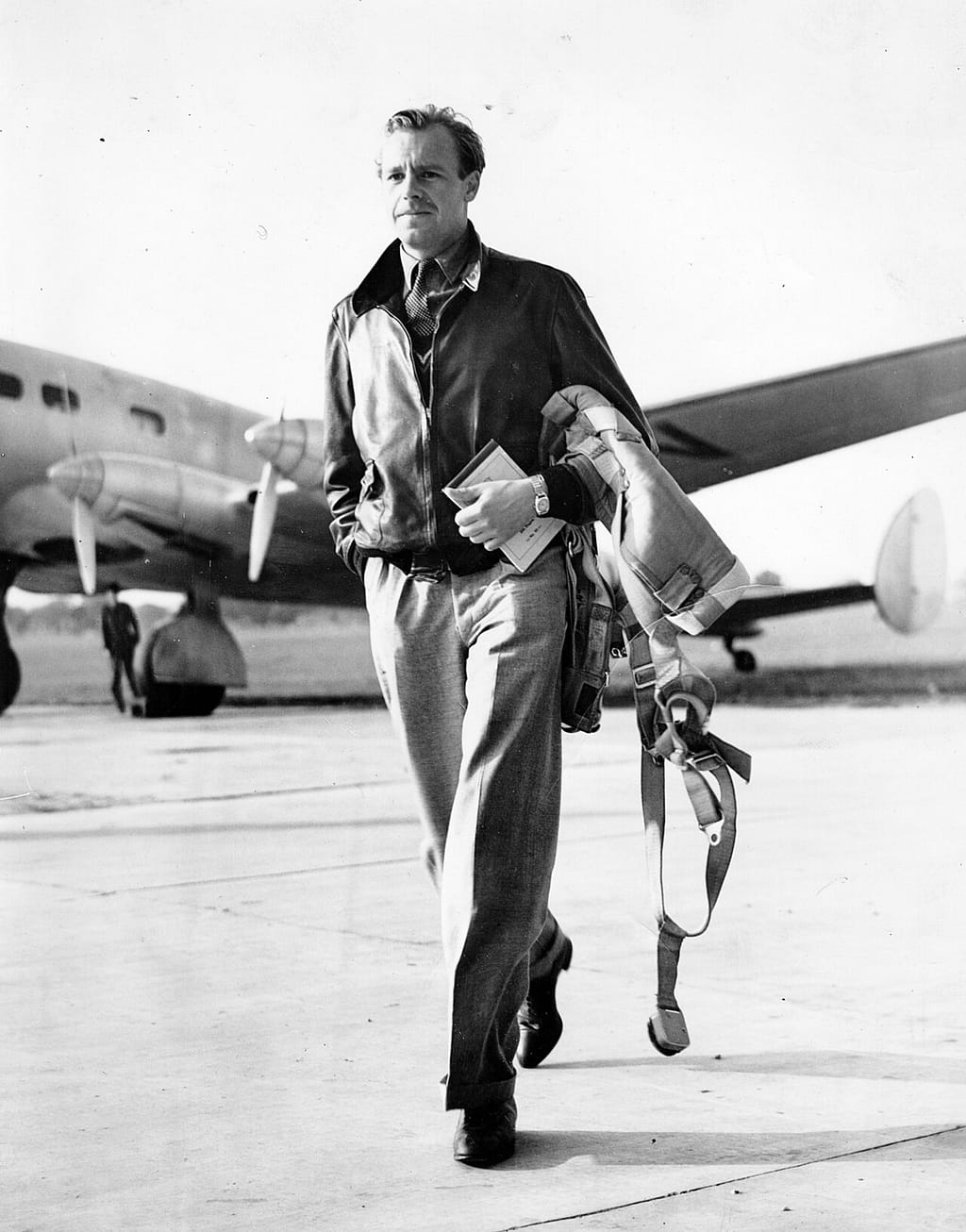
What killed de Havilland almost killed the test pilot sent to investigate it. Captain Eric "Winkle" Brown flew a DH.108 to reproduce the fatal condition — and found it. Deliberately diving toward the same speed, he felt the aircraft come apart around him.
Brown survived for a brutally simple reason: he was short. His head was not thrown against the canopy frame with the force that had broken de Havilland's neck, and he was able to pull back on stick and throttle together and ride the oscillation out. He later described the DH.108 flatly as "a killer." Coming from the man who flew more aircraft types than anyone in history, that was not a casual verdict.
Two more, both fatal
The third Swallow, VW120, was the most advanced — a more powerful Goblin engine, an ejection seat, power-boosted controls meant to tame the pitch problem. It set a world air speed record over a 100-kilometre circuit in April 1948, and on 6 September 1948 John Derry is thought to have taken it past the speed of sound in a dive, most likely the first British pilot to do so. For a moment the Swallow looked less like a killer and more like a pioneer.
It did not last. On 15 February 1950, VW120 shed its left wing in a dive and crashed near Brickhill, Buckinghamshire. Squadron Leader Stuart Muller-Rowland died — again, a broken neck from the aircraft's oscillations. Ten weeks later, on 1 May 1950, the surviving first prototype, TG283, tumbled into an inverted spin during low-speed trials. Squadron Leader George Genders bailed out too low; his parachute never fully opened. He was the third pilot, and the last. Every DH.108 ever built was now gone, and so were all three men who had pushed them fastest.
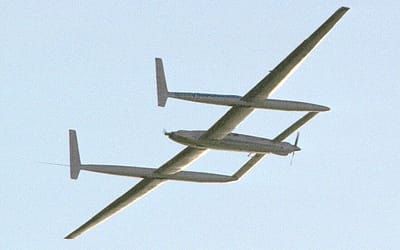
The DH.108 Swallow in action — the shape that led Britain toward the sound barrier.
What the Swallow bought
It is tempting to file the DH.108 under tragic failure. That is not quite right. Those 480 flights taught British engineers, in the hardest possible way, what an untamed swept wing does at transonic speed — knowledge that fed straight into later aircraft with proper tails and, eventually, the electronic flight-control systems that make today's tailless bombers possible.
The Swallow was beautiful, and it was ahead of its time, and it killed everyone who flew it to the edge. Both halves of that sentence are true, and aviation moved forward on the strength of the second one.
A closer look at de Havilland's ill-fated tailless jet.
Sources: Wikipedia (cross-checked); This Day in Aviation (Bryan Swopes); FLIGHT and Aircraft Engineer, 3 October 1946; Eric Brown, Wings On My Sleeve.
0 Comentarios