
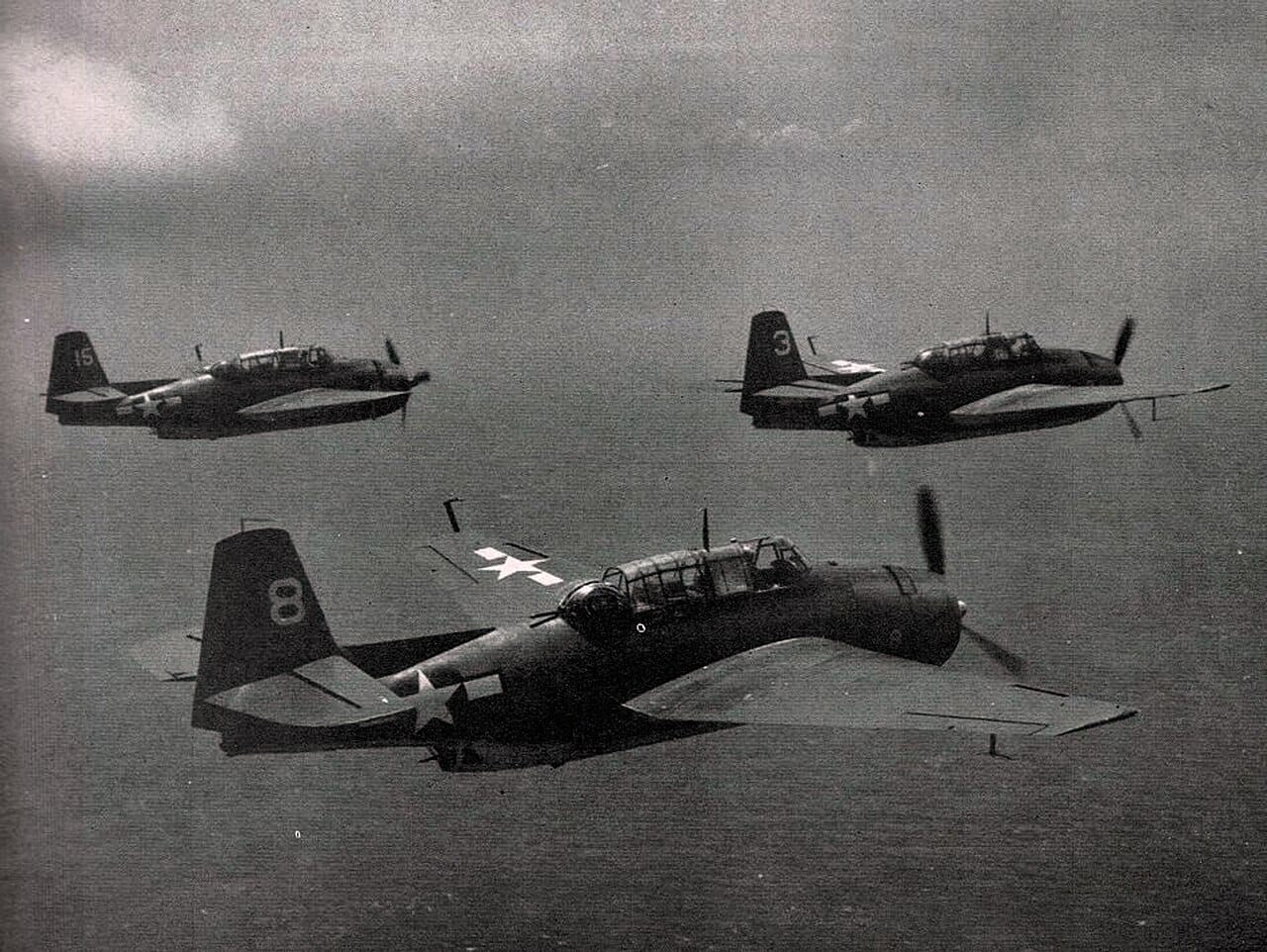
Six Grumman Avengers took off from Midway on the morning of 4 June 1942. It was the aircraft’s first day of combat. One came back, flown by a pilot with no elevator control, no flaps, no compass, no radio, a dead gunner behind him and sixty-four bullet holes in the airframe.
The Avenger went on to become the most successful torpedo bomber of the war, sank the two largest battleships ever built, and carried a future American president into the sea off a Japanese island. It began with the worst debut in naval aviation.
Datos rápidos
- Aeronave: Grumman TBF Avenger; built by General Motors as the TBM
- Primer vuelo: 7 August 1941
- Motor: Wright R-2600 Twin Cyclone, 1,700 hp
- Multitud: Three — pilot, turret gunner, radioman/bombardier
- Combat debut: Midway, 4 June 1942 — six aircraft, one returned
- Construido: 9,839 total — 2,293 by Grumman, 7,546 by General Motors
- Notable: Every torpedo hit on Musashi came from an Avenger
- Submarine kills: Around 30, mostly from escort carriers
The confusion worth clearing up first
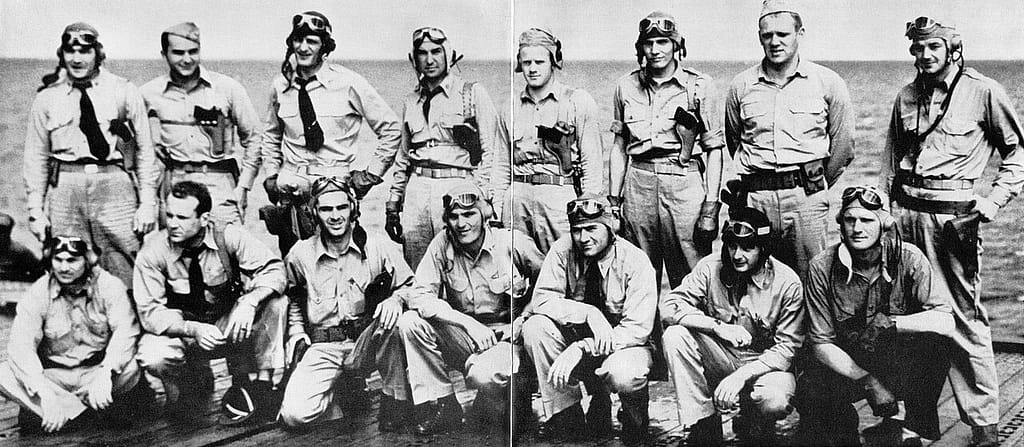
Torpedo Squadron 8 is famous for being annihilated at Midway, and it was — but the story is usually told as one event when it was two, involving two different aircraft types in two different places.
VT-8 had been split in March 1942. Lieutenant Commander John Waldron took the senior pilots and the squadron’s obsolete TBD Devastators aboard USS Hornet. The rear echelon stayed behind at Norfolk to collect the brand-new Avengers, and reached Pearl Harbor on 29 May — one day after Hornet had sailed.
So six of those Avengers flew forward to Eastern Island, Midway, and fought as a land-based detachment that had never joined its own carrier. Waldron’s fifteen Devastators attacked from Hornet two hours later. All fifteen were lost, with one survivor, Ensign George Gay. Between the two attacks the squadron lost twenty aircraft and forty-five men in a single morning.
Seventy minutes
The alert came at 0555. The six Avengers were airborne by about six, led by Lieutenant Langdon Fieberling, who had argued against the plan they were about to execute. They found the Japanese carrier force at around 0655 and attacked Hiryū at about 0710.
They had no fighter escort. Roughly thirty Zeros were airborne. Doctrine required a torpedo bomber to fly straight, low and slow through the final run. By a quarter past seven it was finished. Five of the six were shot down. Not one torpedo hit anything.
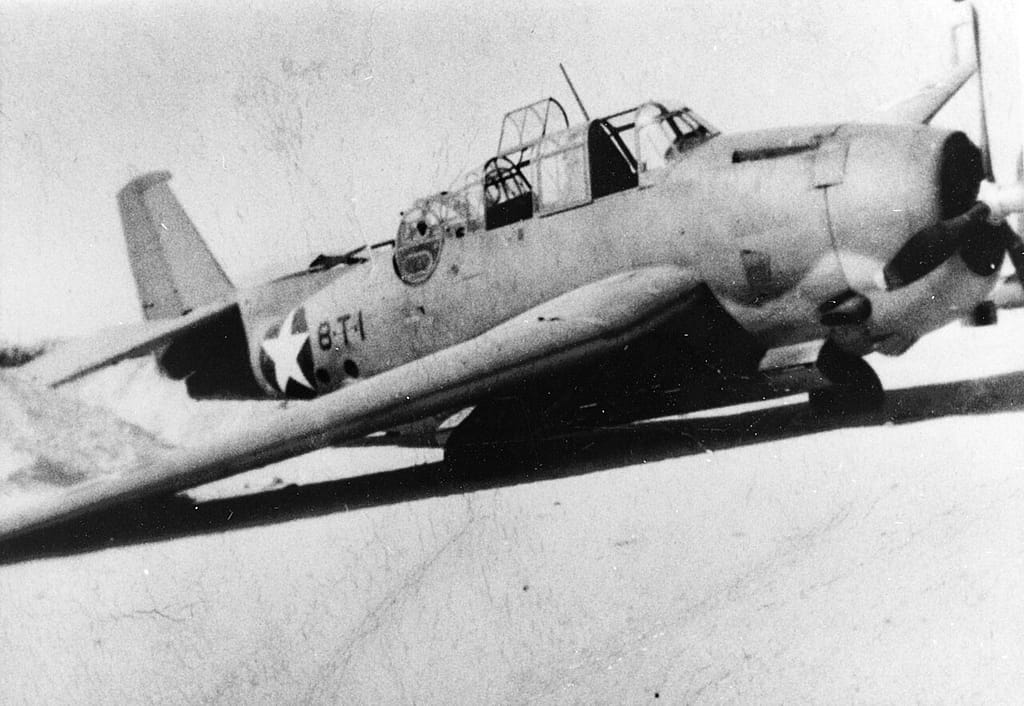
Ensign Albert “Bert” Earnest, flying 8-T-1, was the only pilot to come home. His turret gunner, Jay Manning, had been killed by a 20 mm round. His radioman, Harry Ferrier, was seventeen years old and had been creased across the scalp. The hydraulics were shot out, the bomb bay doors jammed open, the instrument panel destroyed, and the elevator control cables severed.
He discovered it about twenty feet above the Pacific, and flew roughly two hundred miles home on trim alone, landing on one wheel. He was awarded the Navy Cross twice for that morning: once for pressing the attack, and again for the flight back.
Why it went wrong, and it was not the aeroplane
Three things killed those crews: no escort, a doctrine that demanded a slow straight run, and the Mark 13 torpedo.
The Mark 13 in 1942 had to be dropped from around fifty feet at 110 knots to work at all — an envelope that essentially required the crew to volunteer. Even inside it the weapon broached, ran cold, ran deep and sank. The Bureau of Ordnance eventually counted twelve distinct defects. In 1943 testing, only 31 percent of drops were satisfactory.
The fix came from Caltech, which established the correct water-entry angle and produced two pieces of plywood and sheet metal that changed everything: a drag ring on the nose and a shroud ring on the tail. Both were in service by the middle of 1944. By that autumn the torpedo could be dropped from 800 feet at 300 knots, and the Bureau reported that hot, straight and normal runs approached 100 percent.
The Avenger itself was sound. It was the heaviest single-engine carrier aircraft of the war, the first US carrier aircraft with a power-operated gun turret, and it could carry a torpedo or 2,000 lb of bombs entirely internally.
John Ford’s film of the Torpedo Squadron 8 pilots, shot shortly before Midway. Almost none of the men in it survived the battle.
What it did afterwards
The redemption was total. Avengers helped sink the carrier Ryūjō in August 1942 and finish the battleship Hiei that November. In the Atlantic and Pacific, Avenger and Wildcat teams flying from escort carriers accounted for around thirty submarines.
Then the two big ones. When Musashi was sunk in the Sibuyan Sea in October 1944, every torpedo hit on her came from an Avenger. Six months later, twenty Avengers attacked Yamato deliberately from one side, concentrating their torpedoes to port to force her to capsize. She did.
The Chichi Jima mission
On 2 September 1944, four Avengers of VT-51 flew from the light carrier USS San Jacinto against a Japanese radio installation on Chichi Jima. One was flown by a twenty-year-old lieutenant junior grade named George Herbert Walker Bush.
His aircraft was hit before he reached the target. He completed the dive and dropped his bombs, then flew out to sea and bailed out at low altitude, striking his head on the tail as he went. His two crewmates — Lieutenant Junior Grade William “Ted” White and Radioman Second Class John Delaney — were both killed. One of them got out and his parachute failed. It has never been established which.
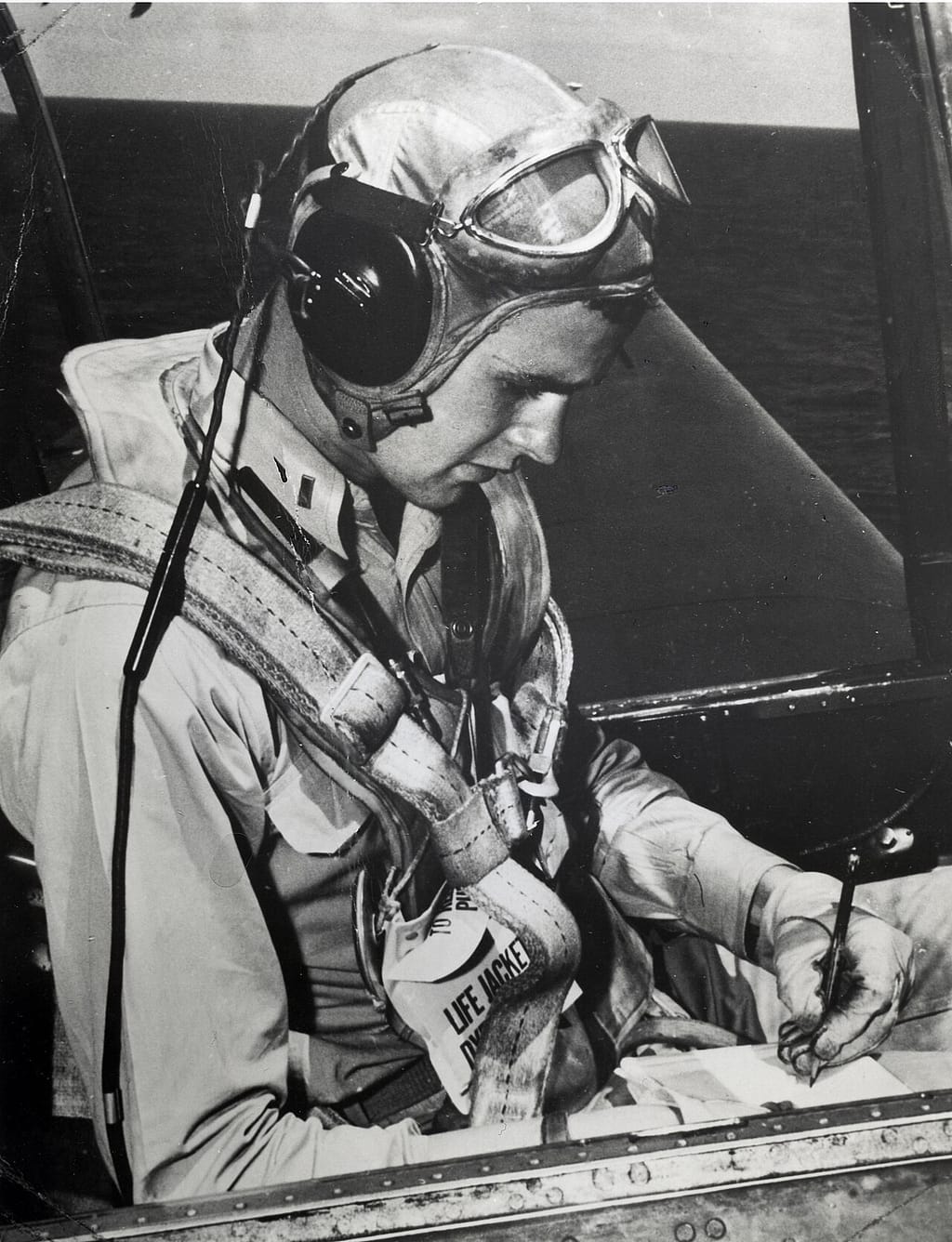
The submarine USS Finback picked him up at 1156. He stayed aboard for the remaining month of her patrol, standing lookout watches, before returning to his squadron.
Years later, asked about the aircraft rather than the day, his verdict was that of a pilot: “The Avenger was a great, stable airplane. It was the easiest plane to land aboard the carrier.”
The George and Barbara Bush Foundation on the Chichi Jima mission and the rescue by USS Finback.
The verdict Earnest gave himself
Midway is often described as the moment the torpedo squadrons, by dying, pulled the Japanese fighters down to sea level and cleared the sky for the dive bombers. It is a comforting reading, and Earnest — who had more right than anyone to accept it — refused to.
He flew home on a trim tab with a dead man behind him, was decorated twice for it, and spent the next sixty years declining to inflate what it meant. He retired a captain and died in 2009.
Sources: Naval History and Heritage Command, US Naval Institute Naval History (Earnest 2001, Ferrier 2008), National Naval Aviation Museum, NavWeaps, HistoryNet, National Archives
0 Comentarios