

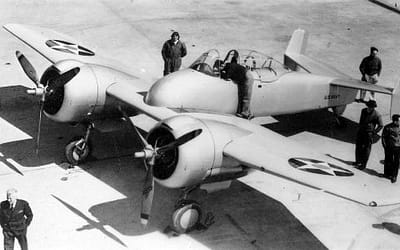
In September 1939, Poland went to war in the air flying gull-winged fighters that belonged to another decade. Yet in a hangar at Okęcie sat the aircraft that was supposed to change all that: the PZL.50 Jastrząb — the Hawk — a sleek, modern, all-metal monoplane that never got the chance to fight.
Its story is one of the great what-ifs of the Second World War: a promising fighter strangled by the one thing its designers could not conjure — a powerful enough engine — and finished off by a cruel irony on the war’s opening days.
Datos rápidos
- Diseñador: Wsiewołod Jakimiuk, head of PZL’s fighter team
- Role: single-engine monoplane fighter to replace the PZL P.11
- Engine (prototype): 840 hp Bristol Mercury VIII — badly underpowered for the airframe
- Primer vuelo: February 1939
- Ordered: 300 aircraft in 1938; production cancelled spring 1939, with 30 left under construction
- Destino: the sole flying prototype was shot down in September 1939 — by Polish anti-aircraft gunners
A hawk for a modernising air force
By the mid-1930s the Poles knew their famous gull-winged PZL P.11 — a world-beater when it appeared — was sliding into obsolescence. Wsiewołod Jakimiuk, who led PZL’s fighter team, drew up a sturdy low-wing monoplane, all metal, deliberately roomy enough to accept far more powerful engines as they became available. It was named Jastrząb, the Hawk.
The plan was sound. The execution was cursed. The powerful engines Poland was counting on never materialised in time, and the prototype had to make do with an 840 hp Bristol Mercury VIII — an engine sized for a smaller, lighter fighter.

Underpowered and out of time
Confidence ran so high that in 1938 the Polish Aviation Command ordered 300 Jastrząb As before the prototype had even been finished, paying for the first hundred in advance. Then the delays began. A British-supplied undercarriage arrived four months late, pushing the maiden flight back to February 1939 — and when the Hawk finally flew, it disappointed.
The little Mercury could push the big fighter to only 274 mph, a full 35 mph below expectations, and the aircraft was twitchy in slow turns and suffered tail flutter at speed. Some of that was fixable — a redesigned carburettor intake, built for the wrong engine, was throttling the Mercury; enlarge it and the modified prototype hit its promised 310 mph by August 1939. But it was never quite trusted, and it was still in airworthiness trials when time ran out.
Killed by its own side
In the spring of 1939 a new air-force chief, General Zając, cancelled Jastrząb production outright, allowing only 30 already-started airframes to continue at PZL’s Okęcie works. Then the Germans invaded. PZL’s test pilot, Jerzy Widawski, tried to fly the one airworthy prototype east to Lwów to save it — and was shot down by a Polish anti-aircraft gun whose crew took the unfamiliar shape for a German aircraft.

Poland’s airmen went to war outnumbered and outdated, and yet fought with a ferocity that stunned the Luftwaffe. Many escaped the collapse, made their way west, and flew again — most famously in the Battle of Britain, where Polish squadrons became legends of the RAF.
Had the Jastrząb arrived two years earlier with the engine it deserved, those same pilots might have met the Luftwaffe on even terms in 1939. Instead the Hawk remains one of aviation’s saddest might-have-beens — a good aircraft that was simply born too late, into a country that ran out of time.
Sources: J. Rickard, historyofwar.org; Wikipedia; armedconflicts.com.


0 Comentarios