
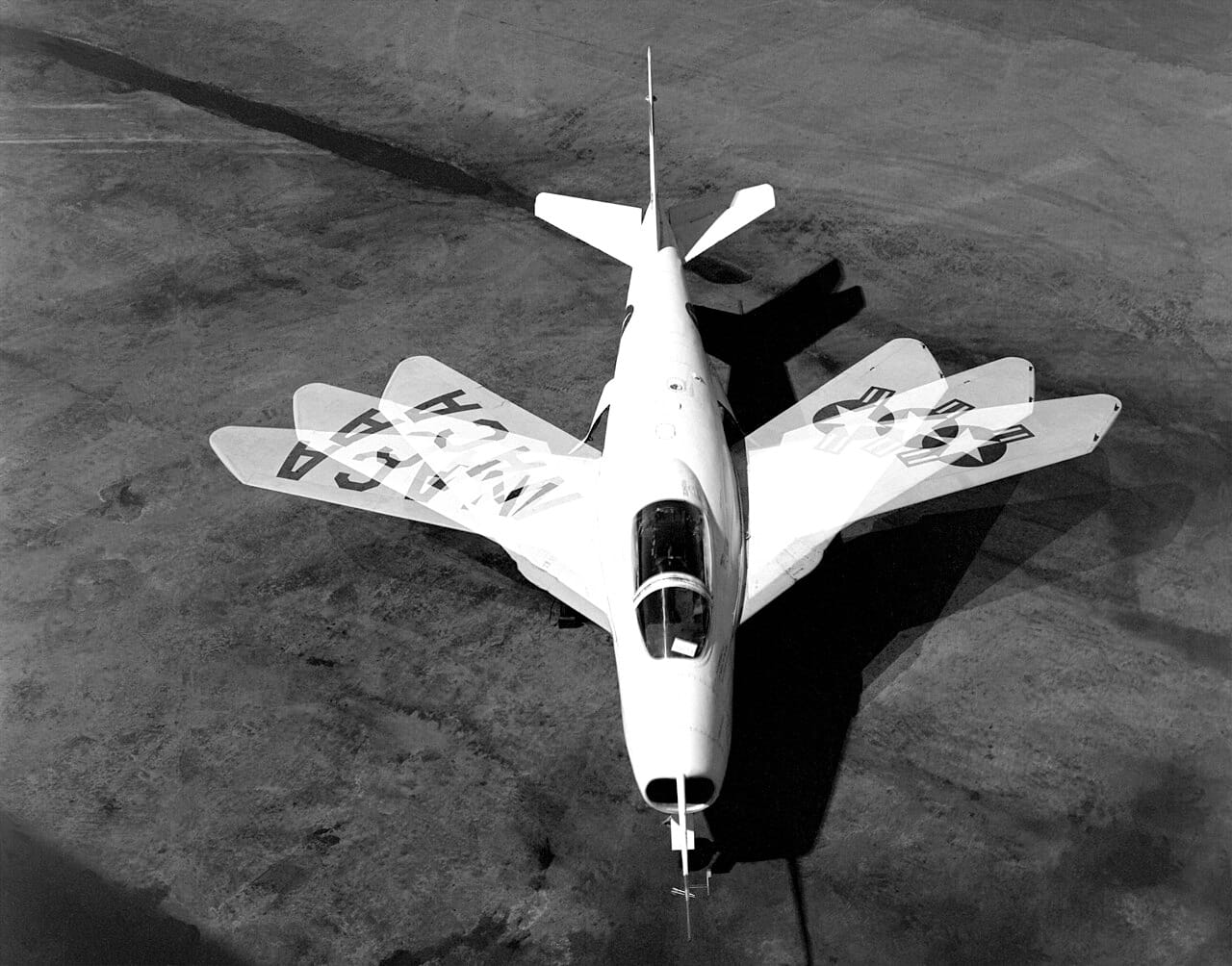
Every swing-wing jet that followed — the F-14 Tomcat, the F-111, the Tornado, the B-1 — owes a debt to one small, awkward and rather dangerous research aircraft from the early 1950s. The Bell X-5 was the first aeroplane in the world that could change the sweep of its wings while it was flying.
It proved that variable-geometry wings worked. It also very nearly refused to come out of a spin, and it killed one of its pilots.
Datos rápidos
| Aeronave | Bell X-5 |
| Motivo de fama | First aircraft to vary wing sweep in flight |
| Sweep positions | 20, 40 and 60 degrees |
| Inspired by | The captured Messerschmitt P.1101 |
| Primer vuelo | 20 June 1951 (Jean “Skip” Ziegler) |
| Motor | One Allison J35 turbojet |
| Construido | Two |
| Legado | Paved the way for the F-111, F-14, Tornado and B-1 |
A German idea, finished in America
The X-5 traced its origins to a captured German design, the Messerschmitt P.1101, which could have its wing sweep reset — but only on the ground, with the aircraft parked. Bell’s engineers, led by Robert Woods, took the idea further: they built a jet whose wings could sweep back and forth between 20, 40 and 60 degrees while airborne. To keep the aircraft balanced as the sweep changed, the entire wing assembly slid forward and back on rails.

Bell test pilot Jean “Skip” Ziegler first flew the X-5 on 20 June 1951. The variable-sweep concept worked beautifully: swept forward for slow flight and landing, swept back for speed, exactly as intended.
A vicious streak
The trouble was not the sweeping wing but the rest of the aeroplane. A flawed tail layout gave the X-5 a nasty, sometimes unrecoverable spin, especially with the wings swept fully back to 60 degrees. The pilots who flew it never quite trusted it.
Fellow NACA pilot Stanley Butchart put the flying technique more bluntly.
Not everyone could. On 13 October 1953, US Air Force Major Raymond Popson entered a spin with the wings at 60 degrees and could not recover. He was killed, and the second of the two X-5s was destroyed.

The wing that changed everything
Despite its dangers, the X-5 did its job. It confirmed the wind-tunnel predictions about variable-geometry wings and gave engineers real flight data on how a swing-wing aircraft behaved. Within two decades that knowledge had produced a whole generation of swing-wing combat aircraft. A young NACA pilot named Neil Armstrong even flew the surviving X-5, years before he flew to the Moon.
The X-5 was awkward, twitchy and never a weapon. But as a proof of concept, it was one of the most influential research aircraft ever built.
Sources: NASA Dryden/Armstrong Fact Sheet; National Museum of the USAF; Wikipedia.


0 Comentarios