

Buried in Japan’s record ¥8.89 trillion (about $56 billion) defence budget request for fiscal 2027 is a single phrase that quietly redraws the country’s air-combat ambitions. The Ministry of Defense now describes the ASM-3 — until now a supersonic anti-ship missile — as an “air-to-surface / anti-air missile.” In plain terms, Japan intends to turn its Mach 3 ship-killer into a long-range air-to-air weapon.
It is a small line item with large implications. A missile built to gut warships would instead be pointed at the aircraft that hold an enemy’s air campaign together: the airborne early-warning radars, the tankers, and the command jets that orbit far behind the front line and rarely expect to be shot at.
Datos rápidos
| Arma | ASM-3 / ASM-3 Kai supersonic missile |
| Constructor | Mitsubishi Heavy Industries · ATLA |
| Propulsión | Integral rocket-ramjet |
| Velocidad | Mach 3-plus |
| Tamaño | ~6 m long, ~940 kg |
| Original role | Air-launched anti-ship (Mitsubishi F-2) |
| New role | Long-range air-to-air (FY2027 budget) |
| Budget request | ¥8.89 trillion (~$56 billion) for FY2027 |
A ramjet built to kill ships
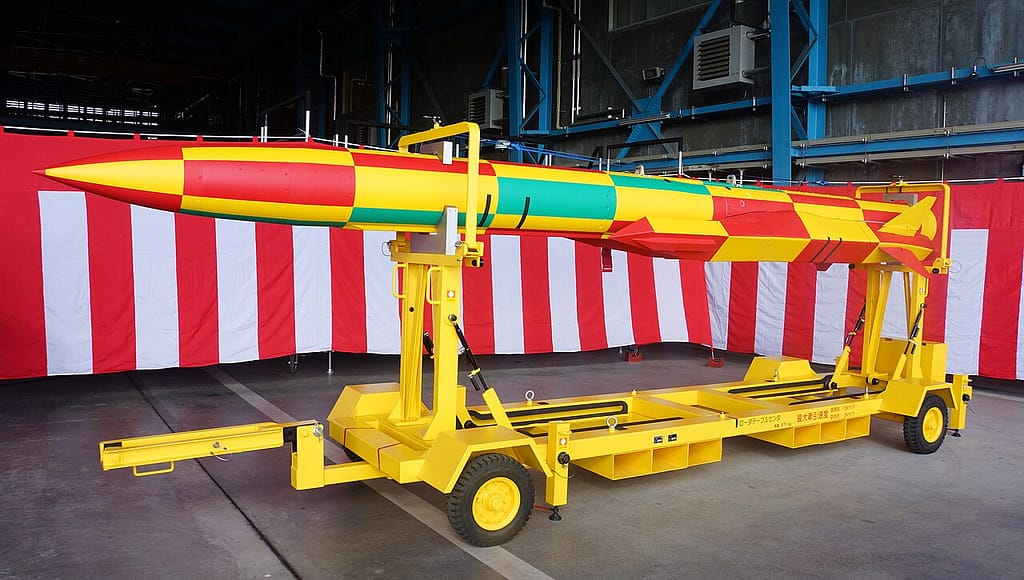
The ASM-3 is a Mitsubishi Heavy Industries design developed with Japan’s Acquisition, Technology and Logistics Agency (ATLA). It is roughly six metres long, weighs about 940 kilograms, and is driven by an integral rocket-ramjet that accelerates it past Mach 3 — fast enough to compress a warship’s reaction time to seconds. It was conceived to arm the Mitsubishi F-2, Japan’s licence-evolved relative of the F-16.
The baseline weapon reached roughly 200 kilometres. The improved ASM-3A, fielded earlier this decade, stretched that to an estimated 300 to 400 kilometres, and a further upgrade — the ASM-3 Kai — is reported to push the reach toward 600 kilometres, with some estimates higher. Each step has been about the same thing: letting an F-2 fire from outside a modern warship’s air-defence umbrella.
From anti-ship to anti-air
Turning that airframe into an air-to-air missile is a logical, if ambitious, leap. A weapon that already cruises at supersonic speed over hundreds of kilometres has exactly the qualities needed to threaten large, slow, high-value aircraft. The target set is specific: airborne early-warning and control jets, aerial tankers, and airborne command posts — the enabling aircraft an adversary cannot easily replace.
The Ministry of Defense’s own budget language is the tell.
Kill those aircraft, or merely force them to orbit further back, and an opponent’s fighters lose the radar picture and the fuel that let them fight forward. It is the same logic behind the very-long-range missiles that Russia, China and the United States have all pursued.
Joining an exclusive club
Only a handful of nations field air-to-air missiles in this class: Russia with the R-37M, China with the PL-17, and the United States with the AIM-174B and the developmental AIM-260. Japan wants in, and the reason sits just across the East China Sea, where China’s air arm has grown faster than any other in the region.
Two caveats temper the headline. This is a development line, not a fielded weapon — and Japan’s FY2027 request carries a large number of placeholder entries pending revisions to the country’s core security documents. The launch platform will also matter: the F-2 fleet is ageing, so a mature air-to-air ASM-3 would most likely fly on the F-35 and, eventually, the GCAP fighter Japan is building with Britain and Italy.
Still, the intent is now on the record. Japan is no longer content to sink ships from a distance. It wants to reach out and touch the aircraft that make an air force dangerous — and it plans to do it with a missile it already knows how to build.
Sources: The War Zone; The Aviationist; Breaking Defense; Japan Ministry of Defense FY2027 budget request; Naval News.
Publicaciones relacionadas
AIM-424 Malice: The US Navy Reveals a 250-Mile Air-to-Air Missile


0 Comentarios