
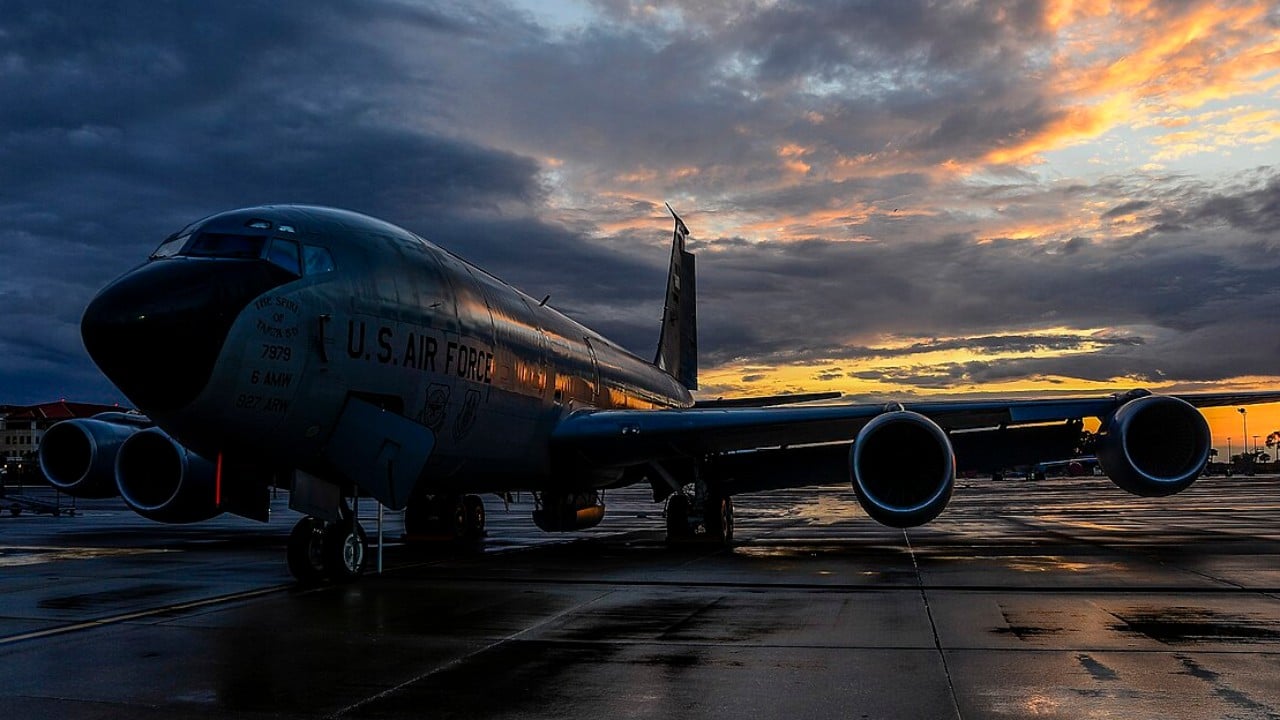
A US Air Force casualty assistance officer told the widow of a major killed in a KC-135 crash that certain combat-related benefits were not available to her family, because — in his words — the United States has not declared war.
That is not how any of it works. Combat pay entitlements do not depend on a congressional declaration of war, and never have.
The money, it turned out, had already been paid. It had simply been classified wrongly in the paperwork, so it looked as though it was missing. The Air Force established that within days, and the widow herself has since issued a statement making clear the family’s benefits were not broadly denied or withheld.
We are covering it for one reason only: the wrong thing she was told is a thing a lot of families believe, and it is worth correcting properly.
Quick Facts — What actually happened
The loss: Maj. John “Alex” Klinner, 33, killed 12 March 2026 when a KC-135 Stratotanker crashed over western Iraq. Six airmen died
His unit: Chief of Squadron Standardization and Evaluations, 99th Air Refueling Squadron, Birmingham, Alabama
The error: A casualty assistance officer said combat benefits were unavailable because war had not been declared
La realidad: Hostile Fire Pay, Imminent Danger Pay and the Combat Zone Tax Exclusion had already been paid, but were misclassified in the paperwork
Resolved: Air Force officials confirmed the position to the family on 31 August 2026
The correction: The widow stated on 3 September that the impression benefits had been denied or withheld “was not the case”
Story broke: 2 September 2026
The Rule That Was Got Wrong
This is the part worth knowing, because it applies to every serving family.
Hostile Fire Pay is $225 a month, payable when a member is killed, injured or wounded by hostile fire, a mine or other hostile action. Imminent Danger Pay is $7.50 per day of official duty in a designated area, capped at the same $225 a month. A member receives one or the other, not both. The Combat Zone Tax Exclusion removes certain pay from taxable income, and eligibility follows from entitlement to those pays.
None of it requires Congress to declare war. Entitlement flows from designated areas and from the circumstances of hostile fire. The last formal US declaration of war was in 1942; every entitlement since has been built to work without one, for the obvious reason.
Separately there is the Death Gratuity — a one-time, tax-free $100,000, normally paid within 72 hours. Then the longer-running benefits: SGLI life insurance of up to $500,000, monthly Dependency and Indemnity Compensation from the VA, and the Survivor Benefit Plan annuity. None of those were reported as affected in this case.
What She Actually Said
The widow, Libby Klinner, raised the issue publicly in late August. Her original post captured why it stung.
Department of the Air Force officials spoke with her on Monday 31 August and confirmed that all eligible combat theatre benefits had in fact been included in the pay she had already received, including Hostile Fire or Imminent Danger Pay and the Combat Zone Tax Exclusion. The problem was classification, not payment.
She issued a clarifying statement on 3 September saying so, and noting that the coverage had created an impression of benefits being broadly denied or withheld, which was not the case. She has since deleted her personal social media accounts.
Her sharpest line is the one that should survive all this.
That is the story. Not a scandal about withheld money — a casualty assistance officer, assigned to guide a family through the worst month of their lives, giving them a confidently wrong answer about the law.
The Air Force declined to say whether other families had encountered the same misunderstanding. We looked for evidence of a wider pattern and could not establish one. The most relevant government audit of casualty assistance programmes dates from 2006 and concerns programme oversight rather than benefit classification. Anyone telling you this is a documented systemic failure is going beyond the record.
The Wider Question It Sits Inside
The reason the phrase “we have not declared war” had any purchase at all is that there is a live argument about what to call the operation that killed him.
Vice President JD Vance, asked about the case at a White House briefing on 3 September, said the administration would reach out directly and that “we will certainly work that on the back end.” He declined to characterise the Iran operation as a war. The President has separately described it as a military conflict rather than a war and, at a press conference on 4 September, called it “a small thing” for the United States before acknowledging the eighteen American deaths.
Whatever it is called, the entitlements are unchanged. That is the point of writing them the way they are written.
Preguntas frecuentes
Were the widow’s benefits actually denied?
Do US combat pay benefits require a declaration of war?
What is Hostile Fire Pay and Imminent Danger Pay?
What other benefits do US military survivors receive?
What happened to the KC-135 in Iraq?
Is this part of a wider pattern of survivor benefit errors?
Sources: NOTUS; Military Times / Air Force Times; Military.com; Snopes; Department of the Air Force statements; US Department of Defense casualty identification release, 15 March 2026; Defense Finance and Accounting Service benefit definitions.
0 Comentarios