
A ramjet has no moving parts and no way of starting itself. It works by ramming air into a duct so fast that the compression alone is enough to burn fuel usefully, which means that at zero knots on a runway it is an expensively shaped tube of nothing. Something else has to get it moving first.
For seventy years that something has usually been a rocket booster, thrown away on every single test. On 9 September 2026, the Atlanta company Hermeus unveiled its answer to that bill: Ramjet-X, an expendable ramjet vehicle that is carried to Mach 3 under the wing of a reusable drone, dropped, and left to accelerate on its own while the mothership flies home to collect the next one.
If the shape looks familiar to anyone who has spent time reading about the Blackbird family, that is not a coincidence.
Datos rápidos
| Vehicle | Hermeus Ramjet-X, expendable ramjet-powered test aircraft |
| Desvelado | 9 September 2026 |
| Transportador | Hermeus Quarterhorse, a reusable high-speed uncrewed aircraft roughly the size of an F-16 |
| Release conditions | Around Mach 3, where the ramjet can begin operating |
| Target performance | Around Mach 4 and about 100,000 feet |
| Tamaño | Approximately 22 feet long and 7 feet wide, per Axios |
| Configuración | Delta wing with pronounced dihedral, no horizontal tail, vertical fin plus ventral fin |
| Carriage | Company imagery shows one Ramjet-X on a pylon under each wing, with six underwing hardpoints in total |
| Business model | “Flight Test as a Service” for outside customers |
| Government link | Selected by the Defense Innovation Unit under the HyCAT high-cadence airborne testing programme |
The problem Hermeus is actually solving
High-speed flight testing in the United States is not short of ideas. It is short of flights. Every experiment that needs a sustained Mach 4 environment has historically needed its own booster, its own range slot, its own mountain of paperwork, and its own budget line, and the hardware is consumed each time. The result is a field that advances in single-digit numbers of flights per decade.
Replacing the booster with an aeroplane changes the arithmetic in two ways at once. The expensive, reusable half of the system comes back and flies again, and the launch itself can happen inside an approved test range rather than requiring the range to be built around a launch site. Hermeus can, in principle, take off from an ordinary airport near a range, release inside the block, and land again.
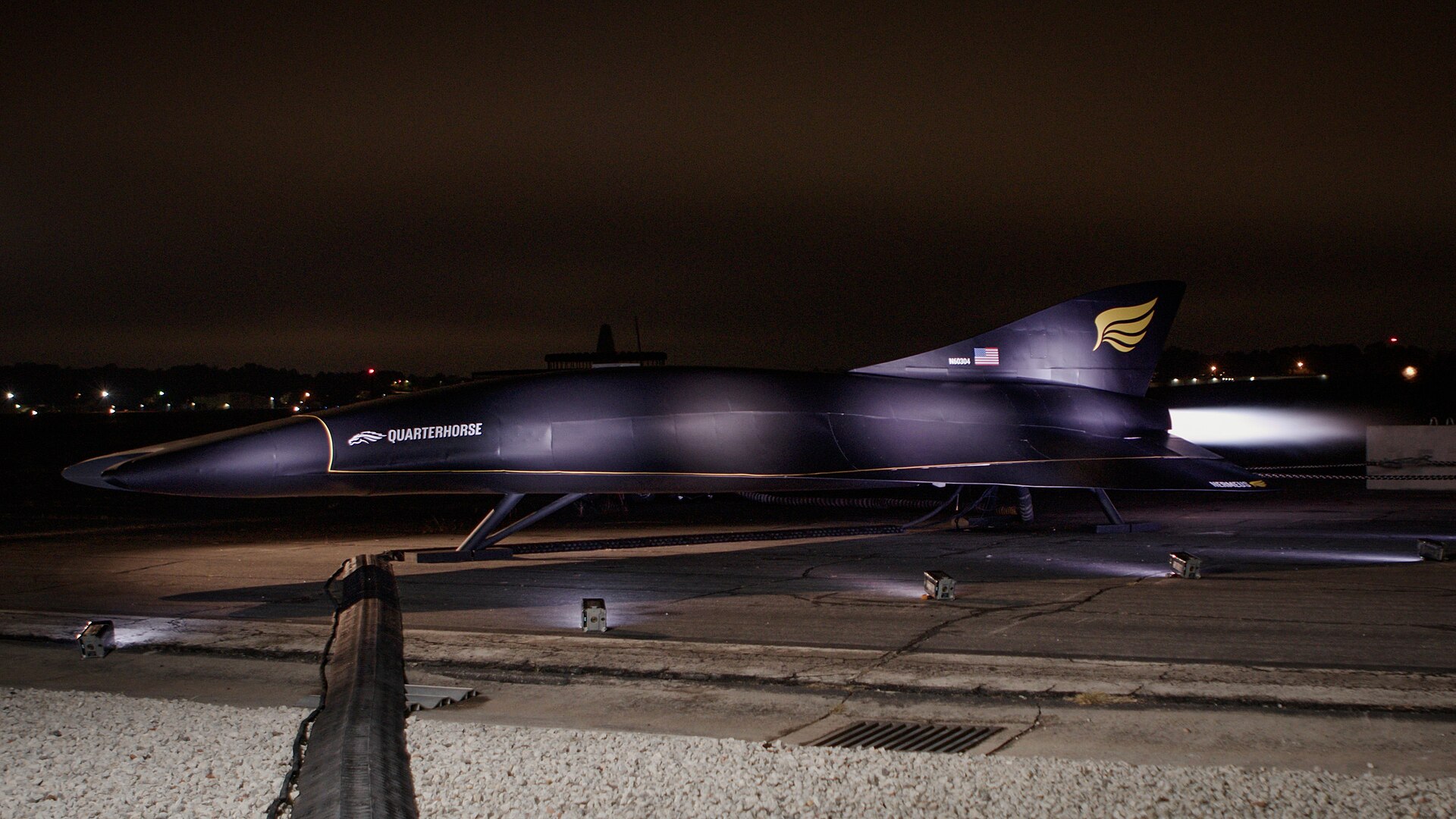
The imagery Hermeus released shows a Ramjet-X under each Quarterhorse wing, which implies two separate high-Mach experiments in a single sortie. It also shows six underwing hardpoints altogether. Hermeus has not said what the other four are for, and that silence is doing more marketing than any press release could.
A very familiar silhouette
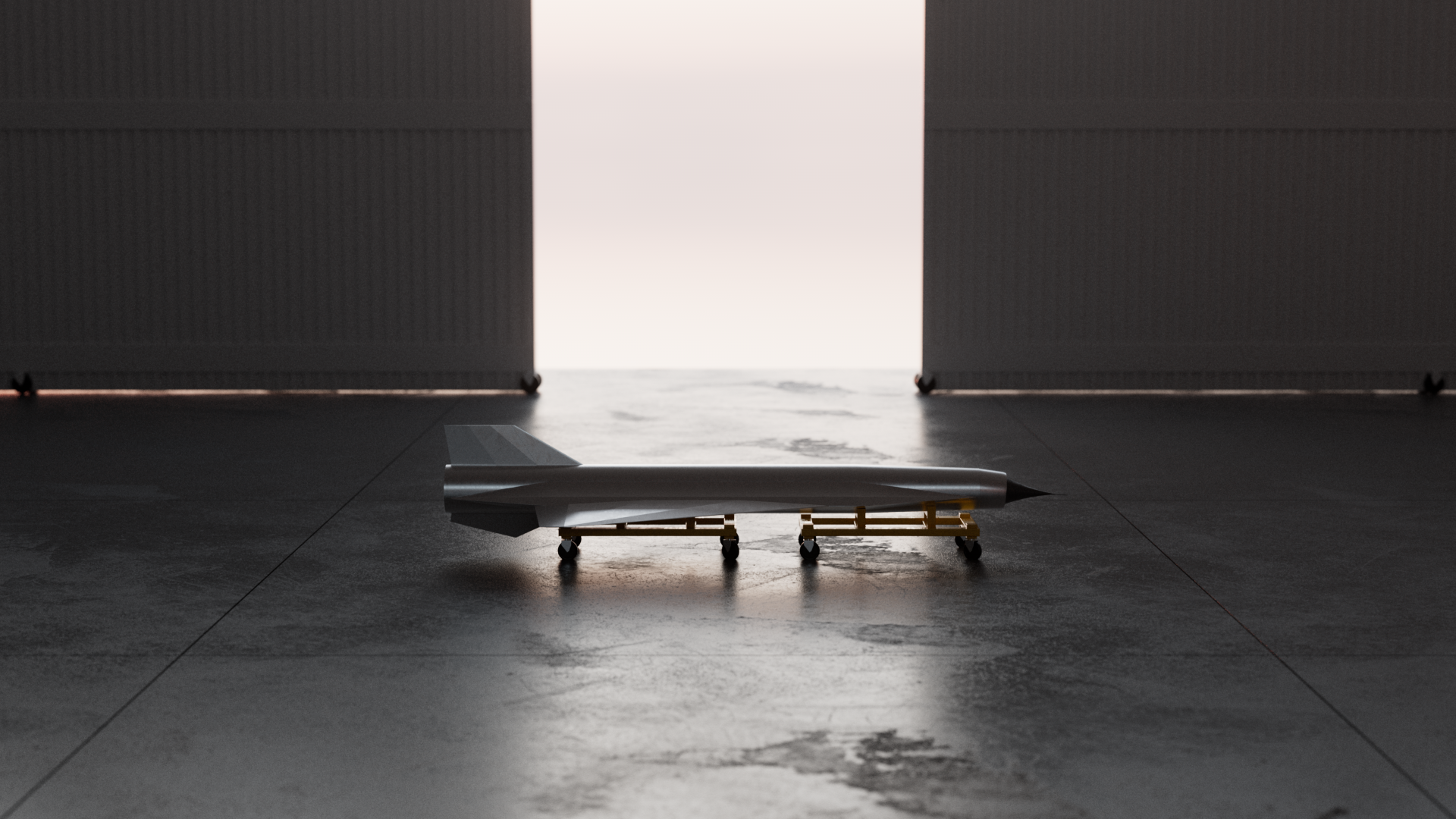
Ramjet-X is a compact, missile-like vehicle with delta wings carrying pronounced dihedral, no horizontal tail surfaces, a conventional fin and a ventral fin underneath. Ramjet propulsion, air launch from a fast mothership, an expendable airframe. Aviation historians will recognise all of that.
Lockheed's D-21 Tagboard did exactly this in the 1960s, launched from the back of an M-21 derivative of the A-12. The D-21 was a much larger animal, more than 40 feet long with a 20-foot wingspan against roughly 22 feet and 7 feet for Ramjet-X, and it was a reconnaissance drone rather than a test article. But the architecture is the same idea, sixty years apart, and it failed the first time partly because separating two vehicles at high Mach is genuinely difficult. Hermeus is proposing to do it under the wing rather than off the back, which avoids the specific way the D-21 programme went wrong.
What is not being said
Hermeus has released no range figure, no payload capacity, and crucially no cost per flight, which is the number the entire pitch depends on. It has also not said whether the Ramjet-X vehicles are recoverable, and the company describes them as expendable, which suggests not.
What it has described is the business model. Hermeus is calling it Flight Test as a Service: customers put payloads on the vehicle, including sensors, communications gear, computing and autonomy hardware, materials samples and propulsion experiments, and buy a trip to sustained Mach 4 the way you would buy a ride on a launch vehicle. The Defense Innovation Unit has already selected Hermeus for HyCAT, its programme for buying commercial high-speed flight testing, so there is at least one customer in the room.
Can Quarterhorse actually do this yet?
Not today. Quarterhorse Mk 2.1 reached Mach 1.21 on its third flight earlier this year, which made it, by Hermeus's account, the first privately developed uncrewed supersonic jet. That is a long way short of Mach 3.
The Ramjet-X release condition of roughly Mach 3 points at a later airframe. Hermeus confirmed over the summer that Quarterhorse Mk 2.2 and the Mach 3-capable Mk 2.3 are under construction, and the Quarterhorse in the Ramjet-X imagery has visibly different landing gear from the 2.1, including twin nosewheels. This is a concept for an aircraft that does not exist yet, carrying a vehicle that has not been built, and both halves are on the company's stated roadmap.
Hermeus's own footage of the Mk 2.1's first flight is below, for a sense of how far along the carrier half of the equation actually is.
The idea is sound and the physics are old. What Hermeus is betting is that the reason America stopped flying fast was never engineering. It was accounting.
Preguntas frecuentes
What is the Hermeus Ramjet-X?
Why does a ramjet need to be launched from another aircraft?
Has Ramjet-X flown?
How fast has the Hermeus Quarterhorse actually flown?
Is Ramjet-X the same idea as the Lockheed D-21?
What is “Flight Test as a Service”?
Sources: Hermeus; The War Zone; Axios; Defense Innovation Unit.
0 Comments