
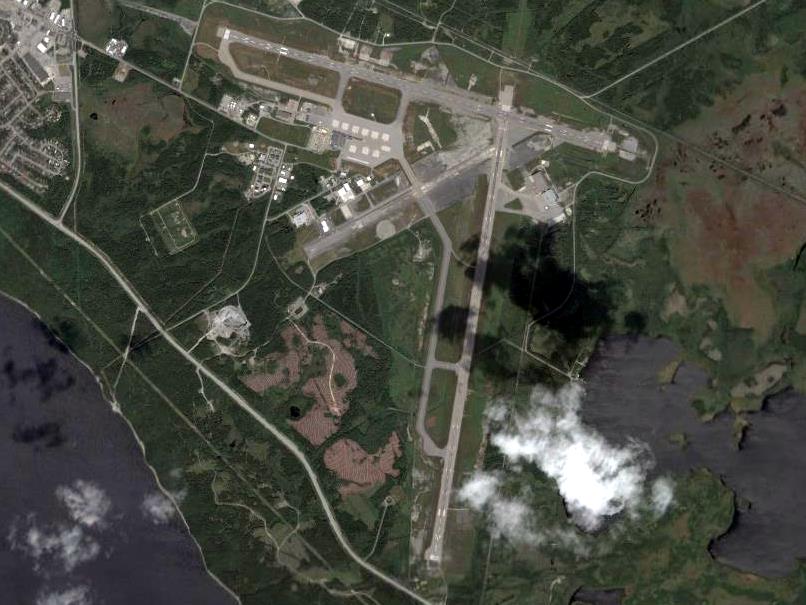
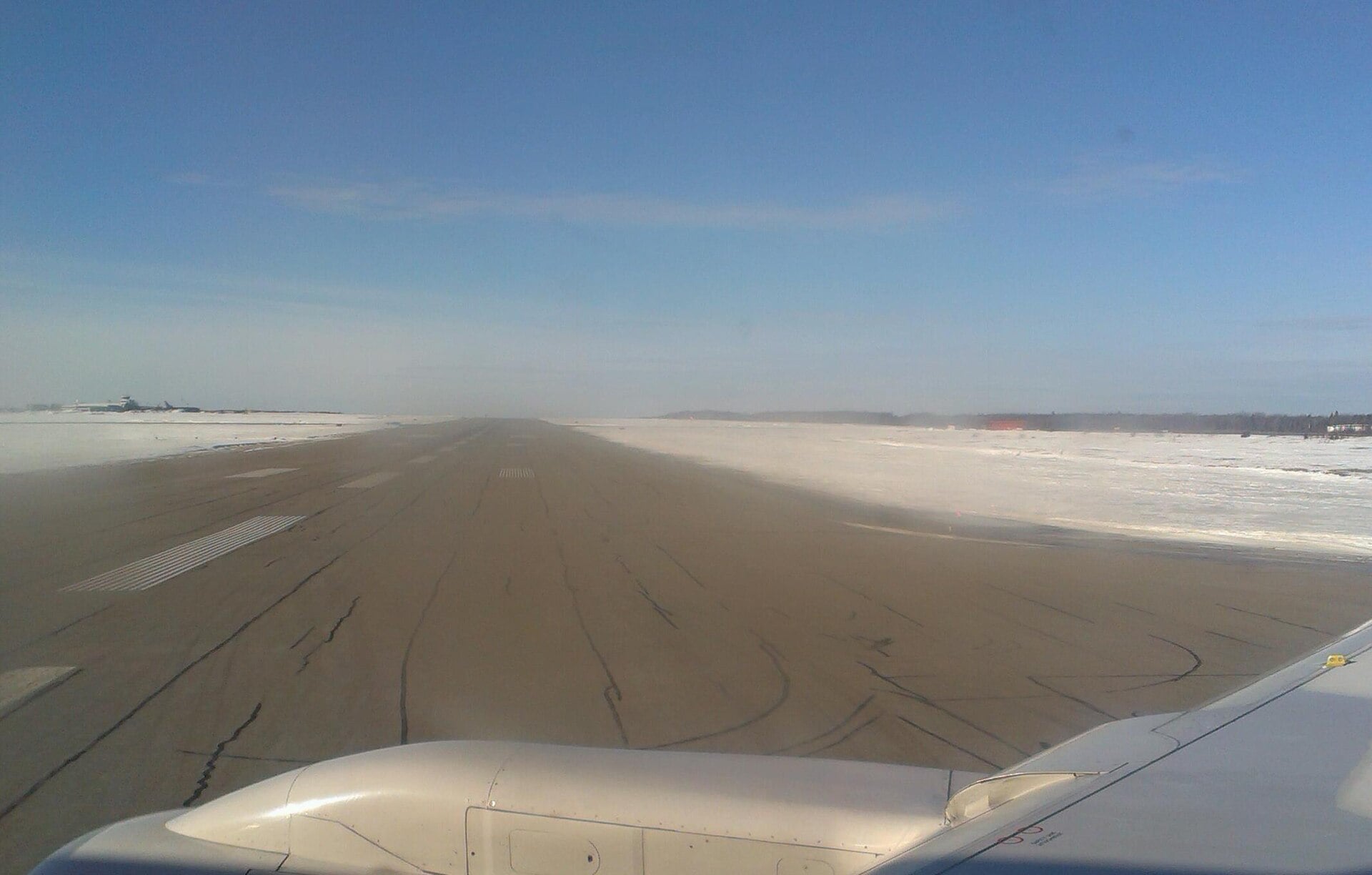
Gander sits in the middle of Newfoundland, in spruce and bog, a long way from anywhere. In 2001 fewer than ten thousand people lived there. Its airport had four runways built for a different era, when piston airliners needed to stop for fuel before crossing the Atlantic and Gander was the last piece of North America they saw.
By the middle of the morning of 11 September 2001, thirty-eight wide-body airliners were parked on those runways, wingtip to wingtip, and the population of the town had gone up by more than half.
Twenty-five years on, the aviation story of that day is usually told as four hijacked aircraft. There was a fifth story running at the same time, and it involved about five hundred aeroplanes that had done nothing wrong and suddenly had nowhere to go.
Datos rápidos
| Operación | Operation Yellow Ribbon, run by Transport Canada |
| Fecha | 11 September 2001 |
| Desencadenar | FAA National Operations Manager Ben Sliney ordered all US airspace closed at 09:45 Eastern, on his first day in the job |
| Aircraft diverted to Canada | Between 224 and 239 depending on the source; Nav Canada records 238 across 17 airports |
| Pasajeros | Transport Canada put the figure above 33,000; Prime Minister Jean Chrétien cited 30,000 to 45,000 |
| Gander | 38 aircraft, around 6,600 passengers and crew, in a town of fewer than 10,000 |
| Most aircraft | Halifax, 47 flights |
| Most passengers | Vancouver, 34 flights and about 8,500 people |
| First airport to receive diversions | CFB Goose Bay, seven aircraft |
| Canadian airspace | Closed to departures except police, military and humanitarian flights, for the first time ever |
The decision that sent them north
Ben Sliney had been the FAA's National Operations Manager for about two hours when he ordered every aircraft in United States airspace to land. It was the first invocation of SCATANA-style national grounding in the agency's history, and it created an immediate and enormous problem that nobody in the building had time to think about: roughly five hundred aircraft were already over the ocean, heading for a country that had just closed.
Transport Canada had activated its situation centre in Ottawa at 09:21 Eastern, eighteen minutes after the second aircraft hit the World Trade Center. Transport Minister David Collenette ordered Canadian airports closed to departures except for police, military and humanitarian flights, and opened to inbound US-bound international traffic. It was the first unplanned closure of Canadian airspace in history.
The rule Nav Canada applied was brutally simple and entirely aeronautical: any transoceanic flight that had passed its point of no return was to land at the nearest suitable Canadian airport. Aircraft began entering Canadian airspace at one to two per minute.
Transport Canada was also told to keep them away from Toronto, Montreal and Ottawa. Nobody knew yet how many hijacked aircraft there were, and the calculation was that if something aboard one of these aeroplanes was going to go wrong, it should go wrong somewhere with very few people underneath. Which is how a great many of them ended up in Newfoundland.
Most of the passengers had no idea
The detail that survives from every account is that the people on board were not told. Crews were instructed not to explain, because a cabin full of frightened passengers at 37,000 feet on a day when aircraft were being used as weapons was a risk in itself. Some of the flight crews did not know very much either.
One passenger on a Frankfurt to Dallas service that ended up at Toronto Pearson told The Washington Post that the captain had announced turbulence three hours before landing, then strong headwinds and a fuel stop in Canada. Only on the ground did he tell them there had been a terrorist attack.
Then they sat. The Royal Canadian Mounted Police had to sweep every aircraft before anybody could get off, and there were dozens of aircraft at some airports, lined up along closed runways. At Gander, some passengers waited most of a day on board before disembarking.
Two aircraft that were escorted by fighters
Not every diversion was calm. NORAD scrambled Canadian and American fighters to intercept and escort civilian airliners on at least two occasions that day.
Korean Air Flight 85, bound for New York with a stop at Anchorage, was believed to have been hijacked. Buildings were evacuated in Anchorage and in Whitehorse, Yukon, where the aircraft was directed. When it landed, witnesses reported that the RCMP ordered the crew off at gunpoint. The cause turned out to be a malfunctioning transponder and a translation error. A year later Prime Minister Jean Chrétien revealed he had authorised the fighters to shoot the airliner down if the pilots judged that it carried terrorists.
Separately, two US Air Force F-15s escorted an Air China Boeing 747 flying from Beijing to San Francisco onto the north runway at Vancouver. Airport officials said afterwards that this too was a communications problem.
What a town of ten thousand did next
Gander took roughly 6,600 people who had not planned to be there, could not leave, and in many cases had no luggage, no money and no idea when they would go home. There were not enough hotel rooms in the province, let alone the town.
So the schools and the church halls and the Legion and the community centres opened, and people drove out to the airport with food and blankets, and the pharmacists filled prescriptions written in other countries, and the bus drivers, who were on strike at the time, stopped striking and drove. This went on for the better part of four days, until American airspace reopened and the aircraft could go.
A year later, about 2,500 people gathered at Gander International Airport for Canada's memorial service. Chrétien told them that 11 September would live long in memory as a day of terror and grief, but that thanks to the acts of kindness done for stranded visitors in Gander and across Canada it would also live in memory as a day of comfort and of healing. He finished by telling the town it had done itself, and Canada, proud.

The story has since been told as a Broadway musical, a Canadian Screen Award-winning documentary, a Heritage Minute and a bestselling book. That is unusual for an air traffic control decision.
Why the numbers never quite agree
If you look up Operation Yellow Ribbon you will find different totals in different places, and it is worth understanding why rather than picking one and pretending it is settled. Transport Canada recorded more than 33,000 passengers on 224 flights. Nav Canada counted 239 flights, and its airport-by-airport table adds to 238. Chrétien spoke of 225 to 250 flights and 30,000 to 45,000 people.
They were counting on a day when nobody had time to count. Some aircraft were logged twice as they were re-routed between airports, some cargo and business flights were included by one agency and not another, and the passenger figures depend on whether crews are in the total. The honest answer is somewhere between 224 and 239 aircraft and somewhere north of 33,000 people.
It remains the largest emergency diversion of civil aircraft ever carried out. It was executed in a few hours by people improvising, and not one of the diverted aircraft turned out to be a threat.
Preguntas frecuentes
What was Operation Yellow Ribbon?
How many planes landed at Gander on 9/11?
Which Canadian airport took the most 9/11 diversions?
Why were planes sent to small airports instead of Toronto or Montreal?
Were passengers told what had happened?
Did fighter jets intercept airliners over Canada on 9/11?
Is Come From Away based on a true story?
Why does Gander have such large runways?
Sources: Transport Canada, 11-09-2001 Four Days in September; Nav Canada; The Washington Post; CBC; Global TV; AOPA; Historica Canada.
0 Comments