
In the summer of 1976 a sound arrived on the shortwave bands that nobody had asked for. It was a hard, flat tapping, roughly ten beats a second, and it walked. One week it sat on top of an amateur band, the next it was parked across an aeronautical channel used by airliners crossing the Atlantic. Radio operators from Florida to Finland heard the same thing, and the nickname settled within days: the Russian Woodpecker.
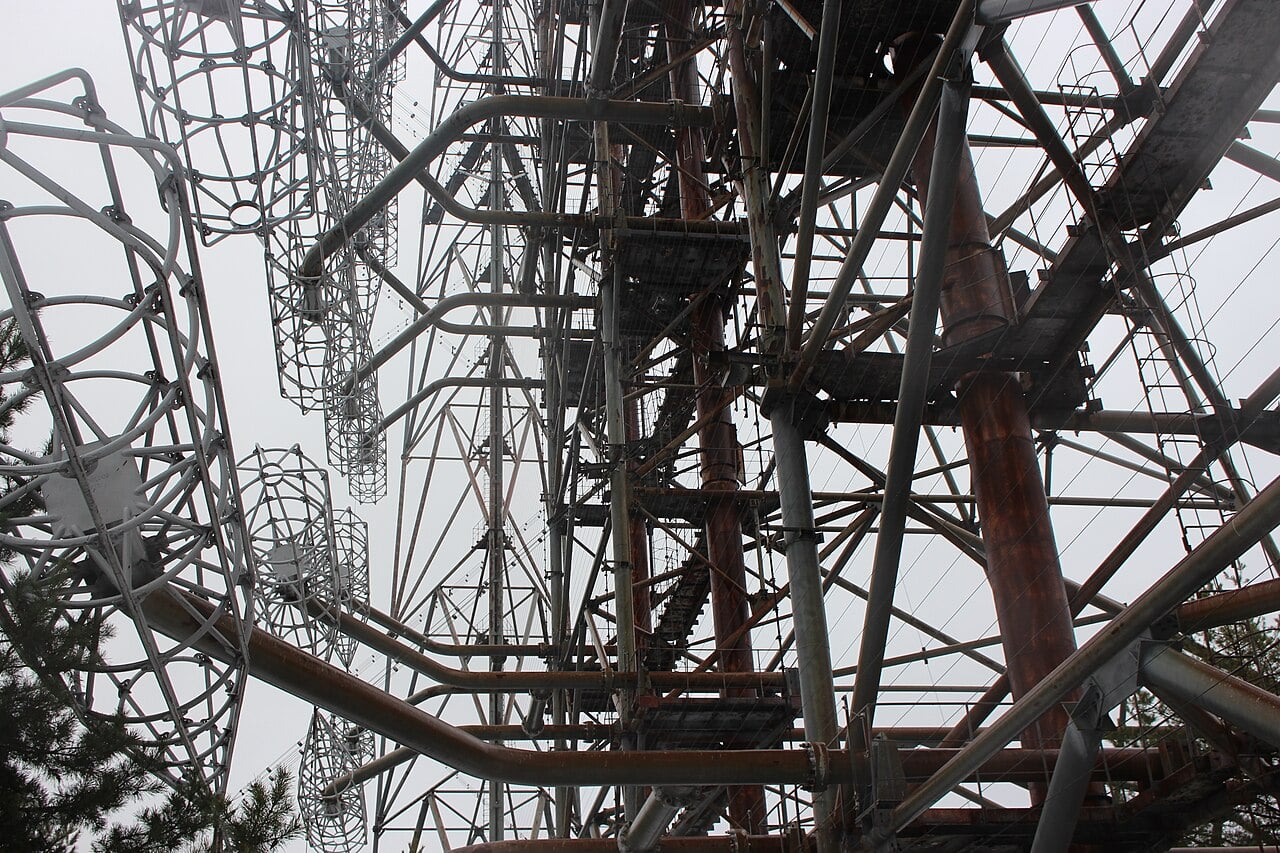
What they were hearing was the far end of an enormous machine standing in a pine forest 12 kilometres from a Soviet nuclear power station that nobody outside the USSR had any reason to think about yet. The antenna was a wall of steel lattice the height of a 40-storey building. Its job was to see missiles launch on the other side of the planet, around the curve of the Earth, by bouncing radio energy off the ionosphere.
The West was building the same thing at the same time, on a shingle spit on the Suffolk coast. Both projects were enormous. Both were technically brilliant. Both failed, in completely different ways, and both are still standing.
Datos rápidos
Duga (5N32), Chernobyl-2, Ukrainian SSR
Role: over-the-horizon backscatter radar for ballistic-missile early warning
Site: receiving array only. The transmitters stood about 60 km away near Liubech
Antennas: two curtains, the low-band one on masts of roughly 135 to 150 m, the high-band one up to about 100 m
Signal: about 10 pulses per second, 7 to 19 MHz in a 1988 FCC study
Heard worldwide: 1976 until 1989
Fate: stopped on 26 April 1986, the day of the Chernobyl accident. Never passed its state acceptance tests
Cobra Mist (AN/FPS-95), Orford Ness, Suffolk
Role: over-the-horizon radar to watch air and missile activity in the USSR and Eastern Europe
Antenna: 18 log-periodic strings, each about 2,200 ft (670 m), fanned at 7 degrees across a 119-degree sector
Power: 10 MW peak specified, about 3.5 MW ever achieved
Cost: between 100 and 150 million dollars, by the programme's own estimate
Operational: January 1973. Terminated 30 June 1973
Cause of failure: a noise nobody has ever identified
The Signal That Walked Across the Bands
Over-the-horizon radar works because the ionosphere is a mirror. Ordinary radar is stuck with line of sight, which is why an aircraft low enough is simply below the beam. Our companion piece on the radar horizon explains why that geometry is unforgiving. Bounce a high-frequency signal off the underside of the ionosphere instead and it comes down again a thousand miles away, well beyond the curve. The catch is that you need enormous power, an enormous antenna, and a layer of charged gas whose behaviour changes with the hour, the season and the sun.
Duga chose the brute-force answer. Observers logged its pulse repetition rate at about 10 Hz, with rarer runs at 16 and 20 Hz, pulses built from a 31-bit pseudo-random sequence, and transmissions typically lasting around seven minutes. A 1988 FCC study put its frequency range at 7 to 19 MHz, although operators around the world logged it far more widely than that as it hunted for whichever band the ionosphere happened to be favouring.
That is the whole problem in one sentence. A radar that has to chase the usable frequency will sooner or later park itself on somebody else's.
The signal itself, recorded off the air. This is what several million radio operators spent thirteen years trying to filter out.
The nickname has a claimant. In July 1982 the Miami Herald ran a piece on radio amateurs fighting the interference, and quoted a Miami Springs operator, Andy Clark, callsign W4IYT, who at the time was running a commercial aeronautical communications station.
Clark also told the paper the signal was raising hell with the airplanes, and that there were aircraft his station simply could not contact. That is not a trivial complaint about a hobby band. Long-haul aircraft over the ocean depended on HF voice, and a 10 Hz hammer landing on the frequency is not something a crew can talk over.
Receiver manufacturers started shipping noise blankers marketed specifically against it. Amateurs formed the Russian Woodpecker Hunting Club and transmitted synchronised Morse at the same pulse rate, on the theory — put bluntly by Wayne Green, publisher of the magazine 73, in the same Herald piece — that returning a signal on the radar's own frequency would bury its echoes. The Soviet side never publicly admitted the transmitter was theirs.
Chernobyl-2 Was the Ear, Not the Mouth
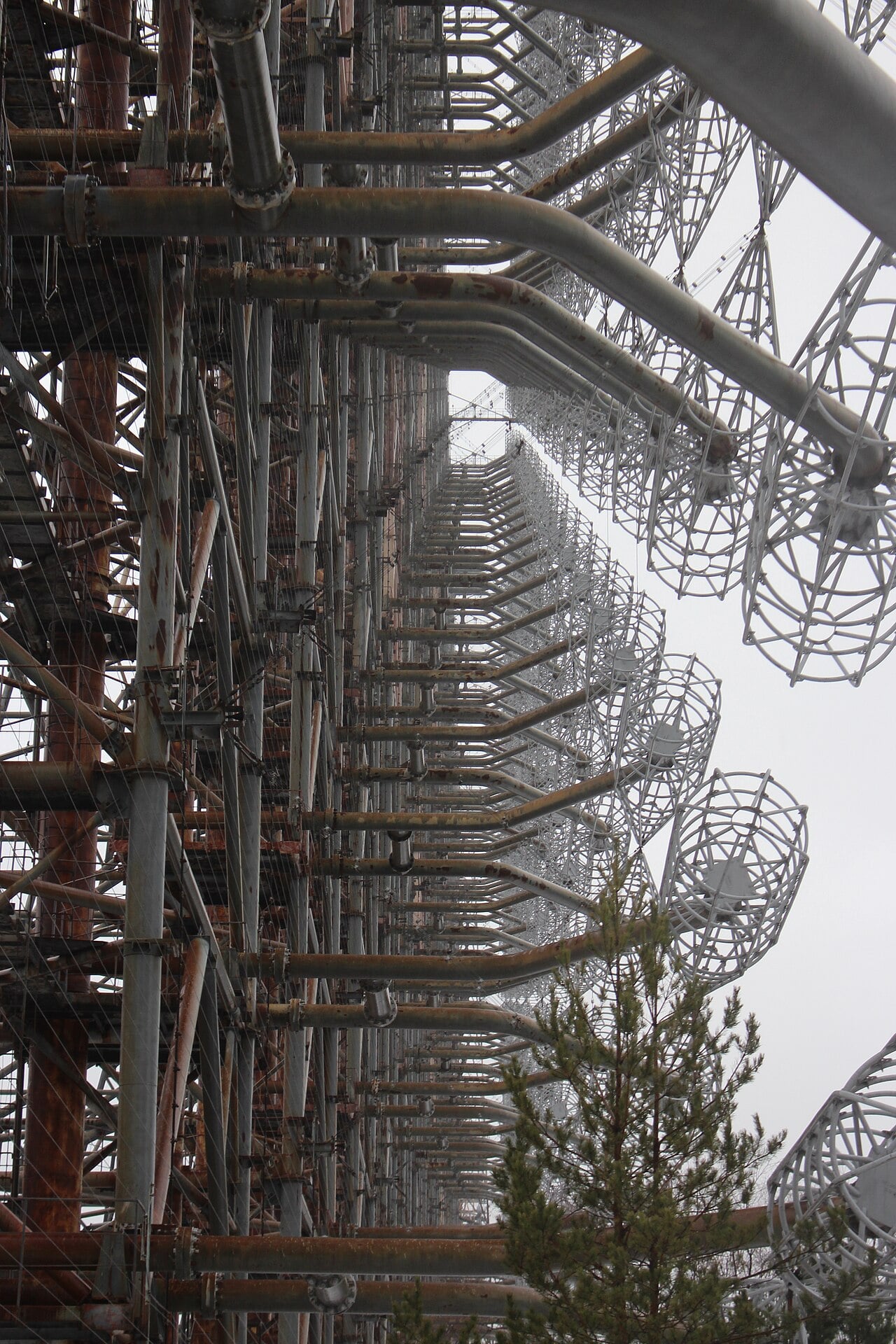
Here is the fact that almost every retelling gets wrong. The photogenic wall of steel at Chernobyl-2, the one in every photograph, never transmitted anything. It was the receiving array. The transmitters sat about 60 kilometres away at a separate closed site near Liubech, in the Chernihiv region, which is also abandoned and which nobody photographs.
Chernobyl-2 itself was a garrison of roughly 1,500 people, and on Soviet maps it was labelled as a children's summer camp. The two receiving curtains are usually quoted as a single structure 150 m high and 700 m long. In fact there are two: a low-band array on masts of about 135 to 150 m and some 300 to 500 m long, and a shorter high-band array roughly 250 m long and up to about 100 m high. Stand in front of them and the 700 m figure makes sense as the combined frontage, which is probably where it came from.
The Soviet designation was 5N32, part of a system the Russian sources call Duga, meaning arc. Western intelligence knew it as Steel Yard, also rendered Steel Work or Steel Works depending on which handbook you read. The name Duga-3, which appears everywhere in amateur-radio literature and on YouTube, does not appear in the Russian-language material at all: the Chernobyl node was radar node No. 1, Duga-1, and the second was at Komsomolsk-on-Amur.
It Never Passed Its State Tests
For all the noise it made, Duga did not do the job it was built for. The physics defeated it. Detecting a missile launch by the disturbance its exhaust plume makes in the ionosphere requires you to model the ionosphere, and in the 1970s nobody could.
The admissions are on the record in Russian accounts of the programme. A May 1982 resolution of the CPSU Central Committee and Council of Ministers acknowledged that the effort had solved a string of hard problems — unique antennas, powerful transmitters, sensitive receivers, large computing systems — and then stated the outcome plainly.
The same material is specific about why. The behaviour of the stations depended on the state of the propagation path and on processes in the ionosphere which had not been sufficiently studied, making it impossible to calculate the real attenuation of the signals or to build a reliable detection model — with the worst limitations on the polar paths, which is exactly where an American missile would come from.
The numbers tell the same story. Early tests of the experimental array near Nikolaev suggested the probability of detecting a single missile launch from US territory would be very low. The Komsomolsk node went on trial duty in 1981 with what the accounts describe as a large number of false alarms, and was accepted for combat duty on 30 June 1982 only for mass and group launch detection, not single launches. After modernisation, single-launch detection probability at 6,000 km is given as improving from 0.5 to 0.7 up to 0.9 to 0.92 — an improvement, but one that arrived years late and only at the eastern node.
The institutional verdict was blunter. The director of the responsible institute, V. I. Markov, is recorded as concluding that nothing more could be squeezed out of the two stations and that developing them further was useless work. The chief designer of the original experimental system, Franz Alexandrovich Kuzminsky, had already been removed as institute director by ministerial order in August 1981.
Megaprojects walks through the Duga programme, the site and the interference it caused.
The Chernobyl Theory, and Why It Is Backwards
Because the array stands 12 km from the ruined reactor, a theory has grown up that the explosion of 26 April 1986 was arranged to bury the radar's failure. It is the thesis of the 2015 documentary The Russian Woodpecker, in which the Ukrainian artist Fedor Alexandrovich argues that a senior Soviet communications official ordered the plant destroyed. It is a genuinely gripping film. It is not a sourced account.
The mundane version fits the evidence better, and it runs the other way. The Chernobyl node had already failed. It had not passed its state tests after the 1985 to 1986 modernisation, and it was due to be presented for state testing again in November 1986. The accident cancelled that. Duga-1 stopped on 26 April 1986 and by the end of that year almost all of its new equipment had been shipped east to Komsomolsk. The disaster did not cover for the radar. It killed it.
Two smaller claims attached to the theory also deserve a flag. The often-repeated figure that Duga cost twice as much as the power station, and the round seven-billion-dollar number, have no documentary basis we could find; even outlets that repeat them label them as speculation. And the story that Phil Donahue, shown the array on the horizon after the disaster, was told it was an unfinished hotel is repeated as legend by the outlets that carry it, not as reporting.
Britain Got the Other One, Because Turkey Said No
While Duga was going up, the US Air Force was building its own over-the-horizon radar to look the other way, into the Soviet Union and Eastern Europe. It very nearly went to Turkey. The declassified programme history is unusually candid about it: the radar was to be located in Turkey, a hiatus developed when the site was not made available, and after a search and some negotiation the British offered a site in Suffolk near the town of Orford.
That is how the largest radar the United States ever built in Britain came to sit on a shingle spit best known for secret weapons trials. The contract went to RCA at the end of 1966, construction started in mid-1967, and the design leaned heavily on the Naval Research Laboratory's earlier Madre radar on Chesapeake Bay. In the United Kingdom the mere fact that the installation was a radar was classified Secret.
The antenna was a fan. Eighteen log-periodic strings radiated from a central hub like spokes, each about 2,200 ft long, separated by 7 degrees and so occupying a 119-degree sector, all of it sitting over a wire-mesh ground screen. The original procurement specification had called for 1,800 ft strings at the same spacing; UK heritage records give 2,040 ft; the programme's own account says 2,200 ft as built. Of 119 degrees of physical array, the radar actually used 91 degrees of azimuth coverage, from 19.5 to 110.5 degrees clockwise from true north, in thirteen beam positions.
It was also less powerful than the legend. The design called for 10 MW peak and 600 kW average. In practice about 3.5 MW peak was achieved. The 10 MW figure that circulates is the specification, not the machine.
The Noise
Cobra Mist went operational in January 1973, six months behind its target date, and was shut down on 30 June 1973. Five months. In between, a Scientific Assessment Committee ran experiments from January to May and reported in May. Then the programme was terminated abruptly, the equipment was dismantled and removed, and hundreds of people and somewhere between 100 and 150 million dollars went home.
The reason was a noise. Not interference in the ordinary sense, and not a fault anyone could find. The radar needed to see aircraft returns buried under ground clutter, which means it needed what the trade calls subclutter visibility: the design goal was 80 to 90 dB, itself well beyond the roughly 60 dB achieved by anything before it. What it got was 60 to 70 dB, because a noise with an almost flat Doppler spectrum sat in every range bin that contained ground clutter — which is to say, in every range bin that mattered.
The declassified account of the investigation, written up by four MITRE engineers in 1979 and declassified in 1993, is one of the more remarkable engineering documents of the Cold War. It opens with an epigraph from The Tempest. Its abstract ends like this.
What makes the report worth reading is the elimination. The equipment was tested exhaustively and exonerated: RCA's hardware was judged of high quality and almost certainly not the source. The ionosphere was ruled out by a Land/Sea experiment comparing adjacent beams pointed over the Black Sea against beams pointed over land, whose results imply the cause was not in the transmission medium; an independent Naval Research Laboratory analysis agreed that the ionosphere could not contaminate a spectrum to the level seen. Auroral modulation was tested and rejected, because the noise turned up on northerly beams whether or not there was an aurora. A separate NRL report advanced meteor echoes. And the noise was not an isolated phenomenon: it appeared at all times of day, in all seasons, in all beams, at all frequencies, in both polarisations.
Which leaves the possibility the report declines to dismiss. The radar existed to watch the Soviet bloc, a function the authors note could have been deeply resented, and they set out the case for a jamming technique not easily recognised as jamming, noting a precedent for it. Their conclusion is careful and, read fifty years later, slightly chilling: the technique is quite feasible, it is not clear that the experiments conducted would have discovered it, and the experiments that would have confirmed or denied the possibility were not conducted.
There is one more line in that report that reframes the whole story. During the 1973 tests, members of the assessment committee visited another over-the-horizon radar site and brought back records that clearly showed the same kind of clutter-related noise. Whatever it was, Orford Ness was not the only place it lived — which raises the possibility the authors themselves float, that natural effects of some kind simply cap subclutter visibility in HF over-the-horizon radar at around 60 to 70 dB.
Duga and Cobra Mist, Side by Side
| Duga (5N32), Chernobyl-2 | Cobra Mist (AN/FPS-95), Orford Ness | |
|---|---|---|
| Operador | Soviet air defence forces | US Air Force, on a British site |
| Looking for | Missile launches from US territory | Aircraft and missile activity in the USSR and Eastern Europe |
| Construido | From 1972, first switch-on given as 1980 | Contract late 1966, construction from mid-1967 |
| Antenna | Two curtains, masts to about 150 m | 18 strings of about 2,200 ft in a 119-degree fan |
| Frecuencia | 7 to 19 MHz per a 1988 FCC study | 6 to 40 MHz |
| Peak power | Western estimates range from 2 to 40 MW. No reliable figure | 10 MW specified, about 3.5 MW achieved |
| Working life | Signal audible worldwide 1976 to 1989. Node stopped April 1986 | Operational January 1973 to 30 June 1973 |
| Why it ended | Failed its state acceptance tests. The reactor accident finished the site | An unexplained noise that capped its detection performance |
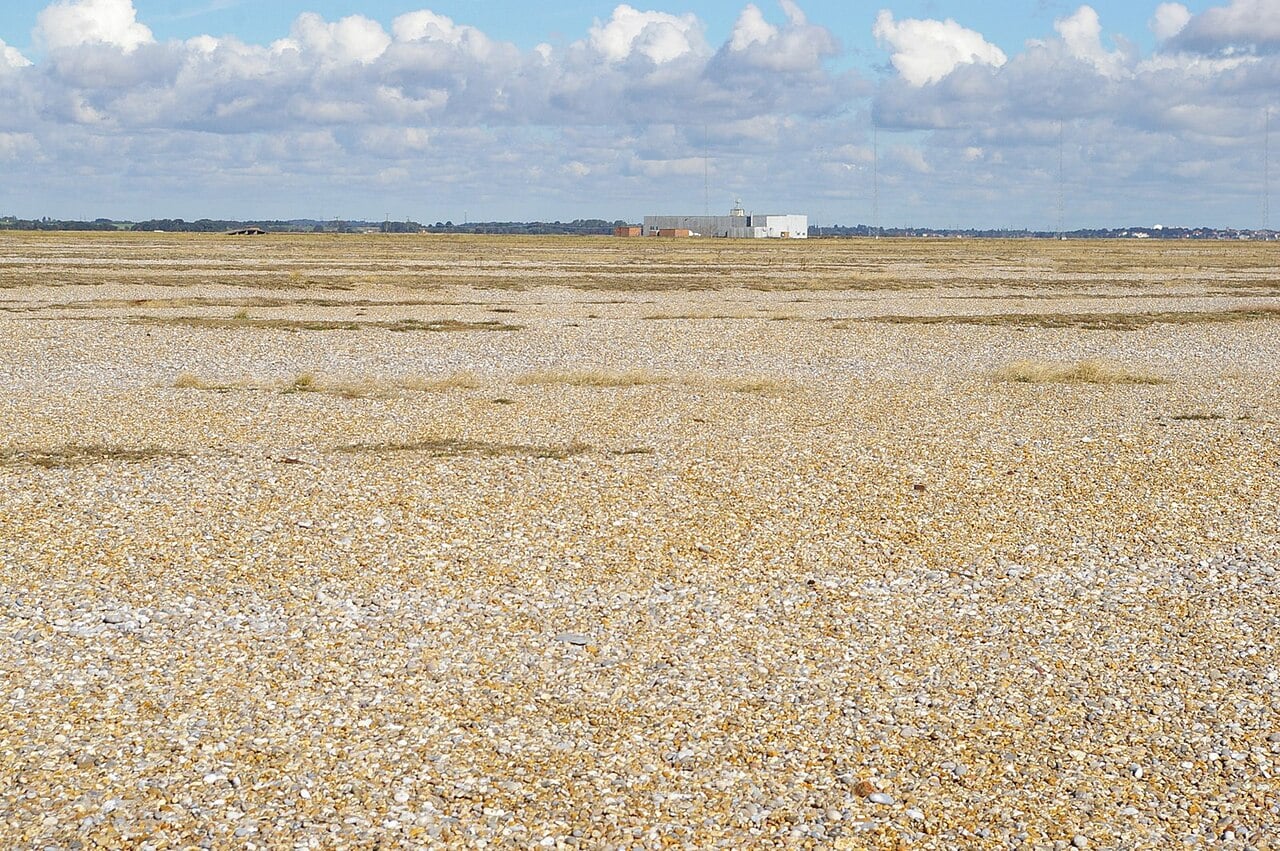
| Still there? | Yes, inside the Chernobyl Exclusion Zone, stripped of equipment | Building yes, antenna no. The site is a National Trust nature reserve |
Figures as sourced in the text. Where sources disagree the range is given rather than a single number.
Two Ruins
Duga-1 is the only one of the three Soviet arrays still standing, and it stands inside the Chernobyl Exclusion Zone, listed by Ukraine as a monument of national significance. Guided visits were allowed from 2013. Access passes were suspended in April 2022 for the duration of martial law and the zone has remained closed to tourists since. Russian forces held the area for about six weeks in early 2022. Much of the radar's technology had already been stripped out long before that.
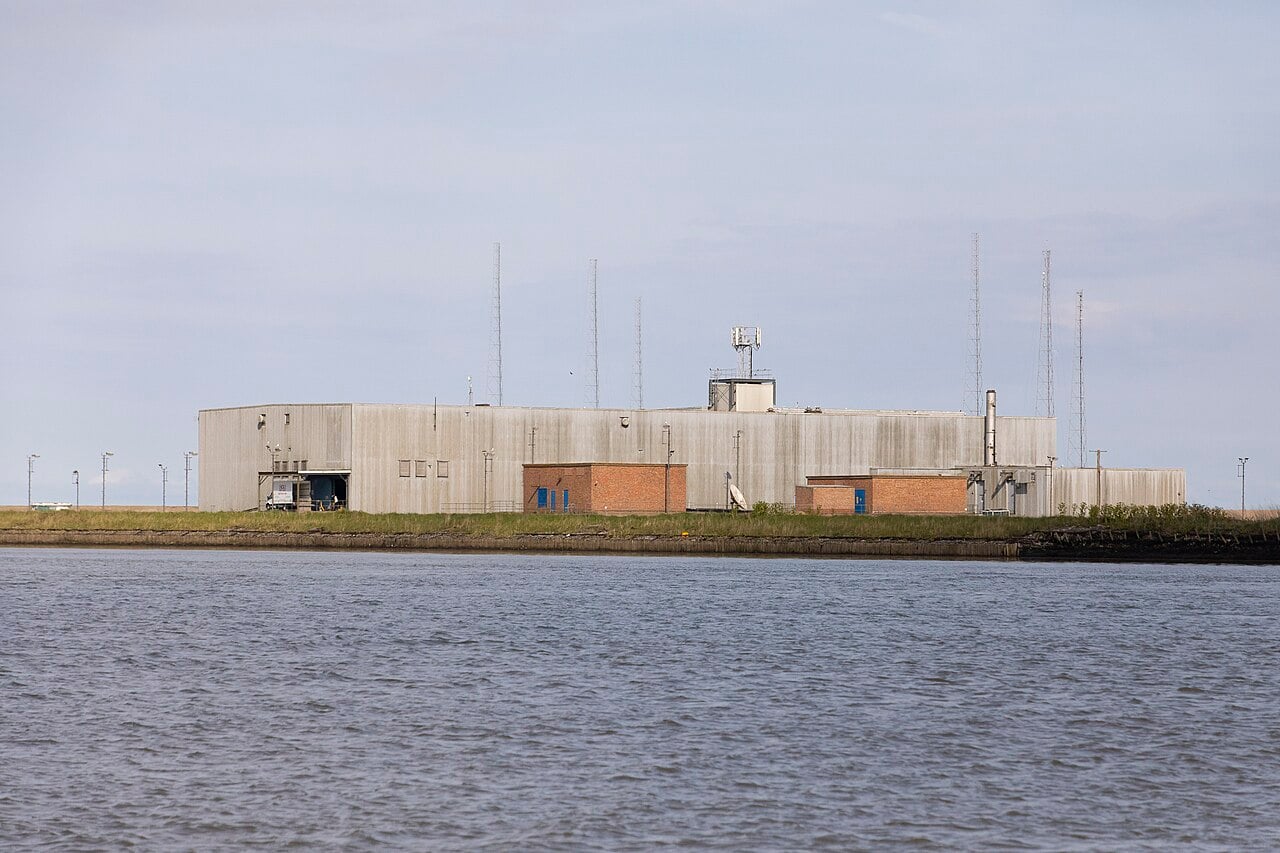
Orford Ness went the other way. The Cobra Mist antenna came down, the building was handed on to the BBC World Service as the Orfordness transmitting station, and the spit is now a National Trust nature reserve where visitors walk past the concrete pagodas of the old weapons-testing establishment. The building is still there, grey and windowless, on a shingle bank in Suffolk.
A walk around Orford Ness and what is left of the Cobra Mist installation.
The tidy moral would be that over-the-horizon radar was a dead end. It was not: modern systems like Australia's Jindalee network work, and work well, on a far better understanding of the ionosphere and vastly more processing. What both of these machines ran into was the gap between building something enormous and understanding the medium it had to work through. The Soviets could not model the ionosphere well enough to trust a launch warning. The Americans could not find the noise.
One of those problems got solved. The other one, fifty-three years later, is still sitting in a declassified report with no answer at the bottom of it.
Sources: Fowle, Key, Millar and Sear, The Enigma of the AN/FPS-95 OTH Radar, MITRE Corporation 1979, declassified 1993; Utley, Headrick, Rohlfs and Hoffmeyer, NRL Report 7655, December 1973; Hugh Griffiths, The History Column: COBRA MIST, IEEE Aerospace and Electronic Systems Magazine; GlobalSecurity.org 5N32 Duga Steel Yard, translating Pervov and Karpenko; Miami Herald, 7 July 1982; Suffolk Historic Environment Record monument ORF 177; National Trust, History of Orford Ness; ARRL; FCC study of 1988 as reported.



0 Comments