
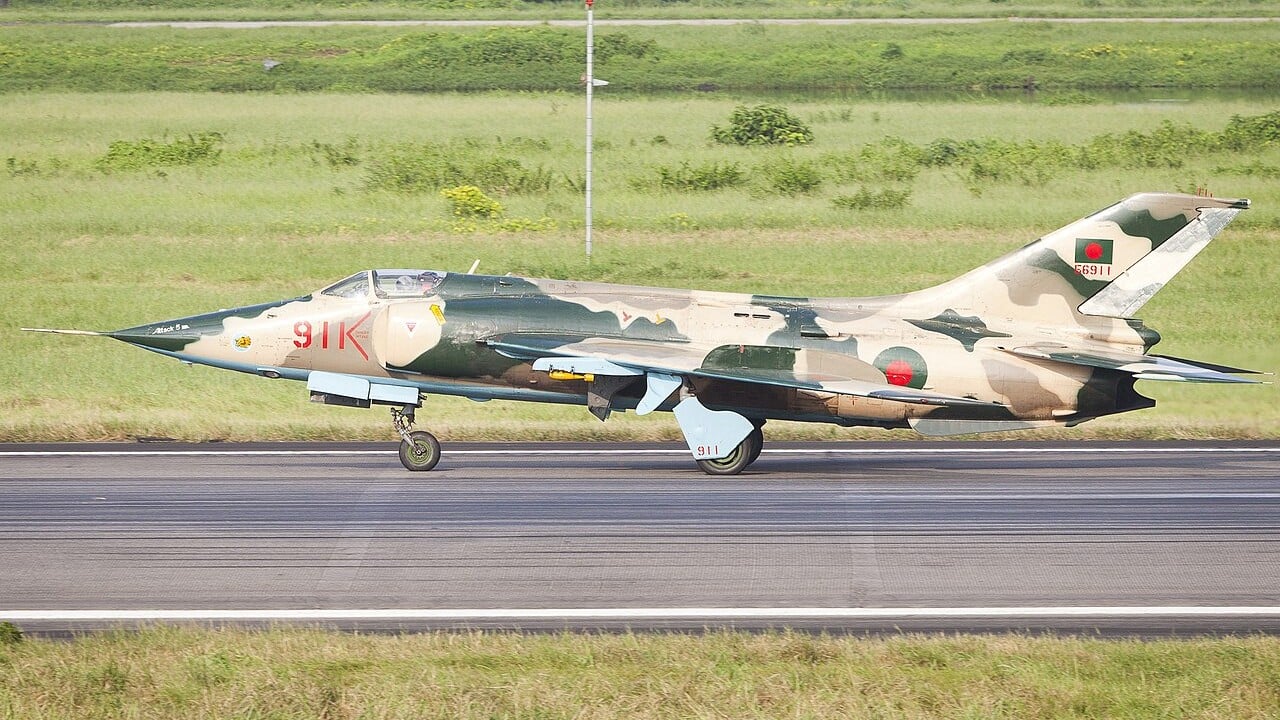
On 30 December 1971, a Chinese pilot named Yang Guoxiang lined up over the Lop Nur test site in north-west China, pressed the release, and waited for a live nuclear bomb to fall away from his small, single-seat attack jet.
Yang tried every release system he had. None worked. With fuel running down, he flew home and landed with the weapon still under his aircraft. A week later, on 7 January 1972, he tried again, and this time the bomb fell. The aircraft he flew was the Nanchang Q-5, a supersonic attack jet that China had built out of the bones of the MiG-19.
Datos rápidos
- Tipo: Single-seat, twin-engined supersonic ground-attack jet
- Origen: Derived from the Shenyang J-6, China’s licence-built MiG-19
- Chief designer: Lu Xiaopeng
- Primer vuelo: 1965; deliveries from 1970
- Motores: Two Wopen-6 turbojets (licence-built Tumansky RD-9)
- Unusual feature: Internal weapons bay about 4 m long
- función nuclear: A Q-5 dropped a live nuclear bomb at Lop Nur on 7 January 1972
- Construido: Estimates range from about 1,000 to some 1,300
- Export (A-5): Pakistan, Bangladesh, Myanmar, Sudan; North Korea reportedly the first customer
A MiG-19 with a bomb bay
China was an enthusiastic user of the MiG-19, building it under licence as the Shenyang J-6 from 1958. That same year, the People’s Liberation Army asked for a jet attack aircraft for close air support, and the job of designing it went to Lu Xiaopeng, who would later also design the J-12 lightweight fighter.
The designation was Qiangjiji-5, attack aircraft number five. It kept the J-6’s two Wopen-6 turbojets, licence-built Tumansky RD-9s, but little else looked the same. The fuselage was longer and area-ruled to cut transonic drag. The intakes moved from the nose to the fuselage sides, freeing the nose for a target radar that was never actually fitted. The wings were larger and less swept.
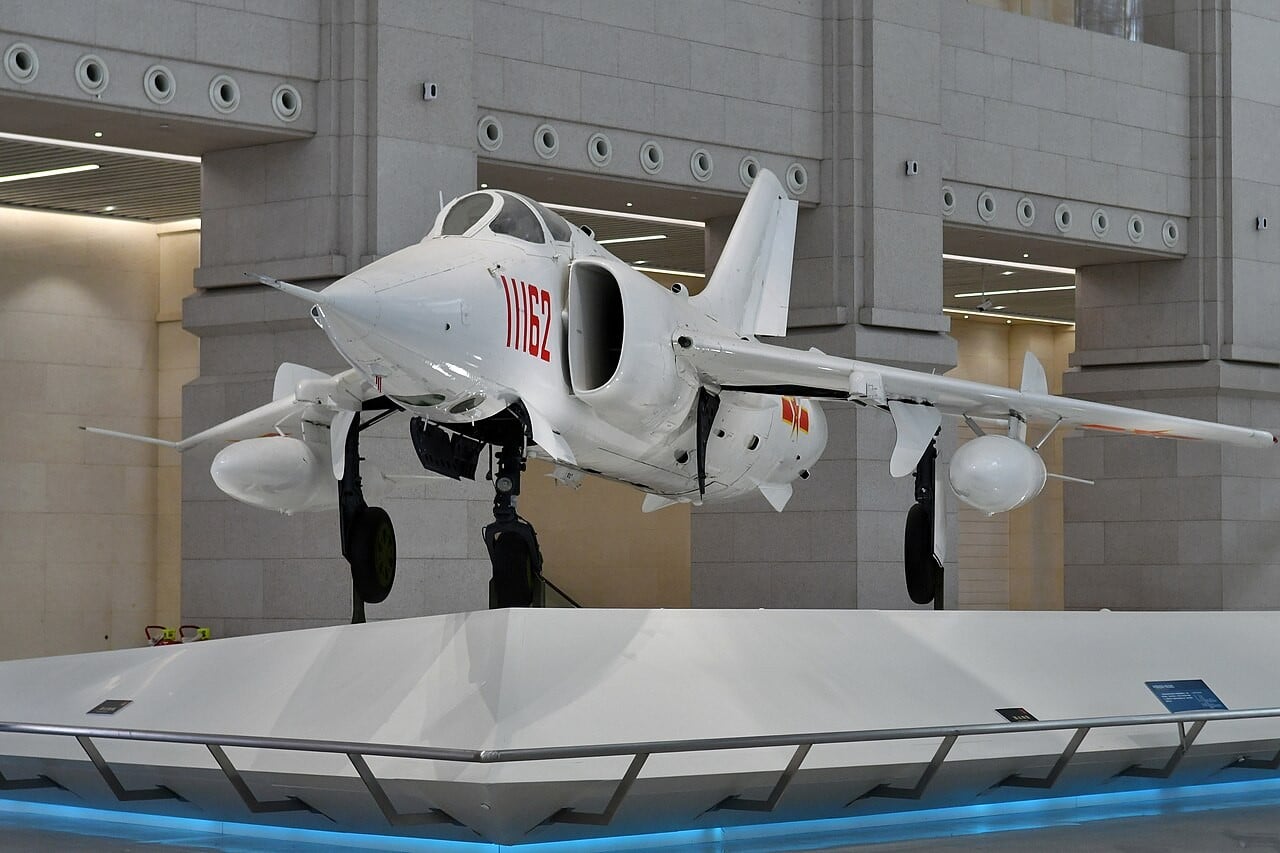
Most unusually for a fighter-sized jet, the Q-5 had an internal weapons bay about 4 metres long. It could carry up to 1,000 kg of bombs inside and the same again on external pylons. The redesign cost some speed at altitude, but at low level, where an attack jet earns its living, the Q-5 was about as fast as the J-6 it came from.
Cancelled, rescued, and finally built
Production drawings were ready in 1960, but China’s political upheavals caught up with the programme and it was cancelled in 1961. A small team kept the project alive until work restarted at Nanchang. The first Q-5 finally flew in 1965, series production was approved at the end of 1969, and deliveries to units began in 1970.
Estimates of how many were built vary, from about 1,000 to some 1,300. Either way, the Q-5 became the People’s Liberation Army Air Force’s standard ground-attack jet for a generation. Later versions such as the Q-5I traded the bomb bay for extra fuel and added underwing pylons, and late upgrades brought laser rangefinders, head-up displays and the ability to drop laser-guided bombs.
Archive footage of PLAAF Nanchang Q-5 attack jets in service.
China’s tactical nuclear jet
The Q-5’s most secret job was nuclear. After the bloody Sino-Soviet border clashes of 1969, the PLAAF wanted an aircraft fast and agile enough to deliver a small nuclear bomb against a Soviet armoured invasion, something its big, slow bombers could not do. A small number of Q-5s were modified to carry such a weapon.
That is the mission Yang Guoxiang flew. After the failed release on 30 December 1971, Lop Nur’s staff were evacuated while he brought the armed jet home. He later described the landing to Smithsonian Air & Space magazine with remarkable calm.
On 7 January 1972, despite snow on the airfield, the bomb released cleanly. Yang called it an H-bomb; its yield has been estimated at up to about 20 kilotons. China’s tactical nuclear programme for the Q-5 was later halted.
Fantans for friends
NATO called the aircraft “Fantan”. For export it became the A-5, and it went to several of China’s closest partners. The Korean People’s Army Air Force is reported to have been the first export customer in the 1970s, although details of its fleet remain murky and some sources dispute it.
The best-documented export was the A-5C, a version fitted with Western equipment on customers’ requests, including Martin-Baker ejection seats and the ability to carry Western weapons such as AIM-9 Sidewinder missiles and Durandal runway-cratering bombs. The Fuerza Aérea de Pakistán began receiving A-5Cs in 1983 and flew them until April 2011, when its last A-5 unit, No. 16 Squadron “Black Panthers”, converted to the JF-17 Thunder.
Archive footage of Pakistan Air Force A-5C Fantans, which served from 1983 until 2011.
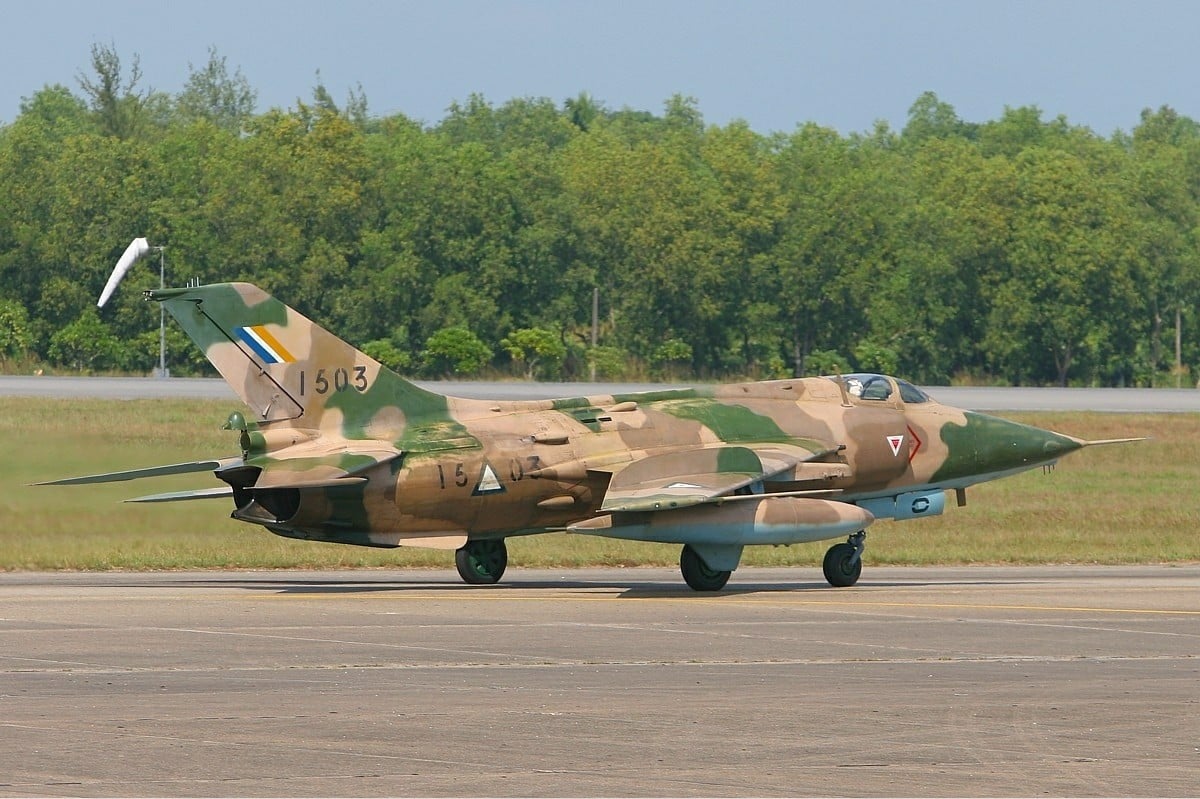
El Bangladesh Air Force also flew around 20 A-5Cs, and the Myanmar Air Force took delivery of about two dozen in the late 1990s. In the 2000s the type went to the Sudanese Air Force, which deployed A-5Cs to Darfur in 2007. Myanmar and Sudan are still reported to fly them.
The end of the line
In China, the Q-5 was gradually replaced by the Xian JH-7 through the 2010s, and the last PLAAF examples are generally reported to have been retired around 2017. Production had officially ended in 2012, more than half a century after Lu Xiaopeng’s team first sketched an attack jet around a MiG-19.
It was never a sophisticated aircraft. Its navigation and weapon-aiming systems lagged far behind Western types, and plans to modernise it with Italian and French avionics collapsed after 1989. But for a country building its first home-grown combat jet, the Q-5 was a remarkable piece of improvisation: a fighter turned into a bomber, a bomber with a nuclear role, and an export that outlived most of the MiG-19s it was born from.
Sources: Smithsonian Air & Space (interview with Yang Guoxiang by Bob Bergin), MILAVIA, Air Forces Monthly (via MILAVIA)
Header photo: Faisal Akram / Wikimedia Commons, CC BY-SA 2.0
0 Comments