
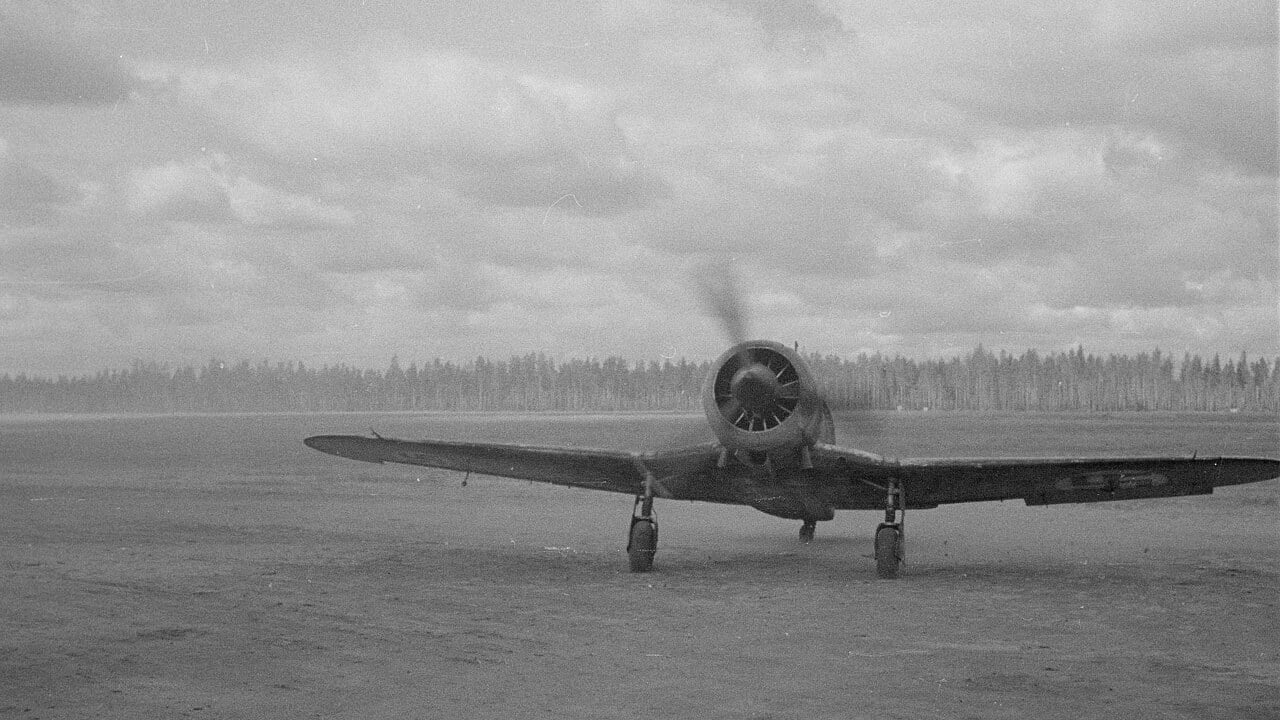
In the winter of 1940, Finnish fighter pilots were taking off from a frozen lake. Their aircraft had been designed in Turin for the Mediterranean, shipped in pieces across a continent at war, and assembled in the snow. It had an open cockpit, two machine guns and an engine that hated the cold. It was the Fiat G.50 Freccia, and in Finnish hands it became an ace-maker.
At home, the Fiat G.50 has a modest reputation: a pioneer that was overtaken almost as soon as it entered service. In Finland it became something else. Its story runs from the end of the Spanish Civil War, through a fruitless autumn on the Channel coast, to the forests around Lake Ladoga.
Datos rápidos
- Tipo: Single-seat, single-engine monoplane fighter
- Diseñador: Giuseppe Gabrielli, Fiat
- Primer vuelo: 26 February 1937, Caselle (Turin)
- Motor: Fiat A.74 RC 38 14-cylinder radial, about 840-870 hp
- Armamento: Two 12.7 mm Breda-SAFAT machine guns, 150 rounds each
- Construido: Around 780, including G.50 bis and two-seat G.50B
- Combatir: Spain (arrived January 1939, too late to fight), Belgium 1940-41, Greece, North Africa, Sicily
- Finland: 33 delivered to LeLv 26; roughly 88 to 99 victories credited, about three lost to enemy action
Italy’s first modern fighter
The G.50 was the work of Giuseppe Gabrielli, a young engineer at Fiat, rather than Celestino Rosatelli, who had designed most of Fiat’s earlier military aircraft. Gabrielli started in April 1935, and the prototype first flew on 26 February 1937 at Caselle, near Turin.
Everything about it was new for Italy. It was a low-wing monoplane of all-metal construction, with only the control surfaces covered in fabric. It had inward-retracting main wheels, flaps and a constant-speed propeller. The Fiat A.74 RC 38 fourteen-cylinder radial gave it roughly 840 to 870 horsepower, depending on the rating quoted, and a top speed of around 470 km/h.
The armament was the weak point: two 12.7 mm Breda-SAFAT machine guns firing through the propeller, with 150 rounds each. Pilots raised on open-cockpit biplanes also disliked the sliding canopy, which was hard to open quickly and tended to collect exhaust fumes. Only the first batch had it; most G.50s were built with a semi-open cockpit.
The rival Macchi C.200 used the same engine and was faster, but it was behind the G.50 in development. Fiat had already tooled up, and the Air Ministry did not want to lose months of production. Both went into service, and production of the G.50 family eventually reached around 780 aircraft.
Aircraft Files tells the story of the Fiat G.50 Freccia, from Gabrielli’s design to its war service.
Spain and the Channel coast
The first twelve production G.50s were sent to Spain with an experimental fighter group, the Gruppo Sperimentale da Caccia. They arrived in January 1939, almost at the end of the civil war, and the fighting stopped before they could prove much. The survivors were handed to the Spanish air force.
By June 1940, when Italy entered the Second World War, the Regia Aeronautica had 118 G.50s, 97 of them with operational units. In the autumn, Mussolini sent an air corps to Belgium to share in the Luftwaffe’s campaign against Britain. The Corpo Aereo Italiano included the Fiat CR.42 biplanes we covered in our CR.42 Falco story, and the G.50s of 20° Gruppo.
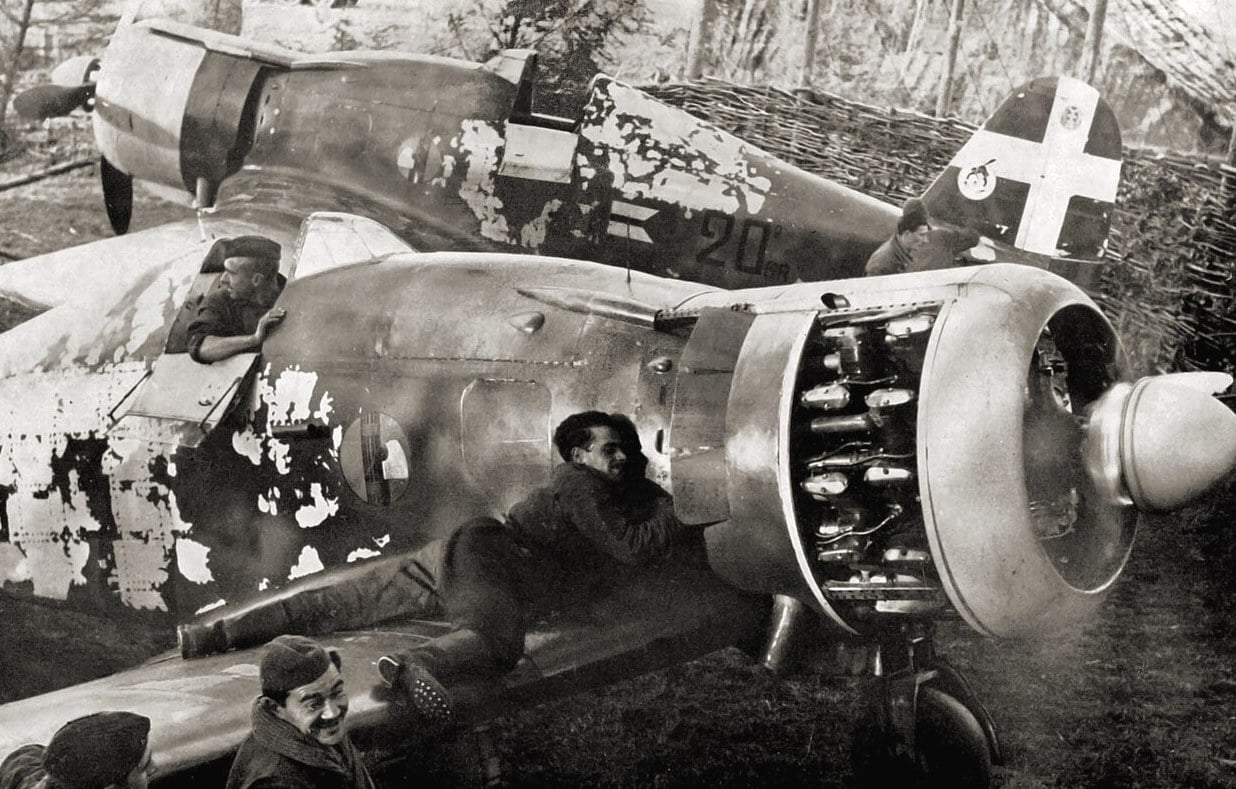
It was a poor fit. The early G.50s had open cockpits, an endurance of about an hour, unreliable radios and no armour until the Germans supplied a seat plate. Patrols chased Hurricanes y Blenheims that simply out-ran them or vanished into cloud.
The G.50s went on to Albania, Greece and North Africa, where the longer-range G.50 bis fought Hurricanes and P-40s with mixed results. By the end of 1941 the Macchis had largely replaced them in the front line, and the Freccia slipped into secondary roles and ground attack, including against the Allied landings on Sicily in 1943.
Fighters on the ice
Finland ordered 35 G.50s in late 1939, after the Soviet Union attacked. Getting them there was a saga: Germany, then still tied to Moscow by the Molotov-Ribbentrop Pact, obstructed the transit, so the aircraft were dismantled and sent north largely by sea. Two crashed during the ferry flights to Finland, and 33 reached the front.
They went to Lentolaivue 26, which had been flying Gloster Gladiators. The first G.50s were not ready until February 1940, weeks before the Winter War ended on 13 March. With their base at Utti under Soviet bombing, the Fiats moved onto the ice of nearby Haukkajärvi. Accounts credit them with between eight and 11 victories in those few weeks, for the loss of one aircraft.
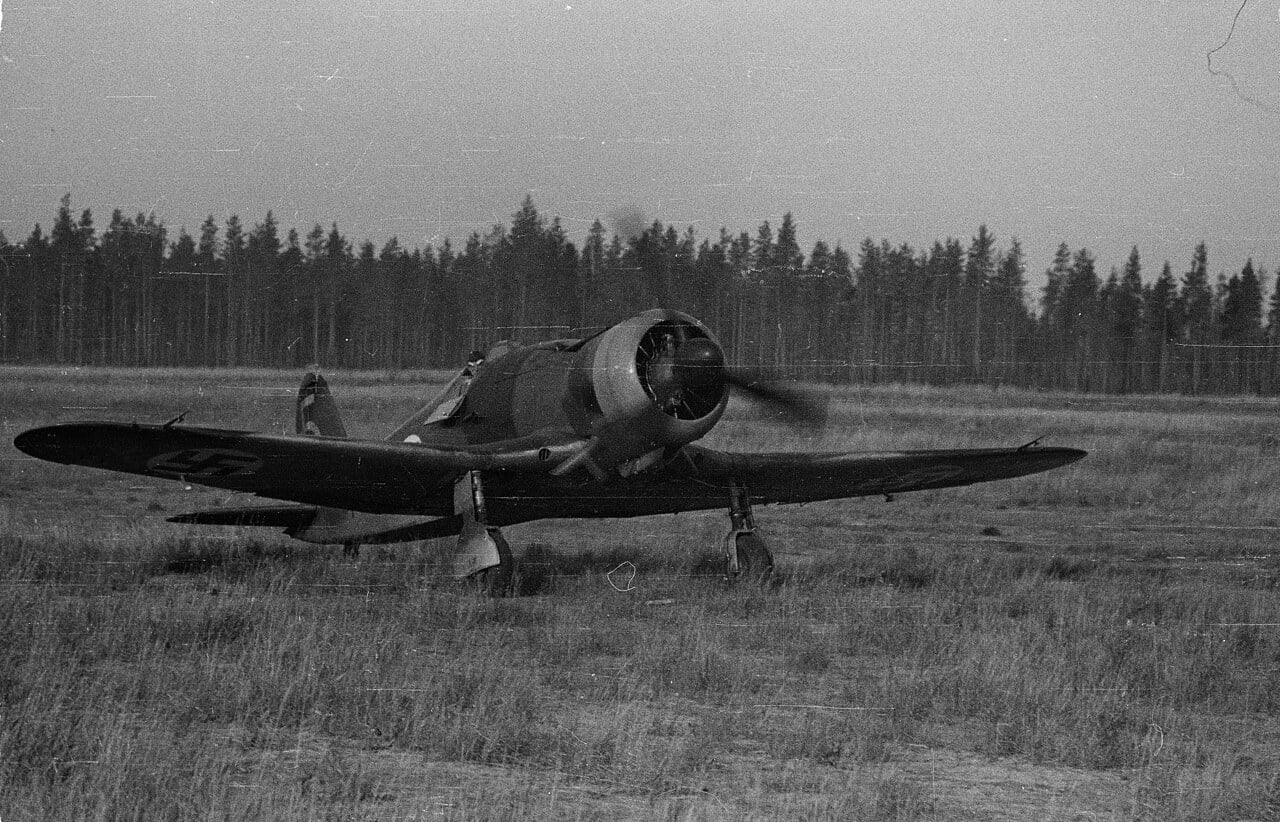
The Finns made the Italian fighter their own. They fitted Swedish propeller spinners because the pitch mechanism froze, tried skis and an enclosed cockpit, and repainted the aircraft as Italian paint peeled. According to some accounts, Finnish pilots still preferred the Hurricane, the MS.406 y el Brewster Buffalo.
The Continuation War
When fighting resumed in June 1941, LeLv 26 was defending the area around Lake Ladoga. On 25 June, the first day of Soviet air raids on Finland, its Fiats caught a formation of Soviet bombers; accounts credit them with between ten and 13 shot down without loss. Oiva Tuominen, who ended the war with 23 victories, claimed several that day.
That was the high point. Newer Soviet fighters arrived in 1942 and 1943, while the Fiats wore out and spare parts ran short. The tallies differ by source: one credits LeLv 26’s G.50s with about 88 victories, another with 99. They agree that only around three G.50s were lost to enemy action. The frequently quoted ratio of 33 to 1 comes from the higher count.
A documentary history of the Fiat G.50, Italy’s “arrow”, including its service with Finland.
The G.50s were withdrawn from front-line service in 1944 and finished their lives as trainers. Today the Italian prototype that started it all is remembered mostly as the ancestor of better fighters: Gabrielli went on to design the Fiat G.55 Centauro and, after the war, the Fiat G.91.
But for a small air force fighting for its life, the Freccia’s faults mattered less than its availability. Finland needed fighters in 1940 that the great powers would sell it, and the G.50 was one of them. On the ice of Haukkajärvi and over Ladoga, it delivered.
Sources: History of War (historyofwar.org, Fiat G.50 Freccia), Plane Encyclopedia (Fiat G.50 in Finnish Service), Finnish Wartime Photograph Archive (SA-kuva)
Header photo: A. Viitasalo, Finnish Wartime Photograph Archive (SA-kuva) / Wikimedia Commons, public domain
0 Comments