

On the afternoon of Sunday 22 August 1909, the crowds on the Bétheny plain outside Reims saw something no one had ever seen before: seven aeroplanes in the air at the same time. Six years after the Wright brothers’ first hops at Kitty Hawk, flying was still a curiosity measured in minutes and metres. Over the next eight days in Champagne, it became a sport, a spectacle and, above all, a fact.
The Grande Semaine d’Aviation de la Champagne was the world’s first international public flying meeting. Almost every important aviator of the day turned up, records fell almost daily, and an American motorcycle builder named Glenn Curtiss beat Europe’s most famous pilot in the first race for the Gordon Bennett Trophy.
Datos rápidos
- Evento: Grande Semaine d’Aviation de la Champagne, the first international public flying meeting
- Fechas: 22 to 29 August 1909
- Place: Bétheny plain, about 5 km north of Reims, France
- Aeronave: 38 entered, 23 flew; 87 flights of more than 5 km
- Crowd: An estimated 300,000 to 500,000 over the week
- Gordon Bennett Trophy: Glenn Curtiss, 28 August, 20 km in 15 min 50.4 s
- Distance prize: Henri Farman, 180 km in a Farman III
- Altitude prize: Hubert Latham, 155 m in an Antoinette
A champagne-funded aerodrome
The meeting was paid for by the great champagne houses of the region, including Moët et Chandon and Mumm, and organised by a committee led by the Marquis de Polignac. Timing helped. Louis Blériot had flown across the English Channel only a month earlier, and public excitement about aviation was running high.
The organisers turned farmland about five kilometres north of Reims into a temporary aerodrome and a small town. There was a huge grandstand, a row of hangars, a 600-seat restaurant, a post office, telegraph offices and even a railway station on the Laon-Reims line. The flying took place over a rectangular 10-kilometre course marked by four pylons, with unharvested crops and haystacks waiting for anyone who came down early.

The scale was unprecedented. Thirty-eight aircraft were entered and 23 actually flew, representing nine different types, and between them they made 87 flights of more than five kilometres. Estimates of the crowd over the week run from 300,000 to half a million. The President of France, Armand Fallières, came on the Tuesday, and among the British visitors was the Chancellor of the Exchequer, David Lloyd George.
Farman flies into the record books
The richest prize was the Grand Prix de la Champagne et de la Ville de Reims, a distance competition worth 50,000 francs to the winner. The world distance record was broken three times in three days. The winner was Henri Farman, who flew 180 kilometres in his Farman III biplane in a little over three hours, and only stopped because the day’s competition closed at half past seven in the evening.

Farman had a secret weapon. Shortly before the flight he had swapped his unreliable Vivinus engine for a new Gnome Omega rotary, built by the Seguin brothers. Hubert Latham and the Antoinette designer Léon Levavasseur protested that the rules forbade changes to the aircraft, but the swap had been officially approved and the protest failed. Reims was the Gnome’s public debut, and the light, reliable rotary would go on to power a generation of aircraft.
The crowd adored him. The correspondent of the London Times reported that on landing Farman was “seized upon by the enthusiastic crowd and carried in triumph to the buffet, where a scene of almost delirious excitement was witnessed.” He also won the passenger prize, as the only pilot to carry two passengers, and left Reims as the meeting’s biggest money winner.
A curator at the Smithsonian National Air and Space Museum explains why the 1909 Reims aviation meeting mattered so much.
Curtiss against Blériot
The event everyone wanted to see was the Coupe Internationale d’Aviation, the Gordon Bennett Trophy, sponsored by the New York Herald publisher James Gordon Bennett. It was a time trial over two laps of the 10-kilometre course, with up to three entrants per nation. France picked Blériot, Latham and Eugène Lefebvre, who flew a French-built Wright biplane. Britain had the Scot George Cockburn on a Farman. America had only Glenn Curtiss.
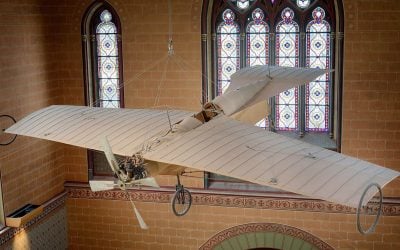
Curtiss had built a new machine for the purpose, a stripped-down biplane with a new 50-horsepower eight-cylinder engine, later known as the Reims Racer. Blériot’s special monoplane had an 80-horsepower eight-cylinder engine. Worried about the attrition on the field, where crashes had left a dozen or more aircraft damaged during the week, Curtiss kept his only aeroplane out of most other events.

On Saturday 28 August, Curtiss flew first. He set a lap record, then went for the trophy and completed the two laps in 15 minutes 50.4 seconds, an average of about 75 km/h. Cockburn could not finish a lap, Lefebvre managed 20 minutes 47.6 seconds and Latham 16 minutes 32 seconds. Blériot flew last. His first lap matched Curtiss’s faster lap, but a squall slowed him on the second, and he finished in 15 minutes 56.1 seconds, less than six seconds behind.
Archival footage of Glenn Curtiss at the Grande Semaine d’Aviation in Reims, 1909.
Under the rules, Curtiss’s victory meant the next Gordon Bennett race would be held in America. Blériot did take the prize for the fastest single lap that afternoon, at 7 minutes 47.4 seconds.
Fire on the final day
Latham, who had ditched his Antoinette in the Channel only weeks earlier, won the altitude prize on the last day by climbing to 155 metres. The final day also delivered the meeting’s most dramatic moment. Spectators expected a rematch between Curtiss and Blériot in the Grand Prix de la Vitesse, but Blériot crashed and his aircraft caught fire and was destroyed. Curtiss took that prize too.
Even the airships got a race. A speed trial over five laps for dirigibles drew no attempts until the final day, when the French Army airship Colonel Renard won it in 1 hour 19 minutes, beating the only other entrant, a Zodiac. It was a fitting footnote: the lighter-than-air era was giving way to the aeroplane in front of the same crowd.

Blériot had already had one narrow escape that week, when engine trouble forced him down and he swerved to avoid a troop of dragoons, hitting the railings in front of the crowd. Flying in 1909 was still astonishingly forgiving: aircraft were slow, low and made of wood that absorbed the impact as it broke. But the luck did not last. Within a month of Reims, two of its pilots, Lefebvre and Ferdinand Ferber, had been killed in flying accidents.
Period film of the first international aviation meeting at Reims, France, in 1909.
Reims 1909 proved that aeroplanes could fly through the day in imperfect weather, not just in the still air of dawn and dusk, and that the real enemy was unreliable engines. It created the air show and the air race, and it gave the Gnome rotary its stage. The champagne growers had wanted to sell a region. They ended up launching an age.
Sources: Wikipedia (Grande Semaine d’Aviation de la Champagne), US Centennial of Flight Commission, Wright Brothers Aeroplane Company (wright-brothers.org), Smithsonian National Air and Space Museum
0 Comments