
Every fighter pilot who has ever pulled a jet into a turn has done it with a stick between the knees. It feels so natural that it is hard to imagine an aeroplane being flown any other way. Yet in 1907 there was no such thing. Pilots worked levers, wheels, hip cradles and foot bars, each moving a different control surface.
The man who changed that was a wealthy young Paris engineer named Robert Esnault-Pelterie. His REP monoplanes looked like nothing else in the sky, his engines were among the strangest ever built, and one of his ideas, a single lever that moved both the elevator and the wings, became the basis of the control stick in today’s cockpits. Then he went on to help invent the science of spaceflight.
Datos rápidos
- Nombre: Robert Esnault-Pelterie (1881-1957)
- Nationality: French
- Aeronave: REP 1 (1907), REP 2 (1908) and later REP monoplanes
- Primer vuelo propulsado: 10 October 1907, about 100 m in the REP 1
- Motor: REP fan-type engine, about 30 hp, of his own design
- Key invention: Single-lever control for pitch and roll, the forerunner of the modern control stick
- Later work: Rocketry and astronautics; L’Astronautique (1930)
- Honor: Crater Esnault-Pelterie on the far side of the Moon, named in 1970
Copying the Wrights, then rejecting them
Esnault-Pelterie was born in Paris on 8 November 1881, the son of a textile industrialist, and studied engineering at the Sorbonne. Like many young Frenchmen, he was stung by reports of the Wright brothers’ success. A History of Aeronautics published in 1921 describes him as working on the lines of the Wright Brothers, bringing American practice to France.
His first glider, built in 1904, copied the Wrights’ 1902 design from incomplete information and was tested on a beach near Calais. It did not work well. He judged the Wrights’ wing-warping, as he understood it, dangerous, and fitted separate hinged surfaces between the wings instead, an early step towards the aileron.
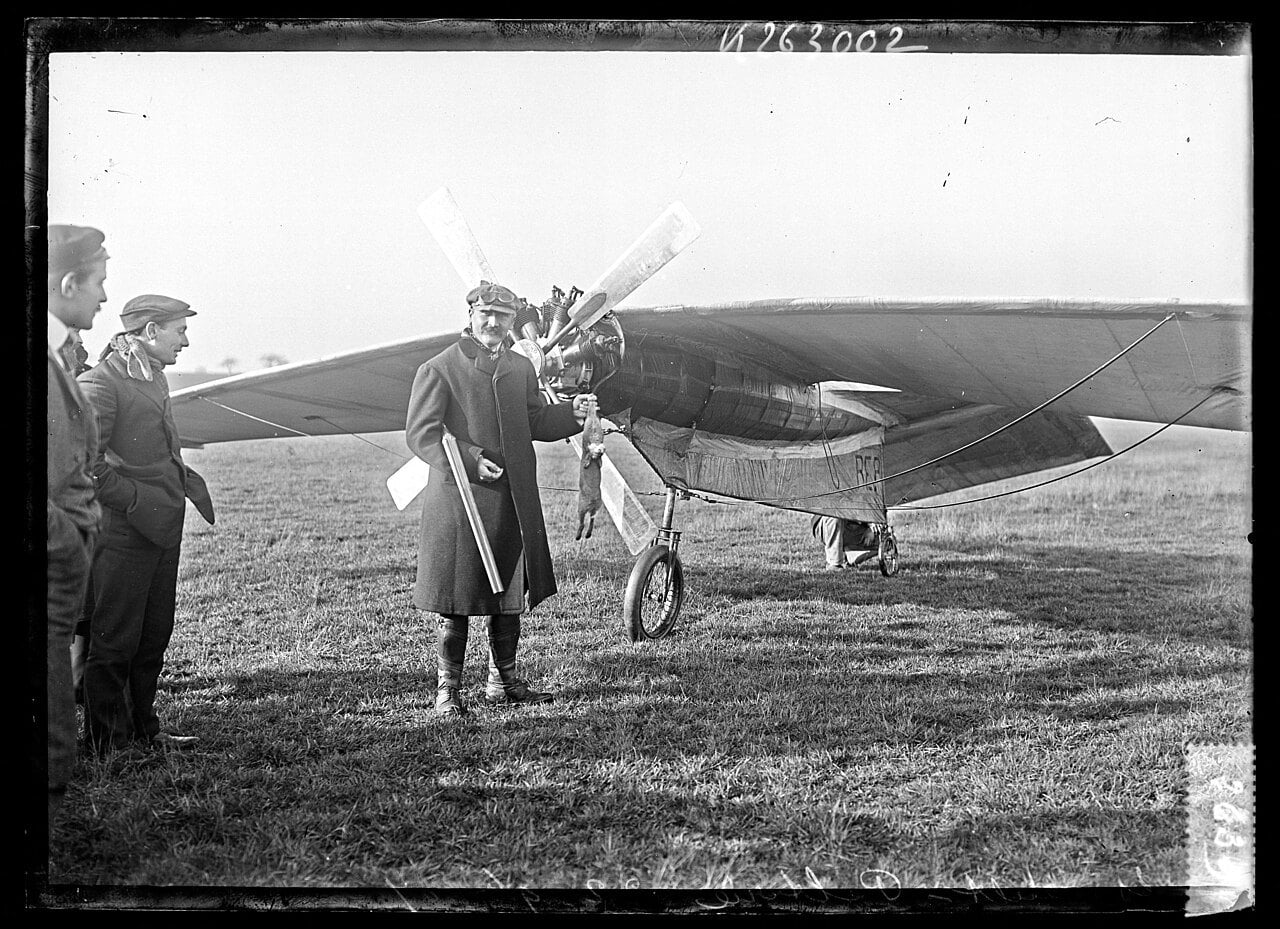
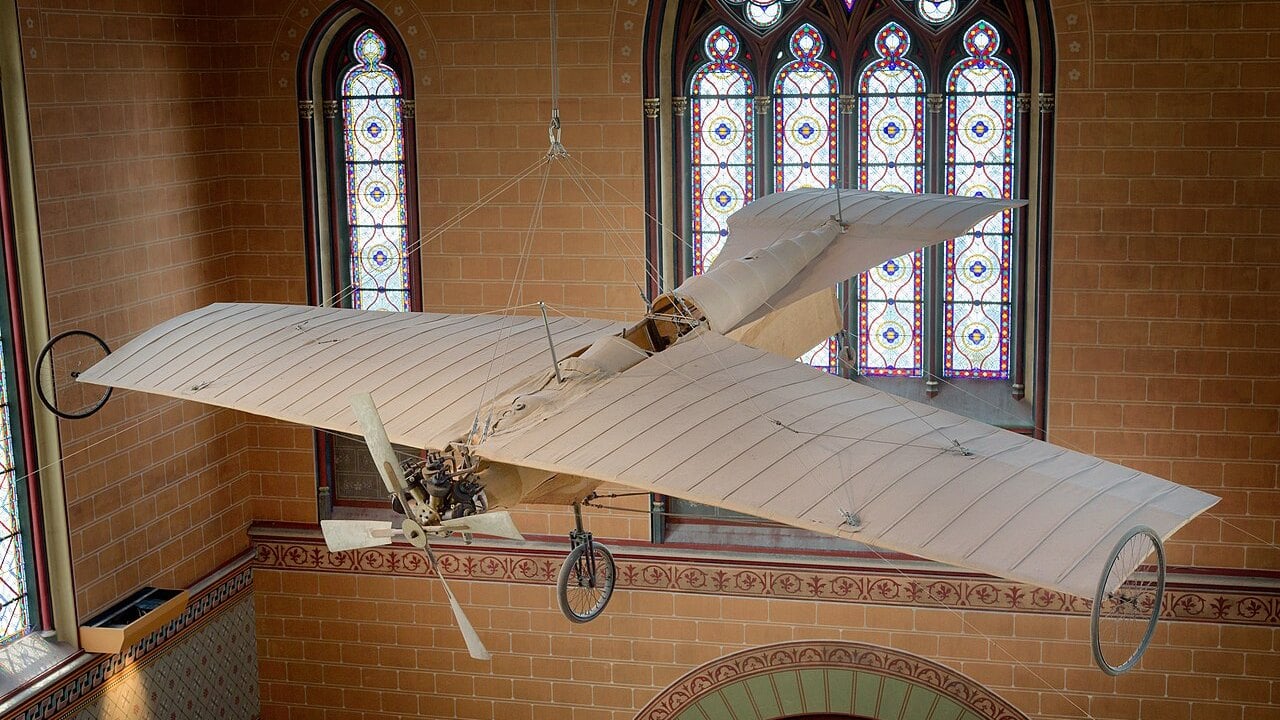
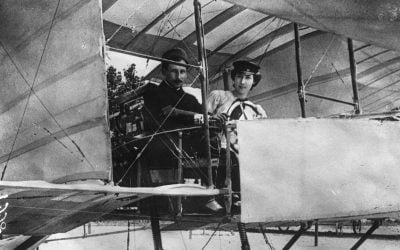
By 1907 he had turned away from biplanes entirely. Experiments had convinced him that bracing wires created far more drag than their thin size suggested, so he built a monoplane whose wings were strong enough to do without most of them. The REP 1 had a steel-tube fuselage covered in varnished silk, a single main wheel under the fuselage, small wheels on the drooping wingtips and a four-bladed propeller at the front. The American meteorologist A. Lawrence Rotch, writing in 1909, thought it resembled a great butterfly.
An engine like a fan
Esnault-Pelterie also built his own engines, sold under the REP name. They were of an unusual fan, or half-radial, layout: the first had seven cylinders in two staggered banks, four in one and three in the other, and produced about 30 horsepower. Later he moved on to a conventional seven-cylinder radial.
He made his first powered flight in the REP 1 on 10 October 1907, covering about 100 metres. It was short, but it was one of the first real flights by a monoplane in Europe. The improved REP 2 followed in 1908, and the original REP 1 survives today, hanging in the Musée des Arts et Métiers in Paris.
Forgotten Aviation on Robert Esnault-Pelterie and his REP aircraft.
One lever for everything
The most important thing in the REP was not on the outside. In the cockpit, Esnault-Pelterie gave the pilot a single upright lever. Push it forward or pull it back, and the aircraft pitched down or up. Move it left or right, and the wings warped to roll the aircraft. The 1921 history put it simply: a single lever actuated all the controls for steering.
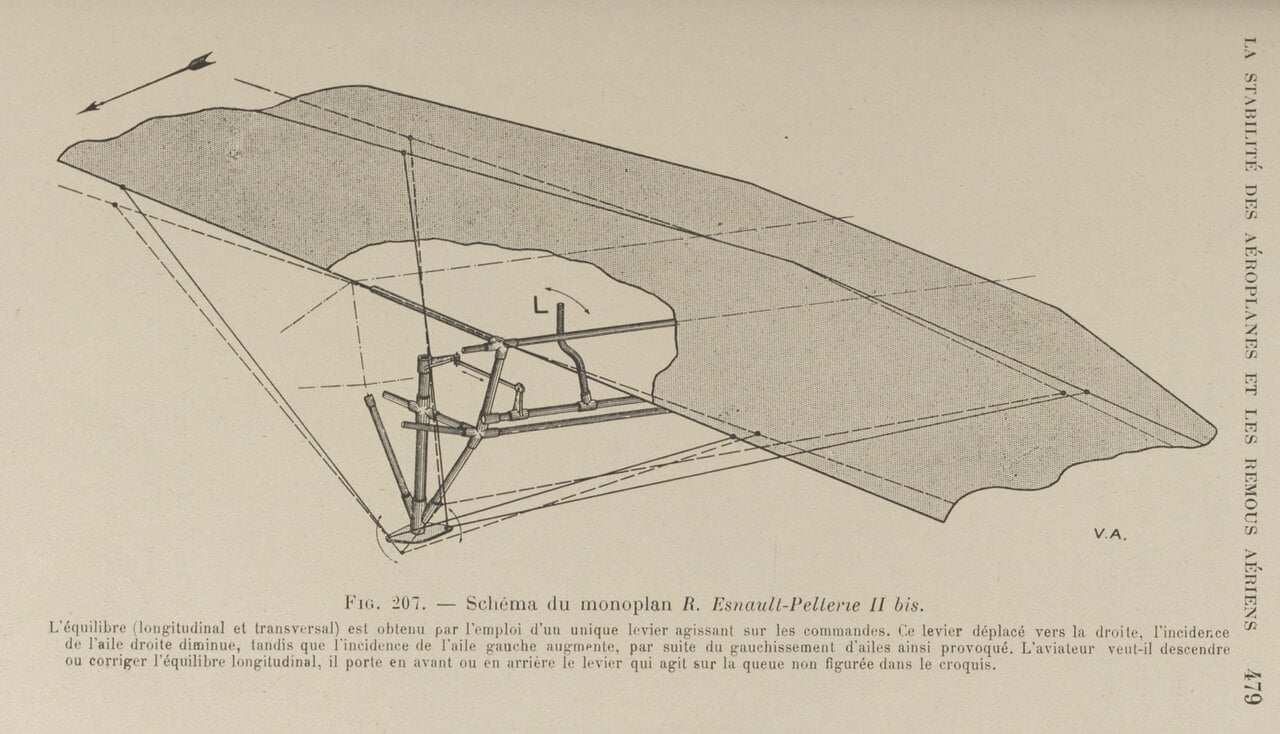
The French called it the manche à balai, the broomstick. The idea spread quickly. According to the Smithsonian historian Tom Crouch, Louis Blériot adopted the arrangement in 1908 for his eighth aircraft, and from there it spread through the French monoplane school. By the First World War, many aircraft were flown with a stick.
Esnault-Pelterie had patented the idea. After the war he went to court over the royalties owed to him by aircraft makers who had used it, a case Flight covered in 1923 as the French “manche à balai” action. The money he eventually won is said to have repaid his family’s heavy investment in his aviation work.
The REP name in Britain
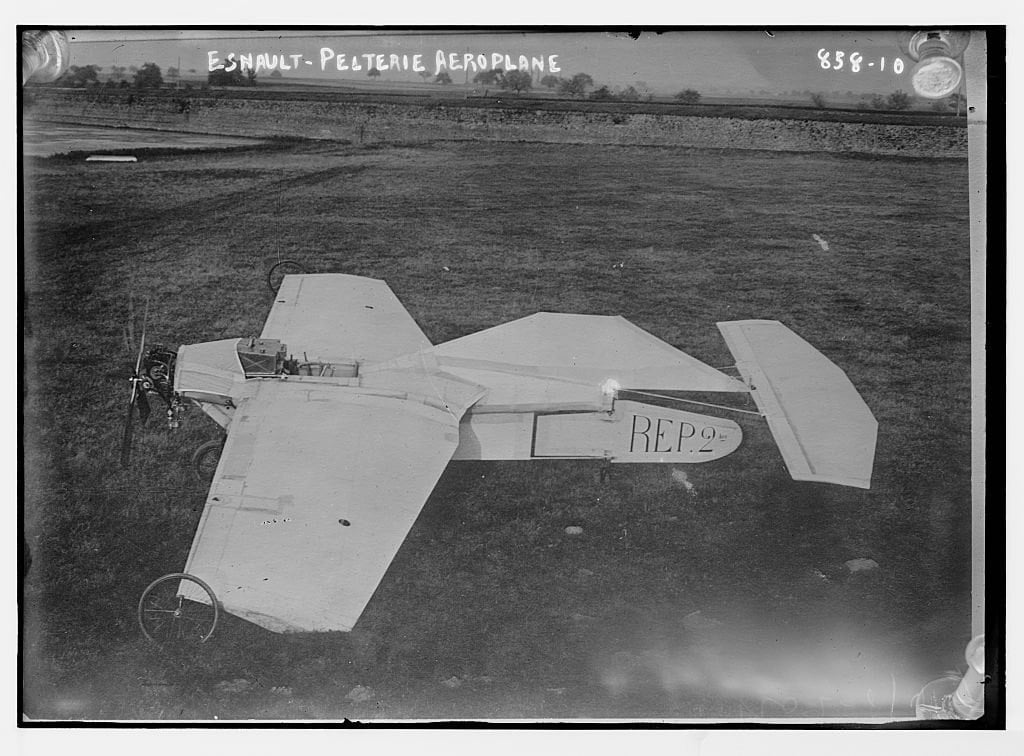
The REP monoplanes themselves never became famous racers, but they had an influence beyond France. Later REP designs dropped the drooping wings of the REP 1 for a more conventional wire-braced layout with a tractor propeller and an enclosed steel fuselage, and the 1921 history noted that the type became well known in Britain through its adoption in the early days by Vickers. The Vickers R.E.P. Type Monoplane, built under licence, marked the beginning of aircraft production at the company that would go on to build the Vimy y el Wellington.
Rotch, writing in 1909, summed up the case the monoplane builders were making: on the same power a monoplane flew faster than a biplane, but its balance was more delicate, turns were risky and a heavy landing could upset it. A simple, intuitive control that let the pilot correct pitch and roll with one hand was exactly what such an aircraft needed.
From the broomstick to the Moon
By then, Esnault-Pelterie’s mind was elsewhere. Without knowing of Konstantin Tsiolkovsky’s work, he presented a paper in 1913 that set out the rocket equation and calculated the energy needed to reach the Moon and the nearer planets. He went on to write L’Astronautique, published in 1930.
With the banker André-Louis Hirsch he founded the REP-Hirsch prize of the Société astronomique de France, the first prize for astronautics in the world. Its first winner, in 1929, was Hermann Oberth. In the early 1930s Esnault-Pelterie experimented with liquid-fuelled rocket engines himself, and lost four fingers in an explosion.
A French-language video biography of Robert Esnault-Pelterie, from aviation to astronautics.
He died in Nice on 6 December 1957, two months after Sputnik 1 reached orbit. In 1970 a crater on the far side of the Moon was named after him. Not bad for the man who also, quietly, gave every fighter pilot the stick in their hand.
Sources: E. Charles Vivian and W. Lockwood Marsh (A History of Aeronautics, 1921), A. Lawrence Rotch (The Conquest of the Air, 1909), François Peyrey (Les Oiseaux artificiels, 1909), Tom Crouch (Blériot XI: The Story of a Classic Aircraft, Smithsonian Institution Press, 1982), Flight (31 May 1923), C. H. Gibbs-Smith (Aviation, NMSI, 2003), Mike Gruntman (Blazing the Trail, AIAA, 2004), Agence Rol / Bibliothèque nationale de France


0 Comments