
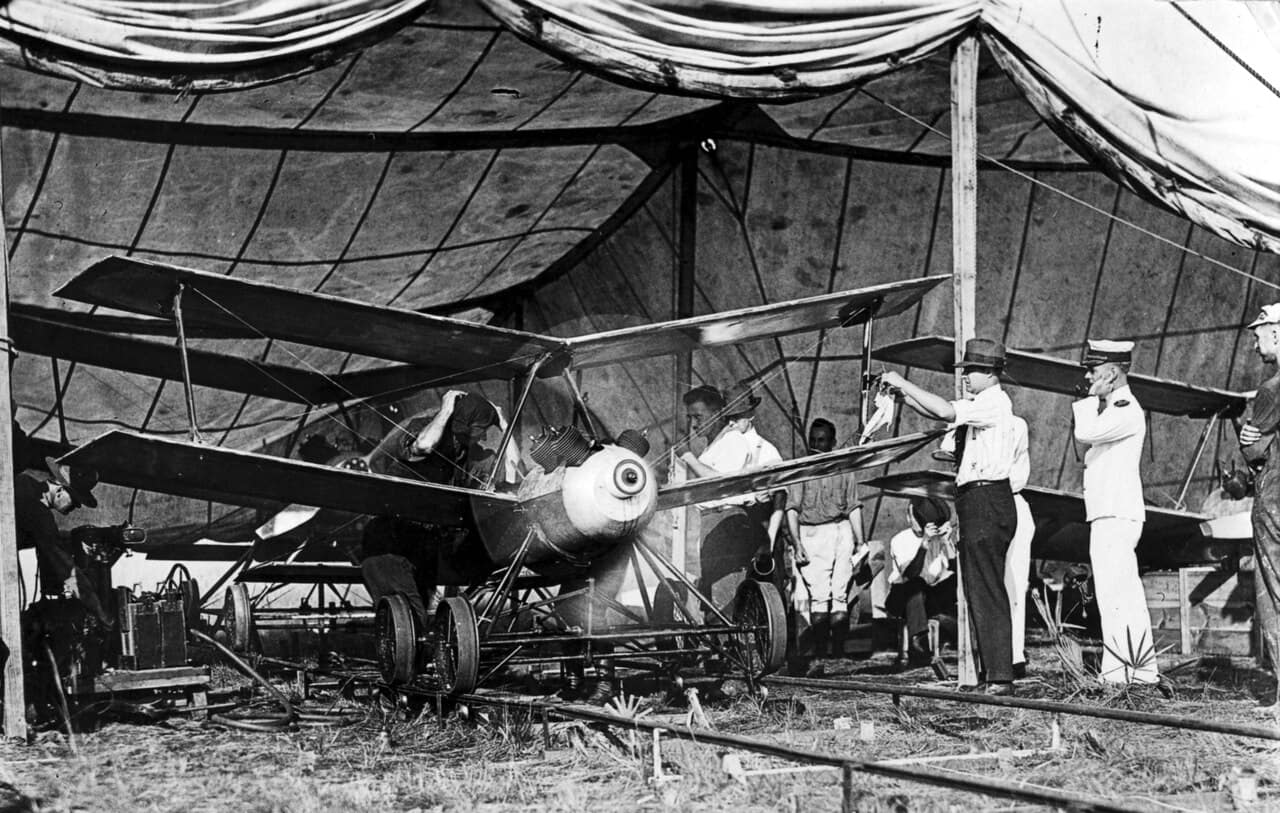
At 5:55 on the evening of Friday 4 October 1918, a small biplane with cardboard wings and a papier-mâché body lifted off a wheeled dolly running down a portable track near Dayton, Ohio. There was nobody aboard and nobody controlling it.
It was supposed to fly a preset distance, shut its engine off, drop its wings and fall on a target. Instead it kept going, climbing, until it disappeared eastwards at ten thousand feet. Charles Kettering, watching it go, decided there was nothing to be done and said to let the thing stay up there.
It eventually ran out of fuel and came down near Xenia. The Army told the local police and the local newspaper that it was a secret project, quashed all publicity, and burned the wreck where it lay.
Datos rápidos
| Nombre | The Kettering Aerial Torpedo, known as the Kettering Bug. Secret project codename: Liberty Eagle |
| Origen | November 1917 — the US Army asked Charles F. “Boss” Kettering for an unmanned machine that could hit a target 40 miles away |
| Construido por | The Dayton-Wright Airplane Company. Orville Wright was aeronautical consultant; Elmer Sperry designed the guidance |
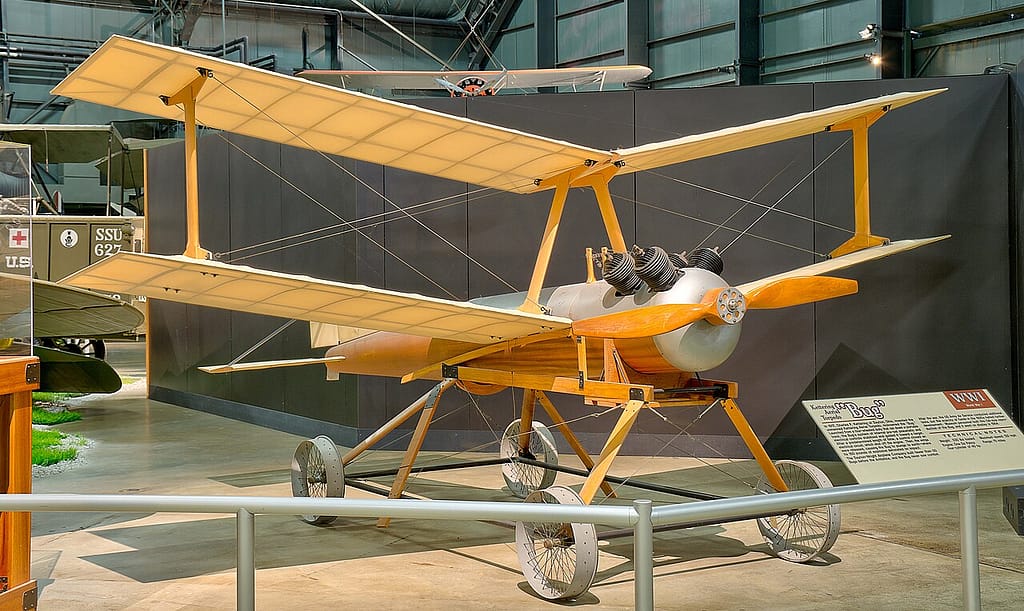
| Construction | Wood laminates and papier-mâché fuselage, cardboard wings |
| Motor | One 40 hp four-cylinder De Palma, mass-produced by Ford at roughly $40 each. Total cost per Bug about $400 |
| Dimensions | Span 14 ft 11½ in, length 12 ft 6 in, height 4 ft 8 in, loaded weight 530 lb |
| Warhead | 180 lb of high explosive. Cruise 50 mph, maximum 120 mph, range 75 miles |
| Lanzamiento | From a four-wheeled dolly running down a portable track — the same principle the Wright brothers used in 1903 |
| Construido | Fewer than 50 before the Armistice. Never used in combat |
How it was supposed to work
There was no radio link and no operator. The Bug flew a course set before launch, held by a gyroscope, with an aneroid barometer maintaining altitude.
The clever and much-repeated part is how it knew when to stop. The usual account is that technicians calculated in advance how many engine revolutions the flight would take — factoring in wind speed and direction along the route — and set a counter accordingly. When the counter reached the number, a cam dropped, the engine cut, and bolts holding the wings retracted so that the wings simply fell away. What was left dropped on the target as a bomb.
It is worth flagging that the National Museum of the US Air Force, which owns the surviving reproduction, describes the mechanism slightly differently: a predetermined length of time closing an electrical circuit to shut the engine off. Revolutions are a reasonable proxy for distance flown through the air, so the two accounts are reconcilable in principle — but they are not the same mechanism, and the museum's version is the one from the institution holding the artefact.
Either way, on the 4 October flight neither cut-off triggered. The Bug flew until it ran out of petrol.
It mostly did not work
The honest test record, as compiled by the historian Kenneth Werrell, is two successes in six attempts at Dayton, one in four at Amityville, and four in fourteen at Carlstrom Field in Florida. Seven successes out of twenty-four.
The first genuine test flight, on 14 September 1918, covered about a hundred feet before nosing into the ground — the carburettor misbehaved and the pneumatic system had swallowed wood splinters. A test on 2 October lasted nine seconds and ended with the Bug turning in a circle and scattering the Army observers who had come to watch.
That unreliability is precisely why it never went to war. The Armistice arrived on 11 November 1918, five weeks after the first partially successful flight, but the deeper objection was already understood: nobody was comfortable sending a device with that failure rate over Allied trenches carrying 180 pounds of high explosive.
Kettering was reportedly delighted rather than dismayed by the stories that circulated afterwards about what the runaway Bug had got up to on its way east.

What it actually was
The Bug is routinely called the world's first drone. That is overreach on two counts.
First, it was not alone. The US Navy's Hewitt-Sperry Automatic Airplane was running from November 1917, and Britain had radio-controlled work of its own in the same period, kept secret at the time. “One of the first” is defensible; “the first” is not.
Second, and more interestingly, it was not really a drone at all. A drone implies something flown or supervised remotely. The Bug had no radio, no operator and no way to be redirected once it left the track. You aimed it, launched it, and hoped.
That makes it far less like a Reaper and far more like a cruise missile — which is exactly what Hap Arnold recognised when he compared it to the V-1 twenty-five years later. A cheap, expendable, pre-programmed airframe carrying a warhead to a fixed set of coordinates, built deliberately from materials nobody would mind losing.
The US government spent about $275,000 on it between 1917 and 1920. Development continued quietly into the 1920s until the money ran out, and the technology stayed classified until the Second World War.
Which means that when the V-1 started falling on London in 1944, the Americans watching it had already built something with the same idea inside it. Twenty-six years earlier. Out of cardboard.
Period film of the Kettering Bug and its launch track.
The National Museum of the US Air Force’s own close survey of the reproduction.
Sources: National Museum of the United States Air Force; Michael H. Taint, “Twenty-Five Years Ahead of Its Time”, Proceedings of the Ohio Academy of History, 2018; Kenneth P. Werrell, The Evolution of the Cruise Missile; Wikipedia.


0 Comentarios