
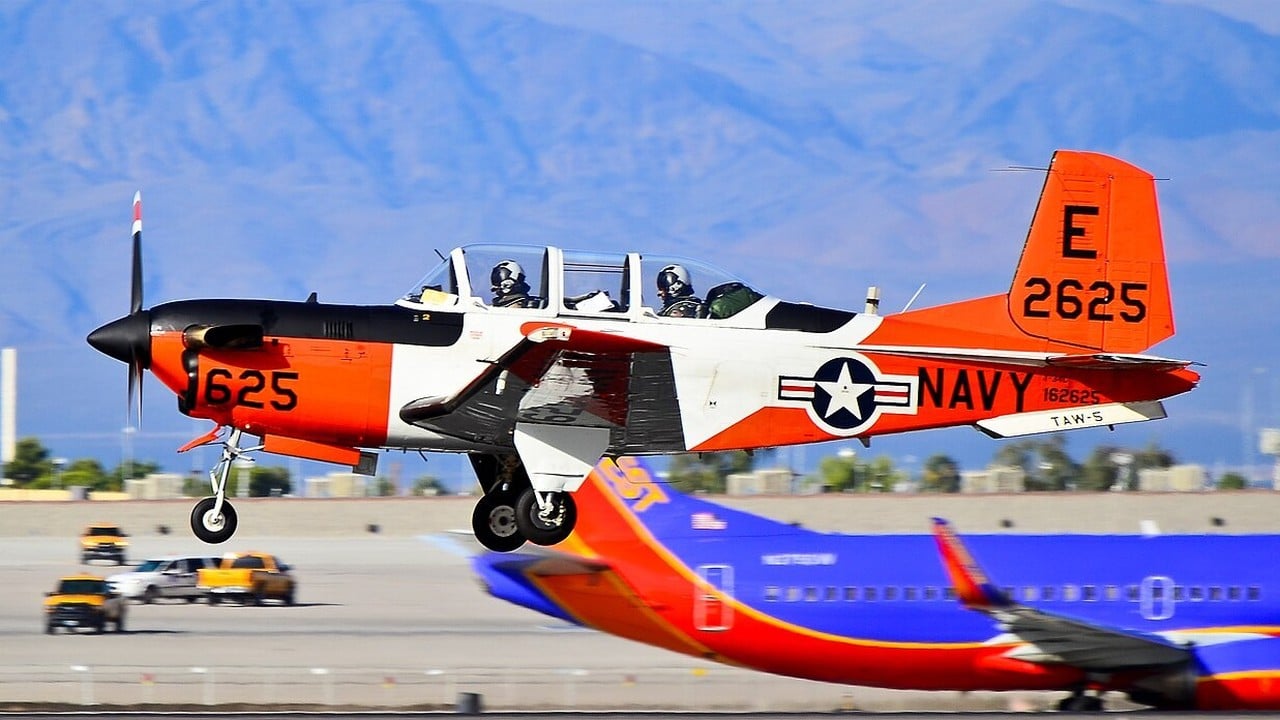
In 1977, a pilot named Julie Clark paid $18,000 at a government surplus auction in Anchorage, Alaska, for an aircraft she had never seen. It was a Beechcraft T-34 Mentor. She flew it 2,900 miles home to California, polished it by hand and flew it at air shows for more than four decades.
Her aircraft was one of nearly 2,000 piston-engined Mentors, and the type is one of the longest-serving trainers in military aviation. For more than half a century, from the early 1950s until the 2010s, a T-34 of one kind or another was often the first military aircraft a new American pilot ever flew.
Datos rápidos
- Tipo: Two-seat tandem primary trainer
- Origen: Beechcraft Model 45 private venture, derived from the Model 35 Bonanza
- Primer vuelo del prototipo: Late 1948
- Piston versions: T-34A (US Air Force, from 1953) and T-34B (US Navy, from 1955); nearly 2,000 built in the US, Canada, Japan and Argentina by 1959
- Turboprop version: T-34C Turbo-Mentor, Pratt & Whitney Canada PT6A-25; first flew 21 September 1973; built until 1990
- Main users: US Air Force, US Navy, Marine Corps and Coast Guard student pilots, plus many export air arms
- Sustituido por: Cessna T-37 (USAF, around 1960); T-6B Texan II (US Navy, 2010s)
A Bonanza in uniform
The Mentor was Walter Beech’s idea. In the late 1940s there was no budget for a new military trainer, so Beechcraft developed one as a private venture, the Model 45, hoping to offer the services a cheaper alternative to the North American T-6 Texan that all of them were still using.
Beech started from its successful Model 35 Bonanza. The engineers kept the wing and much of the structure but replaced the four-seat cabin with a narrow fuselage, two tandem seats and a bubble canopy, giving instructor and student an excellent view. They also swapped the Bonanza’s V-tail for a conventional tail, which the conservative military was more likely to accept. The prototype first flew in late 1948.
It was a modest aeroplane by design. The prototype’s 185 hp Continental engine was the same as fitted to contemporary Bonanzas and had less than a third of the power of the T-6’s radial. That was the point: a cheaper, simpler aircraft for the very first hours of military flying, before students moved on to something bigger.
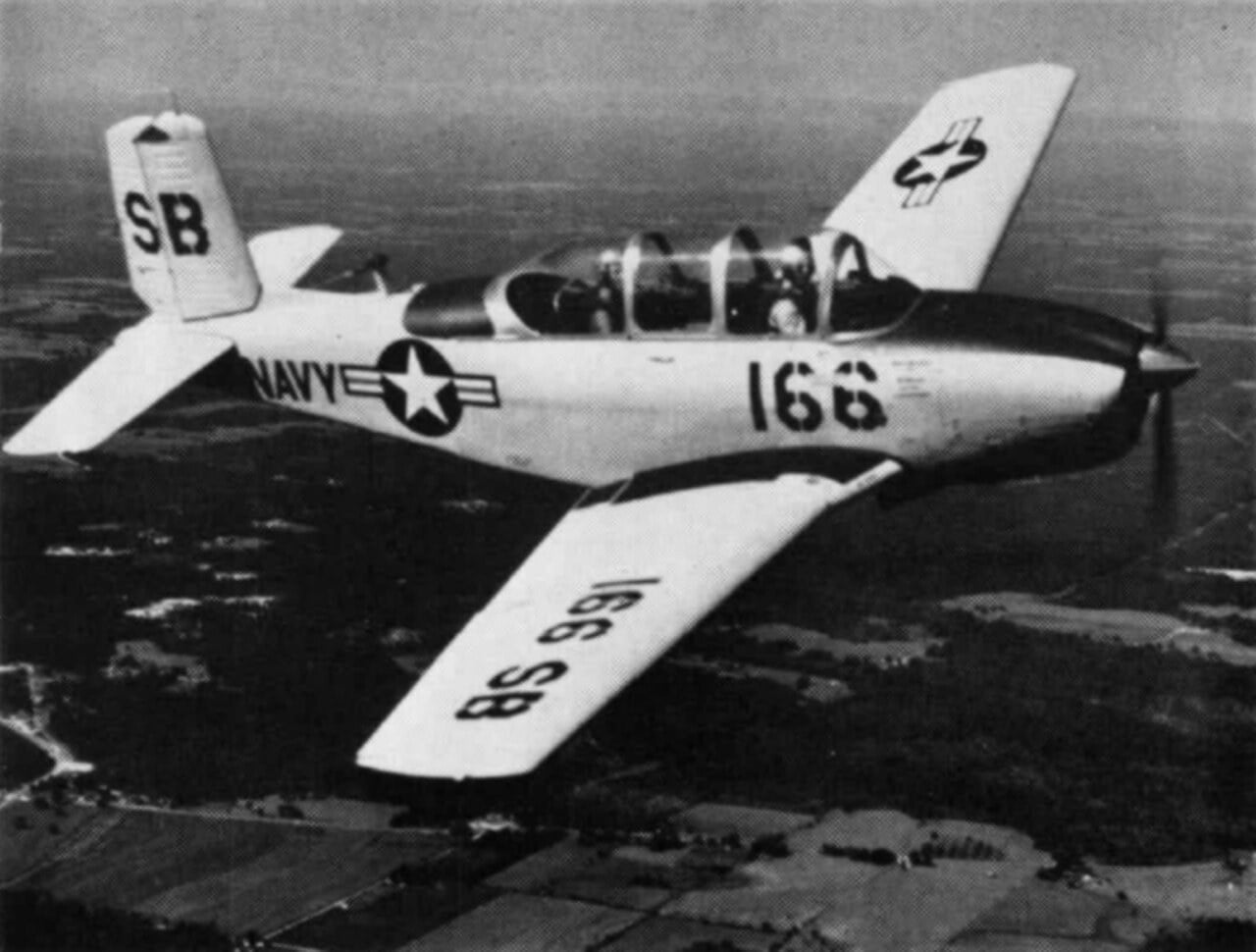
It took years to win an order. The US Air Force evaluated Model 45 test aircraft as the YT-34, ran a long competition and finally ordered the T-34A Mentor into production in 1953. The US Navy followed with the T-34B, which entered production in 1955 with differential braking instead of nosewheel steering and adjustable rudder pedals in place of movable seats.
First step in the pipeline
In the Air Force, the T-34A became the primary trainer at contract flying schools across the southern United States, replacing the T-6. Students moved on to the T-28 Trojan before advanced training. The Air Force era was short: by around 1960, the jet-powered Cessna T-37 Tweet had taken over, and many T-34As went to base aero clubs and later to the Civil Air Patrol.
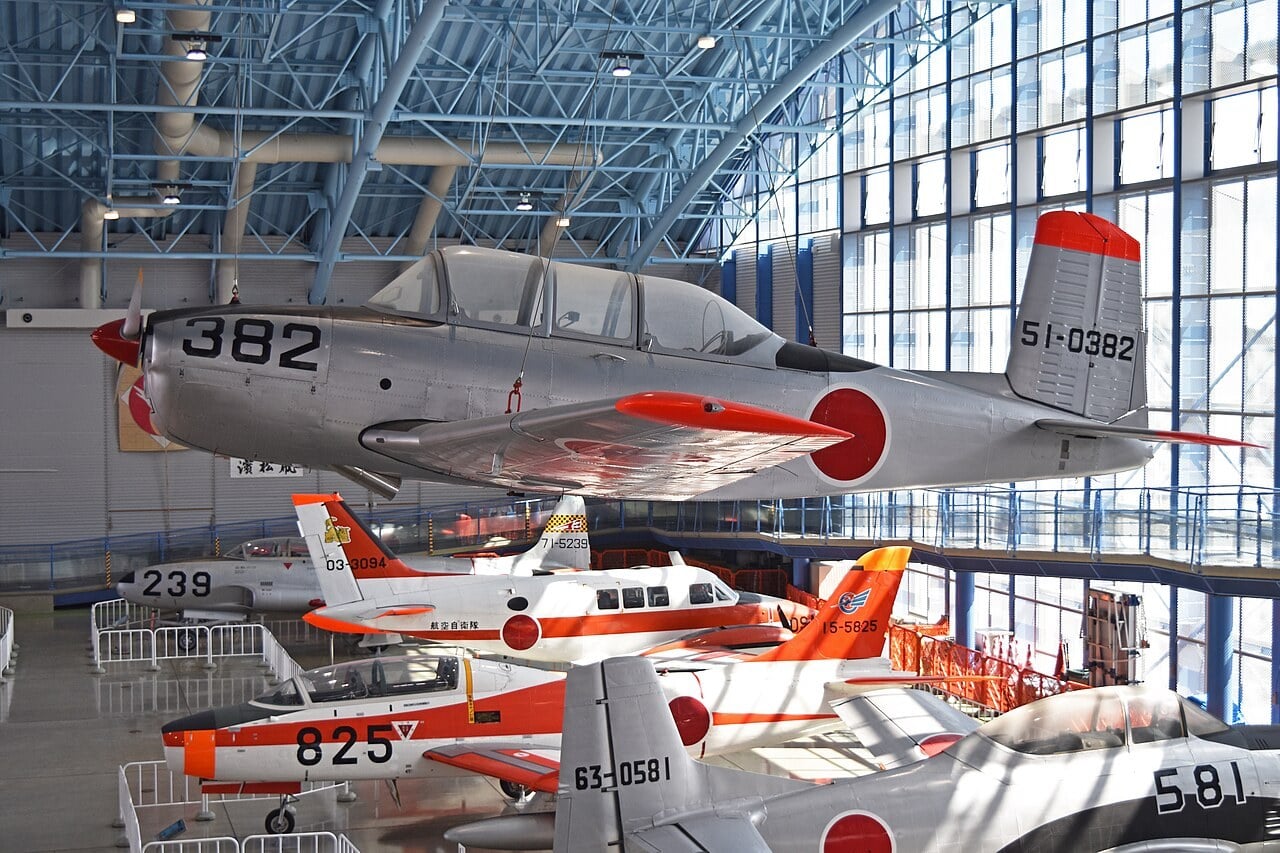
The Mentor also went abroad. Licensed versions were built in Canada, Japan and Argentina, and piston Mentor production in the US and abroad ended in 1959 at nearly 2,000 aircraft. Fuji’s Japanese-built examples trained pilots for the Japan Air Self-Defense Force, and other Mentors served from Latin America to Asia.
The Navy kept faith with the piston T-34B much longer, flying it as an initial primary trainer at Saufley Field in Florida into the mid-1970s. By then, Beechcraft had something better.
Dark Skies on the T-34C Turbo-Mentor, the turboprop version that trained US Navy aviators for decades.
The Turbo-Mentor
In 1973, at the Navy’s request, Beechcraft converted two T-34Bs with a Pratt & Whitney Canada PT6A-25 turboprop. The new T-34C Turbo-Mentor also received a wing derived from the Beech Baron and landing gear from the larger Beech Duke. The first turboprop conversion flew on 21 September 1973, and production resumed for the Navy in the mid-1970s.
The T-34C replaced the T-28 as the Navy’s primary trainer at Whiting Field in Florida and Corpus Christi in Texas, and generations of Navy, Marine Corps and Coast Guard aviators, plus many allied students, learned to fly in it. An armed export version, the T-34C-1, could carry weapons on four underwing hardpoints. Turbo-Mentor production ended in 1990.
At Whiting Field, which in 2016 handled about 60 percent of the Navy’s primary flight training, the T-34C was the first aircraft that Navy, Marine Corps and Coast Guard students learned to fly. Base spokesman Jay Cope described it as slower than its successor, with older-style instruments and a lower cruising altitude, but very durable.
Some of those export aircraft saw combat. Argentine Naval Aviation sent T-34C-1s to the Falklands in 1982, where they flew reconnaissance missions before being destroyed on the ground in the SAS raid on Pebble Island.
Handing over to the Texan II
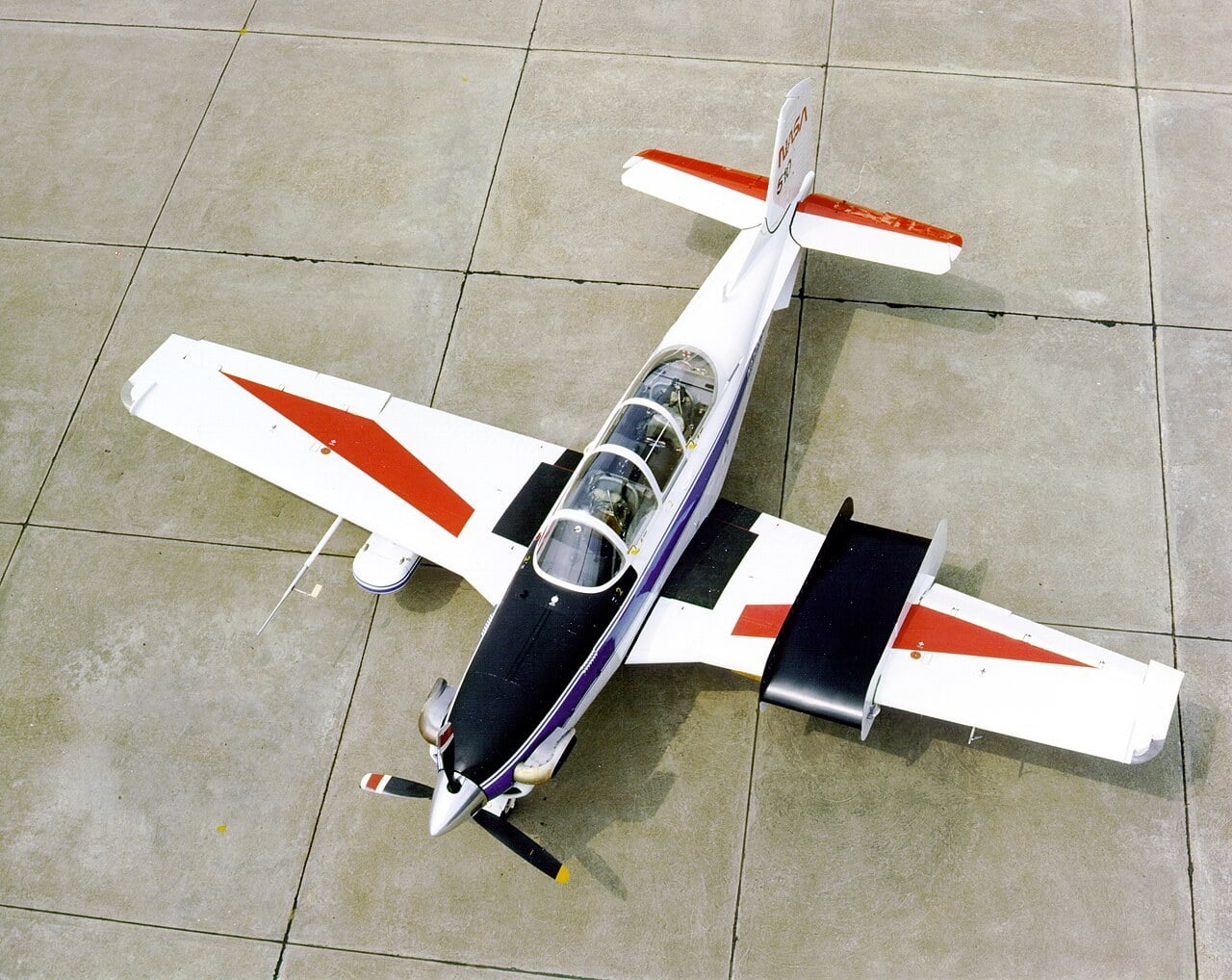
The Turbo-Mentor’s training career ended only in the 2010s, when the Navy replaced it with the T-6B Texan II. In June 2016, Naval Air Station Whiting Field welcomed its last new T-6B, completing a changeover that had started in 2009. Even then, a few T-34Cs stayed on with test units and as spotter aircraft, and NASA used T-34Cs as slow chase planes for research flights.
Civilian Mentors have kept flying too, with warbird owners and display teams. Julie Clark, who retired from Northwest Airlines as a captain, flew her T-34 “Free Spirit” on the air show circuit for more than 40 years. She flew her final show at her home field in Rancho Murieta, California, on 19 October 2019, after a farewell tour that included EAA AirVenture at Oshkosh.
She told AOPA that she planned to keep flying the T-34 for fun and that it would eventually go on display at the Hiller Aviation Museum in her hometown of San Carlos, California, where she had soloed in 1969.
Julie Clark flies her T-34 Mentor “Free Spirit” at EAA AirVenture Oshkosh in 2019, her farewell season.
It was never fast, and it was never meant to be glamorous. But the Mentor did the most important job in military aviation: taking someone who had never flown and turning them into a pilot. It did that job for more than half a century.
Sources: Pima Air & Space Museum, WUWF Public Media, AOPA, Flying magazine, NASA, Wikipedia (Beechcraft T-34 Mentor)
Header photo: Tomás Del Coro / Wikimedia Commons, CC BY-SA 2.0
0 Comments