

For nine months, China’s first electric airliner demonstrator had been flying with nobody on board. On Saturday 14 November 2026, that changed. The COMAC CE-25A took off from Binzhou in Shandong province with two pilots and a flight test engineer aboard, spent 16 minutes and 38 seconds in the air and covered 60.4 kilometres, according to COMAC figures carried by China Daily and Global Times.
The state-owned Commercial Aircraft Corporation of China said the aircraft performed normally and that all indicators met expectations. The whole test, ground work included, lasted 57 minutes and 46 seconds. The announcement came the same day, through Xinhua, CCTV and the state press.
Datos rápidos
- Aeronave: COMAC CE-25A, China’s first electric commercial aircraft (COMAC)
- First piloted flight: Saturday 14 November 2026, Binzhou, Shandong province
- Multitud: Two pilots and one flight test engineer
- Vuelo: 16 min 38 s airborne, 60.4 km; whole test 57 min 46 s
- Earlier testing: First uncrewed autonomous flight 2 February 2026; 19 uncrewed autonomous flights
- Stated specs (COMAC): 19 passengers, 10 t MTOW, 300 km/h cruise, 2,400 m cruise altitude, 400 km range
- Propulsión: Ten electric ducted fans above the wings (per Global Times)
- Proceso de dar un título: CAAC has accepted the type certificate application
Nineteen seats and ten fans
The CE-25A is COMAC’s first electric commercial aircraft. According to the figures COMAC released through state media, it is designed to carry 19 passengers on intercity routes, with a maximum take-off weight of 10 tonnes, a cruising speed of 300 km/h, a cruising altitude of 2,400 metres and a range of 400 kilometres.
There are no turbofans or turboprops. Global Times reported that ten electric ducted fans sit in rows above the wings, a distributed propulsion layout. The photographs released after the flight show five fan nacelles grouped along each wing of a red-and-black T-tailed airframe.
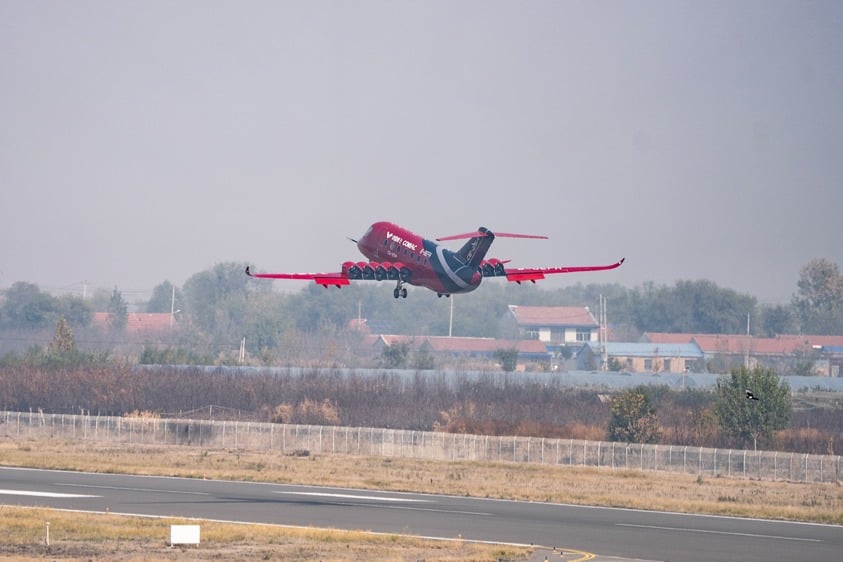
The designation spells out the brief. According to Global Times, the “E” stands for electric and the “25” for CCAR-25, China’s airworthiness rules for transport-category aircraft, the same standard that applies to large airliners. The “A” marks the first product in a planned series.
Xinhua’s New China TV report on the CE-25A’s first crewed flight in Binzhou.
Flying for months, quietly
The crewed flight also told the outside world how far the programme had already come. According to COMAC, the full-size CE-25A made its first uncrewed autonomous flight on 2 February 2026, and had since completed 19 uncrewed autonomous flight validations.
That surprised observers. COMAC unveiled the CE-25A concept in 2023, AeroTime noted, but the first public images of a full-size aircraft only appeared in late October 2026, with no public confirmation at the time that it had flown. COMAC calls the 14 November sortie a crewed “intelligent” or “smart” flight. As Air Data News pointed out, the company has not explained how control was shared between the pilots and the automated systems.
The partners are COMAC, the battery maker CATL and Shanghai Jiao Tong University, among others, according to China Daily. COMAC has not disclosed which battery powers the aircraft. The Civil Aviation Administration of China has accepted COMAC’s application for a CE-25A type certificate, state media reported.
Where the CE-25A fits
Global Times described the target market as high-frequency short-haul routes of 200 to 400 kilometres. That puts the COMAC CE-25A in the same 19-seat class as commuter turboprops, but with a range that, on COMAC’s own figures, keeps it to short regional hops.
Abroad, the nearest comparison is Sweden’s Heart Aerospace X1 demonstrator, which made its first crewed flight in August 2026. Heart is ultimately aiming at a larger hybrid-electric airliner, the ES-36 that Afterburner covered when JSX placed its order. COMAC, by contrast, is pursuing an all-electric design from the outset.
Experts quoted by Global Times said the CE-25A is meant to be the first of a CE family, with larger and longer-range new-energy aircraft to follow, as well as possible business jet, rescue and uncrewed cargo variants. Those are ambitions, not programmes, for now.
China News Service footage of the CE-25A’s first piloted flight on 14 November 2026.
What is on the record is one short flight with people aboard after 19 without. For an aircraft class that has struggled for years to get beyond small demonstrators, a 10-tonne electric aircraft built to transport-category rules flying over Shandong is a milestone worth watching. The harder part, certification and real batteries carrying real passengers, is still ahead.
Sources: COMAC statement (via China Daily, Xinhua and Global Times), China Daily, Global Times, Reuters, AeroTime, Air Data News
Header photo: Xinhua via China Daily


0 Comments