
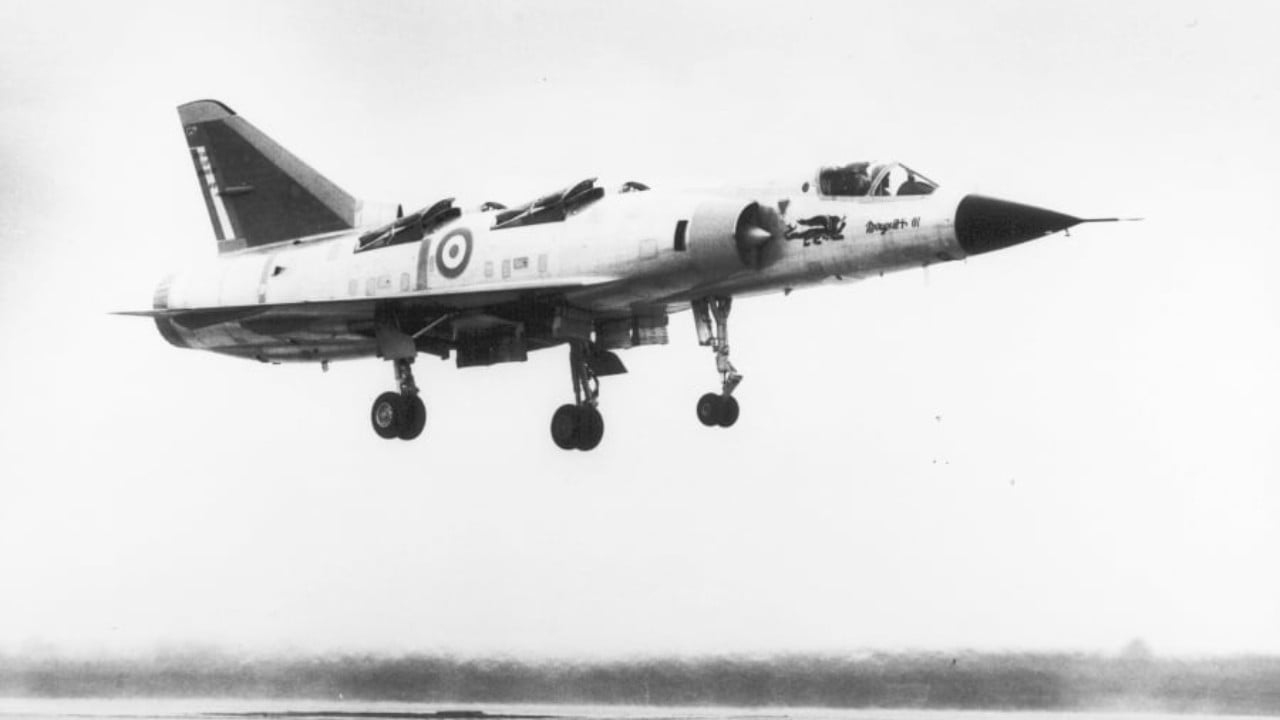
In September 1966 a French prototype that could take off vertically flew at Mach 2.04 in level flight. Nothing that could hover had ever gone that fast. To manage it, the Dassault Mirage IIIV carried nine jet engines: one large turbofan for forward flight and eight small Rolls-Royce lift jets packed into the fuselage behind the cockpit.
It was the most ambitious answer to a question NATO asked in 1961: could Europe have a supersonic strike fighter that did not need a runway? Within weeks of that record, the answer was effectively no.
Datos rápidos
- Tipo: Experimental supersonic VTOL strike fighter
- Fabricante: Dassault Aviation, France
- Testbed: Balzac V, converted from the first Mirage III prototype
- Engines (Mirage IIIV): One TF104/TF106 or TF306 turbofan plus eight Rolls-Royce RB162 lift jets
- First hover: 12 February 1965 (prototype 01)
- Velocidad máxima: Mach 2.04 in level flight, September 1966 (prototype 02)
- Prototypes: Two Mirage IIIV; 02 lost on 28 November 1966
- Sobreviviente: Mirage IIIV 01, Musée de l'Air et de l'Espace, Le Bourget
NATO's Impossible Requirement
In August 1961 NATO issued NBMR-3, a requirement for a supersonic V/STOL strike fighter. It called for a combat radius of about 460 km, cruise at Mach 0.92, a Mach 1.5 dash and a payload of around 910 kg. Eleven designs were submitted. The two serious contenders were Hawker Siddeley's P.1154, a supersonic Harrier with one vectored-thrust engine, and Dassault's Mirage IIIV, which used dedicated lift jets.
NATO chose the P.1154 in May 1962, but no country ordered it, and France pressed on with its own design. The Mirage IIIV was seen as politically attractive because of its multinational industrial plans, but technically it had nine engines where the British design had one.
Ruairidh MacVeigh's Flying Failures episode on the Dassault Mirage IIIV.
Balzac V: Learning to Hover
Dassault proved the idea first with the Balzac V. It was converted from the very first Mirage III prototype and fitted with eight Rolls-Royce RB108 lift engines plus a Bristol Orpheus for forward flight. Tethered hovering began on 12 October 1962, and the Balzac made its first free hover six days later. On its 17th sortie, on 18 March 1963, it made its first transition from hover into wing-borne flight.
The Balzac also showed how dangerous the concept was. It suffered two fatal accidents, in January 1964 and September 1965, and was not repaired after the second.

Nine Engines and Mach 2
The Mirage IIIV itself was a bigger aircraft. Prototype 01 first hovered on 12 February 1965 and made its first transition in March 1966. It started with a Pratt & Whitney-derived TF104 turbofan, soon replaced by the more powerful TF106, and reached Mach 1.32. Prototype 02 flew from June 1966 with a TF306 and, in September 1966, reached Mach 2.04 in level flight.
There was a catch the records did not show. The Mirage IIIV never combined a vertical take-off and supersonic flight in the same sortie. Eight lift engines meant extra weight and fuel that did nothing in forward flight, and the high-speed record flights were not vertical take-offs.

The End
On 28 November 1966, prototype 02 was lost in an accident. NBMR-3 had already been terminated in 1965, and the British had cancelled the P.1154 the same year. There was no longer a NATO order to win and no French requirement big enough to justify the cost. The programme ended.
Mirage IIIV 01 survives at the Musée de l'Air et de l'Espace at Le Bourget. NATO's vertical strike fighter finally arrived decades later, with a different engine layout, as the F-35B.
Jumpseat & Aerobuzz on the Mirage III V, the vertical fighter that aimed for Mach 2.
Archive footage of the Dassault Balzac V testbed hovering and flying.
Sources: Wikipedia (Dassault Mirage IIIV); Musée de l'Air et de l'Espace; San Diego Air and Space Museum Archives; Ruairidh MacVeigh; Jumpseat & Aerobuzz

0 Comments