
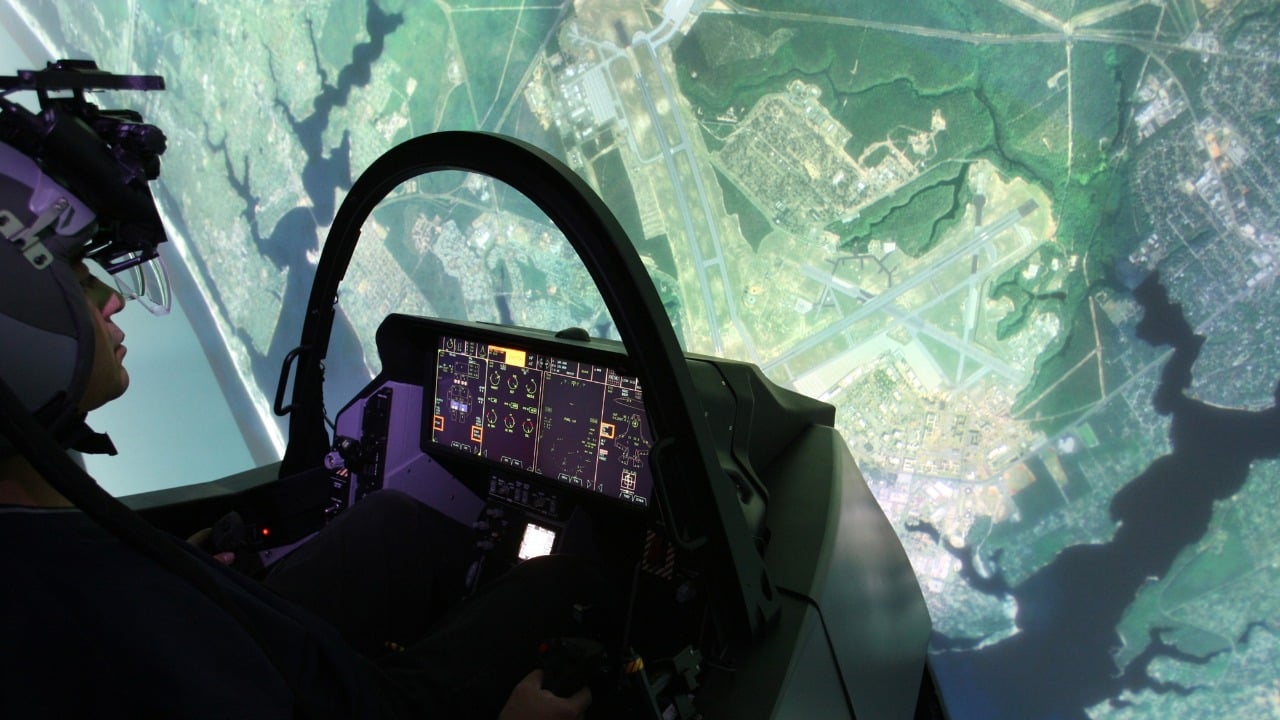
On 17 November 2026, Lockheed Martin put out a short press release from Lemoore, California. Four F-35 full mission simulators, bolted to the floor of a building at Naval Air Station Lemoore, had been connected in real time to six F/A-18 that were actually airborne. The pilots in the domes and the pilots in the sky flew the same engagement, against the same adversaries, at the same moment.
Some of those adversaries did not exist. They were constructive entities — software aircraft, flown by software pilots, injected into the scenario and visible on the radars of everyone taking part, live and simulated alike.
This is live, virtual, constructive training, and it is the quiet answer to a problem the US Air Force has been admitting in public for more than a decade: the ranges it owns are no longer big enough, and the aeroplanes it flies are no longer willing to show what they can do in front of anyone who cares to watch.
Datos rápidos
The terms — Live: real people, real systems. Virtual: real people, simulated systems. Constructive: simulated people, simulated systems. (DoD 5000.59-M, January 1998)
The 17 November 2026 event — four F-35 full mission simulators at NAS Lemoore connected to six airborne F/A-18s, using the US Navy continuous training environment and Link-Inject-to-Live ground stations. Lockheed Martin did not state the date of the flight itself.
Nevada Test and Training Range — 2.9 million acres of land and about 12,000 square nautical miles of airspace in total.
The mismatch — a 2016 Nellis assessment put the usable range box at roughly 100 by 100 nautical miles, against a joint air operations area of 1,200 by 1,100.
SLATE capstone (autumn 2018) — 16 live aircraft, four virtual players and more than 80 constructive entities in one scenario.
Cost comparison — in 2016 the 325th Fighter Wing put an F-15C flying hour at about $17,000 and a simulator hour at about $230.
Three words, defined in 1998
The taxonomy is older than most of the aircraft it now describes. The DoD Modeling and Simulation Glossary, published as DoD 5000.59-M in January 1998, sets out all three in a single page.
Live simulation is “a simulation involving real people operating real systems.” A Red Flag sortie is live. Virtual simulation is “a simulation involving real people operating simulated systems” — a pilot in a dome, flying a jet that exists only as software. Constructive, in the glossary’s words, covers “models and simulations that involve simulated people operating simulated systems,” where real people provide inputs “but are not involved in determining the outcomes.”
That third category is the one that does the heavy lifting. A constructive entity costs almost nothing to create, can be created eighty at a time, and can be given whatever radar, whatever missile and whatever tactics the intelligence community says the real thing has.
The glossary is also unusually honest about its own invention. The same document notes that the categorisation “is problematic, because there is no clear division between these categories,” since the degree of human participation and the degree of equipment realism are both “infinitely variable.” Twenty-eight years on, that caveat describes the Lemoore event rather well.
Lockheed Martin’s own explainer of F-35 distributed mission training — the architecture that the Lemoore event extended to live aircraft.
The range stopped being big enough
The Nevada Test and Training Range is enormous by any ordinary standard. The Nellis fact sheet lists 2.9 million acres of land, 5,000 square miles of restricted airspace, a 7,000-square-mile Military Operating Area, and roughly 12,000 square nautical miles in total. It is the largest contiguous air and ground space available to the US military.
It is also, by the Air Force’s own arithmetic, about the size of a postage stamp.
In 2016, Lieutenant Colonel Kenneth Voigt, then commander of the 505th Test Squadron at Nellis, set the two numbers side by side in an Air Combat Command release: a realistic joint air operations area is “1,200 by 1,100 nautical miles, compared to the Nevada Test and Training Range, which is about 100 by 100 nautical miles.” Three years later Major General Peter Gersten, then commander of the Air Force Warfare Center, told an AFA symposium the range was about 50 per cent too small to train modern aircraft against advanced threats.
The Government Accountability Office put the problem in colder language. In GAO-16-864, published in September 2016, officials at the Nevada range told auditors that current range capabilities were adequate to replicate only a first Gulf War-era threat scenario. The ranges, GAO wrote, “lack many of the more advanced threat replication systems” needed to challenge the F-35 and the F-22. Two F-22 squadron commanders at Langley told GAO that the size of their airspace limited the missions they could practise at all.
The jet that will not switch itself on
Size is only half of it. The other half is that a fifth-generation fighter is a collection of secrets, and a public range is a place where secrets get photographed.
Lieutenant General James Holmes, then the Air Force deputy chief of staff for strategic plans and requirements, put it plainly in 2016: “With a lot of our fifth generation systems, a lot of our training has to be done in the simulator because we don’t want it out in the open where anybody can watch and see what we’re doing.” Gersten later added that adversaries observe open-air training by satellite and attempt to get at it through cyber intrusion.
So the aircraft that most needs realistic training is the one least able to train realistically in the open. And when it does fly against the emitters the range can provide, Holmes said, the result is a jet that is “kind of yawning through the training.”
Put the two problems together and the conclusion writes itself. If the threat cannot be built, and the aircraft cannot be switched fully on, then the only place a realistic fight can happen is partly inside a computer. The question becomes how much of the fight, and how to connect the parts.
SLATE: the ten-year road to Lemoore
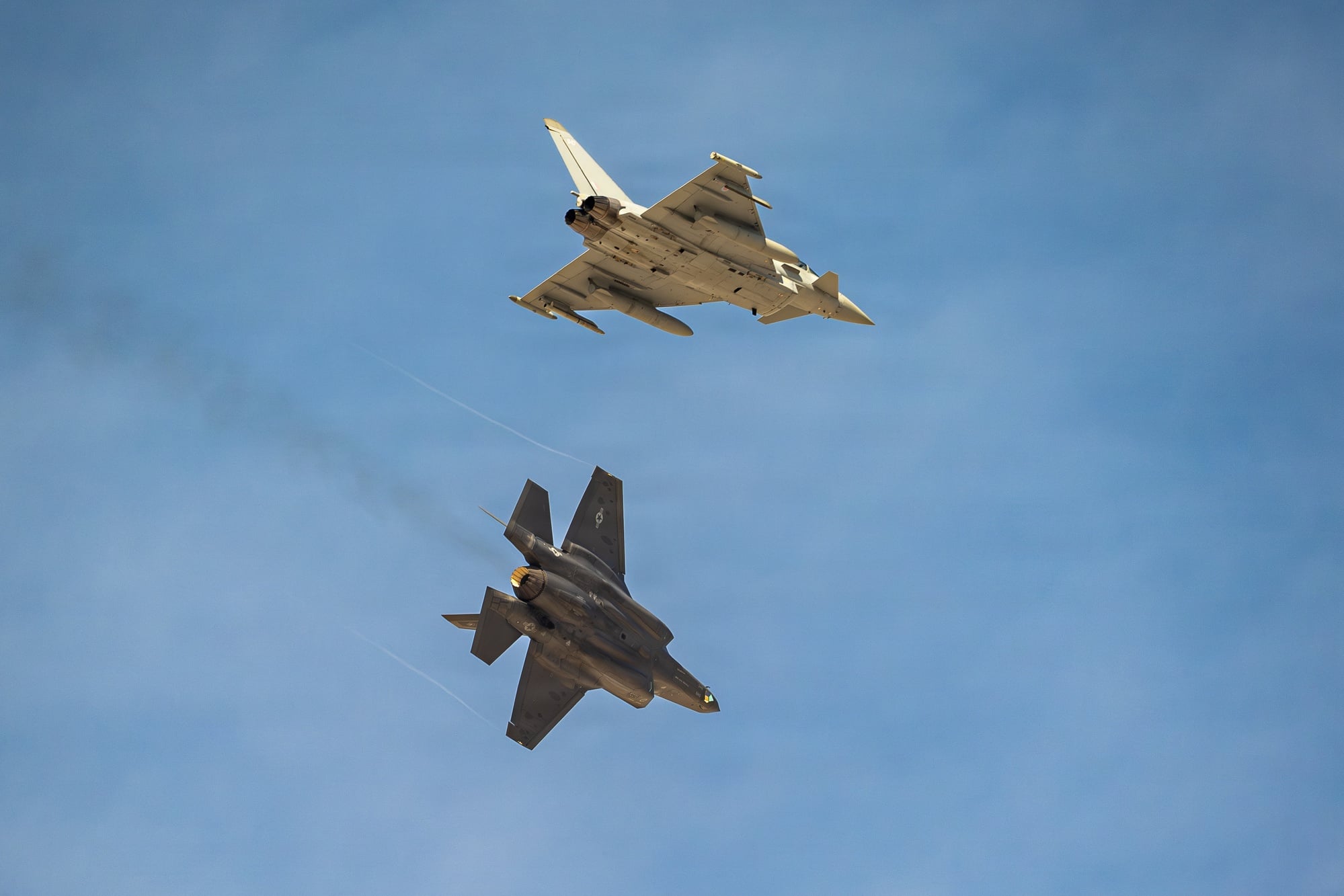
The idea of injecting synthetic opponents into a live cockpit is not new. Making it work, securely, at fighter speeds, took most of a decade.
The Air Force Research Laboratory ran the Secure Live-Virtual-Constructive Advanced Training Environment as a 40-month Advanced Technology Demonstration in three phases. AFRL’s own account, published in Fights ON! in Winter 2019, describes a government-owned advanced training waveform with NSA-certified encryption, carried in a pod, designed to inject virtual and constructive entities into live aircraft without modifying the jet’s operational flight program.
The write-up is refreshingly candid about the middle of the programme. Phase II, which pushed live system data through the pod into a multiple independent levels of security architecture, had “only modest success initially.” The capstone exercise, flown at Nellis in the autumn of 2018, put 16 live aircraft, four virtual players in simulators and more than 80 constructive entities into a single large force employment scenario.
The Navy then picked the work up. In 2021 the F/A-18 and EA-18G programme office, PMA-265, ran a technical maturation demonstration at NAS Patuxent River with F/A-18E/F and EA-18G aircraft, assessing a system called Synthetic Inject to Live. It pulled in Navy simulators, an F-35 effects based simulator, Aegis trainers and an MH-60R trainer in Jacksonville; the Royal Australian Air Force took part too.
Which is how you get to a press release that casually names “Link-Inject-to-Live ground station systems” as though everyone already knows what they are.
Cubic’s account of the hardware built for the SLATE Advanced Technology Demonstration — the pod that made secure injection into a live cockpit possible.
The network nobody sees
None of this would matter without the plumbing, and the plumbing has been quietly growing since the Clinton administration. In November 1997 the Air Force awarded Boeing a $333.4 million contract for the F-15C Contractor Training Simulation Service — two four-ship sets of full mission trainers, at Eglin and Langley, networked to each other. That was Distributed Mission Training, later renamed Distributed Mission Operations.
Today the Distributed Mission Operations Network is the backbone. Northrop Grumman, which has supported the programme for 25 years, says in its fact sheet that the network spans 19 aircraft types, 65 geographic regions and more than 120 sites, running around 1,800 events and 16,000 training hours a year. The last independently dated milestone is the 100th US Air Force site, established in March 2022.
The exercise that uses it hardest is VIRTUAL FLAG, run by the 705th Combat Training Squadron at the Distributed Mission Operations Center at Kirtland Air Force Base, New Mexico. Each edition runs nine calendar days with a four-day employment phase. The lineage runs back to an exercise called DESERT PIVOT, established in October 2000; it was elevated to flag level and renamed in May 2003, and the first Coalition VIRTUAL FLAG followed in September 2009.
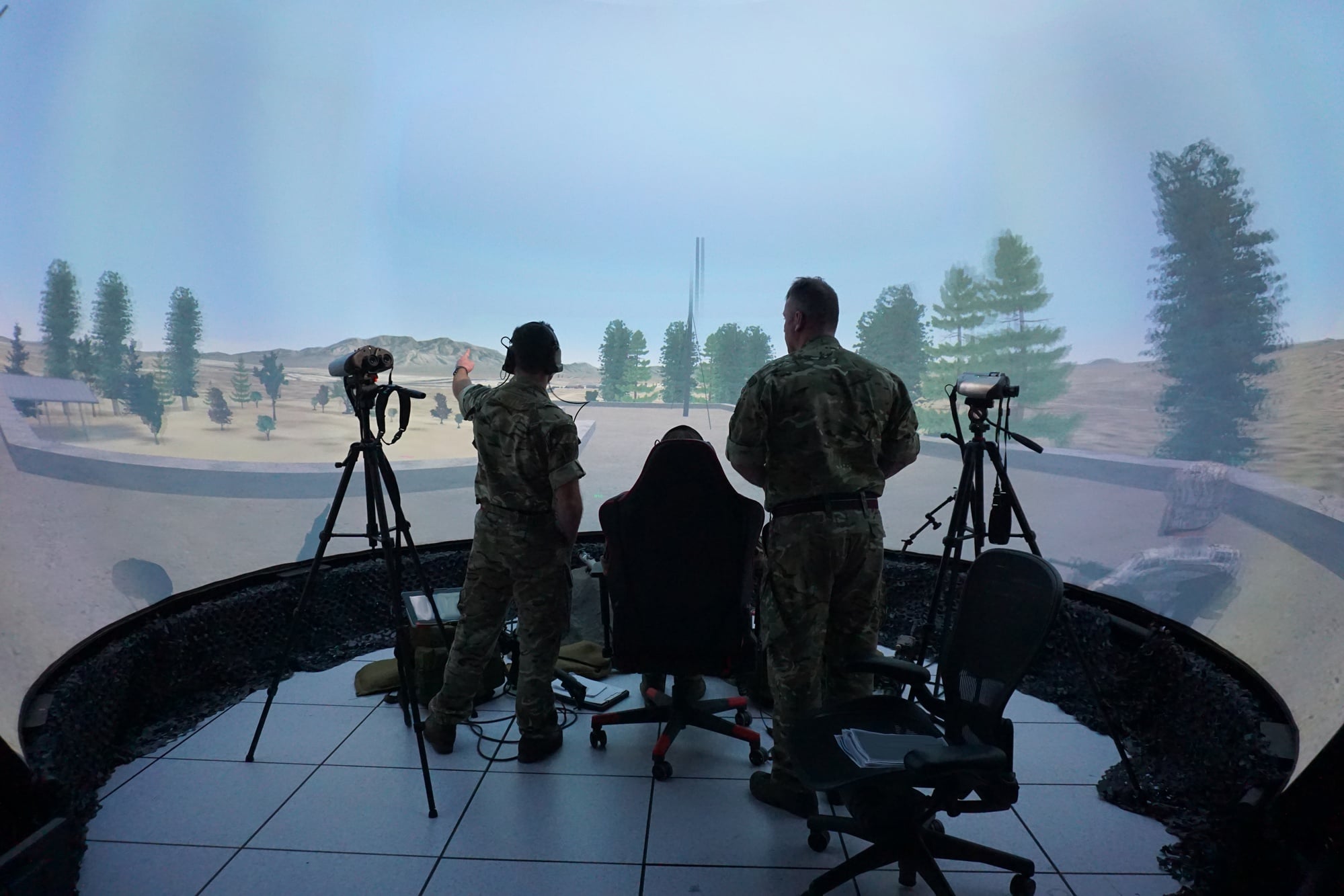
The scale is now genuinely strange. VIRTUAL FLAG 26-4, flown from 3 to 7 August 2026, drew more than 267 participants from 28 units across the Air Force, Space Force, Army, Marine Corps, the United Kingdom and Australia. RAF Typhoon and Voyager crews flew tactical simulators at RAF Waddington, more than 4,000 miles from Kirtland. RAAF battle managers ran E-7 simulators from Australia, more than 8,000 miles away. They were all in the same fight.
The 505th Command and Control Wing’s own film of Coalition VIRTUAL FLAG 21-1, shot inside the Distributed Mission Operations Center.
The money argument, and its limits
The cost case is the easiest part to make and the easiest to overstate. The cleanest sourced comparison is also the oldest: in 2016 the 325th Fighter Wing put an F-15C flying hour at roughly $17,000 by widely accepted methods, while its simulators cost $1.2 million a year to run, working out at about $230 an hour — under one per cent.
For scale on the live side, the Defense Department’s FY2026 reimbursable rates put an F-35A at $18,600 an hour and an F/A-18E at $22,407. Those are billing rates rather than full cost-per-flying-hour accounting, but the direction is not in doubt.
What is in doubt is how much of the syllabus should move. Here the official record is unusually blunt. GAO found in 2016 that aircrews were required to fly 36 simulator missions a year — 48 for F-35 crews — and that the Air Force could produce no analysis supporting either figure. The 36 had been set, GAO wrote, on the capacity of the simulators at one installation. Nobody could explain why the F-35 needed twelve more than the F-22.
Four years later GAO went further. Reporting RAND’s findings in GAO-20-91, it recorded that “no research has been conducted on the appropriate live-to-simulator mix ratio during continuation training in a squadron,” and that establishing one would require robust measures of proficiency that do not currently exist.
That is a remarkable admission to find inside a programme now worth billions. The services are confident that synthetic training works. They cannot yet prove how much of it is the right amount.
What a dome still cannot do
The people building this are not the ones overselling it. When the Air Force opened its $38 million Virtual Test and Training Center at Nellis in August 2020, Peter Zupas, an operational training and test infrastructure analyst at the Air Force Warfare Center, said flatly that simulators are no substitute for live-fly operations. The centre complements live flying. It does not replace it.
Lockheed Martin’s own release makes the same concession in passing, and it is the most interesting sentence in it: simulators and live aircraft together give “repeatable mission scenarios in the simulator” plus “the physical demands of high-G flight.” The dome can give a pilot a thousand repetitions of a tactical problem. It cannot give them the eighth G, the sweat in the mask, or the knowledge that a mistake is permanent.
Which is why the Lemoore demonstration matters more than the September one. Two months earlier, on 21 September 2026, Lockheed Martin connected 16 F-35 full mission simulators at Yuma, Miramar, Iwakuni and Lemoore with F-18 simulators and an E-2D controller at Oceana for a two-hour mission rehearsal. Impressive, and entirely synthetic — nobody left the ground.
In November, six aircraft did. That is the whole point of the word “live” sitting at the front of the acronym: the pilot pulling g over California and the pilot sitting still in a dome are now in the same engagement, shooting at the same adversaries, and only one set of those adversaries is made of metal.
Sources: Lockheed Martin press releases of 17 November and 21 September 2026; DoD 5000.59-M, DoD Modeling and Simulation Glossary, January 1998; AFRL Fights ON! Vol. 33, Winter 2019; GAO-16-864 and GAO-20-91; Nellis AFB and 505th Command and Control Wing fact sheets; Air & Space Forces Magazine; Defense News; NAVAIR; Boeing; Northrop Grumman; Department of Defense FY2026 reimbursable rates.


0 Comments