

Walk up to a flying B-17 Fortaleza Voladora at an American airshow and look at the fuselage beside the crew door. Somewhere near the entrance, in letters between two and six inches high, there will be a word. Most visitors never notice it. It is the single most consequential thing printed on the aeroplane, because it decides what the owner is allowed to do with sixty tonnes of restored history.
On some warbirds that word is EXPERIMENTAL. On a small number it is LIMITED, and almost everyone, including people who work around these aircraft, assumes limited is the normal case. It is not. Limited category is the rarer certificate, the older one, and the one the FAA has no remaining legal mechanism to hand out.
Here is the part that surprises even people who read the regulations for a living. Title 14 of the Code of Federal Regulations contains a section explaining how to get a limited category airworthiness certificate for your aeroplane. It contains no section at all explaining how to get the limited category type certificate that the first section requires you to already have.
Datos rápidos
Certificate: limited category, a special airworthiness certificate issued on FAA Form 8130-7
Issuing rule: 14 CFR 21.189, unchanged in substance since 1965
Operating rule: 14 CFR 91.315, rewritten with effect from 2 December 2024
Prerequisite: the aircraft must already conform to a limited category type certificate
How many such type certificates are published: 33, listed as AL-1 to AL-33 in Table 8-1 of FAA Order 8130.2M
What is on the list: Second World War American military aircraft, every single one
Marking required: the word “limited” near each cabin or cockpit entrance, 2 to 6 inches high (14 CFR 45.23(b))
Live deadline: every letter of deviation authority issued under the old 91.319 terminates on 1 December 2026 (14 CFR 91.326(d)(4))
What 21.189 Actually Says, and How Short It Is
The whole rule fits in a paragraph. An applicant is entitled to a limited category airworthiness certificate when two things are true: the aircraft “has been previously issued a limited category type certificate and… conforms to that type certificate”, and the FAA finds after inspection, including a flight check flown by the applicant, that it is “in a good state of preservation and repair and is in a condition for safe operation”. The FAA then writes whatever limitations it thinks are necessary.
That is it. No design review, no compliance findings against Part 23 or Part 25, no structural substantiation. The regulation does not care how the aeroplane was built, because the whole point of the category is that it was built by Boeing or North American in 1944 to a military specification that no civil certification basis will ever match.
What the rule does care about is condition, and it is not a formality. The current FAA guidance is blunt about what an inspector may demand of a machine that has spent decades outdoors.
Removing rivets and cutting openings. On a seventy-year-old airframe whose owner has just spent a decade and a seven-figure sum putting it back together. That sentence is the real cost of the limited category, and it is why a certificate with almost no paperwork can still be the hard road.

Part 21 Has No Way to Give You the Type Certificate
Subpart B of Part 21 is where type certificates come from, and it is a finite list of doors. Section 21.21 covers normal, utility, acrobatic, commuter and transport category aircraft, plus manned free balloons, special classes, engines and propellers. Section 21.24 covers primary category. Section 21.25 covers restricted category. Section 21.27 covers surplus aircraft of the Armed Forces, and sends them into the normal, utility, acrobatic, commuter or transport categories. Section 21.29 covers imports.
There is no section headed “Issue of type certificate: limited category aircraft”. Read the subpart end to end and you will not find one.
So 21.189 is a door that opens onto a corridor nobody can build any more. The limited category type certificates that exist are survivors of the old Civil Air Regulations, written when thousands of combat aircraft were being sold off into civil hands and somebody had to decide what a surplus Liberator was legally allowed to do. New ones are not issued. The pool is what it is.
Thirty-Three Entries, and the Names Tell the Story
The FAA publishes the list. It is Table 8-1 in Order 8130.2M, the current edition of the airworthiness certification order, and it runs from AL-1 to AL-33.
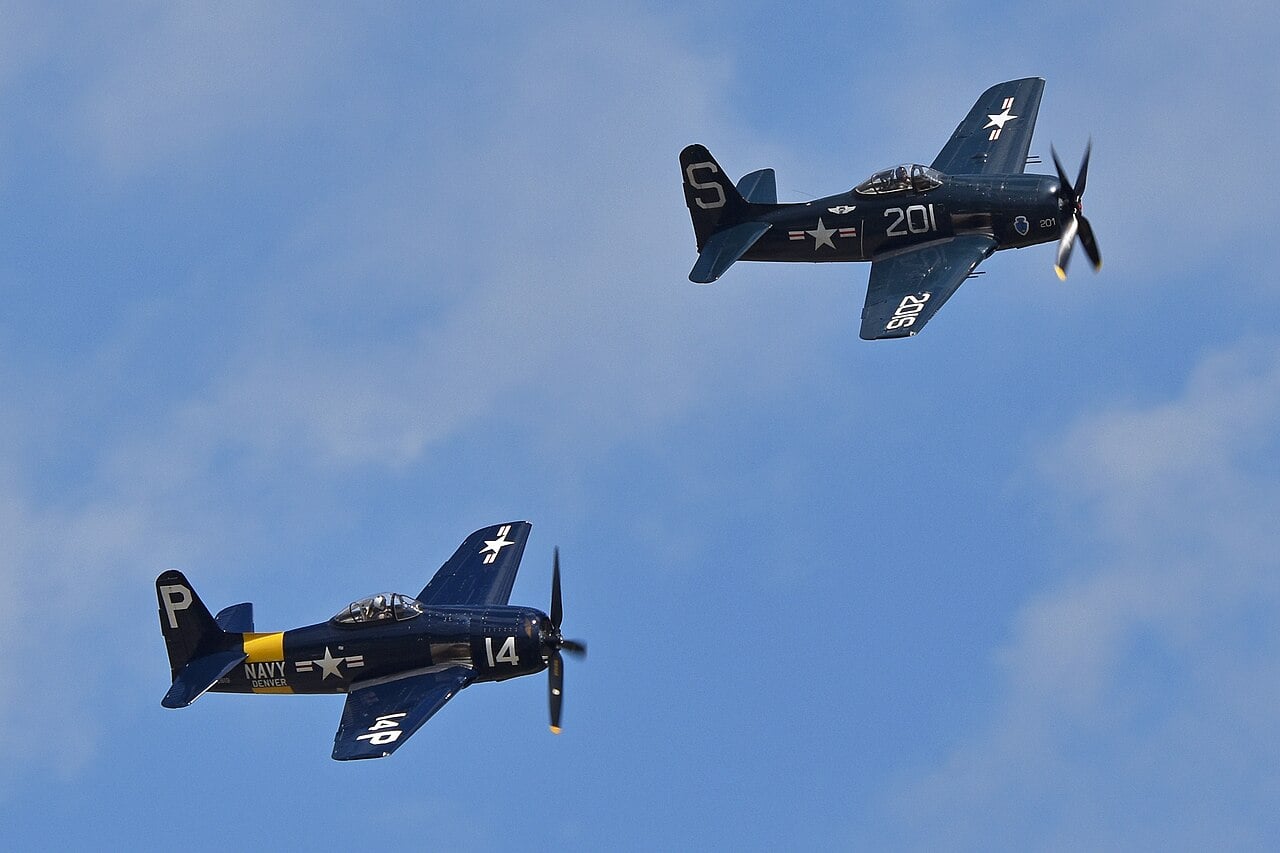
AL-1 is the B-17F and B-17G. AL-2 is the B-25 Mitchell in six variants. AL-3 is the A-26 Invader, AL-8 the Grumman Avenger in six, AL-10 the P-38 Lightning and its F-5 photo-reconnaissance variants, AL-11 the P-51 Mustang, AL-14 the P-61 Black Widow, AL-18 the P-40 Warhawk in L and N models, AL-21 the P-63 Kingcobra, AL-23 the F8F-1 Bearcat. There are three Sikorsky helicopter entries on it, a Martin PBM-5 Mariner flying boat, a Vought Kingfisher floatplane and a Culver target drone.
The column that nobody reads is the one headed TC Holder, and it is the most revealing part of the table. The B-17 certificate belongs to Transcontinental and Western — the airline that became TWA. The Martin B-26 at AL-33 is held by the Tennessee Gas Transmission Company, which wanted a fast twin to patrol pipelines. The Sikorsky R-5A at AL-19 belongs to an outfit called Hel-i-cop Advertising. The Avenger certificate sits with Air Trading Corp, the Liberator with Consolidated Vultee, the Mustang with Cal Pacific.
None of these were museums. The limited category was not written for airshows or for history. It was written in the late 1940s and 1950s so that pipeline patrollers, aerial sprayers, freight haulers and sign-towing operators could legally fly cheap war-surplus metal, and the FAA needed a category that let a B-17 do commercial work without pretending it met civil transport standards. The warbird movement inherited the paperwork of an industry that no longer exists.
One detail is worth noting for anyone who wants to be precise. In Order 8130.2J, the 2017 edition, the table was headed simply “Limited Category TCs”. In 8130.2M, issued on 22 July 2026, the same 33 rows carry a new heading: “Sample of Limited Category TCs”. The FAA has quietly stopped presenting its own table as complete, which is a good reason to check the type certificate data sheet rather than the table if a specific airframe matters.
A full B-17 sortie from the cockpit, with the radio traffic left in. This is the product the limited category and its experimental cousin ultimately exist to make possible.
Why Most Warbirds Are Experimental Instead
If the list is 33 entries long and heavily biased toward large American types, then every warbird not on it — every Spitfire, every Hurricane, every MiG, every Sea Fury, every T-6 Texan, every jet — has to be certificated some other way. That other way is an experimental certificate issued for exhibition under 14 CFR 21.191(j), which Afterburner covered in detail on 1 November in FAA Experimental Exhibition Certificate: How Warbirds Stay Legal.
The trade is straightforward once you see both halves. Experimental exhibition is available to anything, but it comes with a program letter, a defined purpose and a set of operating limitations that constrain where and why the aircraft may fly. Limited category needs no program letter and no annual statement of intent, but it is only open to a type somebody type-certificated decades ago, and it carries its own operating rule.

91.315 Used to Be One Sentence
Until two years ago, the operating rule for limited category aircraft was the shortest regulation in Part 91. In full: “No person may operate a limited category civil aircraft carrying persons or property for compensation or hire.”
Twenty words, no exceptions, no subparagraphs. You could fly your Mustang. You could not be paid to fly anybody else in it, or to carry anything in it, for any reason.
That text is gone. Amendment 91-378, published on 2 October 2024 and effective on 2 December 2024, replaced it with a targeted version. The rule now reads that except as provided in the new section 91.326, no person may operate a limited category civil aircraft carrying persons or property for compensation or hire in operations that require an air carrier or commercial operator certificate under Part 119, are listed in 119.1(e), require management specifications for a fractional ownership programme, or are conducted under Part 129, 133 or 137.
The blanket ban became a list. That matters, because the things it now names are the things a warbird operator would actually want to do. Paid sightseeing is the clearest case: the Part 119 exception for nonstop commercial air tours in 119.1(e)(2) applies only to aircraft holding a standard airworthiness certificate, and a limited category aircraft by definition does not hold one. The door the rule leaves open is not the door the ride business needs. That is why paid warbird flights still run on an exemption, through the Living History Flight Experience programme, which the 1 November piece covers.
The P-40 That Rewrote the Rule
The reason 91.315 changed at all is a Curtiss P-40 Warhawk and an argument about what the word “compensation” means.
An operator, Warbird Adventures, was selling flight instruction in a two-seat TP-40. The FAA’s position was that a student paying for a lesson in a limited category aircraft is a person being carried for compensation, which the old 91.315 prohibited outright, and that the only lawful route was an exemption. The operator did not apply for one, kept advertising, and the FAA issued an emergency cease and desist order. The US Court of Appeals for the District of Columbia Circuit dismissed the petition for review.
The FAA then said so officially. Its policy notice of 12 July 2021, docket FAA-2021-0592, set out the position in terms that left no room:
The notice went further and closed the obvious workaround: 91.315, it said, “does not permit an individual to obtain deviation authority to conduct flight training for compensation or hire”. It also promised to consider a fast-track exemption process and a rulemaking. Both happened. Section 814 of the FAA Reauthorization Act of 2024 forced the issue, and Amendment 91-378 delivered it.
The new 14 CFR 91.326 is what replaced the argument. Flight training, checking and testing in a limited category aircraft is now allowed, with a letter of deviation authority as the default and two carve-outs that need none: where the instructor does not supply both the training and the aircraft, nobody advertises the aircraft for training, and nobody is paid for the use of it beyond ownership and operating expenses; or where nobody is paid for anything at all.
An in-flight walk through a B-17 during a paying passenger flight. The aircraft is Nine-O-Nine, N93012, which crashed at Bradley International Airport in Connecticut on 2 October 2019 with thirteen people aboard. Seven died. The NTSB’s final report in May 2021 cited the pilot’s handling after an engine shutdown, inadequate maintenance, the Collings Foundation’s ineffective safety management system and the FAA’s inadequate oversight of it. The FAA revoked the foundation’s ride-carrying exemption in March 2020 and audited every other exemption holder.
A Deadline Four Weeks Away That Nobody Is Discussing
Buried at the end of 91.326 is a transition provision with a hard date. Every letter of deviation authority issued under the old 14 CFR 91.319 before 2 December 2024 may continue to be used — but only until 1 December 2026, when, in the regulation’s own words, it terminates.
That is four weeks from now. Any operator still flying training on a pre-2024 LODA needs a new one issued under 91.326(b), and the rule asks for the application at least 60 days before the intended operations. For anyone who has not started, the maths no longer works.
What a P-51D costs to own, which is the quiet reason any of this regulatory architecture matters: almost nobody can keep a limited category aircraft flying on private money alone.
The Word by the Door
So the next time you walk past a Flying Fortress on a showground, look for the two-inch lettering beside the crew hatch. If it says LIMITED, you are standing next to one of thirty-three type certificates that the United States government issued to pipeline patrollers and freight operators three-quarters of a century ago, and has never issued again. If it says EXPERIMENTAL, the aeroplane is flying on a program letter and a stated purpose.
Either way, it is in the air because somebody read the regulations very carefully. That is less romantic than the engines, and it is the only reason the engines still run.
Sources: 14 CFR 21.189, 21.21, 21.24, 21.25, 21.27, 21.29, 45.23, 91.313, 91.315, 91.326 and 119.1, read from the GPO Code of Federal Regulations XML on govinfo; FAA Order 8130.2M, Airworthiness Certification of Aircraft, 22 July 2026, chapter 8 and Table 8-1; FAA Order 8130.2J, 21 July 2017; Notification of Policy for Flight Training in Certain Aircraft, 86 FR 36493, 12 July 2021; Amendment 91-378, 89 FR 80310, 2 October 2024; AOPA; FAA Notice N 8900.573; National Transportation Safety Board.



0 Comments