
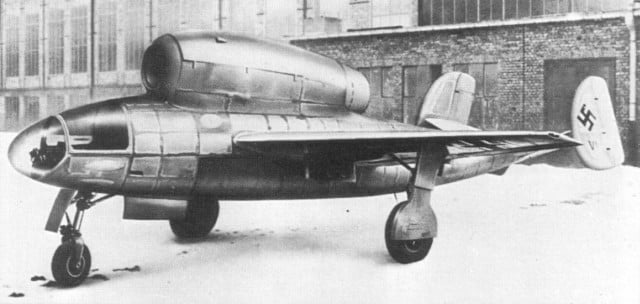
In February 1943 the German Air Ministry asked for a single-seat aircraft to attack invasion shipping. Henschel answered with something that looks, even now, like a mistake in the drawing: a small jet with a turbine bolted to its spine, wooden wings, and a pilot who did not sit in it. He lay in it, face down, chin forward, looking out through a glazed nose a few centimetres above the runway.
The Henschel Hs 132 was not a joke and it was not a paper fantasy. It had a contract, prototypes under construction and a first flight date. It simply never got there.
Datos rápidos
| Tipo | Single-seat jet dive bomber, later proposed as a bomber interceptor |
| Requirement issued | 18 February 1943, by the Reichsluftfahrtministerium |
| Motor | One BMW 003 turbojet of 1,760 lbf, mounted on top of the fuselage |
| Crew position | Prone — the pilot lay on his stomach |
| Estructura | Wooden wings and deliberately simple construction, to spare strategic materials |
| Design load | 12 g, far beyond a conventional dive bomber |
| Speed (Hs 132A) | 780 km/h clean at 6,000 m; 700 km/h with the bomb |
| Armament (Hs 132A) | One 500 kg SD 500 bomb, semi-recessed under the fuselage |
| Prototypes | Six ordered May 1944; three started at Schönefeld in March 1945 |
| Destino | Schönefeld overrun by the Red Army in 1945. Nothing ever flew. |
Why Anyone Would Fly Lying Down
The prone position was not a Henschel eccentricity. It was a serious line of research, and it addressed two real problems at once.
The first is g tolerance. A pilot sitting upright greys out when acceleration drives blood down and out of his head. A pilot lying flat, with heart and brain at roughly the same height, can take noticeably more before that happens. In an aircraft meant to dive at a ship and pull out hard, that matters more than comfort does.
The second is frontal area. A prone pilot needs a shallow nose instead of a deep cockpit, so the fuselage can be thinner and lighter. For an interceptor flying into the massed defensive fire of a B-17 Fortaleza Voladora formation, the chance of being hit is largely a function of how big a target you present head-on. Shrink the frontal area and you shrink the problem.
Germany had already flown the idea. From early 1943 the Akaflieg Berlin B9, a small twin-piston-engined experimental machine, flew with its pilot prone and showed that the position worked: the aircraft could be flown, and the pilot did handle higher loads. It also exposed the catch. Lying down, he could see very little above him and almost nothing behind, which ruled the layout out for anything that had to fight defensively. It suited an aircraft that arrives fast, does one thing and leaves.
Which is precisely what Henschel had been asked to build.
The Cheapest Aeroplane Germany Could Draw
By 1943 Germany was short of aluminium, short of skilled labour and short of time, and the Hs 132 was shaped by all three. The wings were wood. The structure was kept as simple as the job allowed and was meant to be easy to maintain. Nothing about it was elegant, and nothing was supposed to be.
The BMW 003 turbojet sat on the fuselage spine, above the wing, at roughly shoulder height — a consequence of how low the aircraft sat on its nosewheel undercarriage. Aerodynamically this was not the best place for it: the fairings where engine met fuselage cost drag at high speed. Henschel pressed on anyway, encouraged by the fact that the Heinkel He 162 — winner of the Volksjäger competition and an aircraft the Luftwaffe was actually going to receive — used the same engine in the same place.
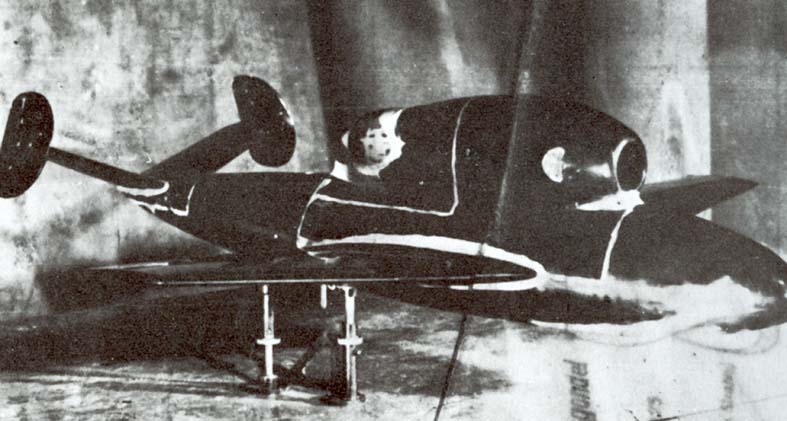
The airframe was stressed for 12 g. That is an extraordinary figure for a bomber of any kind, and it is the number that gives away what the prone cockpit was really for. The attack profile ran like this: begin a shallow dive from outside the ships’ anti-aircraft envelope, accelerate to 910 km/h, toss the 500 kg bomb at the target using a computing sight, then haul out and climb away before the gunners could do anything about it. The pull-out was the violent part, and the pilot had to stay conscious through it.
The computing bombsight never arrived.
Vector 1945 on the Hs 132: the requirement, the layout and how far it actually got.
Four Weeks Short
Henschel put the proposal to the Air Ministry in April or May 1944, by which point wind tunnel work on the layout was already running. A contract for six prototypes was approved in May 1944. Construction of the first three began at the company’s plant at Schönefeld, on the south-eastern edge of Berlin, in March 1945.
That timing tells the rest of the story. The Hs 132 V1 was scheduled to begin flight testing roughly a month after the Red Army reached Schönefeld. The plant was overrun, the incomplete prototypes were taken, and what the Soviets did with them afterwards is unknown. Several developed versions had been sketched out and none of them mattered any more: an Hs 132B with a Junkers Jumo 004 and two 20 mm MG 151/20s, an Hs 132C with the bigger Heinkel HeS 011 and 30 mm cannon for shooting at bombers rather than ships, and an Hs 132D with a longer wing.
The HeS 011 was still pre-production when the war ended, which was true of a great many German projects that looked convincing on paper in 1945.
The Idea Outlived the Aircraft
Germany was not alone. In the United States, Northrop built the XP-79B, a magnesium flying wing whose pilot also lay prone; it flew once, on 12 September 1945, went out of control during a slow roll and killed test pilot Harry Crosby. We have written about that one separately.
The most thorough answer came a decade later, and it came from Britain. The RAF Institute of Aviation Medicine needed a jet to find out whether a prone cockpit was viable for future fighters — Bristol had proposed one for its Type 185 rocket interceptor. The last production Meteorito Gloster F8, serial WK935, was handed to Armstrong-Whitworth, who grafted an entirely new prone cockpit onto the nose, complete with a purpose-built couch, an offset stub control column and suspended rudder pedals hung in front of the pilot. The original fighter cockpit stayed where it was, with a safety pilot in it. WK935 was never flown solo from the front.
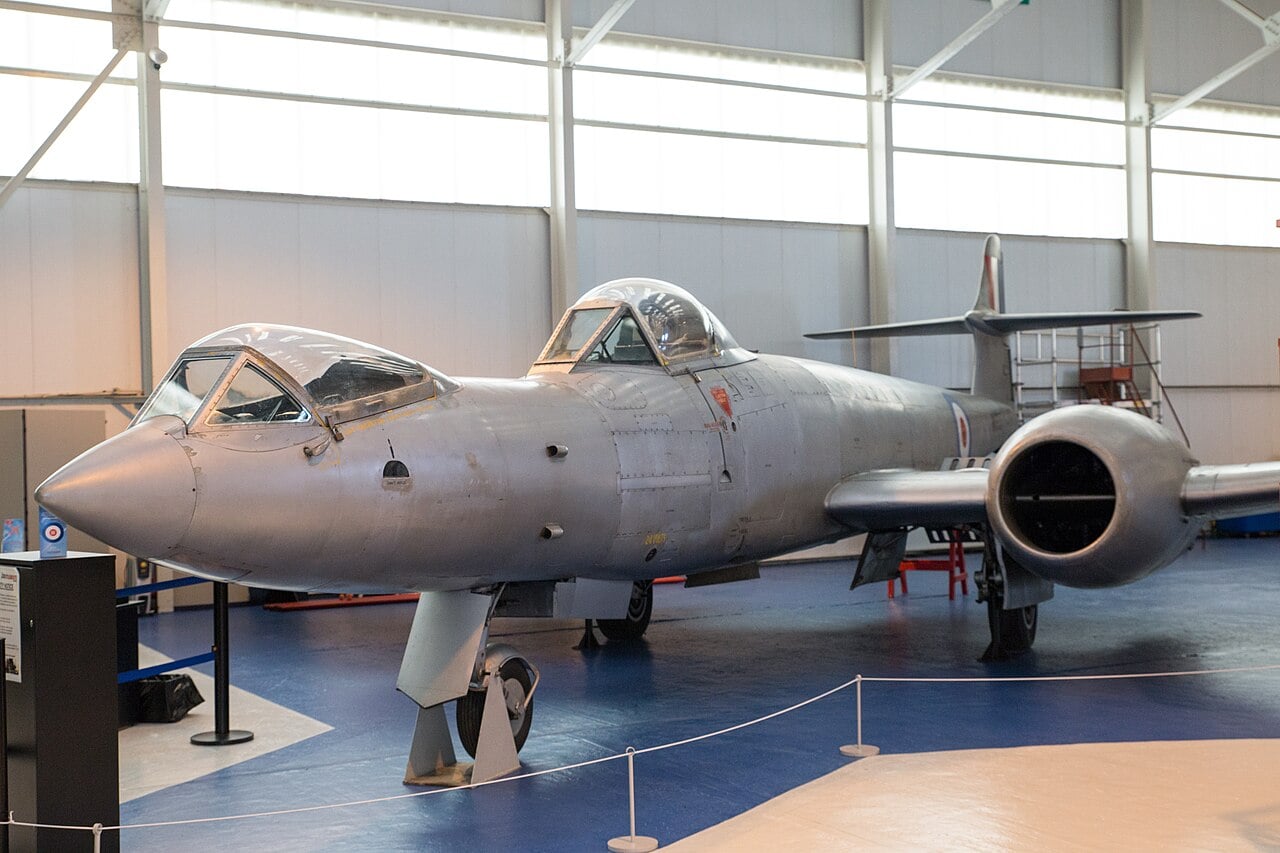
It first flew on 10 February 1954 and completed 99 flights and some 55 hours. The verdict was inconclusive in the polite sense and negative in the practical one. Prone pilots flew the aircraft about as well as anyone flew a normal Meteor. But the view aft was hopeless in mock combat, and the escape procedure was a nightmare on paper and was never used: jettison the rudder pedals, crawl backwards to a hatch, retract the nosewheel, and get out.
By then the argument had been settled elsewhere anyway. The g-suit — a pair of inflatable trousers — delivered most of the tolerance benefit without rebuilding the aeroplane around the pilot. WK935 was retired after a year. It survives, and you can go and look at it.
WK935 in the museum: a walk round the only prone position Meteor ever built.
So the Hs 132 was not mad. It was an aggressive answer to a real problem, built in the cheapest materials available by a country that had run out of the expensive ones. The idea behind it got a fair and far better funded trial nine years later, in peacetime, with instrumentation and a safety pilot, and was found wanting for reasons that had nothing to do with whether a man can fly lying down. He can. He just cannot see behind him, and he cannot get out.
Sources: Wikipedia entries for the Henschel Hs 132, the Akaflieg Berlin B9, the Northrop XP-79 and the Gloster Meteor F8 “Prone Pilot”, drawing on Smith and Kay, German Aircraft of the Second World War; Green, Warplanes of the Third Reich; Jones and Young on WK935; and the Newark Air Museum loan announcement for the aircraft’s current location.
0 Comments