
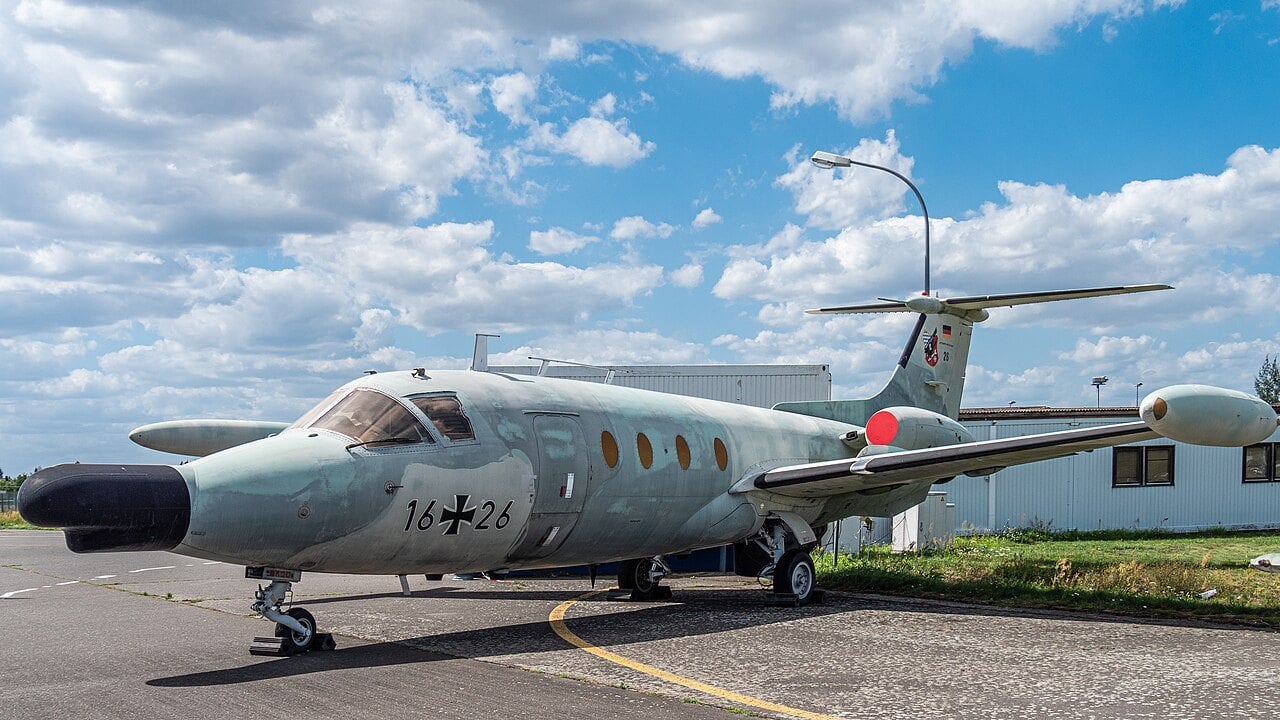
Look at a business jet from above and its wings are either straight or swept back. That goes for every one of them, from the first Learjet to the newest Gulfstream, with a single exception. In the 1960s a company in Hamburg built a ten-seat executive jet whose wings swept forward, like a fighter from a science-fiction film.
It was the HFB 320 Hansa Jet, and it remains the only civilian jet ever to fly with a forward-swept wing. The idea behind it came straight out of a secret Second World War bomber programme.
Datos rápidos
- Aeronave: HFB 320 Hansa Jet, twin-jet business aircraft
- Fabricante: Hamburger Flugzeugbau (HFB), Hamburg-Finkenwerder
- Chief designer: Hans Wocke, formerly of the Junkers Ju 287 programme
- Primer vuelo: 21 April 1964 (prototype D-CHFB)
- Motores: Two General Electric CJ610 turbojets
- Seats: Up to 12 passengers
- Construido: 47 by 1973 (some sources say 45)
- Biggest user: German Air Force, 16 aircraft: VIP transport and ECM training until 1994
A Learjet rival from Hamburg
In the early 1960s Bill Lear was about to show the world that a small, fast jet could sell to business owners. In Hamburg, Hamburger Flugzeugbau, the aircraft company of the Blohm and Voss shipbuilding group, was looking for a project of its own. It had been building the Nord Noratlas under licence and was a partner in the Transall C-160 programme, but it wanted its own aircraft.
A planned 80-seat airliner, the HFB 314, had died for lack of government money in 1959 and 1960. Studies for a business aircraft began straight afterwards. According to Werner Blohm, going ahead with the jet was his father’s quick decision alone, and his authority and experience prevented anyone from turning it down. The forward-swept wing was settled on early.
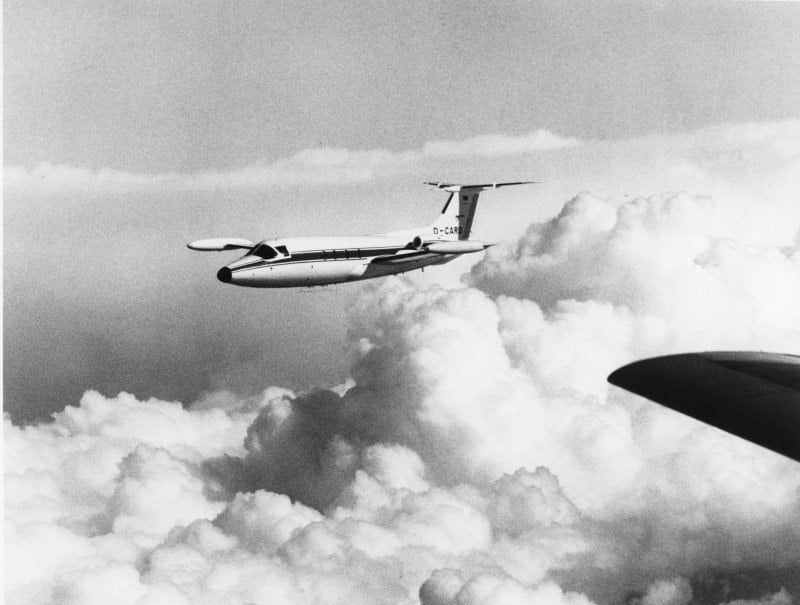
The man who made the wing work was Hans Wocke, head of HFB’s design office. During the war, as an engineer at Junkers, he had worked on the Junkers Ju 287, the jet bomber that first flew a forward-swept wing in 1944. After the war he was taken to the Soviet Union with other Junkers engineers, then worked in East Germany before moving to Hamburg in 1957.
Why sweep the wing forward?
The reason was the cabin. A small jet with a mid-mounted wing is aerodynamically efficient, but the wing’s main spar has to pass straight through the fuselage, usually right where the passengers want to stand. Sweeping the wing forward let the designers put the spar box behind the cabin, leaving a cabin about 15 feet long and 69 inches high with nothing in the way.
There were aerodynamic gains too. On a forward-swept wing the airflow starts to separate near the root first, so the ailerons out at the tips keep working as the aircraft slows down. That promised gentle low-speed handling.
The price was structural. A forward-swept wing tends to twist its tips upwards under load, so the HFB 320 needed a stiff, heavy wing. The engineers also pushed the tip tanks well forward, using their weight to help steady the tips, and fitted a large fin to deal with sideslip. Wind tunnel testing in Göttingen, Amsterdam, Emmen and at Torrejón in Spain ran to roughly 2,600 hours.
Archive footage of the HFB 320 Hansa Jet and its forward-swept wing.
First flight, and a hard lesson
Power came from two General Electric CJ610 turbojets, the same engine as the Learjet, because there was simply no other small jet engine in quantity production at the time. Spain’s CASA and the German firm Siebel built parts of the airframe. On 21 April 1964 the prototype, D-CHFB, took off from Finkenwerder at 10.29 in the morning and landed at Lemwerder 73 minutes later.
Flight testing moved to Torrejón in Spain, where the team flew more than 650 stall tests on 80 flights. On 12 May 1965 the first prototype entered a deep stall that turned into a flat spin. The anti-spin parachute could not recover it, and the company’s chief test pilot was killed. HFB modified the stall warning system and added a stick pusher.
German certification came on 23 February 1967, and the American FAA followed on 7 April 1967. The Hansa Jet seated up to 12 passengers and cruised at up to 825 km/h at 25,000 feet.
A crowd-pleaser that did not sell
It was certainly noticed. The CJ610s were powerful but loud and thirsty, and the Hansa needed a lot of runway, around 5,900 feet of balanced field length at maximum weight, which kept it out of many small airports. Early aircraft went through brakes at an alarming rate, until thrust reversers and bigger brakes arrived. A drag chute was available as an option.
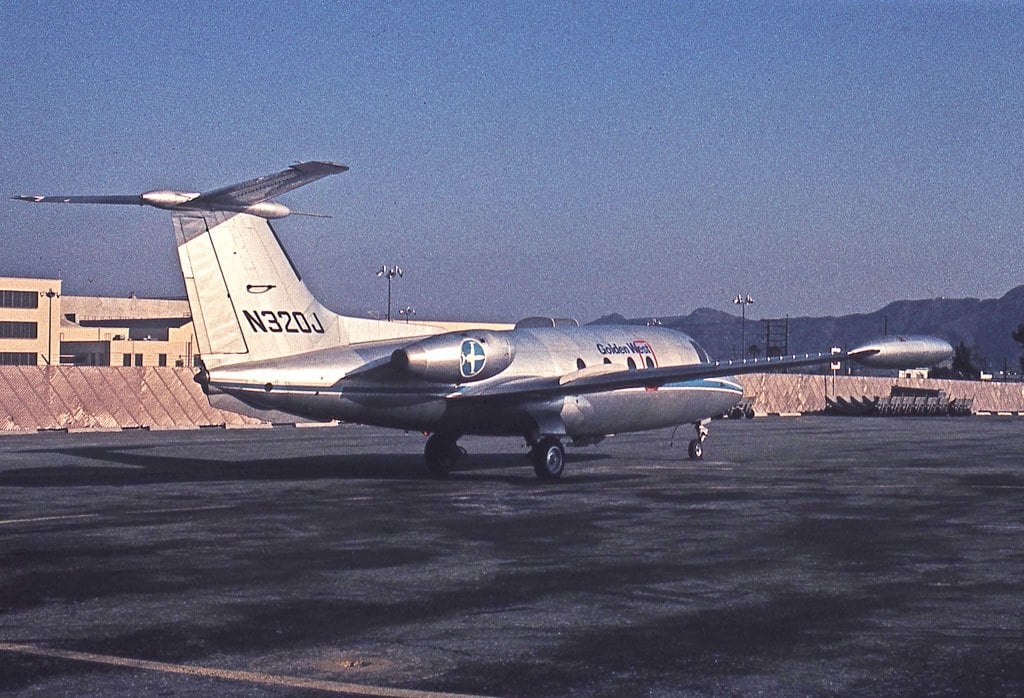
Collins also judged that HFB’s sales and service effort was half-hearted, and customers stayed away. Golden West Airlines and other American operators flew Hansas, but the market belonged to the Learjet, the Sabreliner and the Hawker Siddeley 125.
Production ended in 1973 after 47 aircraft, by Flight International’s count, some sources say 45. HFB stopped just short of the 50 aircraft that would have meant repaying development funding to the city of Hamburg, because it was clear by then that the programme would never make money. A planned stretched successor with turbofans, the HFB 330, never flew.
A walkaround of Hansa Jet TC-LEY, a former Luftwaffe VIP aircraft that ended its days in Turkey.
The Luftwaffe’s Hansa
The biggest customer was the German Air Force, which had 16 in all. Six flew government VIPs with the Flugbereitschaft, the ministry of defence’s transport wing, until Canadair Challengers took over that job in the 1980s. Eight more were delivered between 1976 and 1982 as electronic warfare trainers, jamming radars so that crews could practise against them. Those ECM Hansas soldiered on until 1994.
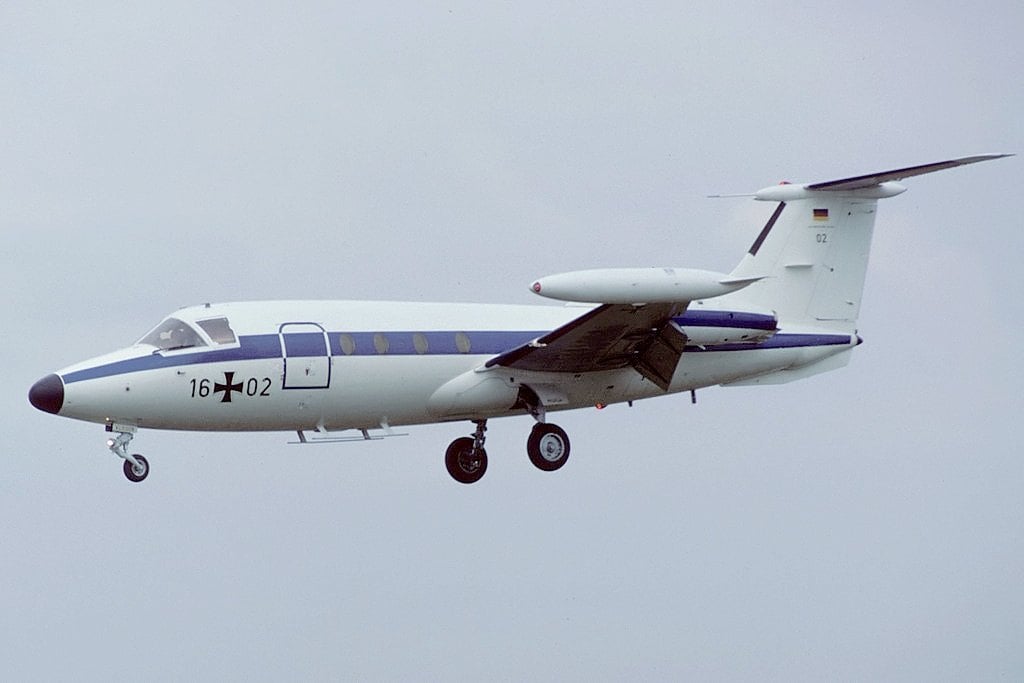
Civil Hansas ended up as freighters, and an operator in Turkey flew them until the early 2000s. The last one active in the United States crashed in St. Louis in 2004 on a maintenance flight, after the pitch trim had been rigged in reverse and not checked before take-off. Too few remained to justify hush kits or new engines.
Back to Finkenwerder
The Hansa Jet left a legacy far larger than its sales figures. HFB went on to become part of Messerschmitt-Bölkow-Blohm, and Hans Wocke led the newly founded Deutsche Airbus. Finkenwerder, where the prototype first flew, is today one of Airbus’s biggest sites.
In 2010 a club called Ein Hansa Jet für Hamburg moved former Luftwaffe aircraft WN1025, retired in 1987 by the Bundeswehr’s test centre at Manching, into an Airbus hall at Finkenwerder to restore it, with the aim of flying it again. Its chairman, Wolfgang Borgmann, told Flight International that the airframe was in surprisingly good shape.
Former Luftwaffe Hansa Jet WN1025 leaves Hamburg Airport for the Airbus plant at Finkenwerder on 16 January 2010.
Other Hansas are on display in museums, among them an ECM aircraft at the Bundeswehr’s military history museum at Berlin-Gatow. Look at one from above and the wings still seem to be on backwards. Two decades later, the Grumman X-29 and then the Sukhoi Su-47 brought the forward-swept wing back as cutting-edge research. A small German business jet had flown the idea in everyday service decades earlier.
Sources: Flight International (2011), AOPA Pilot (2017), Aviation International News (2006), Deutsche Gesellschaft für Luft- und Raumfahrt, Hamburg branch (HFB 320 lecture, 2008), Jane’s All the World’s Aircraft 1973-74

0 Comments