
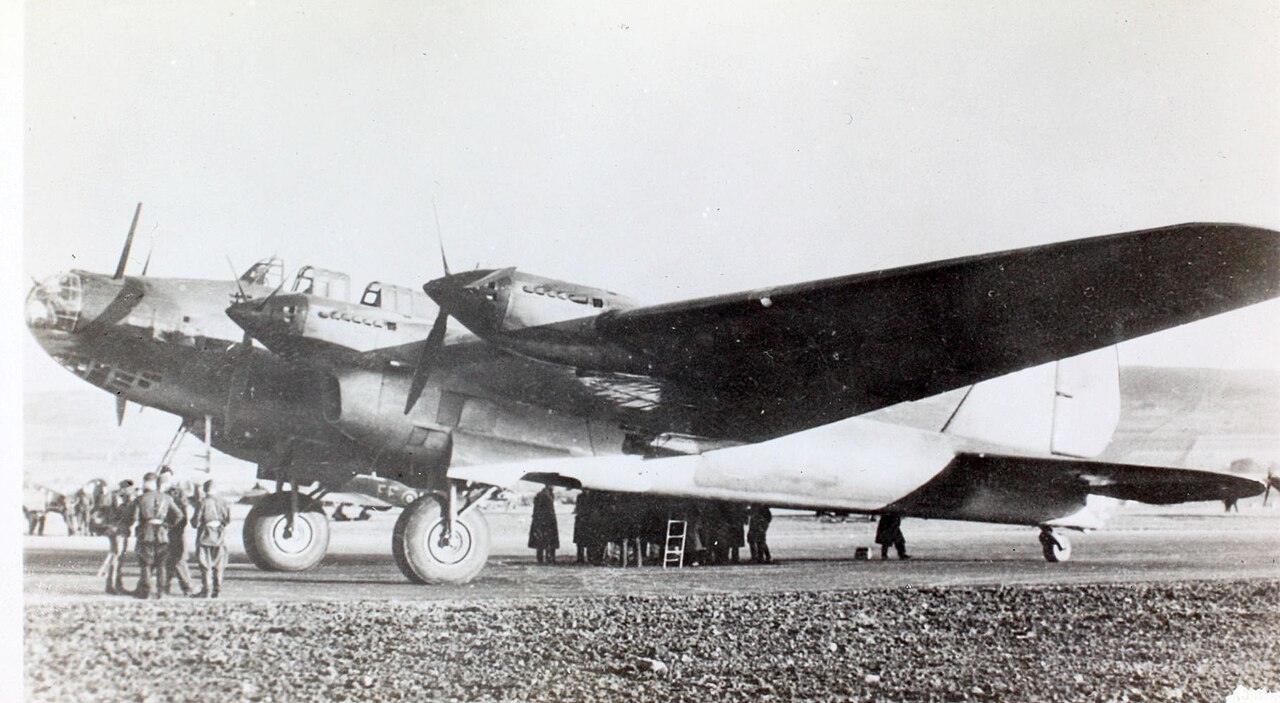
On 19 May 1942 a four-engined bomber lifted off from Ramenskoye, outside Moscow, and turned west towards a continent that Germany controlled from the Atlantic to the Volga.
In the fuselage, sitting on a bench in a heavy flying suit with an oxygen mask over his face, was Vyacheslav Molotov, the Soviet Foreign Minister. He was going to London to see Churchill, and then to Washington to see Roosevelt, to ask for a second front.
Both the British and the Americans had offered to send an aircraft. Stalin refused. If his foreign minister was going to cross the Atlantic, he would do it in a Soviet machine, and the Soviet Union had exactly one type capable of the job: the Petlyakov Pe-8.
Datos rápidos
| Aeronave | Petlyakov Pe-8, construction number 42066, the 28th of 93 built |
| Motores | Four Mikulin AM-35A V12s of 1,340 hp |
| Passenger | Vyacheslav Molotov, Soviet People’s Commissar for Foreign Affairs, and a delegation of nine |
| Capitán | Maj. Endel Puusepp, known in Russian as Endel Pusep |
| Salido | Ramenskoye, near Moscow, 19 May 1942 |
| First landing | Tealing, Scotland, 20 May 1942, after about 15 hours |
| Outbound leg | Roughly 2,700 km flown at 3,000 to 6,000 m, outside air temperature down to -45C |
| Washington | Reached at the end of May via Prestwick, Reykjavik and Goose Bay |
| Hogar | Departed 4 June via Gander, Reykjavik and Prestwick; back near Moscow on 13 June |
| Resultado | Puusepp was made a Hero of the Soviet Union |
The Only Aeroplane That Could Do It
The Pe-8 was the only four-engined heavy bomber the Soviet Union built in series during the war, and there were never many. Ninety-three were completed in total. It began life in 1934 as the ANT-42, designed by a team under Vladimir Petlyakov inside Andrei Tupolev’s bureau, and it was supposed to be the centrepiece of a Soviet strategic bomber force to rival the British and American heavy fleets.
It never was. Both Tupolev and Petlyakov were arrested in the purges of 1937 and 1938 and put to work in NKVD prison design bureaus, which removed the programme’s two most important engineers at exactly the wrong moment. By 1940 only a handful had been built. The type was renamed Pe-8 in 1942, after Petlyakov himself was killed in an air crash.
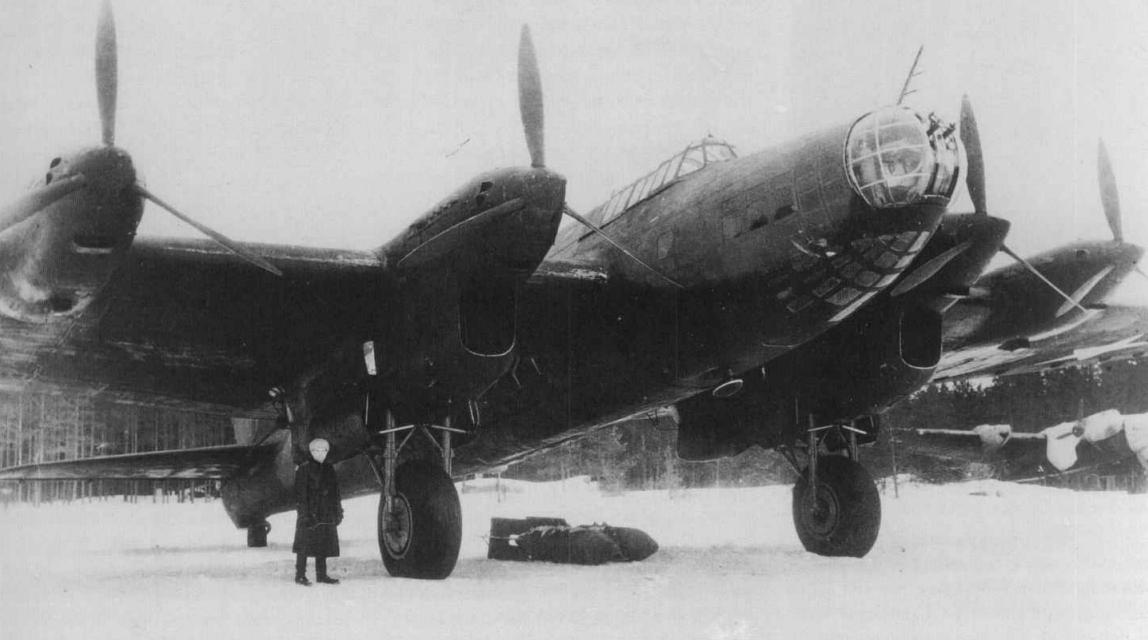
What survived was an aircraft that could fly a long way, very high, and was mechanically unreliable enough that crews planned around failure rather than hoping to avoid it.
The Rehearsal That Killed the Captain
Nobody sent the Foreign Minister across occupied Europe without trying it first. In April 1942 a Pe-8 flew diplomatic staff and mail non-stop from Moscow to Britain, proving the route and the aircraft.
The rehearsal ended badly. Four members of the Soviet military mission boarded an RAF de Havilland Flamingo, R2764 of 24 Squadron, for an internal flight in Britain on 30 April. Over North Yorkshire the starboard engine failed and caught fire; the fire burned through the wing, the engine tore away and struck the tail, and the aircraft came down near Great Ouseburn. Everyone aboard was killed. Among the dead was Maj. Asyamov, the Pe-8 captain who had flown the test run. A detailed investigation with Soviet officers present found no evidence of sabotage.
Command of the aircraft passed to Asyamov’s co-pilot: Endel Puusepp, a Siberian-born Estonian who had spent the 1930s flying instruments and ice reconnaissance in the Soviet Arctic, including landings at the North Pole-1 drifting station, and who by April 1942 had completed thirty night bombing missions against Berlin, Danzig and Königsberg.
Rex’s Hangar on the Pe-8: what the Soviet Union wanted from a heavy bomber, and why it never got it.
Fifteen Hours at Minus Forty-Five
For the mission the Pe-8 was fitted with oxygen equipment, which tells you most of what you need to know about the flight plan. The route to Scotland ran roughly 2,700 km at between 3,000 and 6,000 metres, crossing the front line and German-held airspace at night and skirting neutral Sweden. Puusepp recorded outside air temperatures of minus forty-five.
They landed at Tealing in Scotland on 20 May after about fifteen hours. Photographs from the day show Molotov climbing out in a heavy flying suit and boots to be met by RAF officers, looking less like a foreign minister than a man who had just spent the night in the back of a bomber, which is exactly what he was.
On 24 May they went on for Washington, routing via Prestwick, Reykjavik and Goose Bay, and reached the American capital at the end of the month. Several tyres burst on landing. B. F. Goodrich measured the Soviet wheels and built a new set in two days.
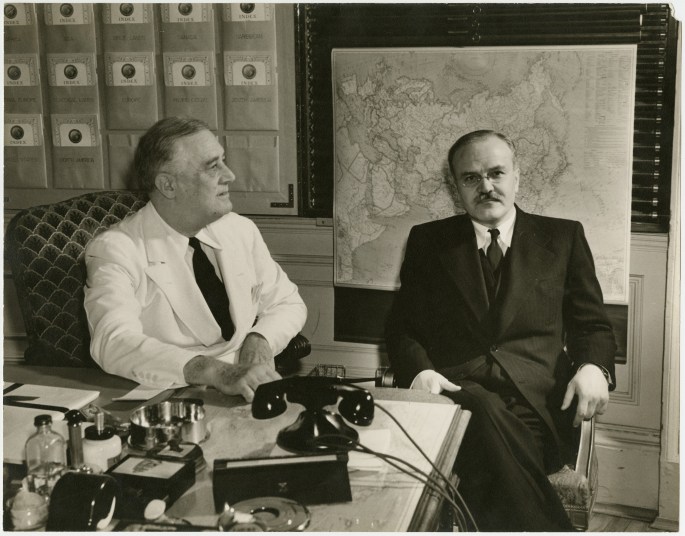
Roosevelt made a point of meeting the aircrew.
Going Home by Lying About It
The return leg was the dangerous one, and Puusepp knew it. The negotiations were finished; if the Germans had worked out that the Soviet delegation was still in the West, the route home over occupied Europe was an obvious place to wait for it.
So the Soviet press announced that the delegation had already arrived safely back in Moscow — while the aircraft was still on the wrong side of the Atlantic. Only after the disinformation had run did the Pe-8 set course east. It left on 4 June, staged through Gander, Reykjavik and Prestwick, crossed the ocean mostly at 8,000 metres, flew through German-controlled airspace without being touched, and landed near Moscow on 13 June.
Puusepp was made a Hero of the Soviet Union for the flight. He went back to bombing, took shrapnel in the spine, had five operations, never fully recovered, and retired a colonel in 1946. He later ran road transport for the Estonian SSR and sat as vice chairman of its Supreme Soviet. He died in Tallinn in 1996.
Dark Skies on the Pe-8 and the campaign to destroy the small number that existed.
The diplomacy is remembered as a disappointment: Molotov got warm words about a second front in 1942 and did not get the invasion. The flight is remembered differently. An unreliable bomber, built in the nineties, flown by a man who had learned his trade over Arctic ice, carried a head of government’s deputy across a hostile continent and an ocean and brought him home. In 1942 that was not a routine capability. It was a statement, and everybody involved understood it as one.
Sources: Wikipedia entries for the Petlyakov Pe-8 and Endel Puusepp, checked against WarHistory.org; the Charles M. Daniels collection, San Diego Air and Space Museum; Yorkshire Aircraft and 24 Squadron RAF Association records of Flamingo R2764; crew recollections collected at Iremember.ru as cited by Kinville.
0 Comments