
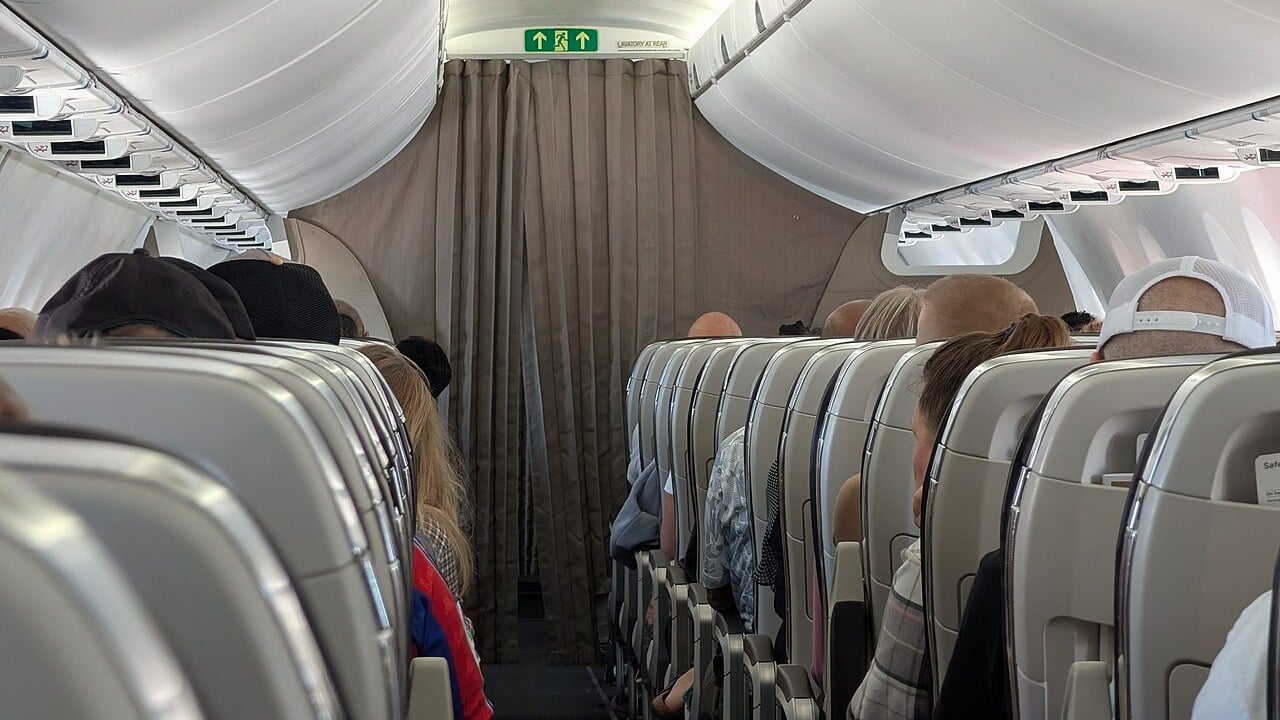
Somewhere over the ocean, a passenger stands up, refuses to sit down, and starts shouting. Cabin crew try the usual escalation. It does not work. Eventually the man is in plastic restraints at the back of the aeroplane with two volunteers sitting beside him, and the captain is on the satellite phone to the company.
Almost everything about what happens next is decided by a treaty signed in Tokyo in 1963, before the Boeing 747 existed, and by a short amending protocol that took until 2020 to come into force because not enough countries had bothered to ratify it.
The question that treaty answers is narrower than people assume, and the question it failed to answer for fifty-seven years is the one that actually matters: when the aeroplane lands, can anybody do anything at all?
Datos rápidos
Governing treaty: Convention on Offences and Certain Other Acts Committed on Board Aircraft, signed at Tokyo 14 September 1963
In force since: 4 December 1969, with 188 States Parties
Captain's power: Article 6, "reasonable measures including restraint"
The 1963 gap: Article 3 gave jurisdiction to the state where the aircraft is registered, not where it lands
La solución: Montreal Protocol 2014 (MP14), in force 1 January 2020, 58 States Parties
Incident rate: one report per 355 flights in 2025, improved from one per 307 in 2024 (IATA)
US criminal maximum: 20 years under 49 U.S.C. 46504, or life if a dangerous weapon is used
US civil maximum: the FAA publishes $43,658 per violation, and one incident can draw several
UK: up to five years for endangering an aircraft; a GBP 2,500 fine for disruptive behaviour towards crew
The commander is the law, for as long as the wheels are up
Article 6 of the Tokyo Convention is the provision every cabin crew training course is built on, and it is worth reading in the original rather than the paraphrase. The aircraft commander may, where he has reasonable grounds to believe a person has committed or is about to commit an offence or an act jeopardising safety or good order, "impose upon such person reasonable measures including restraint".
Three conditions are attached, and they are the whole of the captain's authority: to protect the safety of the aircraft or the people and property in it, to maintain good order and discipline on board, or to make it possible to hand the person over to the authorities on landing. That is not a general power to punish. It is a power to contain.
The same article does something quietly clever about everybody else on the aeroplane. The commander may require other crew members to help. He may request or authorise, but not require, the help of passengers. And any crew member or passenger may act on their own initiative, without being asked, when they have reasonable grounds to believe immediate action is needed to protect the aircraft or the people in it. That last sentence is the legal basis for the rugby team that piles on the man trying to open a door at cruise, and it exists because in 1963 somebody had the sense to see that the captain would be busy flying.
The limits nobody quotes
Two things about Article 6 get overstated in almost every write-up.
The first is how long the restraint may last. Article 7 says it "shall not be continued beyond any point at which the aircraft lands", with narrow exceptions, and the commander must notify the authorities of the state of landing that he has a restrained person on board, and why. Restraint is a flight-phase power. It expires roughly when the aeroplane does.
The second is the immunity. Article 10 is routinely described as blanket protection for crew who restrain somebody, and it is not. Read it: for actions taken in accordance with this Convention, neither the commander, nor any crew member, passenger, owner or operator "shall be held responsible in any proceeding on account of the treatment undergone by the person against whom the actions were taken". Two limits are built into that sentence. The protection only covers action that was itself within the Convention, which means proportionate action for one of the three permitted purposes. And it only bars claims about the treatment of the restrained person. It is a shield against being sued by the man in the cable ties, not a general licence.
Fifty-seven years of walking away
Here is the flaw that made the Tokyo Convention famous among aviation lawyers and useless to a great many cabin crew.
Article 3 is three short paragraphs, and the first is the problem: "The State of registration of the aircraft is competent to exercise jurisdiction over offences and acts committed on board." Where the aircraft happens to land does not come into it.
Picture what that means in practice. An aircraft registered in one country, operated by an airline based in a second, flying between a third and a fourth, with a passenger who holds the passport of a fifth. He assaults a flight attendant at cruise. The aeroplane lands. Police come aboard, work out that the only state with clear jurisdiction under the treaty is the one on the registration plate, which is several thousand kilometres away and has no interest in a prosecution it cannot run, and the man is released at the terminal door.
This is not a theoretical complaint. It is the industry's own, and IATA has been blunt about the consequence.
IATA adds a figure to that, and it is worth attributing carefully, because it is the airlines' own account rather than a measured statistic: its member airlines say the jurisdiction problem is why prosecutions do not proceed in around 60 per cent of unruly passenger cases.
WMUR-TV interviews a passenger who helped subdue an unruly man on a United flight. Article 6 is why he was allowed to.

MP14: the state of landing finally gets a say
The repair was agreed in Montreal on 4 April 2014 and is known to everyone in the business as MP14. It does one central thing: it adds the state where the aeroplane lands, and the state of the operator, to the list of countries competent to act.
The drafting is in two layers, and the distinction is the sort of thing that decides real cases. One paragraph is permissive, saying a state "is also competent" to exercise jurisdiction as the state of landing when the aircraft lands in its territory with the alleged offender still on board. A second is mandatory, requiring states to establish that jurisdiction where the aircraft's last take-off or next intended landing was in its territory, the aircraft then lands there with the offender aboard, and the safety of the aircraft or good order on board was jeopardised. A further paragraph asks a state exercising landing-state jurisdiction to consider whether the conduct is also an offence in the state of the operator.
MP14 also writes in-flight security officers into the text for the first time, extending to them both the power to act without the commander's authorisation where they are deployed under an agreement between states, and the Article 10 immunity. It is careful to add that nothing in the Convention obliges a state to run such a programme at all.
The catch is arithmetic. The Tokyo Convention has 188 States Parties. MP14, in force since 1 January 2020, has 58. The fix exists; most of the world has not adopted it. If your flight lands somewhere that has not ratified, the 1963 gap is still open underneath you.
How often does it actually happen?
Less often than the viral clips suggest, and the trend is downwards. IATA's Incident Data eXchange, drawing on 93,107 incident reports from more than 140 operators, puts the rate at one reported incident per 355 flights in 2025, improved from one per 307 in 2024. Non-compliance with crew instructions remains the most frequently reported category, and reports involving verbal abuse and intoxication both fell.
Note what IATA does not publish: a percentage breakdown by category. Anyone quoting "x per cent of incidents are verbal abuse" is quoting something IATA has not released. The one hard per-category figure in the public record is older, from 2022, when physical abuse was running at roughly once every 17,200 flights.
The American numbers are published in far more detail, and they tell the story of the pandemic years better than any anecdote. The United States recorded 1,161 unruly passenger reports in 2019. In 2021 it recorded 5,973, a jump of 492 per cent. It has been falling ever since without getting back to where it started.
What it costs you in America
Two separate systems can come after an American unruly passenger, and they are often confused.
The criminal one is 49 U.S.C. 46504, and it is severe. Anyone on an aircraft in the special aircraft jurisdiction of the United States who, by assaulting or intimidating a flight crew member or flight attendant, interferes with their duties or lessens their ability to perform them "shall be fined under title 18, imprisoned for not more than 20 years, or both". If a dangerous weapon is used, the ceiling becomes any term of years, or life. That statute traces back to an act of Congress of 5 September 1961, the same legislation that produced America's first sky marshals.
The civil one belongs to the FAA, and it is money rather than prison. Since 13 January 2021 the agency has run a zero-tolerance policy, announced after the surge visible in the chart above, under which it does not issue warnings or counselling but pursues legal enforcement. The FAA publishes a ceiling of $43,658 per violation and stresses that a single incident can produce several violations. It is worth knowing that even that figure trails the regulation behind it: the civil penalty table at 14 CFR 13.301 sets $44,792 for violations occurring on or after 30 December 2024, and the statutory ceiling in 49 U.S.C. 46318 is $35,000, with the published numbers being inflation adjustments on top.
In 2026 to date the FAA has logged 1,509 reports, opened 108 investigations, initiated 88 enforcement actions and levied $1.7 million in fines.
CBS Boston on the FAA zero-tolerance policy at the moment it was introduced in January 2021.
The no-fly list that does not exist
This is the most widely repeated wrong thing about unruly passengers, so it is worth stating plainly: the FAA cannot put you on a no-fly list. It has no such power.
The agency says so itself. Under the heading of travel restrictions it names exactly two consequences, and a federal watchlist is not among them: unruly behaviour can affect your TSA PreCheck eligibility, or land you on an internal no-fly list belonging to an airline. The airline bans are real and some of them are permanent, but they are a commercial decision by a private company, not a government sanction.
The federal No Fly List is a different thing entirely. It is a subset of the terrorist watchlist administered by the FBI-run Terrorist Screening Center, and every criterion for inclusion is terrorism-based: a threat of committing an act of international or domestic terrorism with respect to an aircraft, a threat with respect to the homeland, a threat against a US government facility abroad, or being operationally capable of a violent act of terrorism. Being drunk and obnoxious at row 23 is not on the list, and the FAA is not among the agencies that can nominate anybody to it.
What the FAA can do, and has done, is refer the worst cases to the FBI for criminal review, and work with TSA to strip PreCheck from passengers it has fined.
Who are the people who might be sitting next to you
The Federal Air Marshal Service is the one part of this story the public most wants numbers for, and the one place numbers are deliberately absent.
TSA dates the service to 2 March 1962, when Attorney General Robert F. Kennedy swore in the first class of 18 sky marshals, FAA inspectors who had volunteered and trained to protect aircraft from air piracy. TSA marked the sixtieth anniversary in March 2022 and describes that FAA programme as the groundwork for the modern service. Two other dates circulate and both are traceable to something real but different: the enabling statute was passed on 5 September 1961, and the much larger Treasury and Customs sky marshal programme, stood up after the 1970 hijacking wave, is a separate lineage altogether.
After 11 September 2001 the service was folded into the new TSA and expanded enormously. How enormously, nobody outside will say. TSA's own at-a-glance fact sheet is happy to quantify almost everything it does, down to the number of canine teams and explosives specialists, and when it reaches air marshals it offers one sentence: thousands are deployed every day on domestic and international flights. No headcount. No percentage of flights covered. Any figure you read for either is somebody's estimate, not TSA's.
NBC News on an incident in which federal air marshals broke cover in flight to detain a passenger, the rare moment the service becomes visible.
Britain, where the punishment depends on the verb
The United Kingdom does not rely on the treaty for its domestic offences. The Air Navigation Order 2016 creates them, and the sentencing is split in a way that rewards reading carefully.
Article 240 makes it an offence to act recklessly or negligently in a manner likely to endanger an aircraft or any person in it, and that carries up to five years on indictment. Article 242 says a person must not enter any aircraft when drunk, or be drunk in any aircraft, and that carries up to two years.
Article 245 is the one that catches most real behaviour, and it is deliberately split. Using threatening, abusive or insulting words towards a crew member, or behaving in a threatening, abusive, insulting or disorderly manner towards them, is a summary offence with a maximum fine of level 4 on the standard scale, which is GBP 2,500. Refusing to obey the commander's lawful commands under Article 244 sits in the same band. But intentionally interfering with a crew member's performance of their duties, Article 245(c), jumps to the two-year bracket.
So in British law, swearing at a flight attendant and physically preventing one from doing her job are not the same offence, and the gap between them is a fine and two years in prison.
What it all adds up to
The system is a patchwork, and it shows its age. A treaty written when a transatlantic crossing still meant a propeller somewhere in the fleet gives the captain a containment power that works well, and gave the world a jurisdiction rule that worked badly for over half a century. The fix exists and a third of the world has signed it.
For a passenger, the practical summary is short. In the air, the commander decides, the crew must help and you may. On the ground, whether anything happens to the person in the cable ties depends less on what he did than on which countries' lawyers were in the room in Montreal. And in the United States, the thing that will actually reach him is not a no-fly list but a civil penalty with five figures in it.
Sources: United Nations Treaty Series Vol. 704, Convention on Offences and Certain Other Acts Committed on Board Aircraft (Tokyo, 1963), Articles 1, 3, 6, 7 and 10; Protocol to Amend the Convention (Montreal, 2014), Articles IV, VII and IX; ICAO, current lists of parties; IATA, Fact Sheet: Unruly Passengers, June 2026, and IATA press release of 4 June 2023; US Code, 49 U.S.C. 46504 and 46318; eCFR, 14 CFR 13.301; FAA, faa.gov/unruly and the Zero Tolerance toolkit; FAA Security and Hazardous Materials Safety data to 15 November 2026; FBI, Overview of the US Government Terrorist Watchlisting Process, April 2024; TSA press release of 2 March 2022 and TSA at a Glance; legislation.gov.uk, Air Navigation Order 2016 Articles 240, 242, 244, 245 and 265 and Schedule 13; Sentencing Act 2020 s.122.


0 Comments