
On 25 March 1958, a silver jet fighter on approach to Altenrhein lost its hydraulic flight controls over Lake Constance. Lieutenant Jean Brunner pulled the ejection handle, the aircraft plunged into the lake near Rorschach, and Switzerland’s dream of building its own front-line combat jet sank with it.
Six days earlier, the Swiss government had ordered 100 of them. The FFA P-16 was a home-grown ground-attack fighter designed for the narrow Alpine valleys, and its story ended in a way no one at the Altenrhein factory could have imagined: as the wing of the world’s most famous business jet.
Quick Facts
- Aircraft: FFA P-16, single-seat ground-attack jet fighter
- Builder: Flug- und Fahrzeugwerke Altenrhein (FFA), Switzerland
- First flight: 25 April 1955, prototype J-3001
- Supersonic: 15 August 1956, J-3002 in a dive
- Engine: Armstrong Siddeley Sapphire turbojet (Sapphire 7 on later aircraft)
- Armament: Two 30 mm cannon, 44 rockets in a retractable launcher, underwing stores
- Built: Five aircraft; two lost in Lake Constance, both pilots ejected safely
- Order: 100 ordered on 19 March 1958, cancelled after the 25 March crash
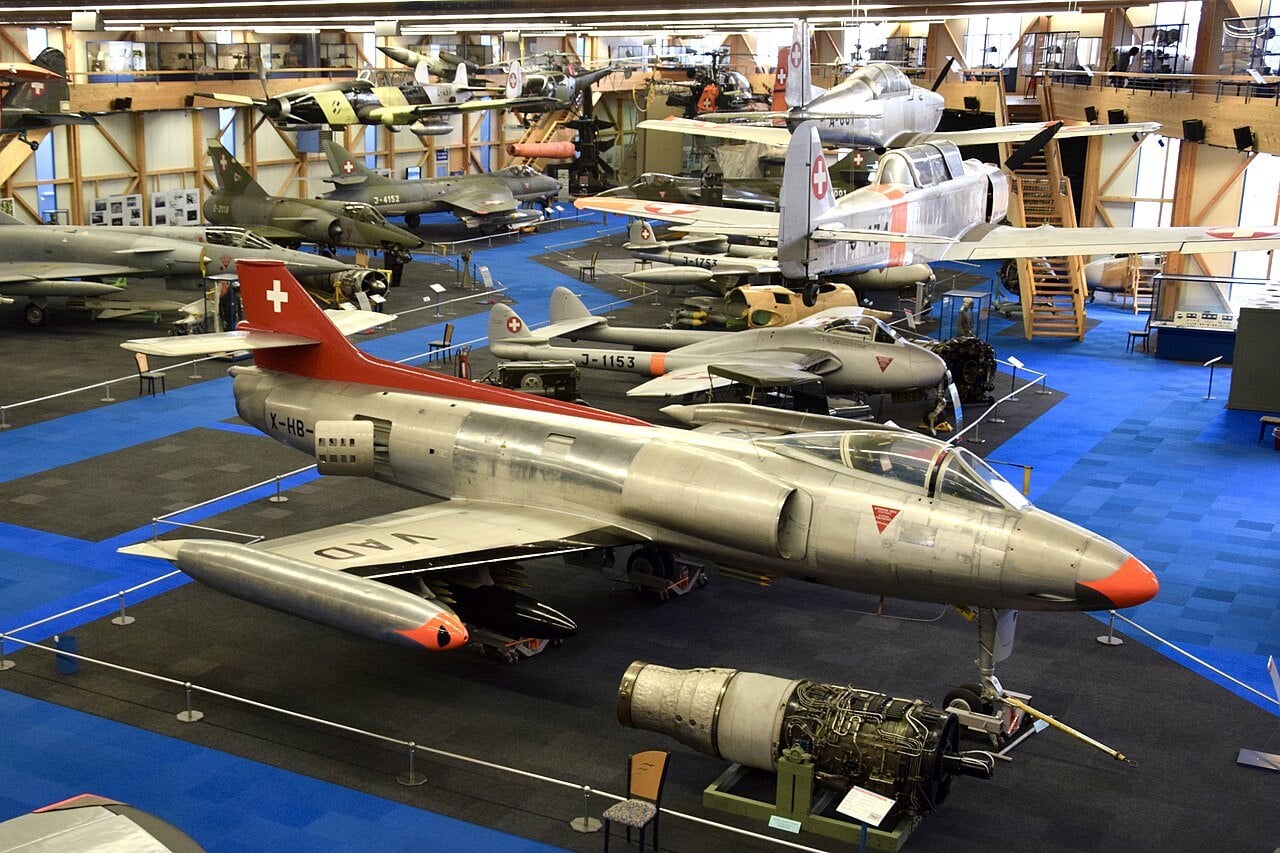
- Survivor: X-HB-VAD, Swiss Air Force Museum, Dübendorf
- Legacy: Its wing was the basis for the Learjet 23
A fighter for the valleys
Switzerland came out of the Second World War with a fleet of piston-engined aircraft and a determination to master the jet age. Two firms competed for the task. The federal factory at Emmen pursued the ambitious four-engined N-20, while Flug- und Fahrzeugwerke Altenrhein (FFA), on the Swiss shore of Lake Constance, worked on a simpler single-engined design.
The Swiss Air Force needed a successor for its obsolete close-support aircraft, and Swiss geography wrote the specification. The new jet had to fly in and out of short strips deep in mountain valleys, handle well at low speed and still be fast and heavily armed. In 1952, FFA received an order for two prototypes of its P-16.
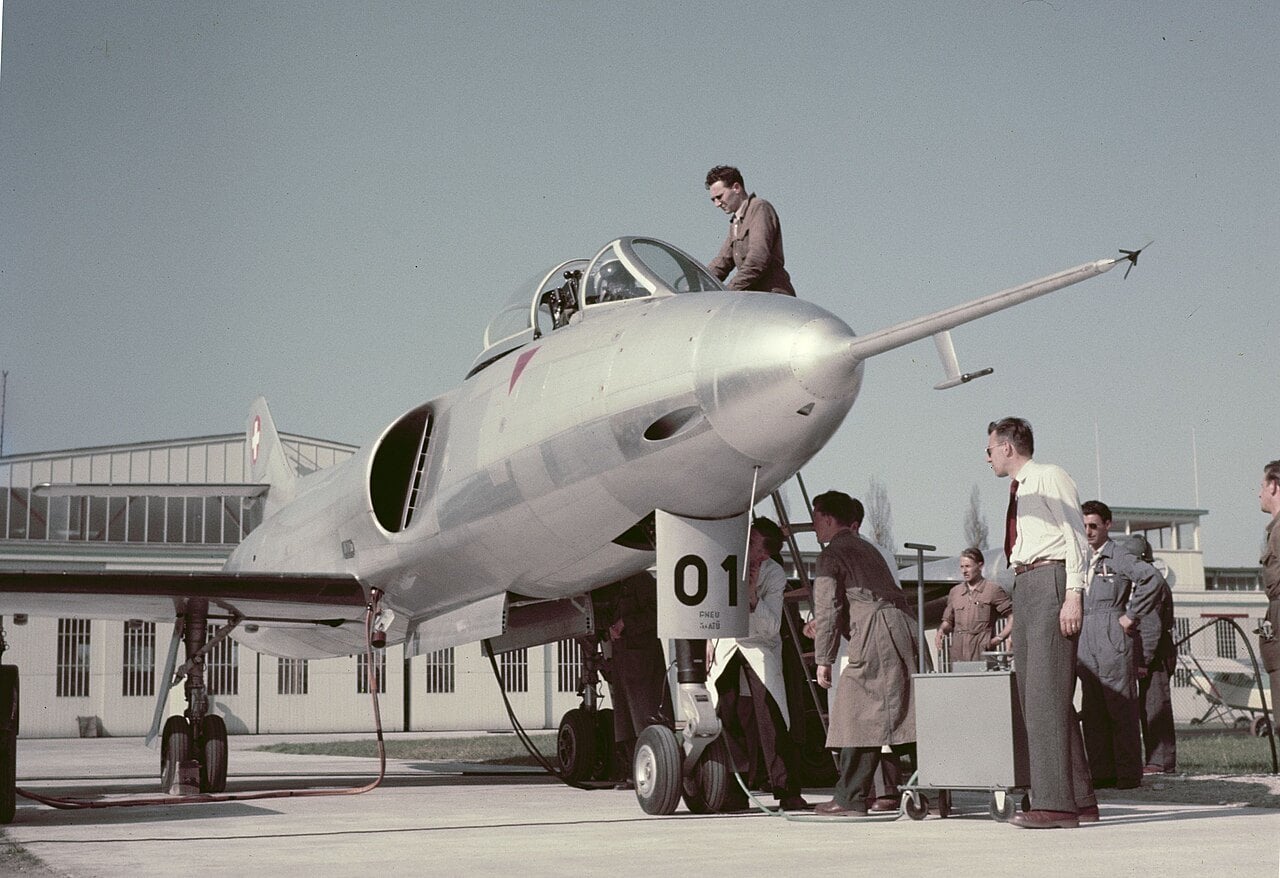
The design team, led by Hans Luzius Studer, gave the P-16 a thin, straight, low-aspect-ratio wing with permanently attached tip tanks and an arsenal of high-lift devices: full-span Krueger flaps on the leading edge, big Fowler flaps at the trailing edge and drooping ailerons. A tough undercarriage with twin wheels on every leg was built for rough fields. Power came from the British Armstrong Siddeley Sapphire, the engine used in some versions of the Hawker Hunter.
First flight, first swim
On 25 April 1955, test pilot Hans Häfliger took the first prototype, J-3001, into the air at Altenrhein. Four months and 22 flights later, on 31 August 1955, a fuel pressure line broke and the engine flamed out. Häfliger tried to glide back to the airfield, but came down short and ejected safely as the jet went into Lake Constance.
Archive footage of the first FFA P-16 prototype in 1955.
The loss looked worse than it was. Lear Jr., who later studied both accidents before flying the type himself, concluded that the jet had been recoverable. According to his account, there was enough height to glide home, but the air brakes were left out and the jet fell short of the runway.
The second prototype, J-3002, took over the test programme in June 1956, and on 15 August 1956 it went supersonic in a dive. The Swiss Air Force put it through trials, and in 1957 a pre-production aircraft with the more powerful Sapphire 7, J-3003, joined the programme.
On 19 March 1958, with parliament’s approval, Switzerland ordered 100 P-16s for 407 million francs. Then, on 25 March, J-3003 suffered its hydraulic failure. According to the account later given by Bill Lear’s son, the pilot ejected without trying the backup system. Brunner, like Häfliger before him, escaped unhurt. Nobody died in either crash.
The order that sank
The political damage was fatal. Within a day, the government moved to halt the contract, and the order was cancelled before a single production aircraft was finished. Federal Councillor Paul Chaudet cited the crashes and a lack of confidence in the manufacturer. Critics had already found a cruel nickname: with two jets lying at the bottom of the lake, the P-16 became “the Swiss Submarine”.
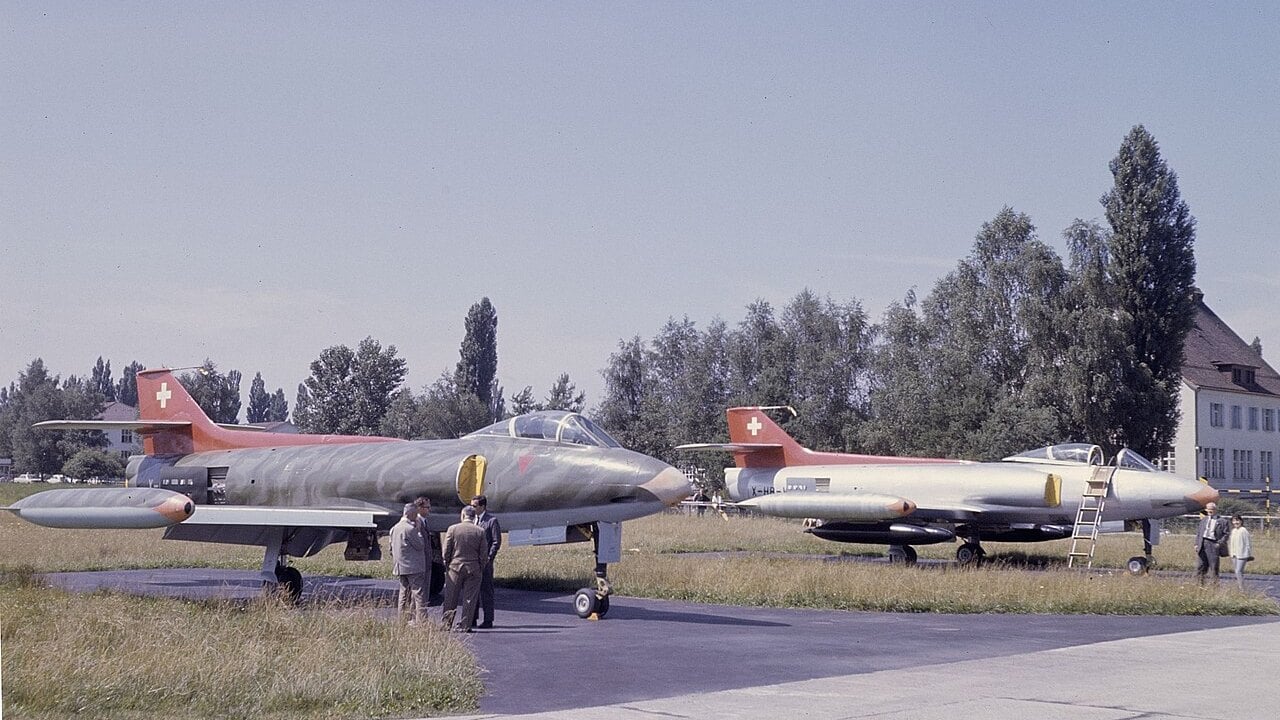
Switzerland had decided earlier in 1958 to buy Hawker Hunters to complement its de Havilland Venom fleet, and the Hunter went on to serve the Swiss Air Force until 1994. FFA refused to give up. At its own expense it completed two more P-16 Mk IIIs, flying them under civil registrations X-HB-VAC and X-HB-VAD in July 1959 and March 1960. They were fully armed, with two 30 mm cannon and a retractable launcher for 44 rockets, and X-HB-VAC wore camouflage.
Period footage of the P-16 ground-attack fighter, posted by the swisstestpilot channel.
On paper the P-16 was formidable. The Swiss-made 30 mm guns fired heavy, high-velocity shells, the retractable rocket launcher sat between them, and underwing pylons carried bombs, napalm and more rockets. At sea level it could reach roughly 1,100 km/h, and in a shallow dive it slipped past Mach 1. For a ground-attack jet built to operate from short valley strips, it was a potent package.
No buyer came. FFA kept proposing improved versions into the 1960s, but the project was finally abandoned in 1969. Almost everything was scrapped. A single P-16, X-HB-VAD, completed with parts from its sister ship, survives at the Swiss Air Force Museum in Dübendorf.
From Swiss fighter to American business jet
The P-16 did have one more chapter. In 1960, FFA asked William P. Lear Jr., an American pilot running his family firm’s Swiss operation in Geneva, to evaluate the aircraft. He flew it several times, came away impressed, and passed his enthusiasm to his father, the inventor and entrepreneur Bill Lear, who was looking for a team to build a fast business jet.
Bill Lear founded the Swiss American Aviation Corporation and hired Studer and the idle FFA engineers. Their design, the SAAC-23, used a modified P-16 wing, with the same multi-spar construction and wingtip fuel tanks. Frustrated by the pace in Switzerland, Lear moved the project to Wichita, Kansas, in 1962. The first Learjet 23 flew there in October 1963.
How much of a Learjet is really a P-16 remains a matter of family pride. Lear Jr. insisted the business jet was a new design that borrowed only the best features of the Swiss fighter, chiefly its eight-spar, fail-safe wing structure and its airfoil. Either way, the line of descent is clear, and the wingtip tanks give it away.
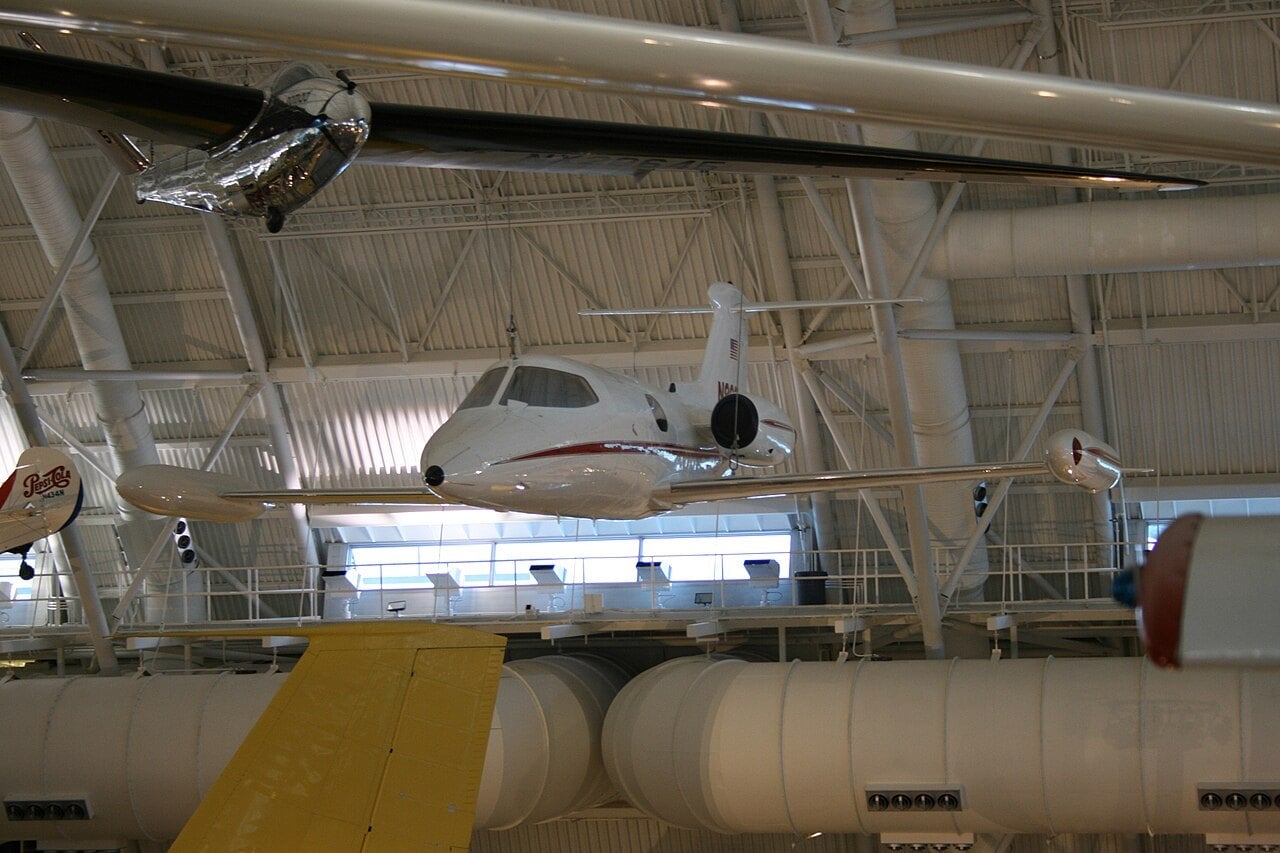
Switzerland never again tried to build its own fighter. But every time a Learjet climbs out from an airport somewhere in the world, a little of the jet that was meant to roar through the Alpine valleys goes with it.
Sources: St. Galler Tagblatt (2025), Robert Craig Johnson (Chandelle, 1997), Tested, Aviation International News (William P. Lear Jr., 2007), Georges Bridel (Schweizerische Strahlflugzeuge und Strahltriebwerke, 1975), Hanspeter Strehler (Das schweizer Düsenflugzeug P-16, 2004)
0 Comments