
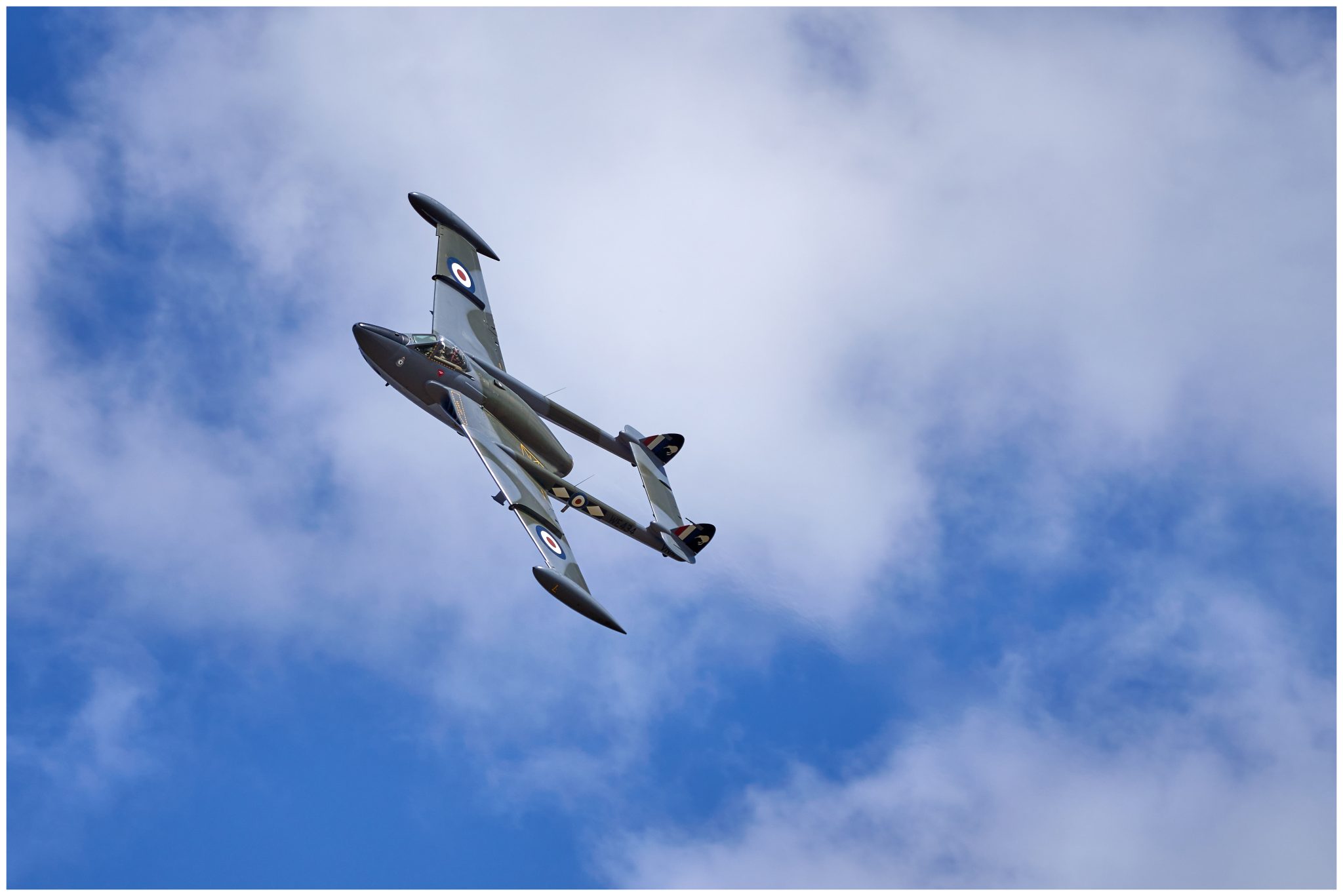
de Havilland Venom
& Sea Venom
Britain’s twin-boom early jet, developed from the Vampire with a thinner wing and a more powerful de Havilland Ghost engine — a fighter-bomber, all-weather night-fighter and carrier-borne naval strike jet that fought at Suez and flew on in Switzerland until 1983.
The de Havilland Venom and Sea Venom: Britain’s twin-boom jet fighter-bomber
The de Havilland Venom was born from a simple wish: to take the promising but underpowered Vampire and make it faster, higher-flying and harder-hitting. De Havilland kept the Vampire’s distinctive twin-boom layout — a short, egg-shaped fuselage pod with the tail carried on two slender booms — but gave the new aircraft a thinner, sharper wing and a far more powerful engine. The result, first flown on 2 September 1949, looked like a Vampire but flew like a different animal.
The transformation came from the de Havilland Ghost, a big centrifugal-flow turbojet developed from the Vampire’s Goblin. Producing around 4,850 lb of thrust, it pushed the Venom to roughly 640 mph and up towards 40,000 feet — a genuine improvement in the era when jet fighters were still finding their feet. Armed with four 20 mm Hispano cannon and able to carry bombs and rockets under its wings, the single-seat Venom FB.1 entered RAF service in 1952 as a fast, punchy fighter-bomber.
The Venom was never a world-beater in the way the swept-wing Hawker Hunter that followed it was — its straight wing and early engine put it firmly in the first jet generation. But it was rugged, simple and effective, and it arrived just when the RAF needed numbers. It served across the world, and above all in the heat: Venoms flew ground-attack strikes in the Malayan Emergency — more than 300 sorties against guerrillas before the type was withdrawn from Malaya in late 1957 — and operated in the tense skies over Aden and the Middle East.
De Havilland also turned the Venom into a night-fighter. The two-seat NF.2 and improved NF.3 carried an airborne-interception radar and a second crewman to work it, giving Fighter Command an all-weather interceptor while more modern designs were still on the drawing board. That radar-equipped, two-seat formula led directly to the aircraft’s most distinctive branch — the navy version.
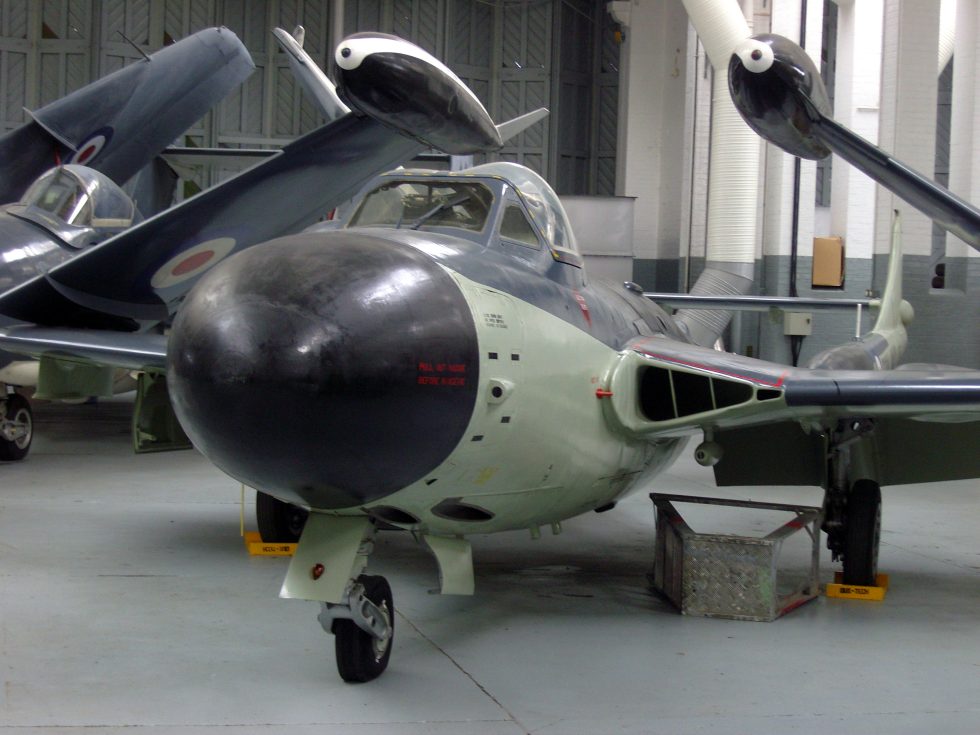
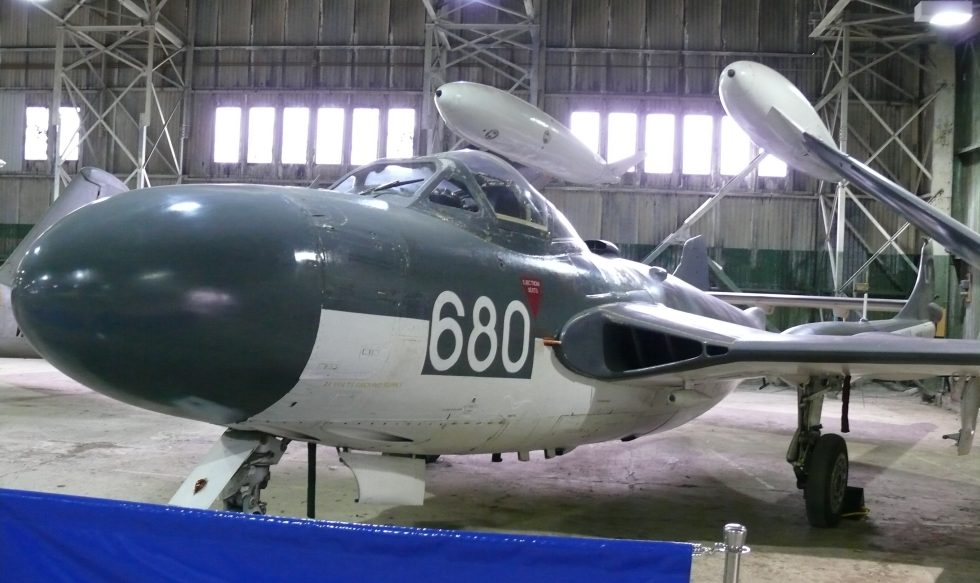
The Sea Venom was a proper carrier aeroplane: folding wings, an arrester hook, a strengthened long-stroke undercarriage and, up front, the same two-seat radar cockpit as the night-fighter. First flown in 1951, it gave the Royal Navy’s Fleet Air Arm its first effective all-weather jet. Sea Venoms saw combat in the 1956 Suez Crisis, flying strike sorties from the carriers HMS Eagle, Albion and Bulwark during Operation Musketeer. The French Navy liked the design enough to build it under licence as the Aquilon, and the Royal Australian Navy flew its own Sea Venoms well into the 1960s.
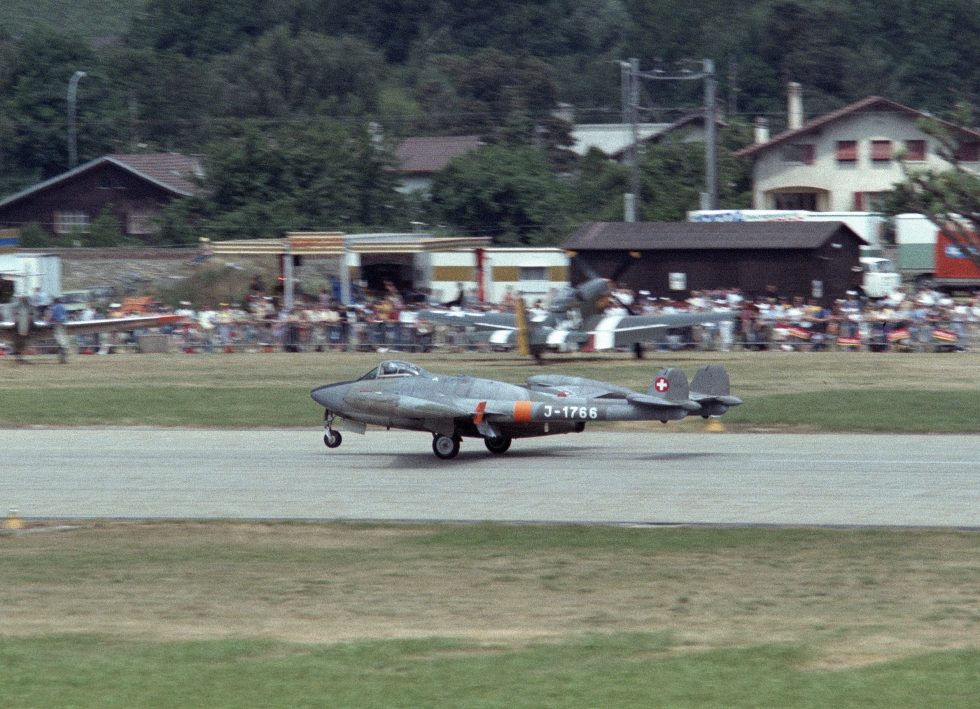
The Venom’s longest and most famous career, though, was neutral. Switzerland license-built the type in large numbers and flew it from Alpine airfields for three decades — long after the RAF had moved on. When the Swiss Air Force finally retired its Venoms in 1983, they were the last operational Venoms anywhere in the world, a straight-winged relic of the early jet age still earning its keep among the mountains a generation after it first flew.
01The de Havilland Venom’s origins: how a better wing and the Ghost engine transformed the Vampire
The Vampire had proved the twin-boom, single-jet layout worked, but by the late 1940s it was running out of performance. De Havilland’s answer was not a clean-sheet design but a thorough reworking. The new thinner wing, with a modest leading-edge sweep on its inner section, delayed the drag rise of high-speed flight and let the aircraft fly faster and higher before compressibility bit. Under the skin went the de Havilland Ghost — a scaled-up development of the Goblin centrifugal turbojet, and notable in its own right as one of the first jet engines certified for civil airliner use, in the de Havilland Comet.
The pairing worked. Where the Vampire topped out around 540 mph, the Venom pushed past 600, with a markedly better climb and ceiling. It kept the Vampire’s virtues — light, simple, easy to build and maintain — while closing much of the gap to the swept-wing fighters just appearing. Officially the DH.112, the Venom was in many ways the Vampire finally allowed to reach its potential, and it became the bridge between de Havilland’s first jet and the jet age proper.
What makes the de Havilland Venom special
The twin-boom layout — a Vampire made sharper
Like the Vampire before it, the Venom carried its tail on two slender booms either side of a stubby central pod, keeping the jet pipe short and efficient in an age when early engines lost thrust down long ducts. What set the Venom apart was its new thin wing, with a slight leading-edge sweep inboard, that let it fly faster and higher than the Vampire while keeping the same friendly, forgiving handling. It is one of the most recognisable shapes of the early jet age.
The de Havilland Ghost — the engine that made it possible
The Venom’s performance came from a single de Havilland Ghost centrifugal-flow turbojet of roughly 4,850 lb thrust, a development of the Vampire’s Goblin. Simple and robust, the Ghost was reliable enough that a version became one of the first turbojets certified to power a civil airliner. In the Venom it delivered a top speed near 640 mph and a ceiling close to 40,000 feet — a real step up over its predecessor.
One airframe, three jobs — and a naval version
Few early jets stretched as far as the Venom. The single-seat FB.1 and FB.4 were fighter-bombers with four 20 mm cannon and underwing ordnance; the two-seat NF.2 and NF.3 added radar to become all-weather night-fighters; and the navalised Sea Venom gained folding wings, an arrester hook and a strengthened undercarriage to fly from carrier decks. From one basic design de Havilland covered strike, interception and naval aviation.
02The Sea Venom: how the RAF’s night-fighter went to sea with the Fleet Air Arm
Turning a land-based night-fighter into a carrier aircraft is never trivial, and the Sea Venom shows why. The Royal Navy needed an all-weather jet that could find and attack targets in darkness or cloud, so de Havilland took the two-seat, radar-equipped NF layout and made it fit for the sea. The wings were given folding tips to fit carrier lifts and hangars; an arrester hook and a stronger, long-stroke undercarriage absorbed the punishment of deck landings; and the airframe was strengthened throughout for catapult launches.
The result, first flown in 1951, gave the Fleet Air Arm its first genuinely capable all-weather jet fighter. Sea Venoms flew strike missions during the 1956 Suez operation from British carriers, and the type served through the late 1950s and into the 1960s. Its influence spread abroad, too: France built a license version, the SNCASE Aquilon, for its own navy, and Australia operated Sea Venoms from shore and ship. The naval Venom is a neat example of how a single sound design could be adapted far beyond its original brief.
03The Venom in Swiss service: why Switzerland flew it longer than anyone
The Venom’s most remarkable career belonged to a country that never fired it in anger. Switzerland chose the type for its air force in the early 1950s and built it under licence at home, producing large numbers of the fighter-bomber variants. The straight-winged, docile Venom suited Swiss needs perfectly: it could operate from short Alpine airfields, was cheap and simple to maintain, and its rugged airframe stood up to decades of hard mountain flying.
Long after Britain, France and Australia had retired their Venoms, Switzerland kept flying. Its aircraft soldiered on through the 1960s and 1970s in the ground-attack and training roles, and only in 1983 did the Swiss Air Force finally withdraw the last examples — making them the last operational Venoms in the world. Many Swiss airframes survive today in museums and private hands, and it is thanks to Switzerland that the Venom remained a flying military aeroplane into the 1980s at all.
Full de Havilland Venom FB.1 specifications
Baseline note: the figures below describe the single-seat Venom FB.1 and the near-identical FB.4 that replaced it — the RAF fighter-bombers that flew almost all of the type’s British combat. Deltas for the two-seat NF.2 and NF.3 night fighters, for the naval Sea Venom FAW.20/21/22 and the French Aquilon, and for the Swiss FB.50 and FB.54 are in grey. Three cautions before the numbers. First, this is not a new aeroplane. De Havilland proposed it in 1948 as the "Vampire FB.8", a thin-wing Vampire with the Ghost engine in place of the Goblin; only when the detail design had drifted far enough from the parent did it become the DH.112 and acquire the Venom name. The fuselage nacelle, the wing-root intakes, the twin booms and the four-cannon nose are all Vampire, and so is the aeroplane’s central limitation. Second, the published figures disagree badly and openly: empty weight varies by some 500 kg between reputable compilations, service ceiling between 12,000 and 13,720 m, and English and German sources give lengths of 9.70 and 9.37 m for the same mark. Where they conflict the more widely cited value is given first and the alternative in grey. Third, the family total of 1,431 aircraft is the figure everyone quotes, but the mark-by-mark totals printed in those same sources add to rather more than that, so treat any single production number as approximate rather than audited.
Dimensions & weights
- Crew
- 1 — the NF.2, NF.3, Sea Venom and Aquilon 202 seated a pilot and a radar operator side by side, slightly staggered, under one canopy; the French Aquilon 203 went back to a single seat and put a turbo-alternator where the observer had been
- Length
- 9.70 m (31 ft 10 in). German-language compilations give 9.37 m (30 ft 9 in) for the same mark. The two-seaters are far longer at 11.15 m (36 ft 7 in), and Swiss aircraft grew again in the early 1970s when a pointed nose was grafted on to house UHF radio, IFF and a ballistic computer
- Wingspan
- 12.70 m (41 ft 8 in) measured over the fixed wingtip tanks. The Venom was the only RAF fighter ever to carry tip tanks as standard equipment, and sources quoting 11.58 m (38 ft 0 in) are measuring the bare wing. The night fighters and the Sea Venom span 13.08 m (42 ft 11 in)
- Height
- 1.88 m (6 ft 2 in); 1.91 m in German sources. The Sea Venom FAW.22 stands 2.60 m (8 ft 6 in) over its taller fin and the "lip" fairing above the jetpipe into which the arrester hook retracts
- Wing area
- 25.9 m² (279 sq ft) — within a few square feet of the Vampire’s, and unchanged from the first Venom to the last Swiss FB.54 of 1958
- Wing thickness/chord ratio
- 10 per cent against 14 per cent on the Vampire. This one change is the entire aeroplane: it is what bought the extra 60 or so mph and the extra altitude, and it is why the wing had to be redesigned and strengthened rather than simply thinned
- Leading-edge sweep
- 17° with a straight trailing edge — taper, not sweepback. No amount of leading-edge angle on a straight wing does what a properly swept wing does, and the Venom was ordered in full knowledge of that as an interim type pending the Hunter and the Swift
- Aspect ratio
- 6.2 measured over the tip tanks; 5.2 on the wing alone. Either way a short, thick-rooted, high-lift planform that turned and climbed well and could not be pushed past the mid-0.8 Machs
- Wing loading
- 270 kg/m² (55 lb/sq ft) at maximum weight; 216 kg/m² (44 lb/sq ft) at normal loaded weight — light for a 1950s jet, which is the other half of the type’s reputation for pleasant handling
- Empty weight
- 4,174 kg (9,202 lb) in the most widely quoted table; other compilations give 3,674 kg (8,100 lb). The gap is too large to be equipment fit alone and is probably a difference between empty and basic operating weight, but no source states which
- Normal loaded weight
- 5,606 kg (12,360 lb) — the NF.3 loaded at 6,646 kg (14,652 lb) and the Sea Venom FAW.22 at 6,819 kg (15,033 lb), the price of a second crewman, a radar and a hook
- Maximum take-off weight
- 6,985 kg (15,400 lb) with full tanks and two 1,000 lb bombs; the Sea Venom FAW.22 is quoted at 7,167 kg (15,800 lb)
- External fuel
- 2 × 341 litres (75 imp gal) in the fixed wingtip tanks, which on the FB.1 could not be jettisoned in flight. The FB.4 was the first Venom cleared for underwing tanks, of 455 litres (100 imp gal) or 227 litres (50 imp gal). Internal capacity is not consistently published and is left out here rather than guessed at
Performance
- Maximum speed, sea level
- 1,030 km/h (640 mph, 555 kn) — the figure in the British sources. German-language tables give a much more conservative 853 km/h (530 mph) for the FB.1, and the heavier Sea Venom FAW.22 is credited with 927 km/h (576 mph) at sea level. The truth for a service aeroplane with worn seals and a hot-country engine is nearer the lower end
- Maximum speed at 9,150 m
- 893 km/h (555 mph at 30,000 ft), quoted for the Sea Venom FAW.22; comparable altitude figures for the FB.1 and FB.4 are not consistently published, which is itself a comment on how thinly documented this "interim" type is
- Limiting Mach number
- mid-0.8 — the prototypes suffered rudder flutter at Mach 0.81 and heavy control forces before modification, and the straight wing set a hard ceiling on the whole design. A Venom pilot who wanted to leave a fight went down and away in a hurry, but he could not dive out of trouble indefinitely
- Rate of climb, sea level
- 45.7 m/s (9,000 ft/min) — genuinely good, better than most contemporaries of its weight class, and the quality that made the Venom worth having as a stopgap. The Sea Venom FAW.22, heavier and hook-laden, managed 29 m/s (5,750 ft/min)
- Service ceiling
- 12,000 m (39,400 ft) in the most-cited table; other compilations claim 13,720 m (45,000 ft) and German sources 12,500 m. The NF.3 is given 13,700 m and the FAW.22 15,225 m, which if true makes the naval mark the best high-altitude Venom of all
- Range
- 1,740 km (1,080 mi) on internal fuel plus the tip tanks. The Sea Venom FAW.22 is quoted at 1,135 km (705 mi), a reminder that carrier equipment and a second crewman cost roughly a third of the endurance
- Thrust-to-weight ratio
- 0.39 at normal loaded weight, 0.31 at maximum take-off weight. Some published tables give 0.41, which requires a lighter aeroplane than any of the quoted weights
- Roll and control
- Manual ailerons on the FB.1; hydraulically powered ailerons from the FB.4 and NF.3 — the single most useful handling change of the programme. The FB.4 also received a redesigned fin and rudder that cured the rudder locking and excessive yaw of the earlier marks, a fault that had killed pilots
- Hot-and-high behaviour
- The reason the type went abroad first — not one single-seat Venom went to a home-based RAF squadron on introduction. Priority went to Germany, Cyprus, the Middle East, Africa and the Far East, where the Ghost’s extra thrust over the Vampire’s Goblin mattered most
- Point-to-point record
- 807 miles in 1 h 23 min — a Cape Town to Pretoria record set in August 1955 during a 10,000-mile flight by four Venoms from RAF Habbaniya in Iraq to Wingfield in South Africa and back. Impressive salesmanship for an aeroplane already earmarked for replacement
- Deck performance
- Sea Venom only — strengthened structure for catapulting, a long-stroke undercarriage from the FAW.21, folding wings and a hook. The canopy was modified so that a crew could escape after ditching, which for a heavy straight-wing jet coming aboard a light fleet carrier was not an academic requirement
Propulsion & systems
- Engine
- 1 × de Havilland Ghost 103 centrifugal-flow turbojet, 21.6 kN (4,850 lbf). English sources are consistent that the FB.4 kept the same Ghost 103; German-language accounts credit the FB.4 with the Ghost 105, which appears to be an error carried forward from the naval marks. The NF.3 and Sea Venom FAW.21 used the Ghost 104 of 22.0 kN (4,950 lbf); the FAW.22 the Ghost 105, quoted variously at 22.9 kN (5,150 lbf) and 23.6 kN (5,300 lbf)
- Engine architecture
- Single-stage centrifugal compressor, ten combustion chambers — 3.30 m (129 in) long, 1.34 m (52.7 in) in diameter, 968 kg (2,135 lb) dry. The Ghost was already the end of the centrifugal line when the Venom entered service; every serious fighter that followed used an axial engine
- Installation
- Wing-root intakes, enlarged over the Vampire’s — the Ghost was 7.5 cm greater in diameter and 53 cm longer than the Goblin, so the rear nacelle and the ducts had to be redrawn even though the front of the aeroplane was left alone
- Licensed engine production
- Sulzer in Switzerland, Fiat in Italy, Svenska Flygmotor in Sweden — Swiss Venoms flew on Sulzer-built Ghosts, the French Aquilon on Fiat-built Ghost 48 Mk 1s, and the Swedish J33 on the RM2, a licensed Ghost. Venezuelan FB.54s used the Ghost 195
- Structure
- Composite wood and metal — a plywood and balsa nacelle in the de Havilland tradition running back through the Vampire to the Mosquito, with a metal wing and metal tail booms. Cheap, quick and quiet to build; less happy in tropical humidity, and a structure the Swiss had to modify repeatedly to more than double its intended fatigue life
- Ejection seat
- None on the FB.1, NF.2 or Sea Venom FAW.20 — the Vampire nacelle had no room for one, and this is the Venom’s worst single feature. The FB.4, NF.3 and Sea Venom FAW.21 introduced a Martin-Baker seat; men who flew the earlier marks over the jungle and the Jebel had a bang seat only in the sense that they had a canopy jettison handle
- Radar
- None on the fighter-bombers — the NF.2 carried the already obsolescent British AI Mk 10 (the wartime American SCR-720); the NF.3 and Sea Venom FAW.21 the AI Mk 21, a Westinghouse AN/APS-57 supplied under the US Mutual Defense Assistance Program, whose scanner reshaped the nose. The Aquilon 202 used the AN/APQ-65 and the single-seat Aquilon 203 the APQ-94
- Sighting and attack systems
- Gyro gunsight, later a computer — Swiss aircraft received a Saab BT-9K ballistic computer for ground attack in the early 1970s, fitted with UHF radio and an IFF transponder in the lengthened nose. It is the only significant avionic modernisation the type ever received anywhere
- Reconnaissance fit
- Swiss FB.50R only — twenty-four aircraft delivered in 1956 with cameras built into the forward section of the fixed tip tanks and into a reshaped nose, which displaced two of the four cannon; a periscope was fitted in their place for the pilot. They served with Fliegerstaffel 10 until 1968
- Undercarriage and arresting gear
- Retractable tricycle — on the Sea Venom, a long-stroke naval undercarriage from the FAW.21, folding wings and an arrester hook stowed in a lip above the jetpipe, the feature that most easily distinguishes a naval Venom in a photograph
- Unit cost
- About CHF 1.2 million per aircraft as a Swiss system buy — a Swiss figure covering the aircraft complete with its share of programme costs, not a comparable British flyaway price. No consistent RAF unit cost for the Venom is published
04The de Havilland Venom’s costs: why no reliable unit price or cost-per-hour survives
The Venom was a product of the early-1950s British and Swiss defence procurement systems, bought in bulk under government contracts and, in Switzerland’s case, license-built at home. Prices were quoted in 1950s pounds and francs that mean little today, and no consistent, verified flyaway unit cost circulates in modern sources. Any single dollar figure you see attached to a Venom should be treated as an estimate rather than a documented price.
There is likewise no credible published cost-per-flight-hour for the type. Operating-cost accounting of the kind kept for modern jets simply was not compiled — or has not survived in the open record — for a first-generation fighter retired decades ago. For the Venom, treat all precise cost numbers with caution.
Armament & payload
The Venom fought every one of its wars with four Hispano cannon and stores that fell where the pilot pointed them
The Venom’s armament was inherited whole from the Vampire and, behind it, from 1940: four 20 mm Hispano Mk V cannon in the underside of the nose, with iron bombs and RP-3 rocket projectiles hung from two wing stations. Nothing on a Venom was ever guided except the Sea Venom FAW.22’s Firestreak and the French Aquilon’s Nord 5103, both of them air-to-air weapons fitted late and used operationally by almost nobody. That was not a problem in the wars the type actually fought. Against guerrilla camps in the Malayan jungle, against tribesmen on the Jebel Akhdar and against Egyptian airfields and vehicle parks in 1956, four cannon and eight rockets were exactly the right currency; the Venom’s real weakness in those campaigns was not accuracy but the fact that the pilot of an FB.1 had no ejection seat and a plywood nacelle around him. Loadouts varied enormously by mark and by operator: the FB.1 could not jettison its tip tanks or carry underwing tanks at all, the Swiss cleared a list of national bombs and rockets that no British Venom ever saw, and the Sea Venom’s ECM conversions had their cannon removed altogether.
Gun
- Four 20 mm Hispano Mk V cannon in the lower nose, grouped tightly beneath the cockpit floor — the same battery, in the same place, as the Vampire FB.5
- 600 rounds total, 150 per gun, in the standard British fit; German sources give 180 rounds per gun for Swiss aircraft, which is the only variation worth noting
- Swiss reconnaissance FB.50Rs gave up the two right-hand guns for camera equipment and a pilot’s periscope, leaving them with two
- The six Sea Venom ECM.21 conversions of 1957–58 and their ECM.22 equivalents lost the guns entirely to make room for jamming equipment
- No cannon of larger calibre was ever fitted, and no Venom carried a gun pack; against a MiG-15 the four Hispanos would have been adequate, but the Venom was never sent anywhere it might have met one
Air-to-air
- Guns only, on every RAF Venom of every mark — no single-seat Venom or RAF night fighter ever carried an air-to-air missile
- De Havilland Firestreak on the Sea Venom FAW.22: trialled in 1958, operational from January 1959, making the Sea Venom the first British carrier fighter to carry a guided air-to-air weapon
- Nord 5103 (AA.20) beam-riding missiles on the French Aquilon 203, guided by its APQ-94 radar; the Aquilon 202 was wired for a pair as well
- The night fighters relied on AI Mk 10 or AI Mk 21 radar to put the aircraft behind a bomber, and then on the four cannon. It was a wartime method being flown a decade after the war
- The Venom claimed no air-to-air victories in any of its operators’ hands; every shot it fired in anger went at the ground
Air-to-surface guided
- None. No Venom of any mark, in any air force, ever carried a guided air-to-surface weapon
- The card is kept because the omission is the point: the type was designed in 1948 and out of front-line RAF service by 1962, entirely inside the era of the aimed dive attack
- Accuracy came from the gyro gunsight, the dive angle and the pilot — and, in Switzerland alone, from the Saab BT-9K ballistic computer fitted in the 1970s, which is as close to a fire-control system as the type ever came
- Swiss Venoms in their last decade were consequently better bombing machines than any RAF Venom ever was, twenty years after the RAF had given the type up
Bombs
- Two 1,000 lb (454 kg) MC bombs on the two wing stations — double the Vampire FB.5’s load, and the improvement the RAF most wanted
- Smaller British loads in proportion: 500 lb, 250 lb and clusters of 100 lb, 60 lb and 20 lb fragmentation bombs
- Napalm in converted 75 imp gal tanks — standard in Malaya, and the weapon that made a Venom strike worth calling for over jungle canopy
- Swiss national stores: the 450 kg Fliegersprengbombe 68, the 450 kg Panzerbombe 69/71 for hardened targets, the 400 kg Feuerbombe 55/69 napalm bomb, and 200 kg and 50 kg fragmentation bombs in pairs and fours
- Maximum external ordnance about 907 kg (2,000 lb); Swiss documentation quotes up to 1,000 kg across four attachment points, an unusually generous reading of the same airframe
Rockets
- Eight RP-3 "60 lb" 76.2 mm rocket projectiles on underwing rails — the wartime British anti-armour and anti-transport rocket, and the Venom’s most-used weapon in the Middle East
- The RAF fired some 900 rockets into the interior of Oman between July and December 1958 alone, alongside 1,094 tons of bombs in 1,635 raids
- Swiss aircraft carried a wholly different national arsenal: SURA-FL and SNORA 81 mm rockets on four rails, the 8 cm Oerlikon, the 52 mm Oerlikon-5, and Bofors M55 75 mm and M56 135 mm
- SERAM T10 120 mm rockets appear in Swiss loading tables as a single round on each of two rails
- Rockets, not bombs, were the weapon of choice at Suez: Royal Navy Sea Venoms attacked Egyptian armour and airfields mainly with RP-3
Pods & other stores
- Fixed wingtip tanks of 75 imp gal (341 l) — standard, unique among RAF fighters, and on the FB.1 not jettisonable, so a damaged aeroplane carried them home or not at all
- Underwing drop tanks of 100 imp gal (455 l) or 50 imp gal (227 l), cleared only from the FB.4 onwards
- Swiss camera tanks: reconnaissance aircraft carried automatic cameras in the forward section of the inner tanks, a neat way of adding a role without a new airframe
- Sea Venom ECM.21 and ECM.22 carried jamming equipment in place of the cannon, flying with 831 Naval Air Squadron from RAF Watton until 1966
- Gun camera; and, on Swiss aircraft after the early 1970s, UHF radio, IFF and the ballistic computer packed into the extended nose
Three typical loadouts
- Operation Firedog jungle strike, Malaya, 1955
- Four 20 mm Hispano with 600 rounds · eight RP-3 rockets · fixed tip tanks. Nos. 45 and 60 Squadrons RAF, joined by loaned aircraft flown by No. 14 Squadron RNZAF, striking guerrilla camps marked by light aircraft. By 15 November 1957, when the Venom was withdrawn from the theatre, the type had flown more than 300 strikes against the insurgents.
- Operation Musketeer, Egypt, from 31 October 1956
- Four 20 mm Hispano · two 1,000 lb MC bombs or eight RP-3 rockets · tip tanks. Nos. 6, 8 and 249 Squadrons flew from RAF Akrotiri in Cyprus against Egyptian airfields and military installations, while Royal Navy Sea Venoms of Nos. 809, 892, 893, 894 and 895 Naval Air Squadrons did the same work from HMS Eagle, Albion and Bulwark. Exactly one RAF Venom was lost in the whole crisis.
- Swiss Alpine close support, 1970s
- Four 20 mm Hispano · sixteen SURA-FL 81 mm rockets on four rails · or two Feuerbombe 55/69 napalm bombs · BT-9K ballistic computer and UHF radio in the long nose. The configuration in which the Venom outlived every other operator, flying ground attack from Swiss valley airfields until 1983 — thirty-one years after the mark entered RAF service as a stopgap.
Sourcing caveat: the Venom is thinly documented for so numerous a type. Ammunition loads, maximum ordnance and even the number of stores stations differ between English- and German-language sources, and the detailed Swiss weapons list has no British equivalent in print. Figures here follow the most widely cited compilations, with Swiss ordnance taken from Swiss and German-language sources; where they conflict, both readings are given rather than one being silently preferred.
Variants
One thin wing produced four separate families, and only the Swiss branch grew old
The Venom split almost immediately. There was the RAF single-seater, which lasted ten years and was always meant to; the RAF two-seat night fighter, an interim answer to an interim question, gone by 1957; the naval Sea Venom and its French cousin the Aquilon, which put a hook on a night fighter and sent it to sea; and the Swiss line, which took the least glamorous version of the aeroplane and kept it flying for three decades.
The British marks are a study in how quickly a stopgap ages. The FB.1 had no ejection seat, manual ailerons and a rudder that could lock at low speed. The FB.4 fixed all three, arrived in 1955, and was withdrawn from RAF front-line service seven years later. The night fighters suffered wing spar failures serious enough to force a strengthening programme, and were replaced by the Gloster Javelin almost as soon as the Javelin worked.
Switzerland did the opposite of everyone else. A consortium of Doflug Altenrhein, Pilatus and the Federal Aircraft Factory at Emmen built 250 Venoms under licence between 1953 and 1958, with Sulzer building the engines, and then spent thirty years modifying them: structural life extension that more than doubled the design fatigue life, new radios, a new nose, a ballistic computer. The result is that the definitive Venom, the one that flew longest and hit hardest, was Swiss.
- DH.112 prototypes (1949–50 / 2)
- VV612 and VV613, both converted from English Electric-built Vampire FB.5 airframes; VV612 first flew on 2 September 1949. Trials exposed rudder flutter at Mach 0.81, heavy control forces and weak airbrakes, all of which took years to work out.
- Venom FB.1 (1952–55 / 375)
- The initial single-seat fighter-bomber; Ghost 103, no ejection seat, manual controls, non-jettisonable tip tanks. Built at Hatfield, Chester (Hawarden) and by Fairey Aviation. Some sources give 373.
- Venom NF.2 and NF.2A (1953–55 / 91)
- Two-seat night fighter with AI Mk 10 radar, developed by de Havilland partly at its own expense from a lapsed Egyptian export project. Night approach accidents and wing spar trouble forced the NF.2A rebuild with a jettisonable clear canopy, revised tail surfaces and a strengthened spar.
- Venom NF.3 (1955–57 / 123)
- The definitive night fighter: Ghost 104, ejection seats, powered ailerons and the American-supplied AI Mk 21 radar in a reshaped nose. Entered service June 1955 and was gone from the RAF within two years. Some sources give 129, and German accounts total all RAF night fighters at 162 rather than 214.
- Venom FB.4 (1955–62 / 250)
- First flown 29 December 1953; Martin-Baker ejection seat, powered ailerons, redesigned fin and rudder, air conditioning, and the first Venom cleared for underwing tanks. The mark that fought at Suez and over Oman. One compilation gives only 150 built, against 250 elsewhere.
- Venom FB.50 and FB.54 exports (1953–56 / 15 + 22 + 2)
- Fifteen FB.50s to the Royal Iraqi Air Force in 1954, serialled 352 to 366 at RAF Habbaniya, with six ex-RAF FB.1s following in 1957; twenty-two Ghost 195-powered FB.54s to Venezuela from December 1955, retired 1972–73; two FB.50s to Italy for evaluation, after which the planned Fiat G.81 licence build collapsed for want of American funding.
- Swiss Venom FB.50, FB.50R and FB.54 (1953–58 / 250)
- The largest single Venom fleet anywhere: 126 FB.50s (J-1501 to J-1625), 24 FB.50R reconnaissance aircraft delivered March to September 1956 (J-1626 to J-1649, some sources J-1650), and 100 FB.54s delivered August 1956 to March 1958 (J-1701 to J-1800). Licence-built by Doflug Altenrhein, Pilatus and F+W Emmen with Sulzer engines, at about CHF 1.2 million per aircraft as a system.
- Venom NF.51 / Swedish J33 (1952–57 / 62)
- Export night fighter for Sweden with Svenska Flygmotor RM2 engines and Swedish-made cannon shipped to England for installation; radar sets were salvaged from time-expired Mosquito NF.XIXs. Delivered December 1952 to July 1957 and flown by F1 wing at Västerås until 1960 — three squadrons, and Sweden’s principal night fighter of the decade.
- Sea Venom FAW.20, FAW.21 and FAW.22 (1954–60 / 50 + 167 + 39)
- The navalised NF.2 with folding wings, a hook in a lip above the jetpipe, a strengthened airframe and, from the FAW.21, a long-stroke undercarriage and ejection seats. The FAW.22’s Ghost 105 made it the fastest and highest-flying Venom of all. Six or seven FAW.21s became unarmed ECM.21 jammers; front-line Royal Navy service ended in December 1960, second-line flying in 1970.
- Sea Venom FAW.53 (1955–56 / 39)
- Australian FAW.21s built at Christchurch in Hampshire from September 1954 and delivered by January 1956. They replaced the Sea Fury with the Royal Australian Navy, flew from HMAS Melbourne, and left first-line service in 1967 for the A-4G Skyhawk; eleven were written off in accidents.
- SNCASE Aquilon 20, 201, 202, 203 and 204 (1952–60 / about 101)
- French licence production with Fiat-built Ghost 48 Mk 1 engines; first flight 31 October 1952. The 201 could operate only from land; the 202 added a strengthened undercarriage, ejection seats and AN/APQ-65 radar; the 203 was a single-seater with APQ-94 and Nord 5103 missiles; the 204 an unarmed trainer conversion. Entered service with Flottille 16F in January 1955 and flew in Algeria and over Bizerte before withdrawal in the mid-1960s. Totals of 101 and 121 both appear in print.
Closing note on survivors. Every flying Venom in the world is an original ex-military airframe — no reproduction Venom has ever been built, and the type is too structurally particular, with its glued wooden nacelle, for anyone to try. Almost all of them are Swiss: the 250 licence-built FB.50s and FB.54s released when the Swiss Air Force retired the type in 1983 became the warbird supply for the whole world, and the Swiss military serials still carry through on to civil registers. Airworthiness among them has fluctuated for four decades as engines, hours and money have come and gone; at the time of writing only one Venom is confirmed airworthy, the Swiss-built J-1630, flying in New Zealand as ZK-VNM, while the Swiss-built J-1643 (HB-RVY) has been under restoration to flight in Switzerland and J-1614 has flown in Britain as G-VENM. Static survivors are numerous and overwhelmingly Swiss: dozens remain in Switzerland and many more are scattered across Europe, including one displayed at the Israeli Air Force Museum at Hatzerim in Iraqi Air Force colours. Venezuela holds what is believed to be the only complete surviving British-built single-seat Venom, the Polish Aviation Museum a British-built Sea Venom, and several Sea Venom FAW.53s survive in Australia. Note also that Swiss retirement is dated 1983 in most sources but 1984 in some Swiss ones; the difference is between the end of operational flying and the final striking off charge.
Operators
The de Havilland Venom was a British fighter-bomber that Switzerland turned into a thirty-year institution.
The RAF used the Venom briefly in Germany, the Middle East and the Far East before Hunters replaced it, and only a handful of export customers followed. Switzerland was the exception: 250 licence-built Venoms served from 1954 until 1983, the last military Venoms anywhere. The Sea Venom carrier fighter and its French Aquilon derivative gave the Royal Navy, the Royal Australian Navy and the Aéronavale their first all-weather jets. RAF and Royal Navy totals are production figures rather than peak strength; the Aquilon count depends on whether imported Sea Venoms are included.
In service with
- No current military operator
- —
Formerly operated by
- Royal Air ForceUnited Kingdom · 375 FB.1, 250 FB.4, 90 NF.2 and 129 NF.3 built for the RAF; last FB.4s retired in 1962
- ~840 · 1952–1962
- Royal Navy Fleet Air ArmUnited Kingdom · Sea Venom FAW.20, FAW.21 and FAW.22; front-line use to 1960, trainers and ECM aircraft to 1970
- 256 · 1954–1970
- Swiss Air ForceSwitzerland · 150 FB.50 (FB.1) and 100 FB.54 (FB.4) licence-built by a Swiss consortium; the last military Venoms in the world
- 250 · 1954–1983
- French Navy AéronavaleFrance · SNCASE Aquilon 20, 202, 203 and 204 plus imported Sea Venoms; Flottilles 11F and 16F
- ~100 · 1955–1966
- Swedish Air ForceSweden · NF.51 night fighters as the J 33 with F 1 at Västerås
- 62 · 1953–1960
- Royal Australian Navy Fleet Air ArmAustralia · Sea Venom FAW.53 with 805, 808, 723 and 724 Squadrons
- 39 · 1955–1973
- Venezuelan Air ForceVenezuela · FB.54; withdrawal date not reliably recorded
- 22 · 1955–
- Royal New Zealand Air ForceNew Zealand · RAF-owned FB.1 flown by No. 14 Squadron in Cyprus and Singapore
- ~18 · 1955–1958
- Iraqi Air ForceIraq · FB.50 fighter-bombers; withdrawal date not reliably recorded
- 15 · 1954–
- Italian Air ForceItaly · two FB.50 pattern aircraft; planned Fiat G.81 licence production abandoned
- 2 · 1952–
10 operators, 0 current. Dates are first delivery to last retirement, and the basis of the quantity column is stated above. Air forces with a MiGFlug Order of Battle page are linked (10 so far); the rest follow as the database grows.
From Vampire successor to the last flying Venom
First flight
The DH.112 Venom, a thinner-winged, Ghost-powered development of the Vampire, makes its first flight on 2 September 1949.
The Sea Venom takes shape
The navalised Sea Venom flies for the first time and begins carrier trials — folding wings, arrester hook and a two-seat radar cockpit for the Fleet Air Arm.
RAF service
The single-seat Venom FB.1 enters Royal Air Force service as a fast fighter-bomber armed with four 20 mm cannon.
War in Malaya
RAF Venoms fly hundreds of ground-attack sorties against guerrillas during the Malayan Emergency before being withdrawn from the theatre in late 1957.
Suez
Sea Venoms fly strike missions from the carriers HMS Eagle, Albion and Bulwark during the Anglo-French Suez operation, Operation Musketeer.
Exported worldwide
Venoms and Sea Venoms serve with Switzerland, Sweden, France, Australia, Venezuela, Iraq, New Zealand and Italy — one of the most widely used early British jets.
RAF and navy retire the type
Faster swept-wing fighters such as the Hawker Hunter and Sea Vixen replace the Venom in British service through the early and mid 1960s.
The last Venoms
Switzerland retires its license-built Venoms — the final operational examples anywhere in the world, more than three decades after the first flight.
Twelve de Havilland Venom stories
A better wing and a bigger engine
The Venom was the Vampire reimagined — same twin booms, thinner wing, far more power.
Read the full story
From fighter to airliner
The Venom’s Ghost turbojet was reliable enough that a version powered the first jet airliner.
Read the full story
A hard-hitting fighter-bomber
With four 20 mm Hispano cannon plus bombs and rockets, the Venom FB packed a serious punch.
Read the full story
Three hundred strikes in the jungle
RAF Venoms flew hundreds of ground-attack sorties against insurgents during the Malayan Emergency.
Read the full story
Policing the Middle East
Venoms operated in the fierce heat over Aden and the Arabian approaches through the 1950s.
Read the full story
Radar in the twin boom
The two-seat NF.2 and NF.3 added radar and a second crewman to make an all-weather interceptor.
Read the full story
A jet for the carrier deck
Folding wings, a hook and a strengthened undercarriage turned the night-fighter into a naval jet.
Read the full story
Sea Venoms over Egypt
During Operation Musketeer, Sea Venoms flew strikes from British carriers against Egyptian targets.
Read the full story
France builds its own
The French Navy liked the Sea Venom enough to build a license version, the SNCASE Aquilon.
Read the full story
Australia’s Sea Venoms
The Royal Australian Navy flew its own Sea Venoms from carrier and shore into the 1960s.
Read the full story
Switzerland’s mountain jet
Switzerland license-built the Venom and flew it from Alpine airfields for three decades.
Read the full story
Still flying in 1983
When Switzerland finally retired its Venoms in 1983, they were the last operational examples on earth.
Read the full story
The de Havilland Venom in pictures
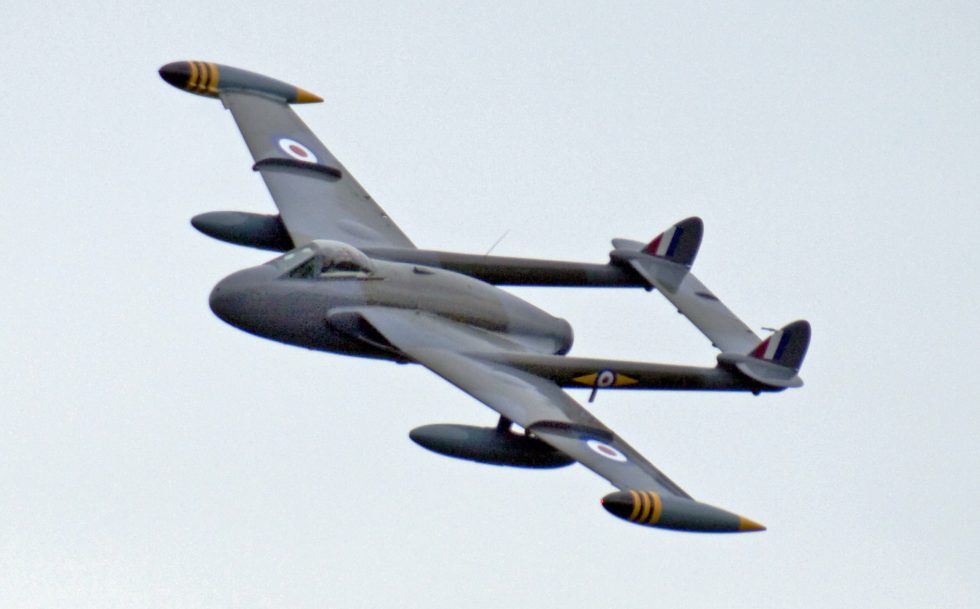
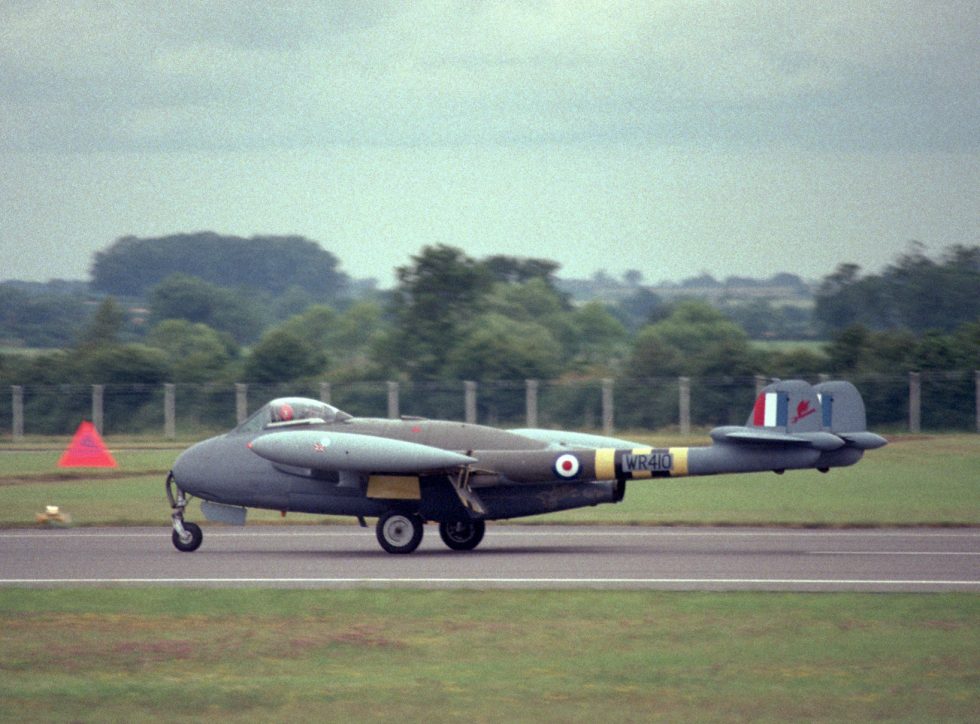
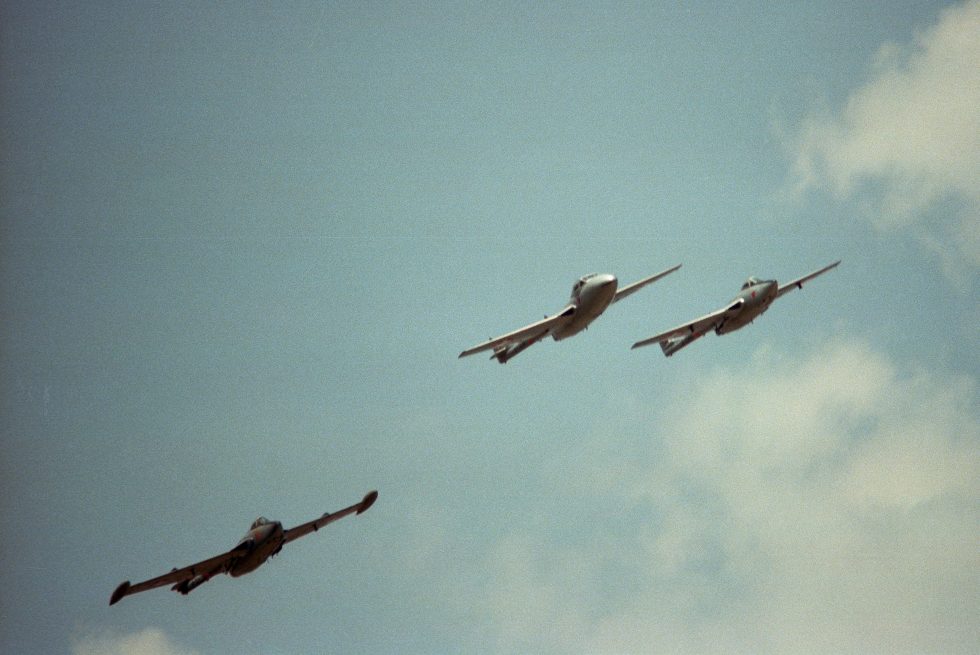
Where the de Havilland Venom flew
An early jet that fought on three continents and at sea
The Venom family never fought a great air battle, but it saw more real action than most first-generation jets. RAF Venoms flew hundreds of ground-attack sorties in the Malayan Emergency and policed the skies over Aden and the Middle East, while the Fleet Air Arm’s Sea Venoms struck Egyptian targets from carriers during the 1956 Suez Crisis. It was, above all, a workhorse — a rugged strike and all-weather aircraft that turned up wherever Britain needed jets in the 1950s.
See how later jets compare in the combat record of every military aircraft. The Venom’s legacy is breadth — a single design that served as fighter-bomber, night-fighter and naval strike jet across a dozen air arms.
Everything people ask about the de Havilland Venom
Can I fly in a de Havilland Venom?
What is the difference between the Venom and the Vampire?
What was the Sea Venom?
Did the Venom see combat?
Why did Switzerland fly the Venom until 1983?
Who else operated the Venom?
You can’t fly the Venom.
These, you can.
Some legends only live in museums — others are fuelled and waiting. MiGFlug has put civilians in real military jet cockpits since 2004.
 Fly the L-39 AlbatrosThe world’s most-flown jet trainer — aerobatics included
 Fly the F-104 Starfighter“The missile with a man in it”
 Fly the MiG-21The Cold War’s most-produced jet
 Fly the T-33 Shooting StarAmerica’s first jet trainer
 Fly the DH VampireA piece of early jet history
 Fly the S.211Agile Italian jet trainer
 Fly the MB-326The classic Aermacchi jet
 Fly the MiG-15The Soviet legend of the Korean War
Continue the tour
Every fact, checked
- RAF Museum — de Havilland DH.112 VenomDevelopment from the Vampire, the Ghost engine, RAF service and variant history.
- Fleet Air Arm MuseumThe Sea Venom as the Royal Navy’s first all-weather jet and its Suez combat service.
- Imperial War MuseumsThe 1956 Suez operation and British carrier air power in the 1950s.
- Military Factory — de Havilland DH.112 VenomSpecifications, variants, production totals and the list of operators.
- Military Factory — de Havilland DH.112 Sea VenomSea Venom naval features, the French Aquilon and Australian service.
- BAE Systems Heritage — de Havilland VenomCorporate history of the de Havilland design and its production.
- National Museum of the US Air ForceReference for early-jet-age fighter-bomber development context.
- Thunder & Lightnings — de Havilland VenomSurviving-airframe history and preserved Swiss and RAF Venom examples.