
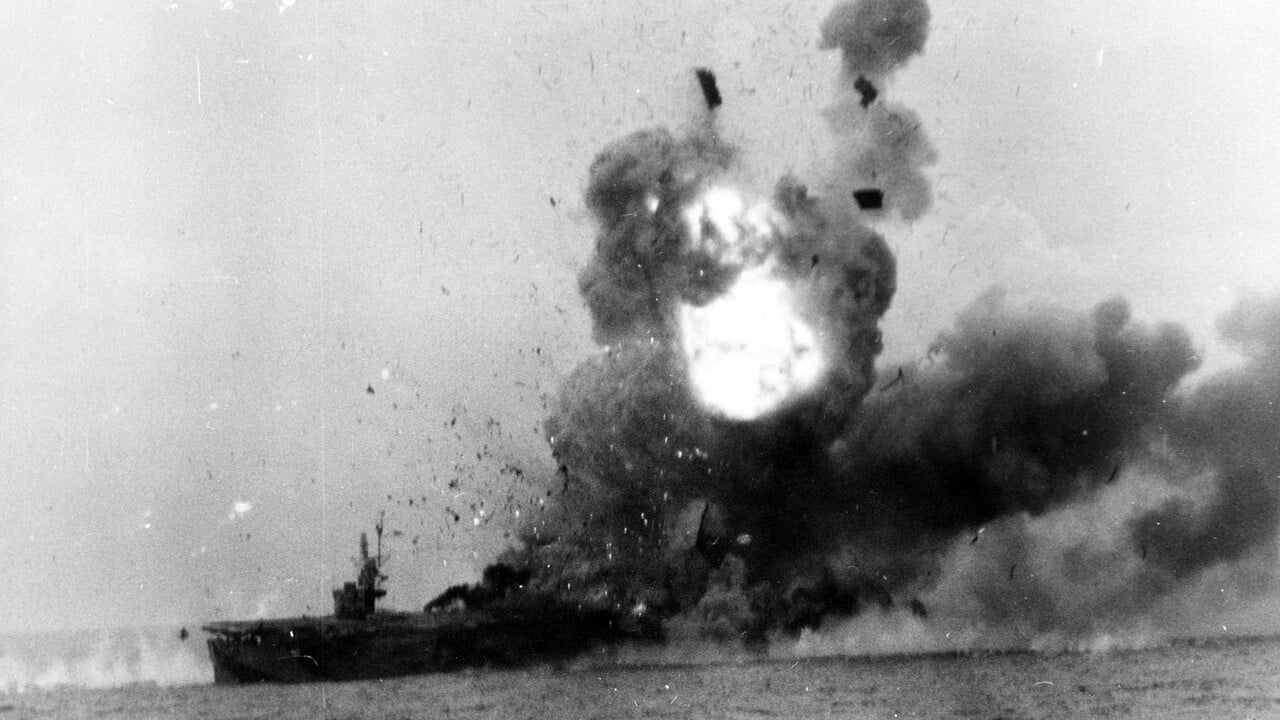
Electrician’s Mate Orville Bethard thought the worst of 25 October 1944 was behind him. His escort carrier, USS St. Lo, had just survived more than two hours under fire from Japanese battleships off Samar. The enemy fleet had turned away. Bethard went below for breakfast.
Then the general quarters alarm sounded again. He stepped back outside, looked for the Japanese fleet, and saw nothing on the horizon. What he saw instead was a single fighter coming out of a rain squall.
Eighty-two years ago today, that Zero and a handful like it opened a new and terrible chapter of the Pacific war. They were the first organised kamikaze attacks: pilots ordered to fly their bomb-laden aircraft into American ships and die doing it. By the end of the morning St. Lo was on the bottom, the first major warship sunk by a suicide attack.
Quick Facts
- Date: 25 October 1944, Battle of Leyte Gulf
- Organiser: Vice Adm. Takijiro Onishi, 1st Air Fleet
- First unit: Shikishima unit, 201st Air Group, led by Lt Yukio Seki (23)
- Aircraft: Five A6M Zeros, each with a 250 kg bomb, plus fighter escorts
- Took off from: Mabalacat airfield, Luzon
- First ship hit: USS Santee, 07:40 (Taffy 1)
- Ship sunk: USS St. Lo, hit 10:51, sank within about 30 minutes
- St. Lo crew: 889 aboard, 746 survived
An admiral with almost no aircraft
By October 1944 Japan’s naval air arm had been bled white. Midway, the Solomons and the “Great Marianas Turkey Shoot” in June had killed most of its experienced carrier pilots, and replacements could not hold their own against American F6F Hellcats and radar-directed fighter patrols.
When American forces landed at Leyte in the Philippines, the Imperial Japanese Navy launched Operation Sho, an all-or-nothing bid to smash the invasion fleet. Its land-based 1st Air Fleet in the Philippines was supposed to help by putting the American carriers out of action. It had only a few dozen aircraft.
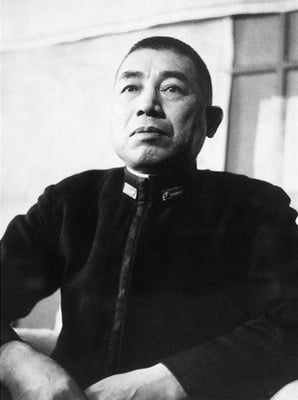
Its new commander, Vice Admiral Takijiro Onishi, was a veteran of naval aviation who had worked on the planning of the attack on Pearl Harbor. On 19 October he met officers of the 201st Air Group at Mabalacat airfield, north of Manila. Deliberate crashes by individual pilots had happened before, but Onishi proposed something new: a planned, organised unit whose only mission was to die hitting a carrier.
The Shikishima unit
Commander Asaichi Tamai of the 201st Air Group gathered 23 young pilots he had trained himself. To lead them, he chose Lieutenant Yukio Seki, a 23-year-old graduate of the naval academy at Etajima who had been trained as a carrier dive bomber pilot. Seki had married his wife Mariko only that spring.
He is said to have closed his eyes and thought for a few seconds before accepting. According to Domei war correspondent Masashi Onoda, Seki later told him privately that he believed he could hit a carrier with a bomb and come back, and that he was going because he had been ordered to.
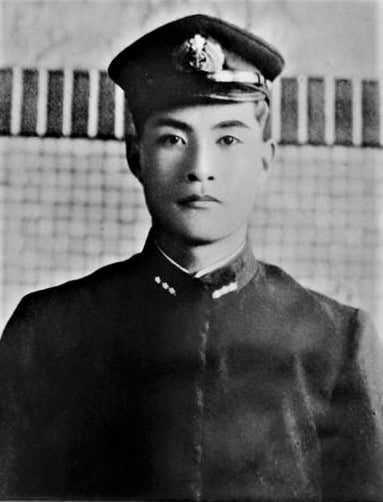
The Special Attack Corps was split into four units, Shikishima, Yamato, Asahi and Yamazakura, names taken from a classical poem by the scholar Motoori Norinaga. Seki led Shikishima: five A6M Zero fighters, each carrying a 250 kg bomb. Fighters flown by the ace Hiroyoshi Nishizawa and three other pilots went along as escorts and witnesses.
The unit first took off from Mabalacat on 21 October and found nothing. The same thing happened for three more days. Before he died, Seki wrote last letters to his mother, to his wife’s parents and to Mariko.
Santee and Suwannee: the first hits
The first blow on 25 October did not come from Seki. At 07:40, aircraft of a separate special attack group dived on Taffy 1, a group of escort carriers south of Taffy 3. One crashed into USS Santee, which the Naval History and Heritage Command describes as the first ship hit by a kamikaze. Minutes later another hit USS Suwannee.
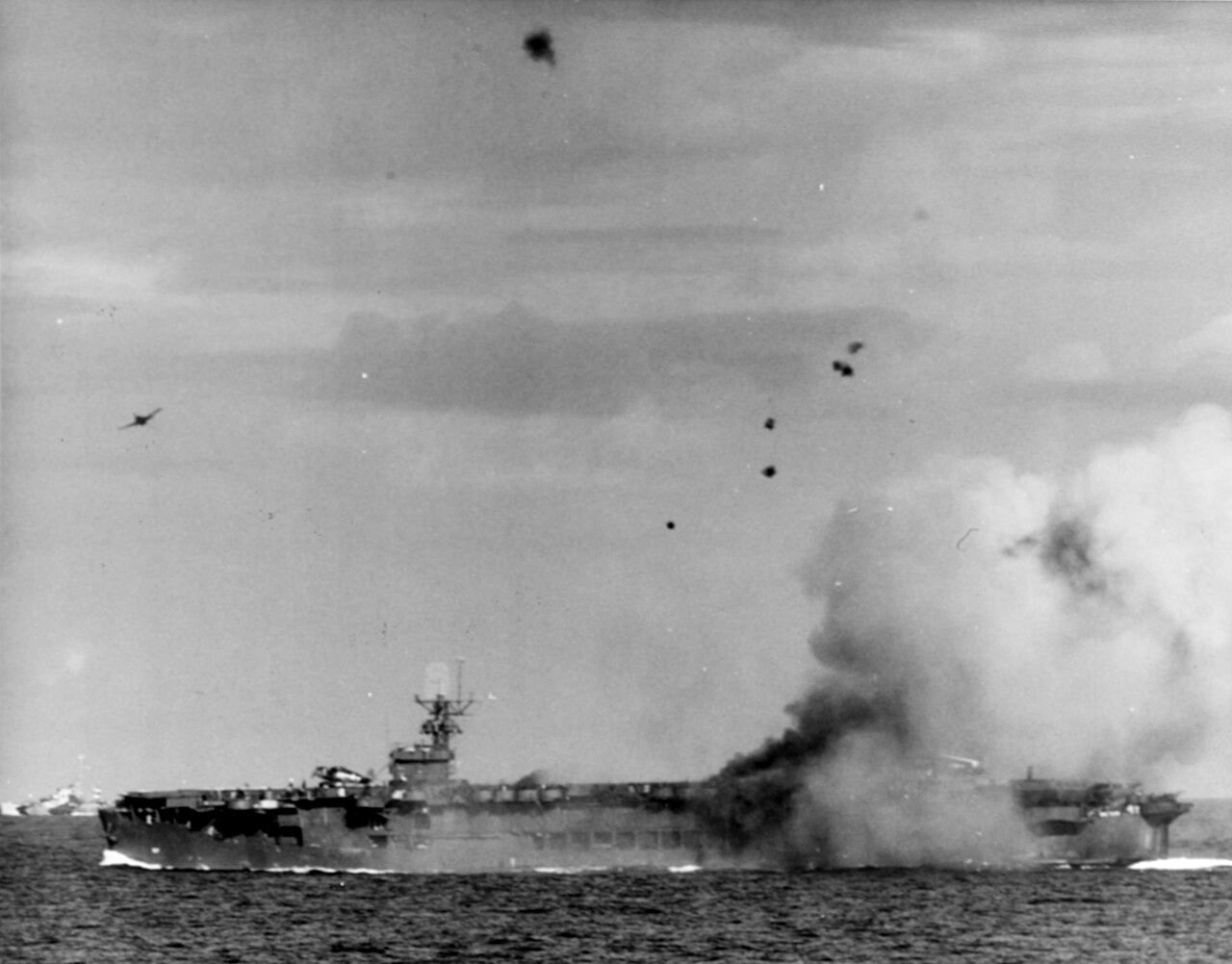
Both ships survived thanks to hard damage control, although Santee was also hit by a submarine torpedo. Suwannee was struck by another kamikaze the next day; she lost 107 men in the two attacks.
10:50, off Samar
Seki’s formation found Taffy 3 at about 10:50, soon after the gun battle with Admiral Kurita’s battleships, while St. Lo’s crew was refuelling and rearming aircraft. Over the next forty minutes, the Zeros came in one after another.
According to the Naval History and Heritage Command, White Plains, Kitkun Bay and Fanshaw Bay were damaged by near misses, one of which clipped Kitkun Bay’s port catwalk before exploding. Kalinin Bay took two hits that wrecked part of her flight deck and a funnel. Then, at 10:51, a Zero smashed into the flight deck of St. Lo.
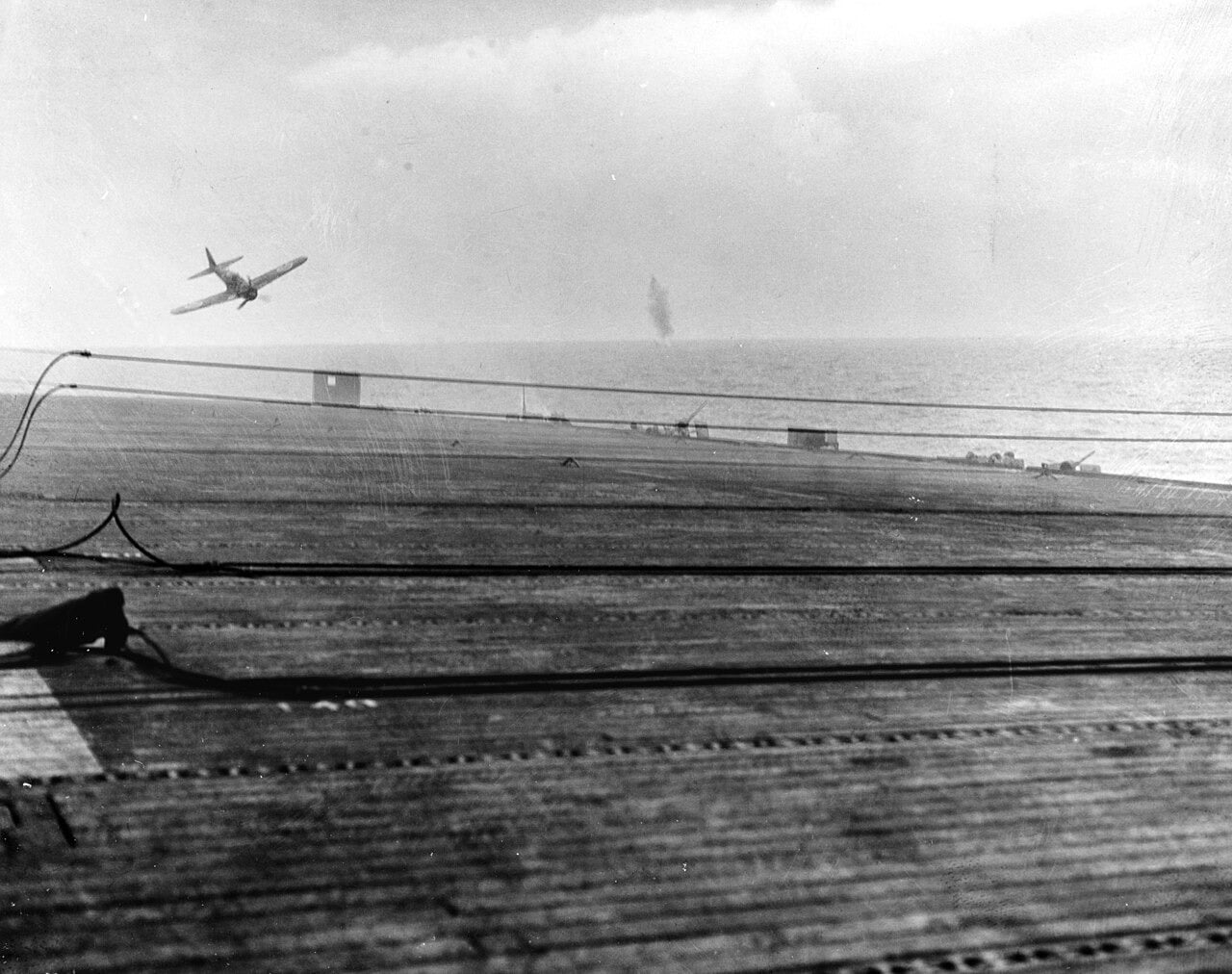
Its bomb punched through the wooden deck into the hangar, where aircraft were being fuelled and armed. Fire spread, and the ship’s action report described a first explosion “followed in a matter of seconds by a much more violent explosion, which rolled back a part of the flight deck.” The torpedo and bomb magazine went up. Within about half an hour St. Lo was gone.
The National WWII Museum’s oral history with Orville Bethard, who survived the sinking of USS St. Lo.
Of 889 men aboard, 746 survived, plucked from the sea by the escorts Heermann, John C. Butler, Raymond and Dennis. Bethard was one of them. Most accounts credit Seki himself with the hit that sank her, though this has been debated; the plane appears to have veered towards St. Lo after being damaged while attacking White Plains.
The carrier had carried the name St. Lo for barely two weeks. Until 10 October she had been USS Midway, renamed to free the name for a new fleet carrier. In May 2019, Paul Allen’s research vessel Petrel found her sitting upright more than 4,300 metres down off Samar.
The father of the kamikaze
For Tokyo, the arithmetic looked irresistible. A handful of Zeros had sunk a carrier and damaged several more. The Special Attack Corps was expanded at once, and over the next ten months thousands of pilots, many of them young student pilots, followed Seki.
Japanese records cited by historians put the toll at almost 4,000 airmen killed in special attacks. They sank several dozen ships, damaged many more and killed several thousand Allied sailors. Later in the war the tactic produced even more extreme weapons, such as the rocket-powered Ohka.
Wartime footage of kamikaze attacks on American ships, from the Smithsonian Channel.
Onishi never left the path he had chosen, and pushed for fighting on in the last days of the war. After Japan announced its surrender on 15 August 1945, he cut himself open in his quarters, refused both medical help and a second to end his suffering, and died on 16 August.
His senior staff officer, Rikihei Inoguchi, later wrote that Onishi had resolved to die from the moment he formed the corps: “In imagination he must have ridden with every pilot of his command as each made his final special attack.” Seki had led the first kamikaze attack, one he reportedly believed he could have made and survived.
Sources: Naval History and Heritage Command (H-Gram 036 and 038; National Naval Aviation Museum; Battle of Leyte Gulf kamikaze photo collection), The National WWII Museum (Eyewitness to the Battle off Samar and the Loss of the USS St. Lo), Kamikaze Images (Last Letters of Lt Yukio Seki, tr. Bill Gordon), The Ethics of Suicide Digital Archive, University of Utah (citing Inoguchi, Nakajima and Pineau, The Divine Wind), Wikipedia (Kamikaze; Yukio Seki; Takijiro Onishi; USS St. Lo)
0 Comments