
The next single-aisle airliner has a geometry problem, and Boeing has quietly patented one answer to it.
The problem is simple to state. The most promising engine architecture for the 2030s — the open fan — has a rotor roughly twice the diameter of a modern turbofan. There is no way to hang one under the low wing of a 737-sized aircraft without the blade tips striking the runway.
Boeing’s patent is for a strut that comes up from underneath the wing, wraps over the top, and puts the engine above it — and which is designed to accept either an open fan or a conventional ducted turbofan on the same aircraft.
Informations clés
- Patent: “Aircraft with Overwing Engine Position” — US20250250017A1, EP4596417A1
- Assignee: La société Boeing
- Filed / published: 1 February 2024 / August 2025 — still pending
- Core idea: Strut attaches to the wing underside and wraps over, engine sits on top
- Stated purpose: A common platform for ducted fans, open fans and open rotors
- Open fan diameter: 120–168 in for a 150-seat twin — about twice a turbofan’s
- CFM RISE target: 20% lower fuel burn than today’s best engines
- RISE status, July 2026: ~500 test campaigns, 3,000+ endurance cycles; flight test “later this decade”
Why anyone is doing this again
The open rotor is not a new idea. It was tested exhaustively in the 1980s and then abandoned, and the reason it was abandoned had almost nothing to do with whether it worked.
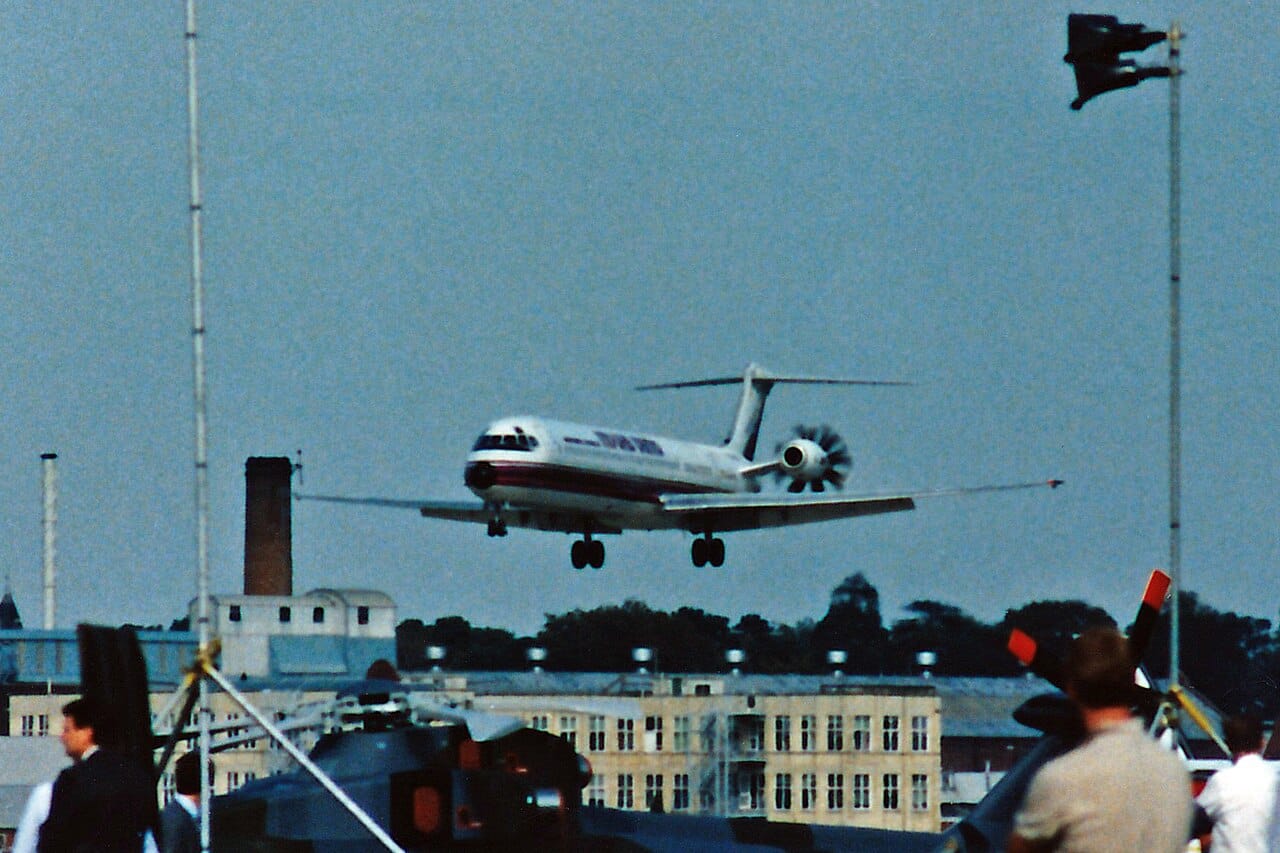
General Electric’s GE36 unducted fan — developed with Snecma, which took a 35 percent stake in 1985 — flew on a Boeing 727 from August 1986 and then on an MD-80 from May 1987. Across both testbeds it accumulated 281 flight hours, reaching Mach 0.865 at 37,000 feet. GE claimed specific fuel consumption more than 20 percent better than any turbofan then on offer. In September 1988 it flew daily demonstrations at Farnborough.
Pratt & Whitney and Allison flew a competing geared propfan, the 578-DX, on an MD-80 from April 1989. It managed fourteen flights before the programme collapsed.
What killed both was the oil price. Boeing shelved the 7J7 — the aircraft the UDF was meant for — in December 1987. When McDonnell Douglas offered the MD-90 in 1989 with a conventional turbofan only, Allison conceded that its propfan’s roughly four-million-dollar price, about 40 percent above a turbofan, could not be justified at the fuel prices of the day.
Cheap fuel and passenger complaints about cabin noise ended it. The engineering was sound.
What is different now
CFM — still GE and Safran, the same two companies — announced RISE in June 2021 as the LEAP’s successor, targeting entry into service in the mid-2030s and 20 percent lower fuel burn.
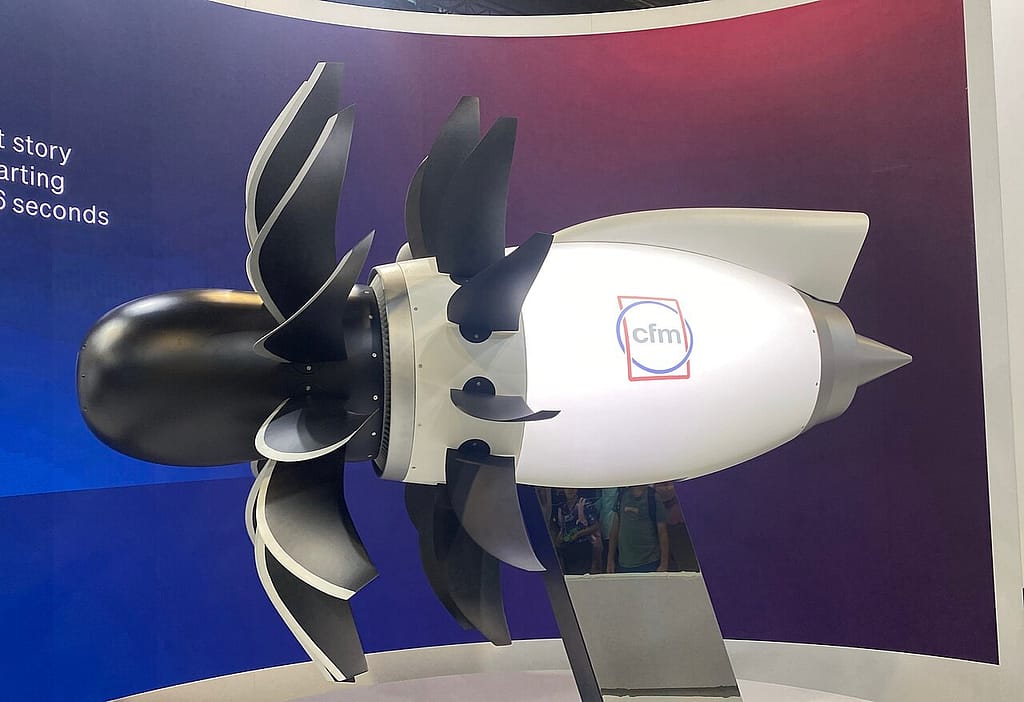
The architecture has changed in an important way. The 1980s designs used two contra-rotating blade rows, which is where much of the noise came from. RISE uses a single rotating stage followed by a fixed stator row, both variable-pitch. The stators de-swirl the flow, and can close almost completely to act as an air brake — which removes the need for a thrust reverser altogether.
It also adds a recuperator, using exhaust heat to pre-warm the air leaving the compressor.
As of GE Aerospace’s own Farnborough statement in July 2026, RISE has run approximately 500 test campaigns and more than 3,000 endurance cycles, and Airbus and CFM have revealed the livery for the A380 flying testbed — with flight testing now described as “later this decade”. That is a slip from the 2026 date announced back in 2022, and worth noting.
The GE36 unducted fan flying at Farnborough in September 1988 — the last time this idea got close to production.
The clearance problem, in numbers
Here is why the strut matters. An open fan sized for a 100- to 150-seat twin needs a diameter somewhere between 120 and 168 inches. A CFM LEAP fan — the engine on today’s 737 MAX and A320neo — is about 78 inches.
You cannot simply hang that under an existing wing. The options are all expensive:
Longer landing gear. Boeing’s own patent background says this can have a significant impact on aircraft architecture, wing platforms and tail dimensions. Longer gear also has to retract into somewhere.
Rear fuselage mounting. A Rolls-Royce study needed a pylon about 8.3 feet long simply to clear each engine from the fuselage side. It also puts the rotor disc beside the rear cabin, moves the centre of gravity aft, and usually forces a T-tail.
A high wing. Solves clearance neatly, and produces a completely different aeroplane, incompatible with the low-wing ground handling that every narrowbody operator on earth is built around.
Over-wing mounting. Historically this meant a large fairing on the upper wing surface, which adds drag exactly where you can least afford it.
What the patent actually claims
Boeing’s answer is to attach the strut to the underside of the wing and route it up and around, so the engine sits above the wing while the upper skin stays clean — no over-wing fairing. The front spar interface reacts roll and yaw, a link interface reacts pitch: a conventional pylon load path in an unconventional geometry.
The background section states the problem in the company’s own words: open rotor aircraft present a particular problem due to their relatively large vertical clearance requirements.
And the commercially important claim is that the design enables the use of conventional strut architecture for different engines — ducted high-bypass fans, open rotors and open fans alike — providing, as the patent puts it, a common platform for the various engine types.
That is the real point, and it is a business point as much as an engineering one. An airframer designing a 737 replacement today does not know whether the winning engine will be an open fan or an ultra-high-bypass ducted turbofan. A wing and strut that accept both let you commit to the airframe without first betting on the engine.
Boeing has a second, related patent for the opposite approach: an under-wing truss strut with a ring-shaped mount encircling the engine, which its text says allows movement of up to 17.5 inches upward compared with conventional strut-to-wing architectures. Different geometry, same objective.
The Pratt & Whitney-Allison 578-DX propfan, the GE36’s rival, on its MD-80 testbed.
Noise, and the thing nobody has solved
The unavoidable trade is that quietening an open rotor costs efficiency. The 1980s work found ways to reduce the noise, but the production configuration of the GE36 gave up about 5 percent of its fuel efficiency to meet the noise chapter of the day.
Current limits are probably not the blocker. A 2012 NASA trade study put open-rotor technology of the time some 10 to 13 cumulative decibels below the then-current Stage 4 limit. The same study, though, found open rotors would be about 9 percent more efficient and 10 to 12 cumulative decibels louder than a future advanced ducted turbofan — which is the honest statement of the choice.
The harder question is certification. There is no casing. A released blade has nothing to contain it, so protection has to come from blade design and from where the rotor disc sits relative to the cabin. Mounting position is therefore not only an aerodynamic decision; it is a safety-case decision, which is another argument for getting the engine up and away from the fuselage.
And the wing it might go on
Boeing’s other big airframe bet is the transonic truss-braced wing, designated X-66A by the US Air Force in June 2023 under a NASA award of 425 million dollars alongside roughly 725 million from Boeing and partners. The concept uses a very high aspect ratio wing braced by a truss, folding outboard to fit existing airport gates, and claims 8 to 10 percent fuel burn from the wing alone.

In April 2025 NASA paused the flight demonstrator to concentrate on a ground-based thin-wing testbed, while explicitly retaining all the design work and hardware. That research is very much alive: in July 2026 NASA reported that a 15-foot composite truss-braced wing article had been loaded to failure at Armstrong, giving way at about 127 percent of design limit load.
None of this is a product. It is a patent application still pending, an engine demonstrator that has not yet flown, and a wing that is being broken deliberately in a laboratory in California. But it tells you what Boeing thinks the next narrowbody has to be able to do — and that it does not yet know which engine will be bolted to it.
An explainer on the open-fan architecture CFM is developing.
Sources: Google Patents (US20250250017A1, EP4596417A1, US20250376264A1), GE Aerospace, NASA, Wikipedia entries on the GE36, PW-Allison 578-DX, propfan and CFM RISE


0 commentaire