

On the evening of 20 November 1962, John F. Kennedy walked into a press conference with news the world had been waiting almost four weeks to hear. The Soviet missiles were already gone from Cuba. What had kept the US Navy’s blockade in place since then was something far less exotic: a squadron’s worth of straight-winged jet bombers that had first flown fourteen years earlier.
L'avion était le Ilyushin Il-28, NATO reporting name “Beagle”. Nikita Khrushchev insisted it was obsolete. Washington insisted it was an offensive weapon within easy reach of Florida. For three weeks after the missile deal of 28 October, the fate of the crisis hung on an airframe that had been designed in 1947.
Informations clés
- Taper: Three-seat twin-jet tactical bomber
- Premier vol : 8 July 1948, Vladimir Kokkinaki
- Moteurs : 2 × Klimov VK-1A turbojets (a developed copy of the Rolls-Royce Nene)
- Vitesse maximale : 902 km/h at 4,500 m
- Gamme: About 2,180 km
- Bomb load: Up to 3,000 kg internally
- Guns: Four 23 mm cannon, two in the nose and two in the tail turret
- Opérateurs : Some 20 air forces; North Korea is the last
A bomber built around a British engine
The Il-28 owed its existence to a remarkable gift. In 1947 Britain sold the Soviet Union a batch of Rolls-Royce Nene jet engines, and Soviet engineers quickly produced an unlicensed copy, the RD-45. Ilyushin’s design bureau, working to a requirement for a bomber that could carry 3,000 kg of bombs at 800 km/h, designed its new twin-jet around two of them.
The first prototype, still powered by imported Nenes, flew on 8 July 1948 with test pilot Vladimir Kokkinaki at the controls. A second prototype followed on 30 December 1948 with Soviet-built engines. Production was ordered in May 1949 with the improved Klimov VK-1, and Stalin wanted the new bomber on show quickly: 25 Il-28s flew over Moscow in the May Day parade of 1950.

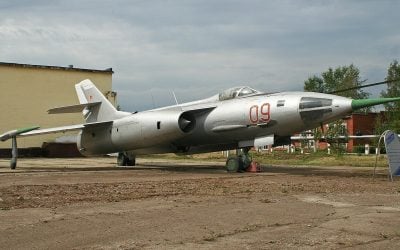
The layout was conventional for the time, even conservative. Its wings were straight, only the tail surfaces were swept, and the engines hung in fat nacelles under the wings. What set it apart was clever engineering for mass production: the wings and tail were split horizontally and the fuselage vertically, so each half could be built and fitted out separately before the halves were bolted together.
Three men, three compartments
The Il-28 had a crew of three, each in his own pressurised compartment. The navigator, who doubled as bombardier, sat in the glazed nose with an OPB-5 bombsight derived from the wartime American Norden. The pilot sat under a bubble canopy with an armoured windscreen and fired two fixed 23 mm cannon in the nose.
At the back, a gunner worked a powered turret with two more 23 mm cannon. His was the loneliest seat in the aircraft. The pilot and navigator had ejection seats; the gunner did not, and in an emergency he had to bail out through a hatch in the floor.

The result was no record-breaker, but it was quick for its day. Jane’s gives a top speed of 902 km/h at 4,500 m and a range of about 2,180 km, with up to 3,000 kg of bombs in the internal bay. Production ran into the thousands; published totals vary widely by source, from about 3,000 to more than 6,000.
Archival footage of a Soviet Il-28 regiment redeploying.
Everybody’s bomber
The Il-28 became the standard Soviet tactical bomber of the 1950s and one of the most widely exported jets of the early Cold War, serving some 20 air forces. The Force aérienne polonaise flew bombers, reconnaissance jets and trainers from 1952 to 1977. The Egyptian Air Force received its first batch in 1956, and its Il-28s were priority targets on the ground for the RAF at Suez and for Israel in 1967.
China received more than 250 Soviet-built examples from 1952. After the Sino-Soviet split it kept building them without a licence as the Harbin H-5, with a redesigned wing structure and a new tail turret. Even neutral Finland bought a handful in the 1960s for target towing and survey work. Their NH codes stood for “Soviet towing aircraft” in Finnish, but they happened to match Khrushchev’s initials, so crews nicknamed them “Nikita”.
The basic airframe proved remarkably adaptable. The Il-28R carried cameras for reconnaissance, with extra fuel in the bomb bay and wingtip tanks. The Il-28T served Soviet Naval Aviation as a torpedo bomber, and the Il-28U trainer added a separate cockpit in the nose for an instructor; NATO gave it its own reporting name, “Mascot”. Jamming, target-drone and atmospheric-sampling versions followed.
Even Aeroflot got some. Demilitarised Il-28Ps gave airline crews their first jet experience and flew urgent cargo, including the printing matrices that let Pravda et Izvestia be printed at the same time in Moscow, Sverdlovsk and Novosibirsk.
A 4K walkaround of the Il-28R preserved at the Finnish Air Force Museum.
Twelve-year-old bombers in Cuba
In 1962 the Soviet Union shipped 42 Il-28s to Cuba, alongside the medium-range ballistic missiles that triggered the crisis. Some were nuclear-capable versions. The Defense Intelligence Agency mapped their reach at 630 nautical miles, enough to cover Florida and the US Gulf Coast.

When Khrushchev agreed on 28 October to remove “offensive” weapons, the bombers became the sticking point. Washington counted them in; Moscow did not. On 12 November Khrushchev wrote that the Il-28 had long since been taken out of production and out of use in Soviet forces. Eight days later he gave way, while making his point one last time.
That same evening Kennedy lifted the naval quarantine. The bombers were crated and shipped home, and the Cuban Missile Crisis was finally over. Khrushchev was not entirely wrong: by the late 1950s the Soviet Air Forces had already relegated the Il-28 to second-line duties, and the supersonic Yak-28 was arriving to replace it.
The bomber that would not retire
Obsolete or not, the Beagle refused to disappear. Chinese H-5s flew into the 1990s, Romania retired its last examples in 2001, and the Il-28 is still believed to serve with the Korean People’s Army Air Force, the type’s only remaining operator.
Mark Felton on North Korea’s Il-28s, the last of their kind still in service.
The Il-28 was built around a British engine, copied without a licence, cloned in turn by China and dismissed by its own creator as scrap metal. It still managed to hold up the end of the most dangerous standoff of the nuclear age. Few bombers have done more by doing so little.
Sources: Wikipedia (Ilyushin Il-28), Air Vectors (Greg Goebel, “The Ilyushin Il-28 Beagle”), The American Presidency Project (Kennedy news conference, 20 November 1962), US Office of the Historian (FRUS 1961–63 vol. XI, documents 171 and 196), Defense Intelligence Agency

0 Comments