
A jet engine that produces tens of thousands of pounds of thrust has one embarrassing weakness: it cannot start itself. Pour fuel into a stationary engine and light it, and you get a fire, not a jet. Before a turbine can run on its own, something else has to spin it up to speed.
That “something else” is the starter, and how it is powered tells you a great deal about the aircraft. Airliners borrow compressed air from a small engine in the tail. Business jets use electric motors. Fighters carry their own miniature turbine, and the B-52 can still, when it is in a hurry, start with an explosive cartridge.
Informations clés
- Why a starter: A gas turbine cannot compress air until it turns, so the high-pressure compressor must be spun first
- Séquence: Starter spins compressor, ignition on, fuel on, light-off (EGT rise), self-accelerating speed, starter cut-out, idle
- Airliners: Air turbine starter driven by air from the APU, a ground cart or another engine, about 30 to 50 psi
- Light jets: Electric starter-generators
- Combattants : Jet fuel starter on the F-15E and F-16
- B-52: Rapid launch with explosive cartridges in two of eight engines
- Failures: Hot start (temperature limit exceeded) and hung start (speed stalls below idle)
Why a jet must be spun before it can burn
A gas turbine is a loop. The compressor squeezes air into the combustion chamber, fuel burns, and the hot gas drives the turbine, which in turn drives the compressor. At rest, nothing in that loop is moving, so there is no compressed air to burn fuel in and no hot gas to turn the turbine.
The FAA’s Aviation Maintenance Technician Handbook puts it plainly: gas turbine engines are started by rotating the high-pressure compressor. On a twin-spool engine, the starter only turns the high-pressure spool, often called N2. The low-pressure spool and the fan, N1, start turning later, dragged along by the airflow.
The starter’s job does not end when the fire lights. At low speed, the engine cannot yet produce enough energy to accelerate on its own, so the starter keeps cranking until the engine passes its self-accelerating speed, and well beyond. Cut it off too early, the FAA warns, and the engine may stall in its acceleration and end in a hot or hung start.
The airliner way: air from the tail
Most airliners use an air turbine starter, a small turbine bolted to the engine’s accessory gearbox. Blow compressed air through it and it spins the engine through a reduction gear and a clutch. According to the FAA, a typical air turbine starter weighs a quarter to half as much as an electric starter able to start the same engine, yet produces considerably more torque.
The air can come from three places: a ground air cart, another engine that is already running (a cross-bleed start), or the auxiliary power unit. Only one source is used at a time, at around 30 to 50 psi, and the FAA handbook advises checking duct pressure before every start. Once the engine runs faster than the starter, a sprag clutch lets the starter’s turbine disconnect and coast to a stop.
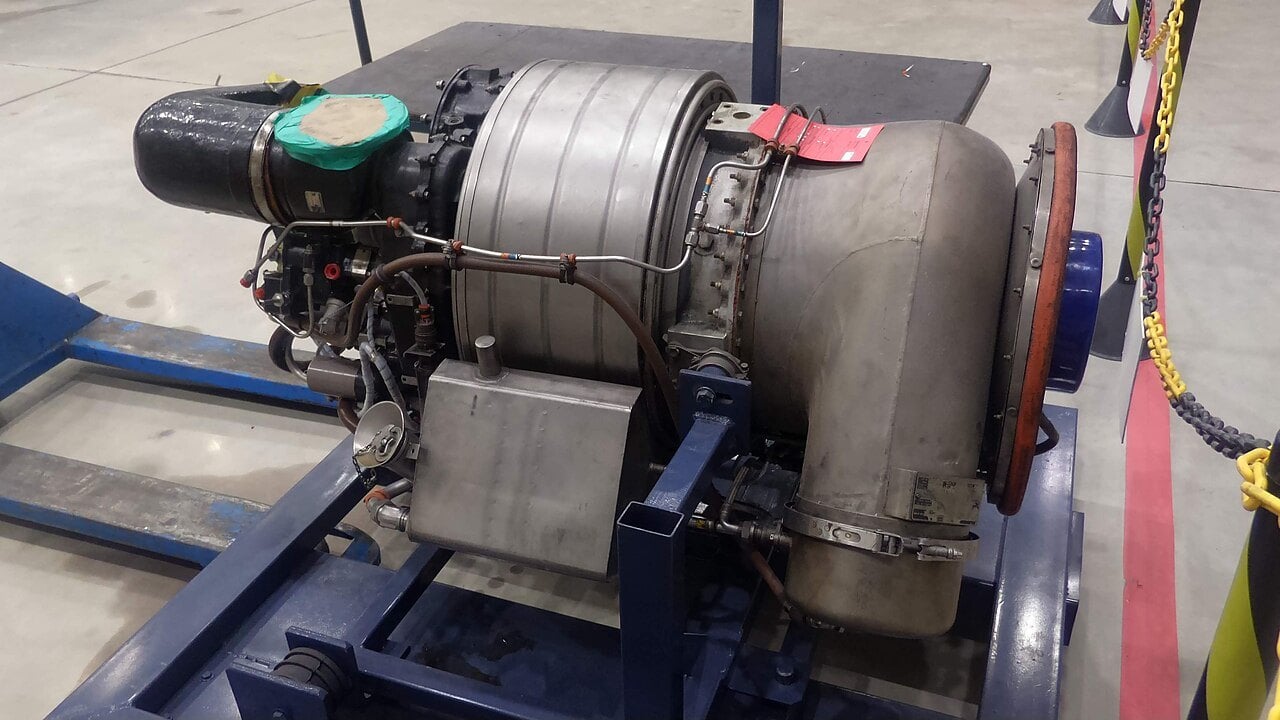
The auxiliary power unit, or APU, is the hidden hero here. It is itself a small gas turbine, usually tucked into the tail. Honeywell, whose predecessor Garrett AiResearch built the first turbine APU, says its GTC43/44 small gas turbine was already providing compressed air to start the main engines of a Convair P5Y in 1950. Its descendant, the 131-9, is the APU on Airbus A320 and Boeing 737 jets today.
Animagraffs explains how an airliner’s auxiliary power unit works, including the compressed air it supplies for engine start.
The same APU powers the lights, air conditioning and cockpit displays at the gate. And it can do more than that.
The start sequence, step by step
Whatever turns the engine, the sequence that follows is much the same. The FAA’s typical start profile runs like this: the starter accelerates the compressor until there is enough airflow through the engine; the ignition comes on; then fuel is introduced. A rise in exhaust gas temperature shows that the engine has lit up.
The order matters. There has to be enough air moving through the engine to support combustion before the fuel-air mixture is ignited, and the spark has to be there before the fuel arrives, so the fuel lights as soon as it is introduced. In the cockpit, the crew watches N2 rise, oil pressure appear, and the exhaust or inter-turbine temperature climb as combustion takes hold. Because the two spools of a twin-spool engine are not mechanically linked, N1 beginning to accelerate is another sign that the engine is genuinely running.
Then the engine passes self-accelerating speed, the starter cuts out, the ignition switches off and the engine settles at idle. On engines with full authority digital engine control (FADEC), much of this sequencing is handled by the computer rather than by hand.
Hot starts and hung starts
Two failures haunt every start. A hot start is one in which the manufacturer’s temperature limit for the start is exceeded. SKYbrary lists the usual reasons as too little airflow through the compressor, incorrect fuel scheduling and slow engine acceleration. Too much fuel for too little air, in other words, and the turbine cooks.
A hung start is the quieter cousin: the engine lights, but its core speed stops climbing and settles below idle. Both are reasons to abort. AOPA notes that most light jets’ FADECs will shut off the fuel automatically if they detect a problem during the start.
Business jets: the starter-generator
Smaller turbines often use a single electric machine that does two jobs. The FAA lists three main types of starter in current use for gas turbine engines: direct current electric motors, starter-generators and air turbine starters. A starter-generator works as a motor to spin the engine for start, then switches roles and becomes the engine-driven generator once the engine is running. According to AOPA, all light jets use starter-generators for engine start.
Fighters: a jet that starts a jet
A fighter cannot count on an air cart waiting at a dispersal strip. Many American fighters therefore carry their own starter. The F-15E Strike Eagle uses a jet fuel starter, which the US Air Force describes as the small motor that starts the fighter’s engines. The F-16 has one too: as its name says, a jet fuel starter burns the same fuel as the main engine.
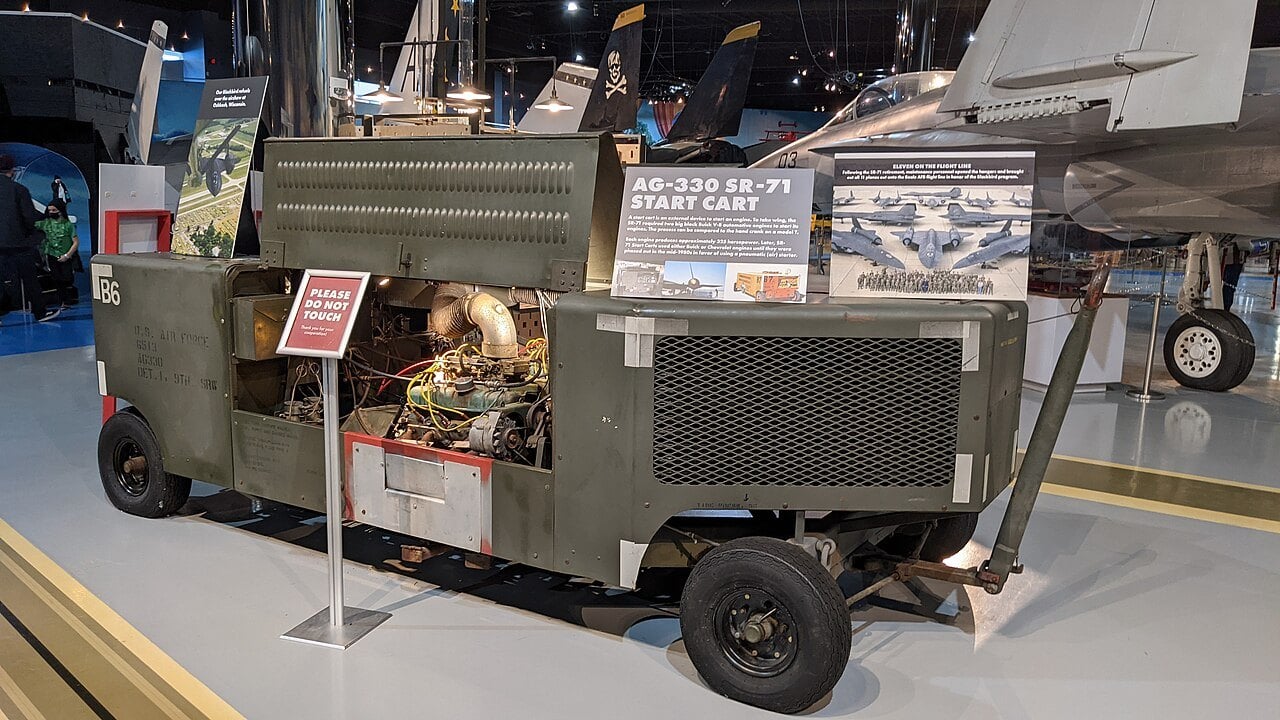
Other aircraft relied on outside help. The SR-71 Blackbird’s Pratt & Whitney J58 engines were started with a dedicated AG330 start cart; one is now on museum display. And the FAA handbook describes another historical option, the air-fuel combustion starter, a turbine-driven power unit that used jet fuel and compressed air to spin the main engine.
Cartridge starts: the shotgun method
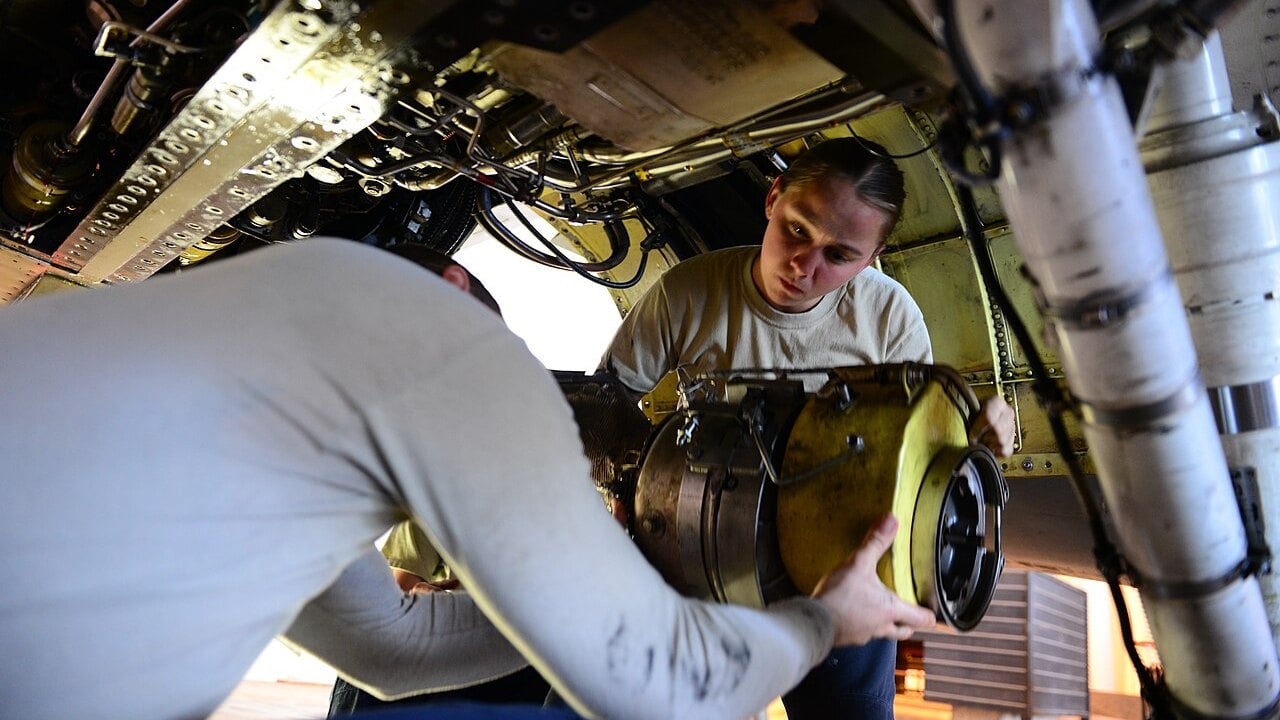
The most dramatic method of all is the cartridge start. The FAA describes a combined cartridge/pneumatic starter that can run on air like a normal air turbine starter, or on a cartridge. The cartridge is loaded into a breech, which is closed and locked; an electrical charge ignites it, and the hot gas it generates drives the starter turbine. A relief valve keeps the gas pressure at the right level.
The B-52 still uses the technique. Normally, a hose from a ground unit starts one engine, which then starts the rest. For a fast launch, the US Air Force says, crews can instead insert a small explosive charge into two of the bomber’s eight engines, which allows a rapid launch.
US Air Force footage of B-52H Stratofortresses cartridge-starting their engines at Barksdale Air Force Base, Louisiana, in October 2019.
From a Boeing 737 at the gate to a B-52 on alert, the principle never changes: spin the compressor, add a spark, add fuel, and keep helping until the engine can stand on its own. Every flight you have ever taken began with that small, carefully timed miracle.
Sources: FAA Aviation Maintenance Technician Handbook, Powerplant (FAA-H-8083-32B, Chapter 5), Honeywell Aerospace, AOPA (Neil Singer, 2018), SKYbrary, US Air Force (af.mil, DVIDS)
0 Comments