

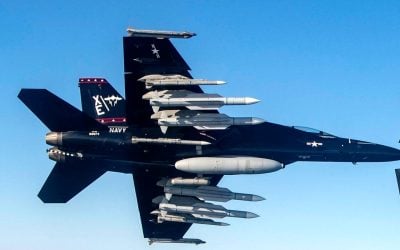
Nothing in the US Navy’s caption mentions an AIM-260 on the Super Hornet in the frame. It describes a Force aérienne royale australienne F/A-18F of No. 1 Squadron taking flight from Naval Base Ventura County Point Mugu, California, on 11 September 2026, during Gray Flag 2026. The serial on the rear fuselage reads A44-209.
The detail that matters sits on the jet’s intake cheek, partly hidden by the main landing gear. TWZ and The Aviationist, which both ran the image on 1 October, identify it as an inert AIM-260 Joint Advanced Tactical Missile (JATM), the classified Lockheed Martin missile meant to succeed the AIM-120 AMRAAM. The Navy had posted the photo to its DVIDS media archive on 30 September, 19 days after it was taken.
TWZ calls it “the first apparent glimpse of an Australian JATM in any context”. Five weeks before the shutter clicked, Canberra had committed almost A$736 million to the missile. In TWZ’s reading, the photo shows that Australian AIM-260 Super Hornet integration has progressed to carrying the weapon, in inert form, at a major US test event.
Informations clés
Aéronef — RAAF F/A-18F Super Hornet A44-209, No. 1 Squadron
Missile — Inert AIM-260 JATM training round on station 7, the ‘cheek’ station
Photographed — 11 September 2026 at Naval Base Ventura County Point Mugu, California, during Gray Flag 2026
Made public — Posted to DVIDS by the US Navy on 30 September; identified as an AIM-260 by TWZ and The Aviationist on 1 October
Gray Flag 2026 — More than 3,000 participants, 150+ organisations, 750+ sorties and 2,000+ flight hours; ended 25 September
Australia’s buy — Almost A$736 million via Foreign Military Sales, announced 6 August 2026; F/A-18F first, then F-35A and EA-18G
Specifications — Classified; no official range figure released
What the photo shows, and what it does not
According to The Aviationist, the AIM-260 is mounted on station 7, the ‘cheek’ station on the outside of the engine intake. When the missile was first publicly photographed, in May 2026, a US Navy test Super Hornet of squadron VX-31 carried it on the same station.
The rest of the loadout: a CATM-9X, an inert AIM-9X trainer, on the right wingtip; a CATM-120, its AMRAAM equivalent, on the outermost left pylon; a Tactical Combat Training System (TCTS) pod on the left wingtip; an AN/ASQ-228 ATFLIR targeting pod on the other cheek station; and three external fuel tanks. None of the three missiles is live.
Blue bands on the AIM-260’s body mark a training round with an inert rocket motor and/or warhead, TWZ notes. No live firing has been reported, and The Aviationist suggests the sortie may have involved captive carry. TWZ adds a caveat: the photo does not establish whether the round was Australian-owned, a US test asset or hardware for a particular integration task.

Gray Flag, by the Navy’s numbers
Gray Flag is the naval aviation test community’s premier large-force test event, held every year at Point Mugu. Naval Test Wing Pacific and test squadron VX-9 hosted the 2026 edition; the Naval Air Warfare Center Weapons Division (NAWCWD) manages the programme and runs the instrumented Point Mugu Sea Range: 36,000 square miles (about 93,000 km²).
By the Navy’s count it was the largest Gray Flag to date: more than 3,000 participants from over 150 organisations, more than 750 sorties against roughly 600 in 2024, and over 2,000 flight hours in two weeks ending on 25 September. On one day, 78 aircraft launched for a single test event, a Gray Flag record. Point Mugu pumped more than 1.3 million US gallons (about 4.9 million litres) of jet fuel.
The RAAF, Royal Canadian Air Force et Royal Air Force joined US Navy and US Air Force test teams, plus surface and subsurface units. The aim is unglamorous: proving that aircraft, weapons, communication systems and networks pass data to each other before fleet aviators meet the problems on deployment. NAWCWD’s Gray Flag programme manager, Adam Madson, calls it the last point at which testers can still change a system before it reaches the fleet.
What Australia is buying
There are two numbers, and they measure different things. A US arms sales notification, published in the Federal Register on 17 March 2026, covers a possible sale to Australia of up to 450 AIM-260s, up to five integration test vehicles and up to 30 guided test vehicles, at an estimated US$3.16 billion. That is a ceiling, not an order.
Australia’s own figure came on 6 August. At Exercise Pitch Black in Darwin, Defence Minister Richard Marles announced that the government is “investing almost $736 million”, in Australian dollars, through Foreign Military Sales; no quantity was given. Canberra says Australia will be the first country to operate the AIM-260 outside the United States.
Official RAAF cockpit footage from a No. 1 Squadron F/A-18F Super Hornet during Exercise Diamond Storm 2022 over Australia’s Northern Territory.
The F/A-18F is first in line for integration, followed by the F-35A Lightning II and the EA-18G Growler. No delivery schedule was published; trade reports, Defense News among them, point to 2033 at the earliest.
The Navy’s write-up of Gray Flag never mentions the AIM-260. Its one Australian voice, Wing Commander Trent Baldry, commanding officer of No. 1 Squadron, said the event offers Australia insight into its interoperability with partners that it could not obtain alone.
A missile still under wraps
The AIM-260 was revealed in 2019 as a joint US Air Force and US Navy programme, with initial fielding then planned for 2022. It keeps the general form factor of the AMRAAM, so that it fits the internal weapons bays of the F-22 Raptor and the F-35. TWZ describes it as a response to China’s PL-15 and other advanced long-range missiles.
Its range, seeker and propulsion remain classified. No official range figure has been released; TWZ and Defense News point to at least 120 miles (about 190 km), possibly considerably more. On 17 September the Pentagon and Lockheed Martin signed a framework agreement towards a future multiyear procurement contract, but disclosed no quantities, costs or delivery dates.
Lockheed Martin announces the AIM-260 JATM framework agreement with the US Department of War on 17 September 2026.
For now, the public evidence is one frame in which the missile hides partly behind a landing gear leg. It is thin evidence, but specific: an RAAF crew flew the weapon’s shape at the largest Gray Flag yet, on the range where the US Navy wants to find problems before the fleet does.
Sources: US Navy / Naval Air Warfare Center Weapons Division (DVIDS story and photos), 30 September 2026; TWZ, 1 October 2026; The Aviationist, 1 October 2026; Australian Minister for Defence media release, 6 August 2026; Federal Register arms sales notification, 17 March 2026; The Defense Post, 1 April 2026 and 18 September 2026; Defense News, 10 August 2026; Breaking Defense, August 2026; Lockheed Martin press release, 17 September 2026; The Aviationist, 18 September 2026
0 Comments