
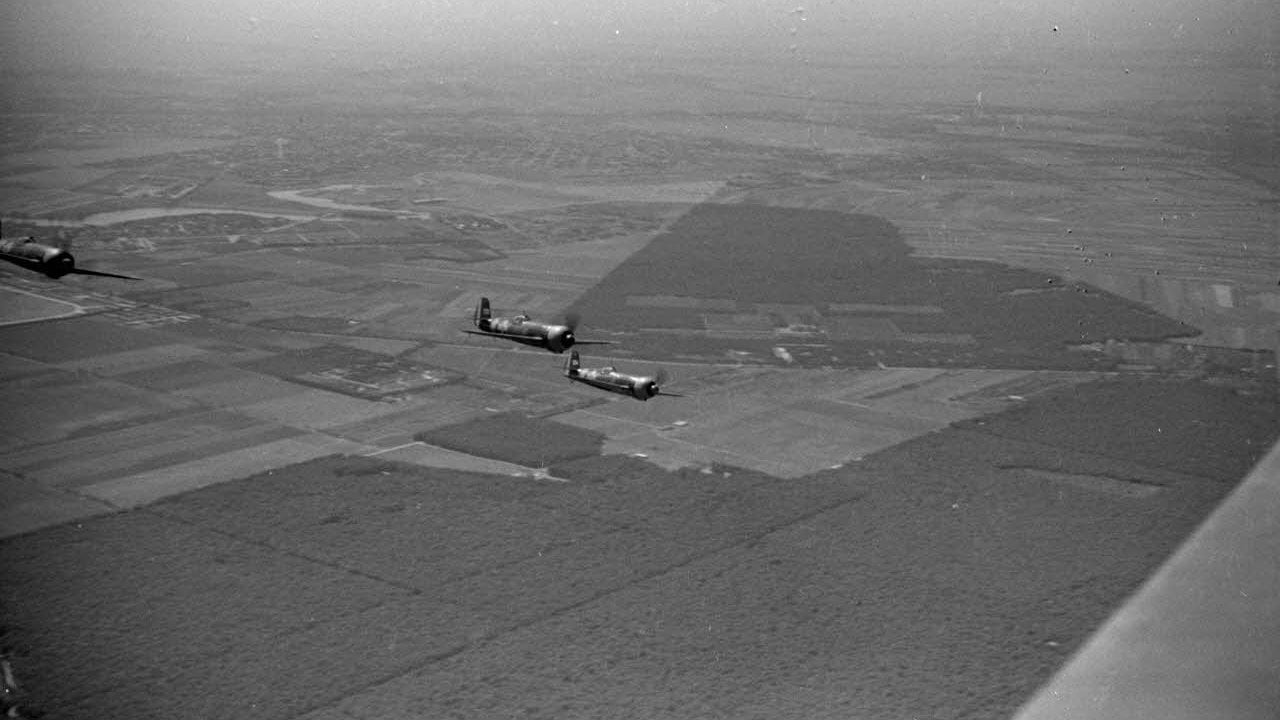
On 10 June 1944, an American P-38 pilot over Romania looked to his left and saw a swarm of Focke-Wulf Fw 190s diving in at him. He fought them, shot several down and went home an ace. There was just one problem with his report: there were no Fw 190s in that fight. The stubby, radial-engined fighters tearing into his formation had been designed and built in Romania.
They were IAR 80s and their dive-bomber cousins, the IAR 81s, from the Industria Aeronautică Română factory in Brașov. For a mid-sized kingdom with a young aircraft industry, designing and mass-producing its own modern monoplane fighter was a bold undertaking, and Romania pulled it off. Its fighter then went on to do something stranger still: it fought for both sides of the Second World War.
This is the story of the IAR 80 fighter, from Polish bloodlines and a borrowed French engine to the skies over Stalingrad, the burning refineries of Ploiești and, finally, the German army it had once fought alongside.
Informations clés
- Constructeur: Industria Aeronautică Română (IAR), Brașov, Romania
- Premier vol : April 1939 (sources give different days in the month)
- Moteur: IAR K14, a licence-built Gnome-Rhône 14K radial, from about 870 hp in the prototype to about 1,025 hp in the IAR 80A
- Production: About 450 IAR 80s and IAR 81s of all versions, 1940 to 1944, according to Romanian historians
- Fought for the Axis: Against the Soviet Union from June 1941, and against US raids on Ploiești in 1943 and 1944
- Fought against the Axis: After Romania changed sides on 23 August 1944, against German and Hungarian forces until May 1945
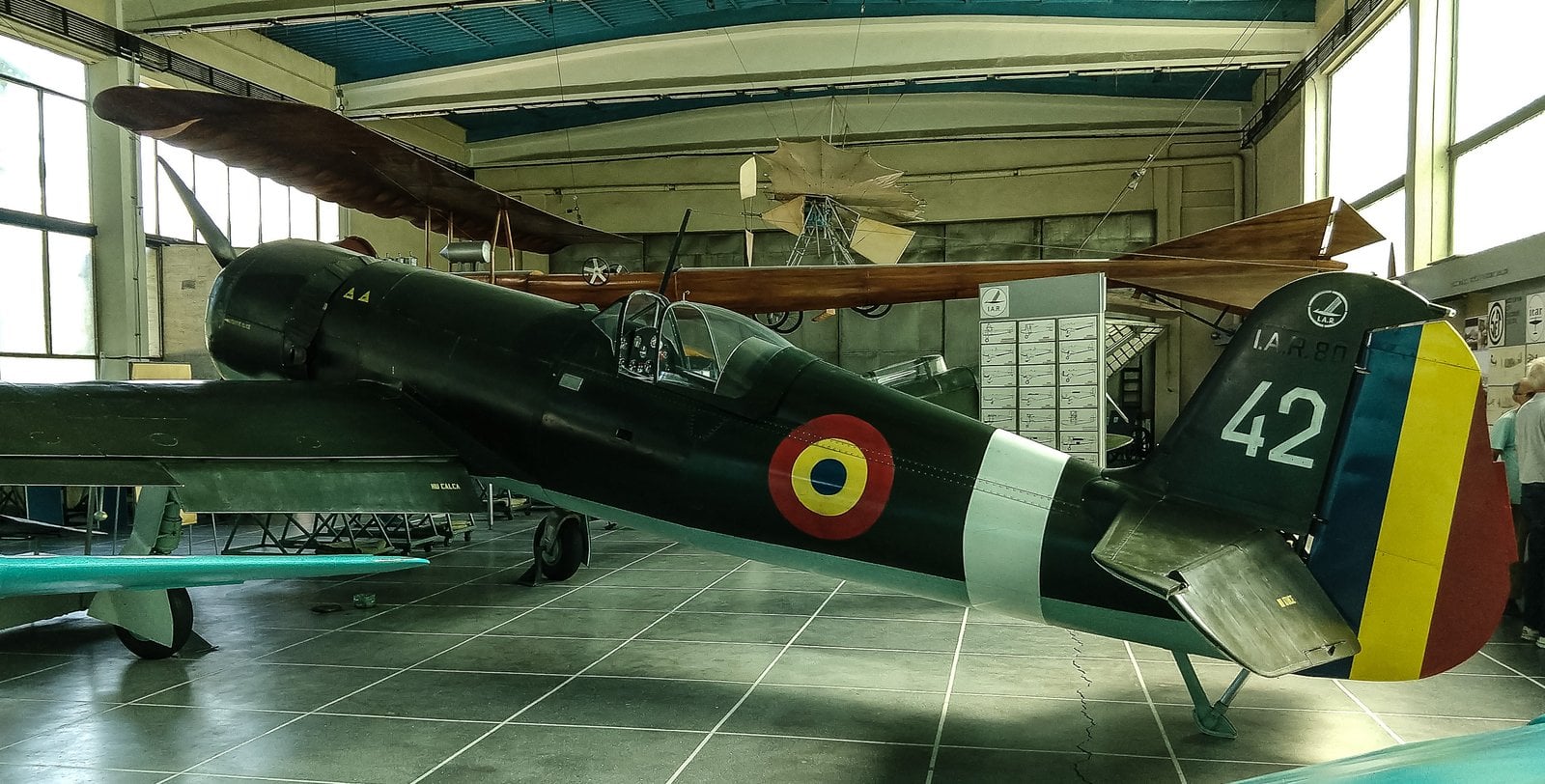
- Survivants : No original airframe is known to survive; replicas are displayed in Bucharest
A Polish tail, a French heart, a Romanian wing
Romania came to the fighter business by way of Poland. In the 1930s its air force bought and licence-built Polish PZL fighters, first the gull-winged P.11 (whose combat career Afterburner told in the story of Poland’s 1939 defenders) and then the more powerful P.24. The engineers at IAR in Brașov learned a great deal from building other people’s aircraft. Then they decided to build their own.
The result, the IAR 80, was a family recipe. The tail, the engine installation and cowling came from the P.24. The engine itself was French: the Gnome-Rhône 14K Mistral Major, a 14-cylinder radial that IAR built under licence as the K14. But the low monoplane wing, the retractable undercarriage and the fuselage were Romanian. The prototype flew in April 1939, with an open cockpit and around 870 hp, and touched about 510 km/h (317 mph), a respectable figure for the day.
So far, so promising. Then geopolitics walked into the hangar. The fighter was meant to carry Belgian FN-Browning machine guns, and in May 1940 Germany overran Belgium. Production stalled for want of guns until Romania joined the Axis in November 1940 and Berlin released the supply. Deliveries began early in 1941, and the six-gun IAR 80A followed that spring with armour and a 1,025 hp engine.
Into the war on the wrong side of history
Romania joined the German invasion of the Soviet Union on 22 June 1941, and IAR 80s of Grupul 8 Vânătoare (8th Fighter Group) went with it. The fighter was nimble and easy to fly, but pilots soon found it underpowered and under-armed. IAR kept adding firepower: heavier 13.2 mm machine guns in the IAR 80B, then 20 mm cannon in later versions, and a dive-bomber variant, the IAR 81, that could carry bombs under its belly and wings.
By 1942 the Romanian fighters were flying over Stalingrad. They were also, by then, being overtaken. Newer Soviet fighters were outclassing the IAR 80, efforts to fit a more powerful German engine came to nothing, and Germany began supplying Romania with Messerschmitt Bf 109s instead. In 1943 the surviving IAR 80s were pulled back to defend home, which, as it turned out, was where the real fight was coming.
Ploiești: the oil the whole Axis needed
Romania’s refineries at Ploiești were among the most valuable targets in Europe, and among the most heavily defended. On 1 August 1943, 178 USAAF B-24 Liberators flew from Libya to attack them at rooftop height in Operation Tidal Wave, a raid Afterburner covered in Le raid qui a volé à cinquante pieds. German flak and fighters waited for them. So did Romanian IAR 80s.
More than 50 Liberators were lost that day to all causes. How many fell to Romanian fighters is still argued over; Romanian records credit IAR pilots with around ten. What is not in doubt is that the low-level bombers flew straight through a defence that the Romanian air force was a real part of, not a footnote to.
When the US Fifteenth Air Force came back in April 1944, it came from Italy, at high altitude and in far greater numbers, often with fighter escorts. Romanian and German fighters rose to meet it, IAR 81Cs among them, now armed with German 20 mm cannon. The Romanian pilots were brave, well trained and badly outnumbered.
The day the “Fw 190s” came from Brașov
On 10 June 1944, the Americans tried something new: P-38 Lightnings of the 82nd Fighter Group, each carrying a bomb, would dive-bomb the Româno-Americană refinery, escorted by more P-38s of the 1st Fighter Group. They came in low to beat the smoke generators. The Romanian 6th Fighter Group, commanded by Captain Dan Vizanty, scrambled 23 IAR 81Cs to meet them.
The American pilots, seeing radial-engined fighters with short wings, reported them as Fw 190s. It was an easy mistake, and one US crews made about IAR fighters throughout the campaign. Second Lieutenant Herbert Hatch was among the escorts.
Hatch was credited with five victories that day, making him an ace in a single mission. For the Lightnings overall it was a bad day: between 22 and 24 P-38s were lost to fighters and flak, depending on the source. Romanian pilots claimed more than 20 of them for the loss of three or four IARs, and the two sides’ accounts have never been fully reconciled. In his own account of the fight, Vizanty called the battle, which he said lasted 12 minutes, “12 minutes chillingly long for some, and incredibly short for others.”
It was the IAR’s last great day against the Americans. Losses mounted through the summer, and in July 1944 the IAR 80 and 81 units were withdrawn from the fight against the US raids while their pilots converted to Bf 109Gs.
Changing sides in a single night
On 23 August 1944, with the Red Army pouring into the country, King Michael had the pro-German dictator Marshal Ion Antonescu arrested and took Romania out of the Axis. Within days the country was at war with Germany. The airmen who had been shooting at American bombers in June were now, in theory, their allies.
Which brings in Romania’s best-known fighter pilot. Captain Constantin “Bâzu” Cantacuzino, a prince, aerobatic champion and the country’s leading ace, is often linked with the IAR 80, but he did not fly it in combat. He fought in a Hawker Hurricane in 1941 and later in Bf 109Gs. On 27 August 1944 he flew Lieutenant Colonel James Gunn III, the senior American prisoner in Romania, to Italy crammed into the fuselage of a Bf 109 painted with American flags. The rescue of more than 1,100 Allied airmen followed.
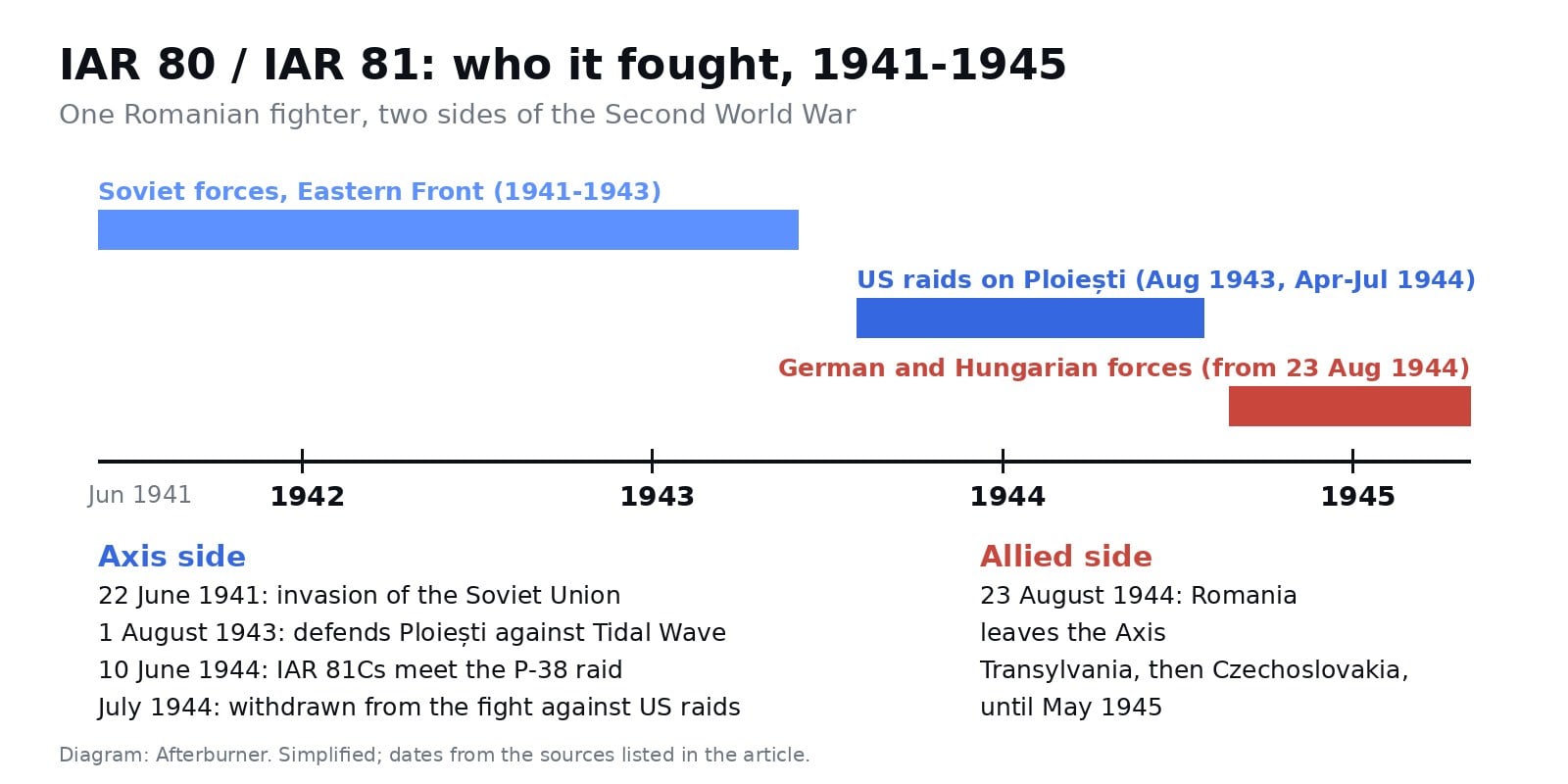
The IAR 80s and 81s, meanwhile, turned around and flew against their former partners, supporting the Soviet and Romanian advance into Transylvania and on into Czechoslovakia. On 21 April 1945, Lieutenant Gheorghe Mociorniță was strafing a German truck column in Czechoslovakia in IAR 81C number 426 when ground fire brought him down. He was killed less than three weeks before the war in Europe ended, flying a Romanian-built fighter, by the army whose side it had gone to war on.
Scrapped, forgotten and rebuilt
The IAR 80 stayed in Romanian service until 1949, when Soviet types replaced it. In the new communist Romania, the fighter that had fought the Soviet Union was not a welcome memory, and the survivors were scrapped. No original airframe is known to exist today.
Replicas now stand in Bucharest, and a volunteer project, IAR 80 Fly Again, has been working to build a flying replica. For a fighter that fought the Soviets, the Americans and the Germans in barely four years, a second life in a peaceful sky would be a fitting final twist.
Sources: HistoryNet (Timothy J. Kutta; Barrett Tillman; Duane Schultz), IPMS Stockholm (Doru Sicoe), Kaiserslautern American (Dr. Marshall Michel, 52nd Fighter Wing historian), National WWII Museum, Air & Space Forces Magazine, Radio Romania International, worldwar2.ro, Faculty of Aerospace Engineering, University Politehnica of Bucharest, Dan Vizanty, personal account, Gândirea Militară Românească.
Header photo: Walter Jacobi, public domain, via Wikimedia Commons
0 Comments