
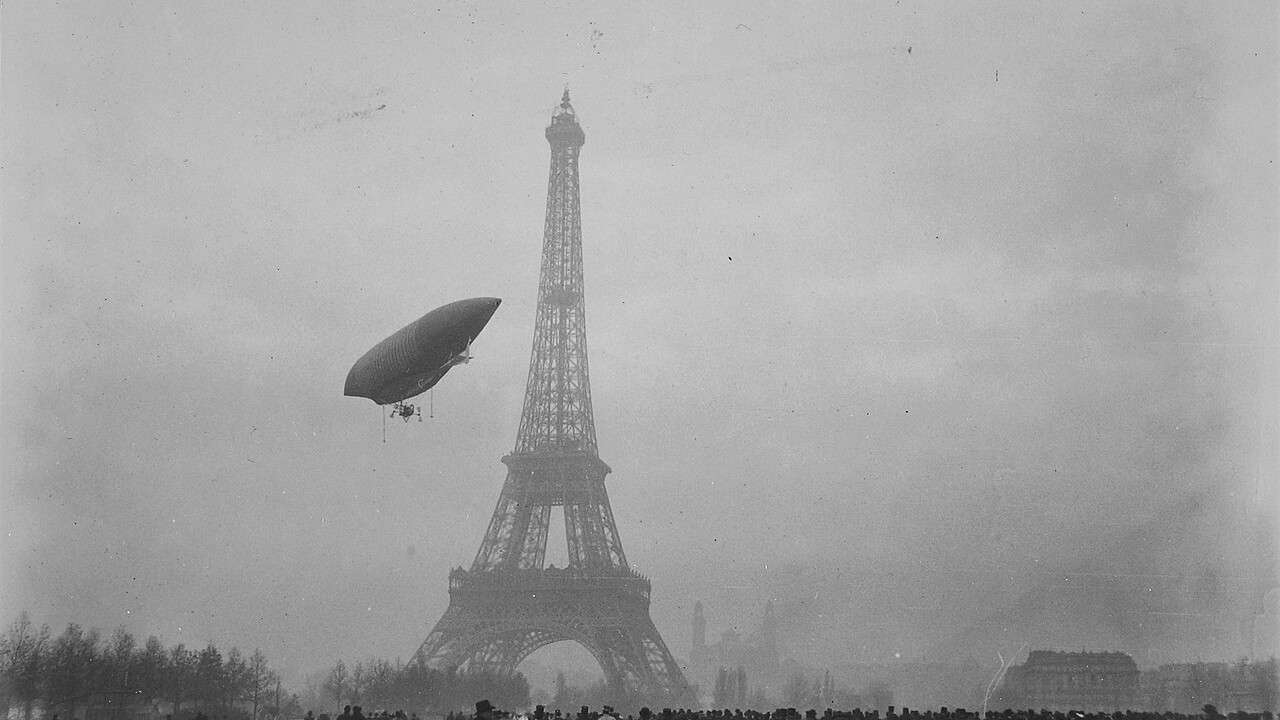
On 12 November 1903, Parisians on the Champ de Mars looked up and saw a long, cigar-shaped balloon coming up the Seine from the west, engine clattering, propellers turning, heading exactly where its pilot wanted to go. It settled on the parade ground in the shadow of the Eiffel Tower. It had flown there from a sugar baron’s estate some 50 kilometres away.
The machine was the Lebaudy, built by France’s biggest sugar refiners and nicknamed Le Jaune, “the Yellow One”, for the colour of its envelope. It is often described as the first truly practical powered airship, and it became the ancestor of the semi-rigid military airships that France, Russia and Austria-Hungary flew before the First World War.
Informations clés
- Airship: Lebaudy (Lebaudy I), nicknamed Le Jaune, “the Yellow One”
- Taper: Semi-rigid: flexible envelope with a steel-tube keel girder
- Builders: Paul and Pierre Lebaudy, sugar refiners; designer Henri Julliot; envelope by Édouard Surcouf
- Base: Moisson, on the Seine downstream from Paris
- First free flight: Mid-November 1902
- Pilote: Georges Juchmès
- Landmark flights: 8 May 1903 Moisson–Mantes and back; 12 November 1903 Moisson to the Champ de Mars, Paris, about 54 km
- Moteur: Single petrol engine of about 35–40 hp driving two propellers (sources differ)
- Successors: Patrie (1906), République, Liberté, Russia’s Lebed
Sugar money and a refinery engineer
Paul and Pierre Lebaudy owned the Lebaudy frères sugar company. Their airship was designed by Henri Julliot, an engineer at the family refinery, and the envelope was made by the Paris balloon maker Édouard Surcouf. According to French accounts, the brothers poured more than a million gold francs into the project.
In 1901 they built a large airship shed on their property at Moisson, in a loop of the Seine downstream from Paris. Steel tubes for the structure arrived by barge in April 1902, and assembling, inflating and testing the airship took months. It made its first free flight around Moisson in mid-November 1902, before being deflated for the winter.
Neither blimp nor Zeppelin
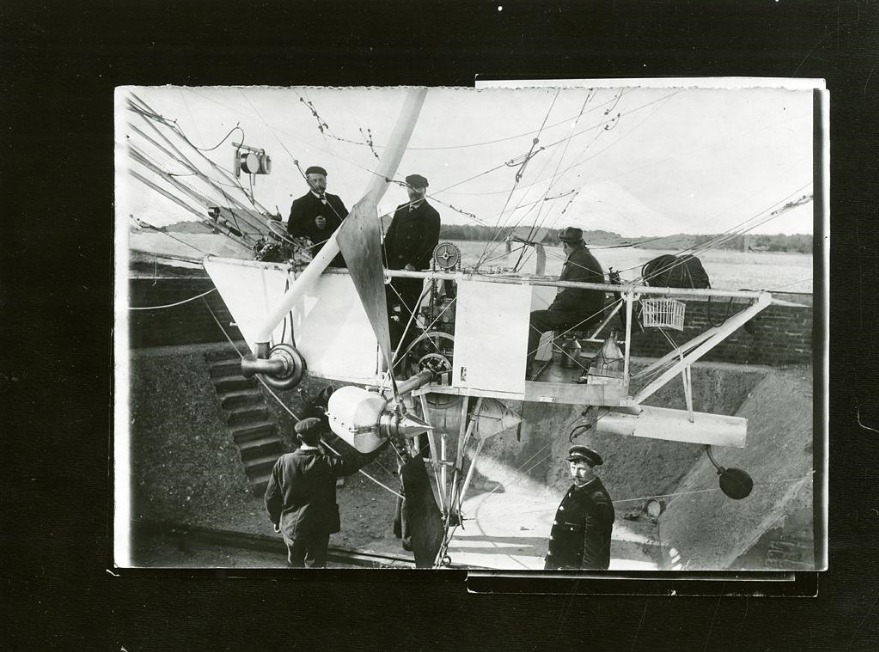
Julliot’s key idea was the semi-rigid layout. A pure pressure airship, a blimp, keeps its shape only through gas pressure, so it sags and buckles when it loses gas. A rigid airship, like Count Zeppelin’s first LZ 1 of 1900, has a full internal skeleton but is heavy and hard to move. The Lebaudy put a stiff keel girder of steel tubing between the envelope and the gondola, spreading the loads along the hull while the envelope itself stayed flexible.
That made the airship steerable and stable in a way earlier designs had struggled to match. It also meant a semi-rigid could be deflated, packed up and moved by road or rail, a point that would soon matter a great deal to armies. The original Lebaudy was driven by a single petrol engine of roughly 35 to 40 hp, turning two propellers; sources disagree on the exact engine.
Alice Guy’s 1907 film of the Lebaudy-built military airship Patrie, the direct descendant of Le Jaune, taking off at Moisson.
The Yellow One earns its name
Reinflated in March 1903, the airship began making longer flights with Georges Juchmès as pilot. On 8 May 1903 it flew from Moisson over Mantes and back, in what aviation chronologies describe as the first fully controlled aerial journey in history. According to French accounts, it was during this flight that the crowds gave it the name Le Jaune, and officers from the army’s balloon establishment at Chalais-Meudon were among the spectators.
More flights followed through the spring and summer. Then came the trip that made it famous. On 12 November 1903, Juchmès took the Lebaudy up the Seine from Moisson, past Poissy and Saint-Cloud, and landed on the Champ de Mars, a controlled journey of some 54 kilometres.
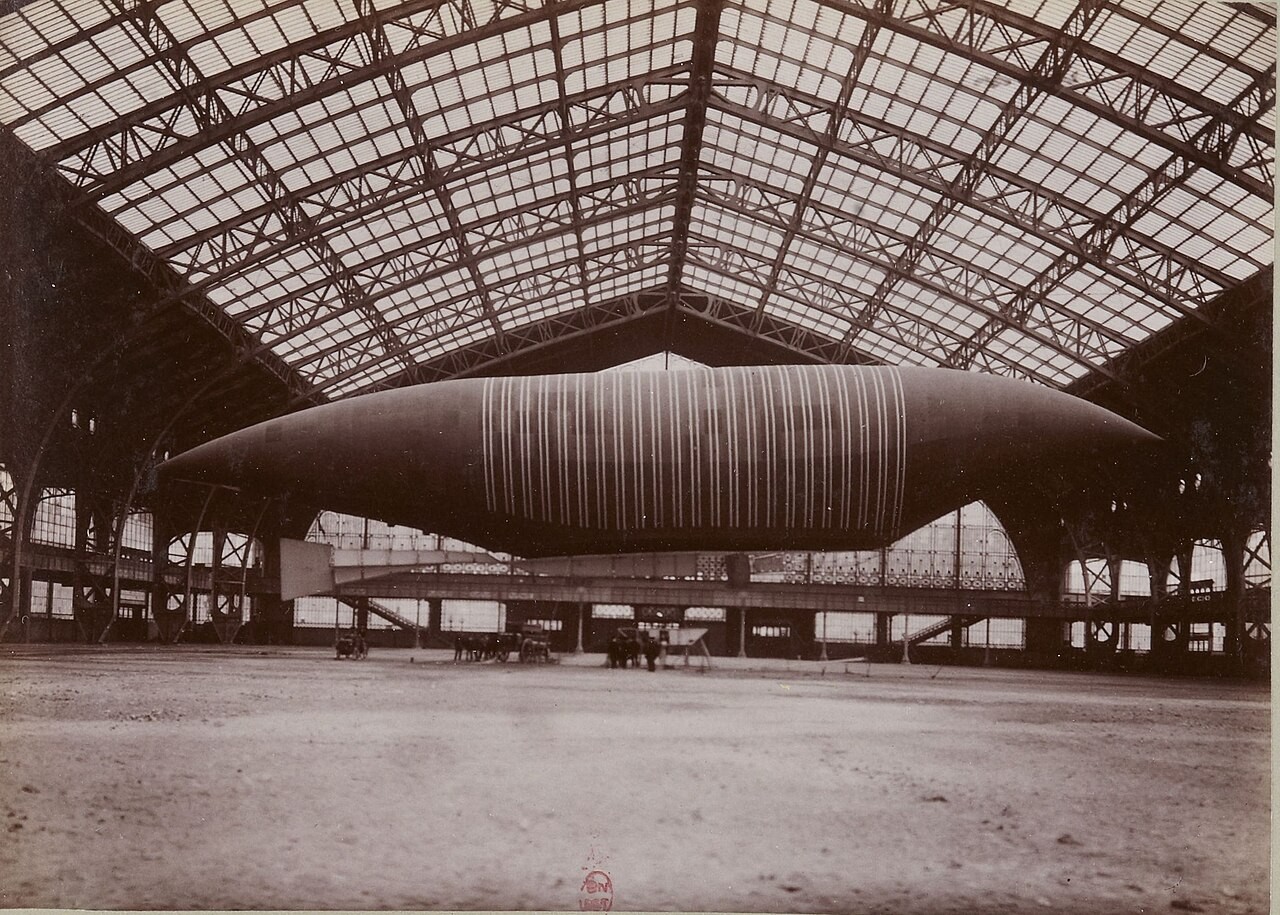
The crowds were so large that the brothers decided to keep the airship in Paris for a few days, housed in the Galerie des Machines left over from the Exposition Universelle of 1889. On 20 November it took off again for Chalais-Meudon, and a photographer caught it sailing past the Eiffel Tower. On arrival, though, the wind threw it against a tree and tore the envelope.
From country estate to army camp
The Lebaudy was repaired and modified at Moisson and flew again from August 1904, including night ascents. In July 1905 it travelled east in stages to the army camp at Châlons, carrying an officer from Chalais-Meudon, and that autumn it took part in military manoeuvres around Toul, where aerial photographs were taken of the fortifications.
The army was convinced. According to French sources, the brothers handed the airship over to the military, and in February 1906 the War Ministry ordered a successor of the same type. That ship, the Patrie, was completed in November 1906 and is regarded as the first airship built specifically for military service. Julliot was clear about what his designs could do.
Le Patrie was followed by the République et Liberté, and Lebaudy sold near-copies abroad. Russia’s Lebed first flew in May 1909, and the Austro-Hungarian army took delivery of its own Lebaudy in 1910. British observers watched closely.
Period footage of the Patrie, built by the Lebaudy brothers at Moisson in 1906, shared by Airship Paris.
Why Le Jaune matters
Le Jaune was neither the first airship nor the biggest. Henri Giffard had flown a steam-powered airship in 1852, and Alberto Santos-Dumont had circled the Eiffel Tower in 1901. What the Lebaudy brought was reliability: repeated, controlled cross-country flights with a crew aboard, in a design that could be built in series and handed to soldiers.
The semi-rigid idea it proved lived on for decades, in Italian designs and in the airship Norge that Afterburner covered in its story of the first verified flight over the North Pole. Not bad for a yellow balloon paid for with sugar.
Sources: Collection Jules Beau (Bibliothèque nationale de France), Progress Magazine (1907), Blackwood’s Magazine (1909), Skytamer aviation chronology, AvStop, Airminded
Header photo: Jules Beau / Wikimedia Commons, public domain

0 Comments