
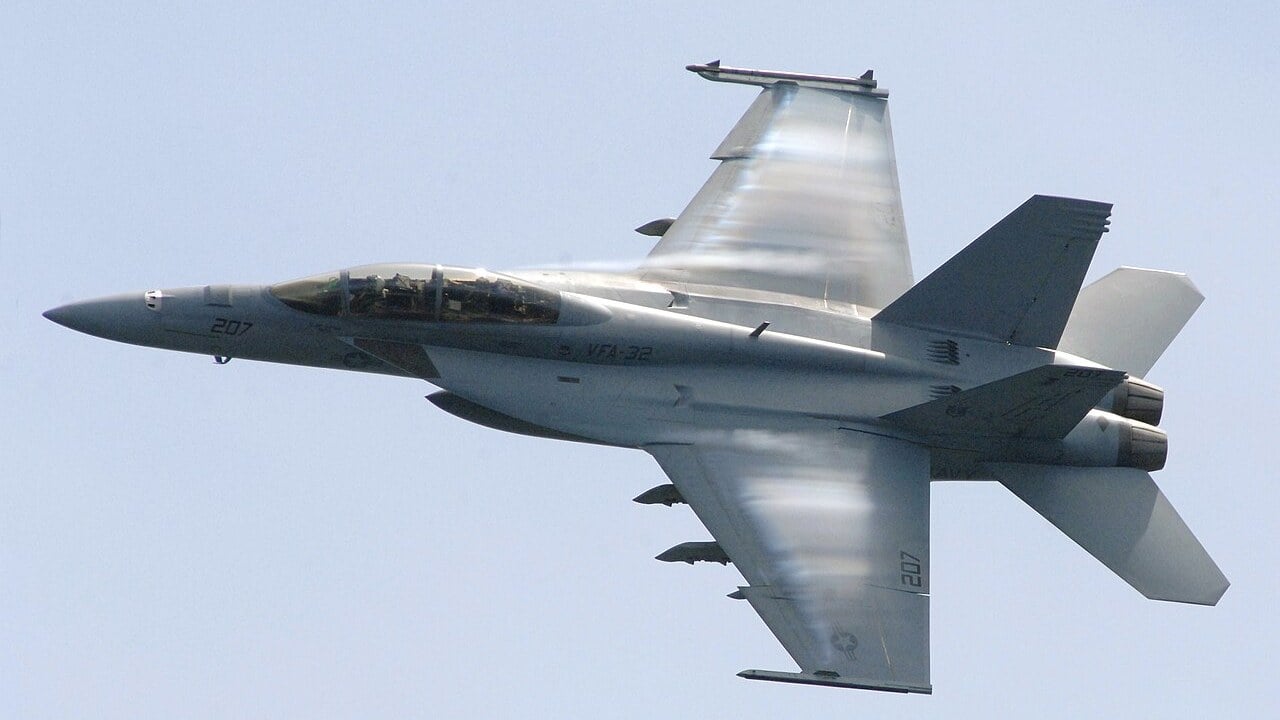
A fully loaded Airbus A320 weighs 78 tonnes. Cruising at 39,000 feet, it is held up by air that is only about a quarter as dense as the air at sea level, pressing on a wing of 124 square metres. Every one of those square metres is carrying more than 600 kilograms of aeroplane.
All of that weight hangs on small pressure differences spread over the wing, created by air being bent gently downward. Explaining wing lift correctly turns out to be one of the most argued-about problems in physics teaching.
Afterburner has already covered the four forces and why the popular explanation of lift is wrong, et angle of attack and the stall. This is the deeper dive, with four interactive graphics: what the air is actually doing, why Bernoulli and Newton are not rivals, the lift equation with real aircraft numbers, and why a fighter’s wing looks nothing like a glider’s.
Informations clés
- What lift is: A mechanical force from a solid body turning a moving fluid; it acts perpendicular to the oncoming flow (NASA)
- Equal transit time: Wrong: the air over the top of a lifting wing reaches the trailing edge first
- Bernoulli or Newton?: Both. Adding up pressure or adding up the flow’s momentum change gives the same force
- Lift equation: L = ½ ρ v² S CL; doubling speed gives four times the lift
- Cessna 172R: CL about 0.28 at 122 kt, about 1.9 at its 47 kt flaps-down stall speed (sea-level air)
- Air at 39,000 ft: About 26% of sea-level density (standard atmosphere)
- Stall: Beyond the critical angle of attack, typically about 15° but airfoil-dependent
- Wing loading: Glider about 33 kg/m²; F-16 about 690 kg/m² at maximum take-off weight
What lift actually is
NASA Glenn Research Center’s definition is refreshingly blunt. Lift is a mechanical force, generated by a solid body in contact with a moving fluid. No fluid, no lift: the Space Shuttle’s wings did nothing in orbit. No motion, no lift: it makes no difference whether the wing moves through still air or the air moves past a still wing, as in a wind tunnel.
Lift is also defined by direction, not by what it opposes. It acts perpendicular to the oncoming flow. In level flight that is straight up; in a turn it tilts toward the centre, and at the top of an aerobatic loop it points at the ground.
The graphic below computes the flow around a wing section and releases virtual smoke pulses, the experiment Cambridge University filmed in a real wind tunnel. Watch the blue dots over the top and the dark ones underneath.
The race that never happens
The classic school explanation says the air over the curved top has further to go, so it must hurry to meet the air underneath at the trailing edge. NASA’s Beginner’s Guide to Aeronautics calls this the most popular incorrect theory of lift. The error, it says, is the speed: the air over the top of a lifting wing moves much faster than equal transit time would require.
Holger Babinsky, a professor in Cambridge University’s Department of Engineering, made the point visible. His smoke pulses split at the leading edge, and the upper half races ahead and leaves the trailing edge while the lower half is still on its way. In his 2003 paper in Physics Education he adds a quietly devastating footnote: if the two halves did arrive together, the wing would produce no lift at all.
There is no law of physics that makes air parcels keep an appointment at the trailing edge. A sail has the same length on both sides and still drives a yacht. A paper aeroplane is a flat sheet. What matters is not path length but how the wing bends the flow.
Bernoulli and Newton describe the same flow
Arguments about lift usually split into two camps: “Bernoulli” (the wing makes a pressure difference) and “Newton” (the wing throws air down and is pushed up). NASA notes that neither Daniel Bernoulli nor Isaac Newton ever tried to explain aerodynamic lift. Their names are just labels for two ways of doing the same sum.
Add up the pressure acting on every square centimetre of the wing and you get the lift. Add up the change in momentum of all the air the wing deflects downward and you get the same lift. Bernoulli’s equation expresses conservation of energy, Newton’s laws conservation of momentum, and a real flow obeys both.
Doug McLean, who spent most of his career at Boeing Commercial Airplanes developing computational fluid dynamics codes, goes one step further. In his 2012 book Understanding Aerodynamics, he describes four things that always appear together around a lifting wing: the flow turns downward, the flow speeds up over the top, a cloud of low pressure forms above and a cloud of higher pressure forms below.
As McLean puts it, the pressure differences exert the lift force on the wing, while the downward turning of the flow and the changes in speed sustain those pressure differences.
Former Boeing aerodynamicist Doug McLean’s lecture at Michigan Engineering on common misconceptions in aerodynamics, including the explanations of lift.
Curved streamlines, low pressure
So where does the pressure difference come from? Babinsky’s answer is a rule anyone who has driven round a roundabout can feel. In his paper he writes that “if a streamline is curved, there must be a pressure gradient across the streamline, with the pressure increasing in the direction away from the centre of curvature.”
Air following the curved upper surface of a wing is bending around a centre of curvature inside the wing. For it to curve, the pressure right at the surface must be lower than the pressure further out, which is ordinary atmospheric pressure. Below the wing the flow curves the other way, so the pressure at the lower surface rises above ambient. Low above, high below: lift.
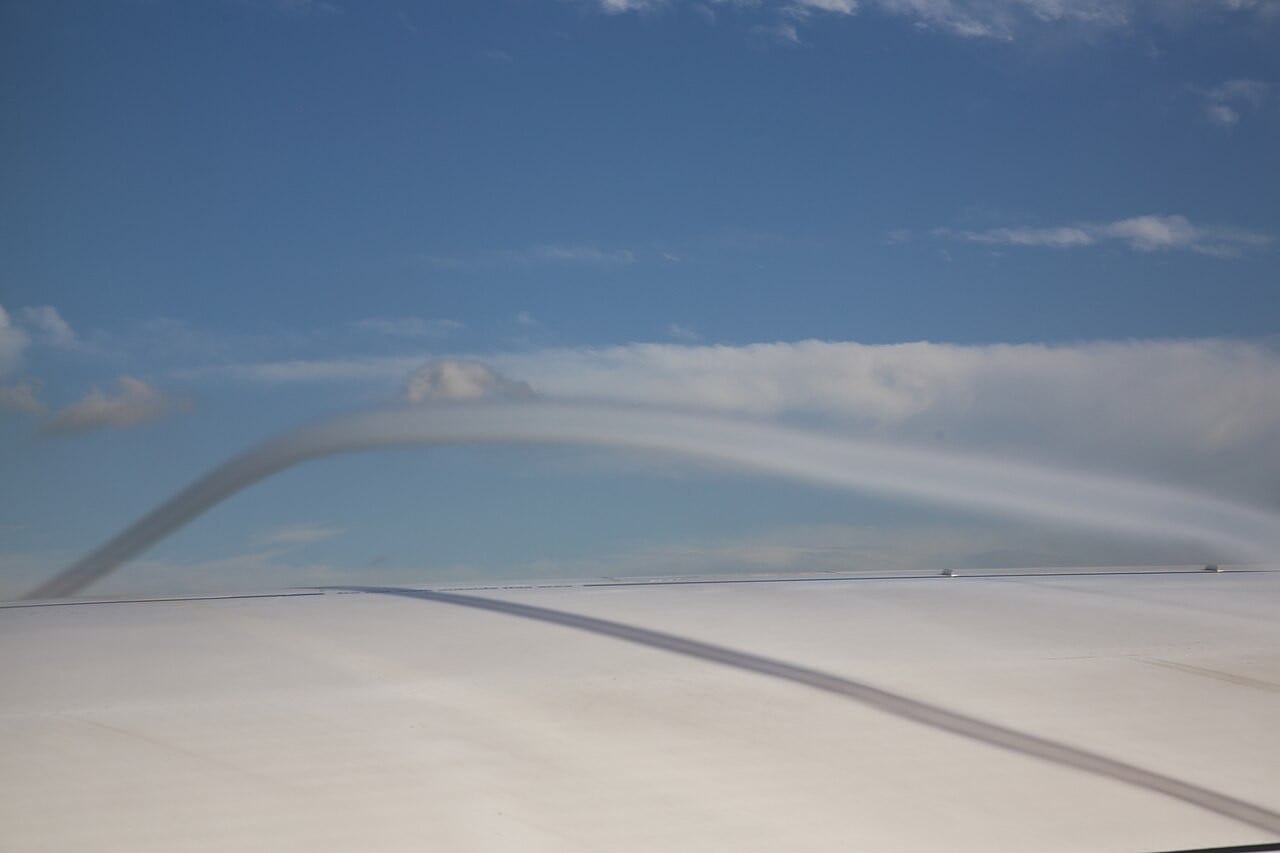
Sometimes the low pressure becomes visible: on a humid day, air expanding and cooling over the top of a wing can condense into a fleeting fog.
Circulation, downwash and the swirl behind every wing
Aerodynamicists describe the same pattern with one number: circulation. Combine the upward flow ahead of the wing, the fast flow above, the slower flow below and the downward flow behind, and the air has a net “spin” around the wing. The Kutta–Joukowski theorem turns that circulation directly into lift per metre of span.
Theory alone cannot say how much circulation a wing gets. The answer lies at the sharp trailing edge: the flow has to leave it smoothly, the Kutta condition, and that pins down the circulation and with it the theoretical lift. The interactive airfoil above is built on exactly this condition.
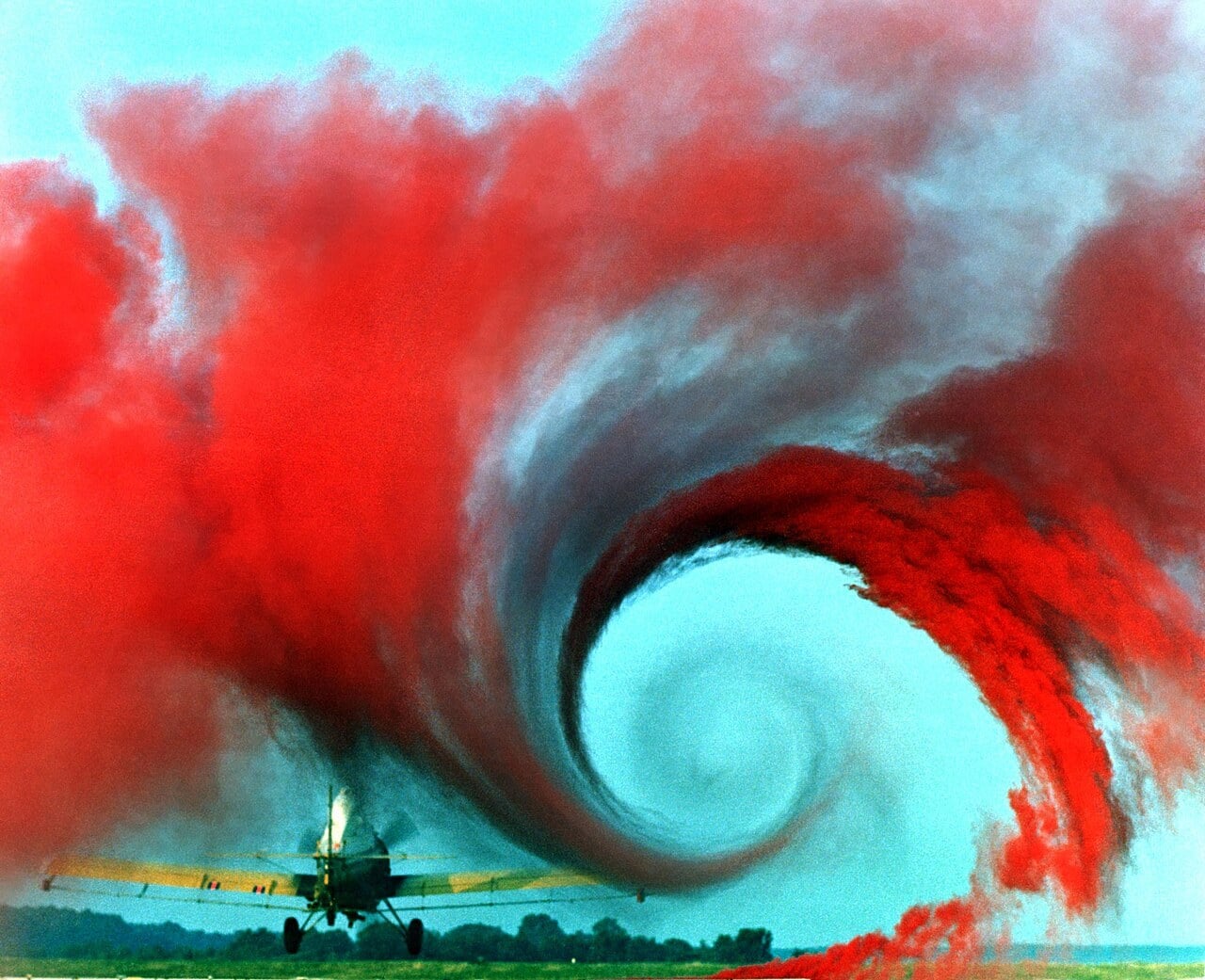
Real wings end, and at the tips the high-pressure air underneath spills around into the low pressure on top. NASA describes the result: a pair of counter-rotating tip vortices and a downwash behind the wing, strongest near the tips. That downwash tilts the lift slightly backward and creates induced drag. It also reduces the lift of short, stubby wings more than long, slender ones.
The lift equation, with real numbers
Engineers package everything into one line. NASA Glenn writes it as lift equals the lift coefficient times the air density times half the velocity squared times the wing area: L = ½ ρ v² S CL. All the hard physics, the shape, the angle of attack, the viscosity, is folded into the lift coefficient CL, which is usually measured experimentally rather than calculated.
The square on the speed is the headline. The FAA’s Pilot’s Handbook of Aeronautical Knowledge puts it simply: an aeroplane at 200 knots has four times the lift of the same aeroplane at 100 knots, if everything else stays the same.
Try it with a Cessna 172R. It weighs up to 1,111 kg and has 16.2 square metres of wing. Flying at its listed cruise speed of 122 knots in sea-level air, the wing needs a lift coefficient of only about 0.28. Slow to its 47-knot flaps-down stall speed and the dynamic pressure falls by a factor of nearly seven, so the same aircraft needs a coefficient of about 1.9. Same weight, same wing, completely different job.
Altitude works the same way through density. Using NASA’s standard-atmosphere model, air at 39,000 feet has about 26 per cent of sea-level density. An A320 at its maximum take-off weight, flying at its Mach 0.78 cruise speed up there, would need a lift coefficient of about 0.73. Load in your own numbers below.
Le F-16 shows the other extreme. At its listed cruise speed of 504 knots, in sea-level air, its 27.87 square metres of wing need a lift coefficient of barely 0.1 to hold up 12 tonnes. Pull 9 g, the jet’s limit, and the wing has to make nine times the aircraft’s weight in lift, which takes it close to 0.9 at the same speed.
Lift is not always equal to weight
“Lift equals weight” is true only in straight, level, unaccelerated flight. The FAA’s handbook explains what changes when the flight path tilts. In a climb, part of the thrust acts upward as if it were lift, and part of the weight acts backward as if it were drag. In a glide, part of the weight points forward along the flight path and does the job of thrust.
Angle of attack is the pilot’s lever on CL: more angle, more lift, until the flow can no longer follow the upper surface. Past the critical angle, typically about 15 degrees but dependent on the aerofoil, it separates and lift collapses. Our stall explainer covers what that means in the cockpit.
How an aircraft flies upside down
If lift came from the curved top surface, inverted flight would be impossible. It is not. A cambered wing turned upside down can still make upward lift: the pilot simply holds the nose high enough that the wing meets the air at a positive angle again.
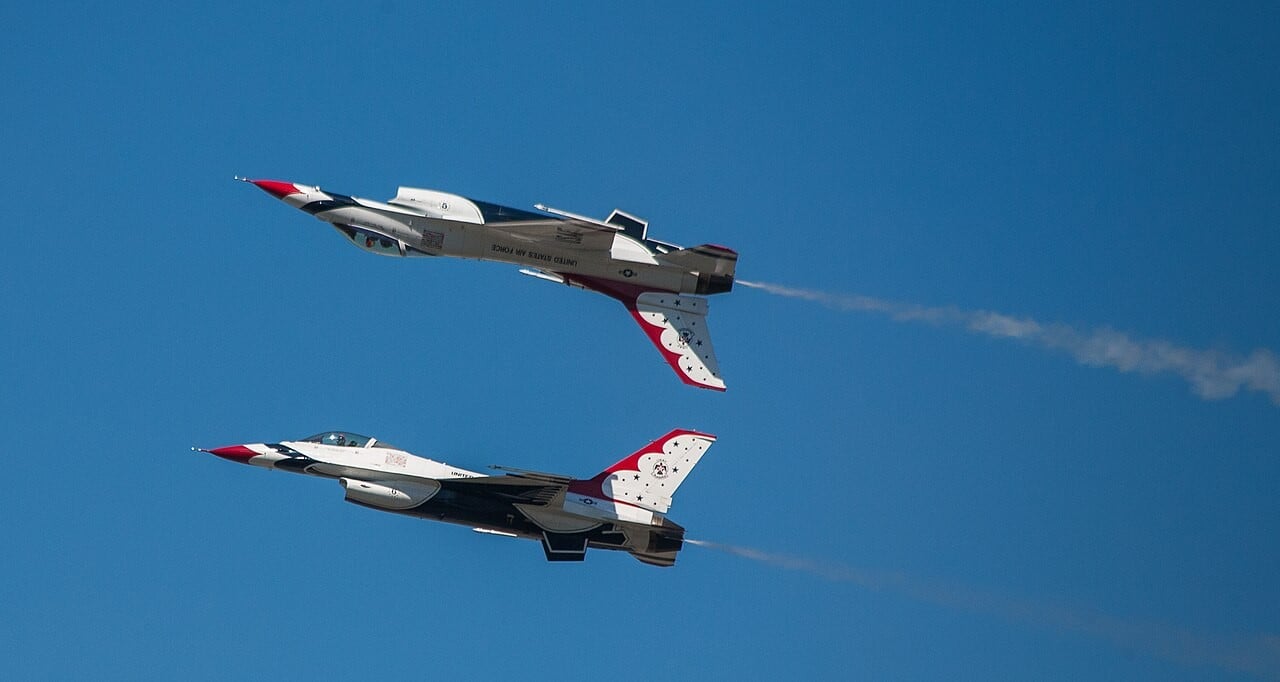
Aircraft built to spend time inverted often use symmetrical sections, identical top and bottom, which make no lift at zero angle and behave the same either way up. The FAA notes that symmetrical airfoils appear on high-speed aircraft and many helicopter rotor blades. The Aéro L-39 Albatros trainer, for example, uses a modified NACA 64A012, a 12 per cent thick section with a design lift coefficient of zero. The F-16 uses a thin, slightly cambered NACA 64A204.
Why fighter wings and airliner wings look so different
Put the planforms side by side and the design priorities jump out. A Schleicher ASK 21 two-seat glider spreads 600 kg across a 17-metre span, about 33 kg per square metre, with an aspect ratio of 16. Long, slender wings lose less lift to the tips and make less drag.
Fighters go the other way. The FAA explains that very fast aircraft need low aspect ratios for strength and aerodynamic cleanness, and that sweep delays the shock waves of near-sonic flight. The F-16’s cropped delta has a 40-degree leading-edge sweep; the MiG-21’s delta is swept at 57 degrees. At maximum take-off weight the F-16 carries close to 690 kg per square metre of wing; leading-edge extensions add lift at high angles of attack, and its blended fuselage makes lift of its own.
The A320 sits in between: a 25-degree sweep for efficient cruise near Mach 0.8, an aspect ratio of 10.3 for range, and a heavily loaded wing, around 630 kg per square metre at maximum take-off weight. Flaps are what make such a heavily loaded wing practical at landing speeds. Swept and delta layouts get their own deep dives in our pieces on swept wings et delta wings.
Flaps: a second wing for slow flight
Flaps are the most common high-lift devices, and the FAA’s handbook describes what they do. A plain flap increases the camber of the wing, so it makes a larger lift coefficient at the same angle of attack. Slotted flaps duct high-energy air from below the wing over the flap, delaying separation and raising the maximum lift coefficient further.
Fowler flaps slide backward on tracks before they droop, increasing both camber and wing area. The A321 stretch of the A320 family gained double-slotted flaps and four extra square metres of wing to cope with its higher weight. The L-39 has double-slotted flaps too. More on that in our guide to flaps and slats.
Veritasium’s visual explainer on how a wing actually works, from flow turning to pressure.
Strip away the arguments and the picture is simple. A wing bends the air downward. Bending air needs a pressure difference, and the pressure difference is the lift. Bernoulli measures it, Newton balances it, and the smoke never meets up again at the trailing edge. Next time you see the Thunderbirds fly inverted, or fog streaming off a wing on a damp day, that is what you are watching.
Sources: NASA Glenn Research Center Beginner’s Guide to Aeronautics (What is Lift?, Bernoulli and Newton, Lift Equation, Downwash Effects on Lift, Venturi Theory, Earth Atmosphere Model, Glide Angle), FAA Pilot’s Handbook of Aeronautical Knowledge chapters 4, 5 and 6, H. Babinsky “How do wings work?” Physics Education 38 (2003), University of Cambridge, Scientific American (Ed Regis, 2020, on Doug McLean), Wikipedia (Lift (force); Stall (fluid dynamics); Airfoil; NACA airfoil; Wing loading; Cessna 172; Schleicher ASK 21; Aero L-39 Albatros; Airbus A320 family; General Dynamics F-16 Fighting Falcon; Mikoyan-Gurevich MiG-21), MiGFlug

0 Comments