
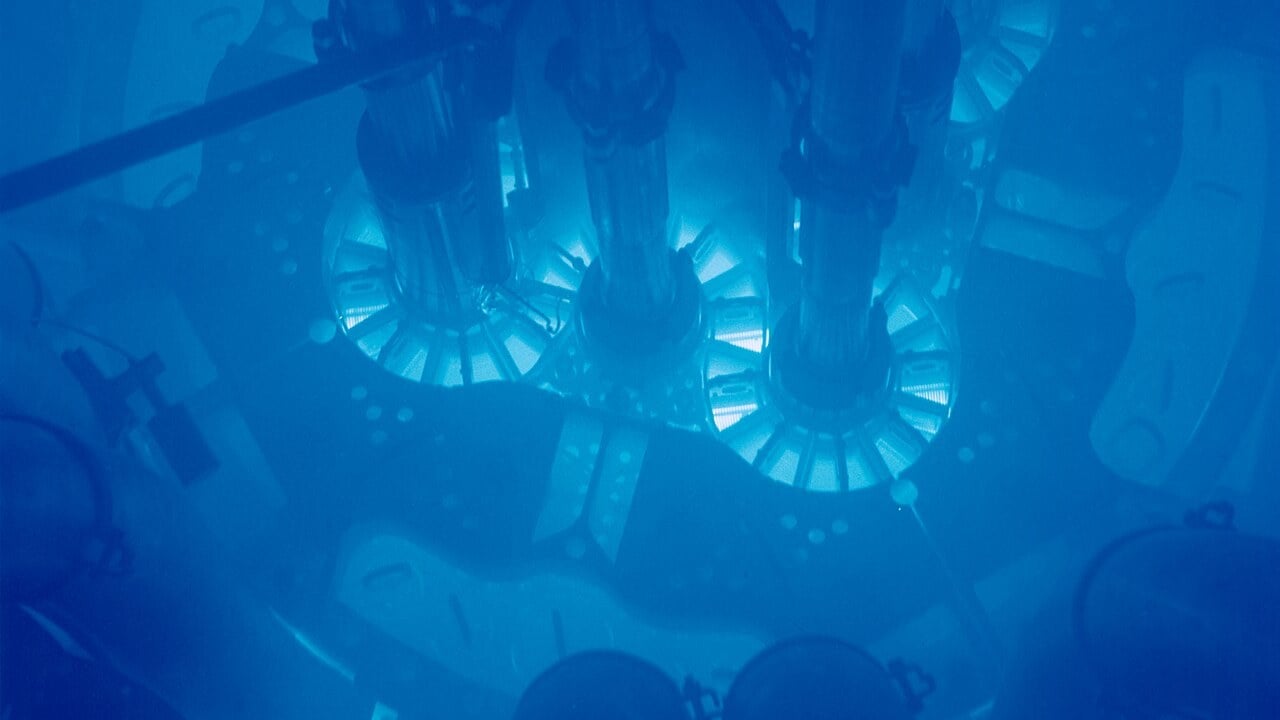
Somewhere under the flight deck of every American supercarrier, uranium atoms are quietly splitting apart. No smoke, no exhaust, no fuel barge alongside. The same process keeps a Nimitz-class carrier steaming for decades between refuelings and carried the first nuclear submarine under the ice to the North Pole. It is called nuclear fission, and it is one of the strangest and most powerful ideas in physics.
This Afterburner explainer covers how nuclear fission works: what happens when an atom splits, how one split triggers the next in a chain reaction, what “critical” really means, how a reactor keeps all of that under control, and why a power reactor cannot blow up like a bomb. Then we follow fission to sea, where it powers the ships that carry the US Navy’s air wings.
Quick Facts
- What it is: A heavy atomic nucleus, such as uranium-235, splitting into two lighter nuclei
- Trigger: Usually the capture of a neutron
- Neutrons released: Typically 2 or 3 per fission (2.45 on average for U-235)
- Energy: About 200 MeV per U-235 fission, versus about 4 eV per carbon atom burned
- Natural U-235: 0.7% of natural uranium
- Discovered: December 1938: Hahn and Strassmann (chemistry), Meitner and Frisch (explanation)
- First chain reaction: Chicago Pile-1, 2 December 1942
- At sea: USS Nautilus, underway on nuclear power 17 January 1955; Nimitz and Ford-class carriers use two reactors each
What is nuclear fission?
Every atom has a tiny, dense nucleus made of protons and neutrons. In very heavy elements such as uranium, that nucleus is only barely holding together. Fission is what happens when such a nucleus splits into two smaller nuclei, releasing energy and a few free neutrons in the process.
The trigger is usually a neutron. Because it carries no electric charge, a neutron can drift right up to a nucleus without being pushed away. According to the World Nuclear Association (WNA), when uranium-235 captures a neutron the new nucleus is unstable and is likely to break into two fragments of roughly half the mass, followed almost instantly by typically two or three new neutrons, 2.45 on average.
The fragments are lighter elements from the middle of the periodic table, such as barium and krypton. Add up the mass of everything that comes out and it is very slightly less than what went in. That missing mass has become energy, exactly as Einstein’s E=mc² predicts.
Why splitting atoms releases so much energy
The numbers are the “aha” moment. The WNA puts the energy from one uranium-235 fission at about 200 million electron volts. Burning one atom of carbon in coal or jet fuel releases about 4 electron volts. Atom for atom, fission is roughly fifty million times more energetic than combustion.
Scaled up, the WNA says fission of uranium-235 releases about 82 terajoules per kilogram. About 85 per cent of the energy first appears as the kinetic energy of the two flying fragments. In solid fuel they travel only a microscopic distance before slamming to a halt, and that motion turns into heat. A reactor is, at heart, a very sophisticated kettle.
Only certain kinds of nucleus split easily. Slow neutrons readily cause fission in uranium-233, uranium-235 and plutonium-239. Uranium-235 is the only naturally occurring isotope that does this, and it makes up just 0.7 per cent of natural uranium; almost all the rest is uranium-238. That is why most reactor fuel is enriched to raise the share of uranium-235.
Khan Academy walks through nuclear fission step by step, from neutron capture to the energy released.
The chain reaction, explained
Here is the clever part. Each fission is started by one neutron, but releases two or three more. If at least one of those goes on to split another nucleus, the process feeds itself. That is a chain reaction, and it is what turns a laboratory curiosity into a power source.
Physicists describe the balance with one number: how many neutrons from each generation go on to cause a new fission. If the answer is less than one, the reaction fades away and the system is subcritical. If it is exactly one, the reaction holds steady and the system is critical. If it is more than one, the number of fissions grows and the system is supercritical.
In a reactor, “critical” is the normal, healthy operating state, not an emergency. The WNA explains that at criticality the number of neutrons stays constant, so the power stays constant. To raise or lower power, operators nudge the balance up or down and then bring it back to exactly critical at the new level.
Not every neutron finds a nucleus. Some escape through the surface, others are absorbed by materials that do not split. This is where the idea of critical mass comes from: the smallest amount of fissile material, in a given shape and setting, in which enough neutrons stay inside to keep the chain going. It is a concept, not a fixed number, because it depends on the material, its density, its shape and what surrounds it.
Moderators: why reactors slow neutrons down
It sounds backwards, but slower neutrons are better at splitting uranium-235. Neutrons born in fission move fast, at around 7 per cent of the speed of light according to the WNA. Slowed down by a moderator, they move at roughly eight times the speed of sound, and at that pace uranium-235 nuclei capture them far more readily.
A moderator is a material made of light atoms that the neutrons bounce off, losing energy with each collision. The US Department of Energy notes that in American power reactors, ordinary water does double duty as both coolant and moderator. The very first reactor used blocks of graphite.
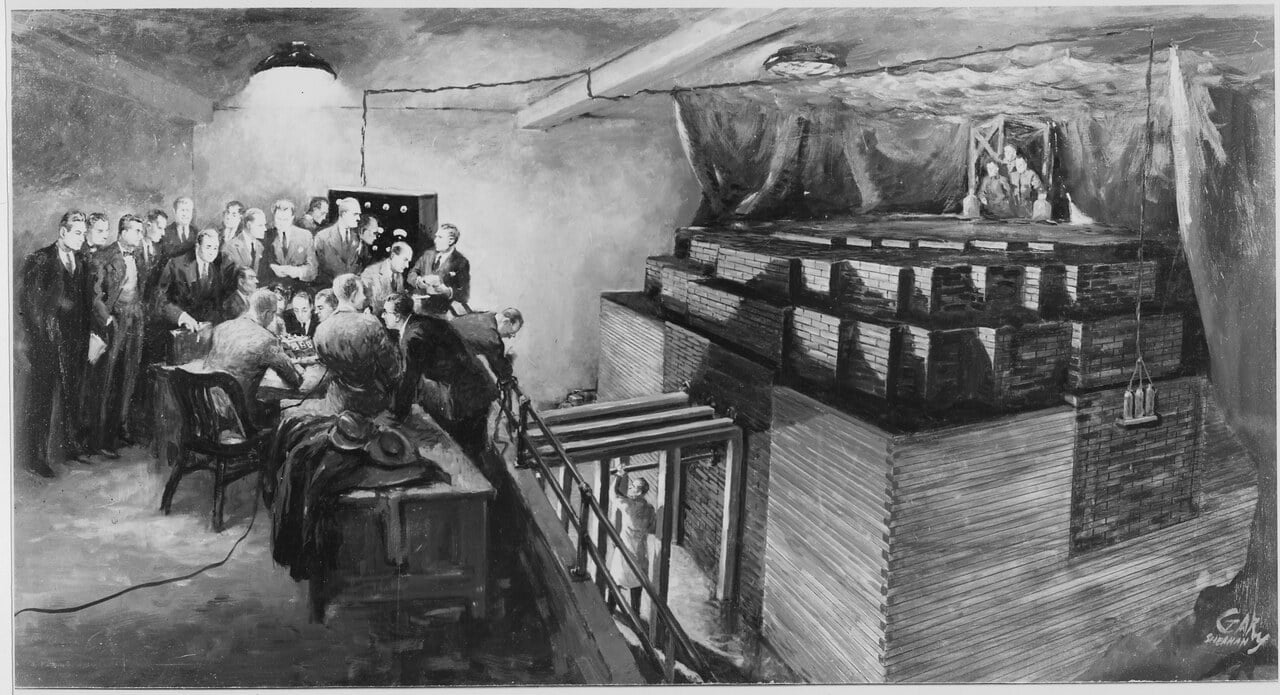
That first reactor was Chicago Pile-1, built in a racquets court under the stands of Stagg Field at the University of Chicago. On 2 December 1942, a team led by Enrico Fermi slowly withdrew the last control rod, and at 15:25 the pile went critical: the first human-made, self-sustaining nuclear chain reaction. It ran for about four and a half minutes at roughly half a watt before Fermi shut it down.
Control rods and the secret of delayed neutrons
Control rods are the reactor’s brake pedal. They are made of materials that absorb neutrons readily. The DOE explains that inserting them into the core reduces the reaction rate and withdrawing them increases it. In an emergency, they can be driven fully in to shut the reaction down.
Rods alone would not be enough if every neutron appeared instantly. The real secret is that a small fraction of neutrons, 0.66 per cent for uranium-235, are released late, from the radioactive decay of certain fission products. The longest-delayed group has a half-life of about 56 seconds, according to the WNA. Those latecomers slow the whole system’s response to a pace that machinery and operators can manage.
Even a shut-down reactor keeps making heat. About 6 per cent of the heat in an operating core comes from the radioactive decay of fission products, and that does not stop when fission does. The WNA points to Fukushima in 2011, where cooling was lost about an hour after shutdown while the fuel was still producing around 1.5 per cent of its full-power heat. That is why reactors need cooling long after they are switched off.
Why a nuclear reactor cannot explode like a bomb
It is the most common question about reactors, and the answer comes down to fuel. Commercial power reactor fuel is only slightly enriched in uranium-235, and the arrangement of fuel, water moderator and control systems is designed to run steadily at exactly critical. A weapon requires material and conditions of a completely different kind.
That does not make reactors harmless. Overheating can damage fuel and release radioactivity, and at Fukushima a hydrogen explosion wrecked reactor buildings. But that was a chemical explosion, not a nuclear detonation. Reactor safety is about keeping the fuel cool and contained, which is why reactors are built with multiple barriers and backup cooling.
SmarterEveryDay visits the world’s first nuclear power plant and explains how a reactor turns fission into electricity.
Fission at sea: nuclear carriers and submarines
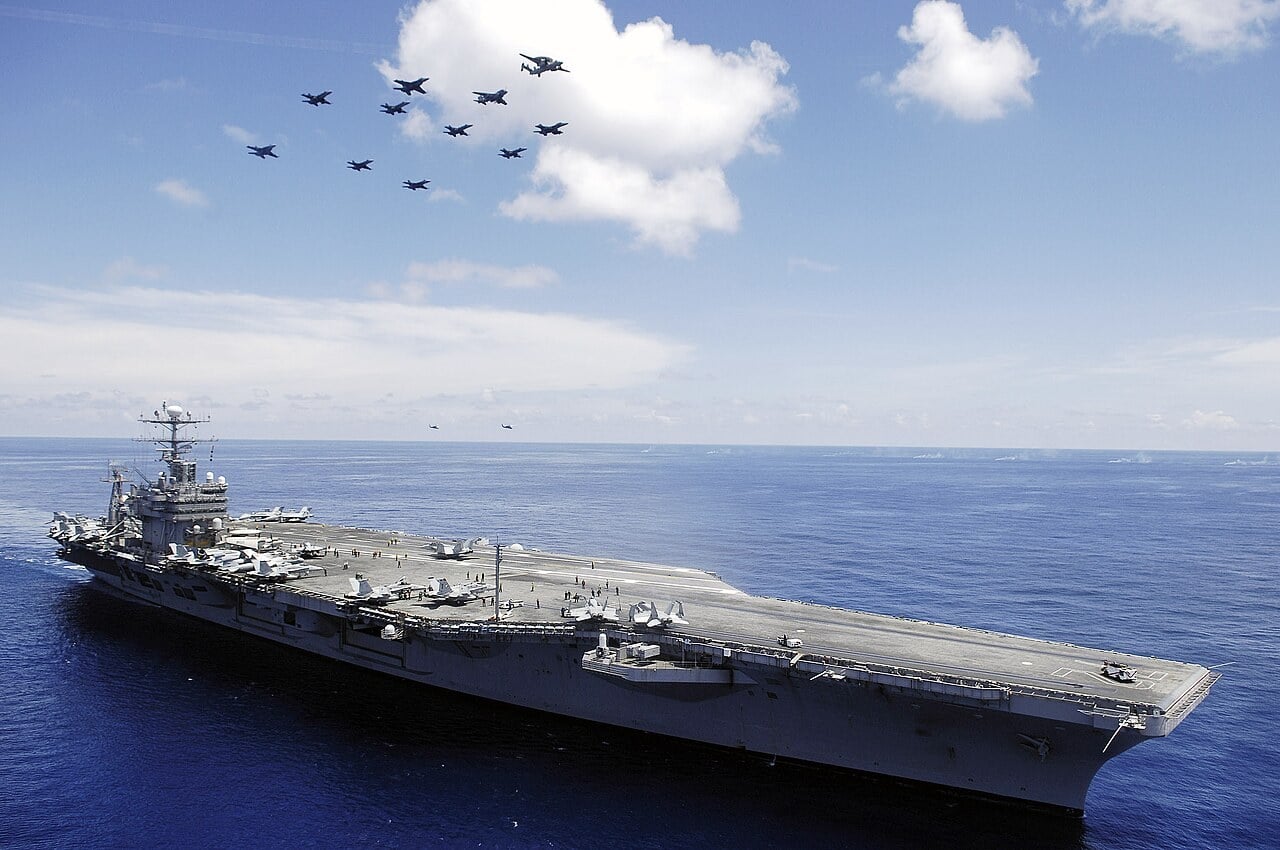
For aviation, fission matters most at sea. The DOE describes the basic idea behind most reactors: heat from fission makes steam, and steam spins a turbine. A naval reactor does the same, except the turbine turns propeller shafts and generators instead of feeding a national grid. The first to do it was the submarine USS Nautilus, commissioned on 30 September 1954.
According to the US Navy’s Naval History and Heritage Command, Nautilus stayed dockside for further construction and testing until 17 January 1955, when her lines were cast off at 11:00 and she was underway on nuclear power. As she headed into Long Island Sound, she famously signalled the message “Underway on nuclear power.” The American Physical Society notes her team designed a pressurized water reactor, the template for the most common reactor types today.
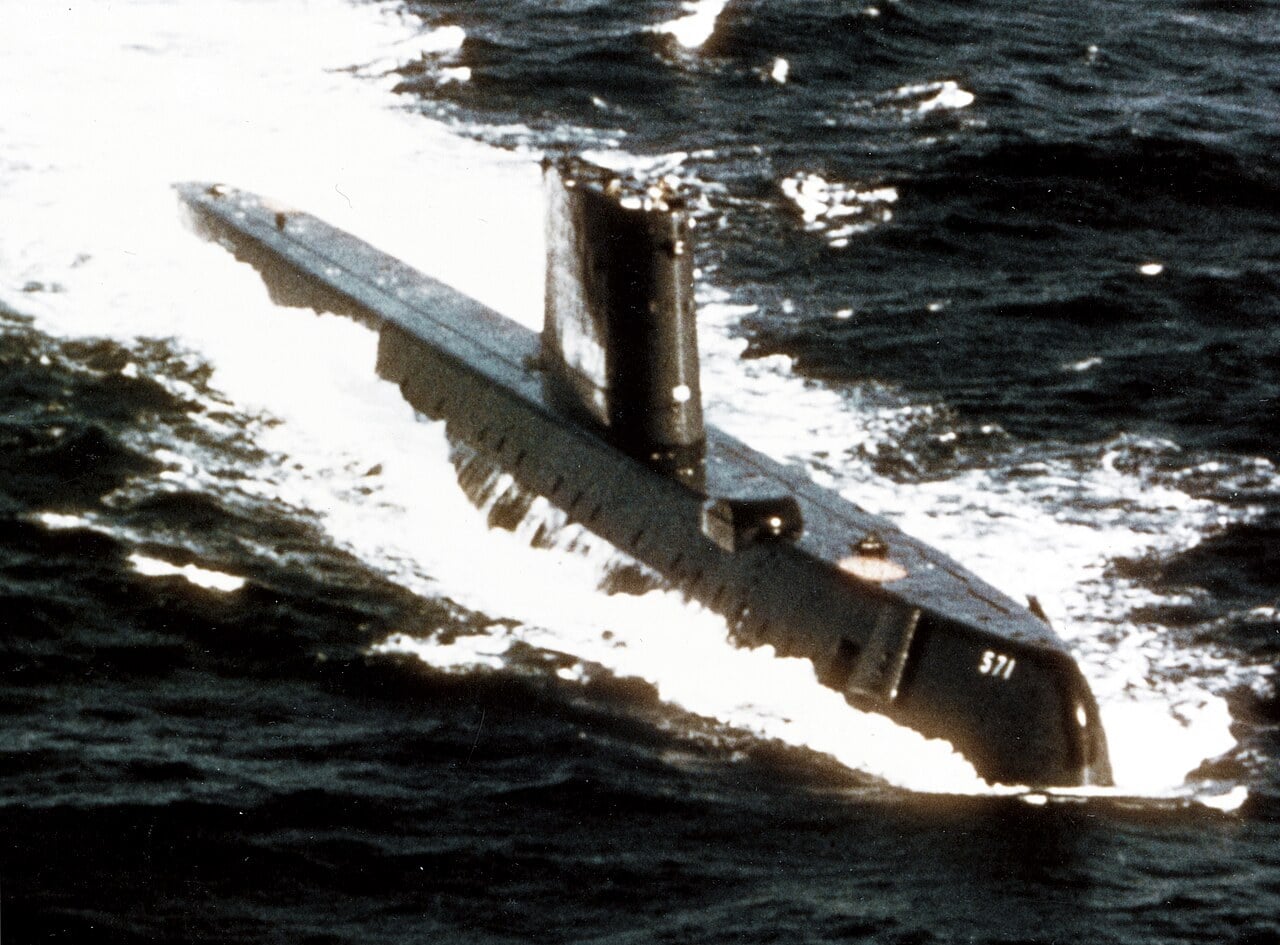
In 1958, Nautilus became the first ship to reach the geographic North Pole, travelling under the ice. Carriers followed. USS Enterprise (CVN-65), the world’s first nuclear-powered aircraft carrier, needed eight reactors. The ten Nimitz-class carriers that followed do the job with two, and the US Navy says the new Gerald R. Ford class also uses two, of the new A1B design.
That endurance changes how a carrier air wing works. Without bunkers of fuel oil for the ship itself, a Nimitz-class carrier has room for considerably more aviation fuel and ordnance than the conventionally powered carriers that came before it. The Navy’s fact file lists more than 60 aircraft for a Nimitz-class carrier, from the F/A-18E/F Super Hornet to the F-35C and E-2 Hawkeye, all launched from a deck pushed through the ocean by fission.
Fission even took to the air, briefly. In the 1950s, the Convair B-36 test aircraft known as the NB-36H carried a working reactor to test radiation shielding for the crew, but it never used the reactor to power the aircraft.
From a Swedish forest to the flight deck
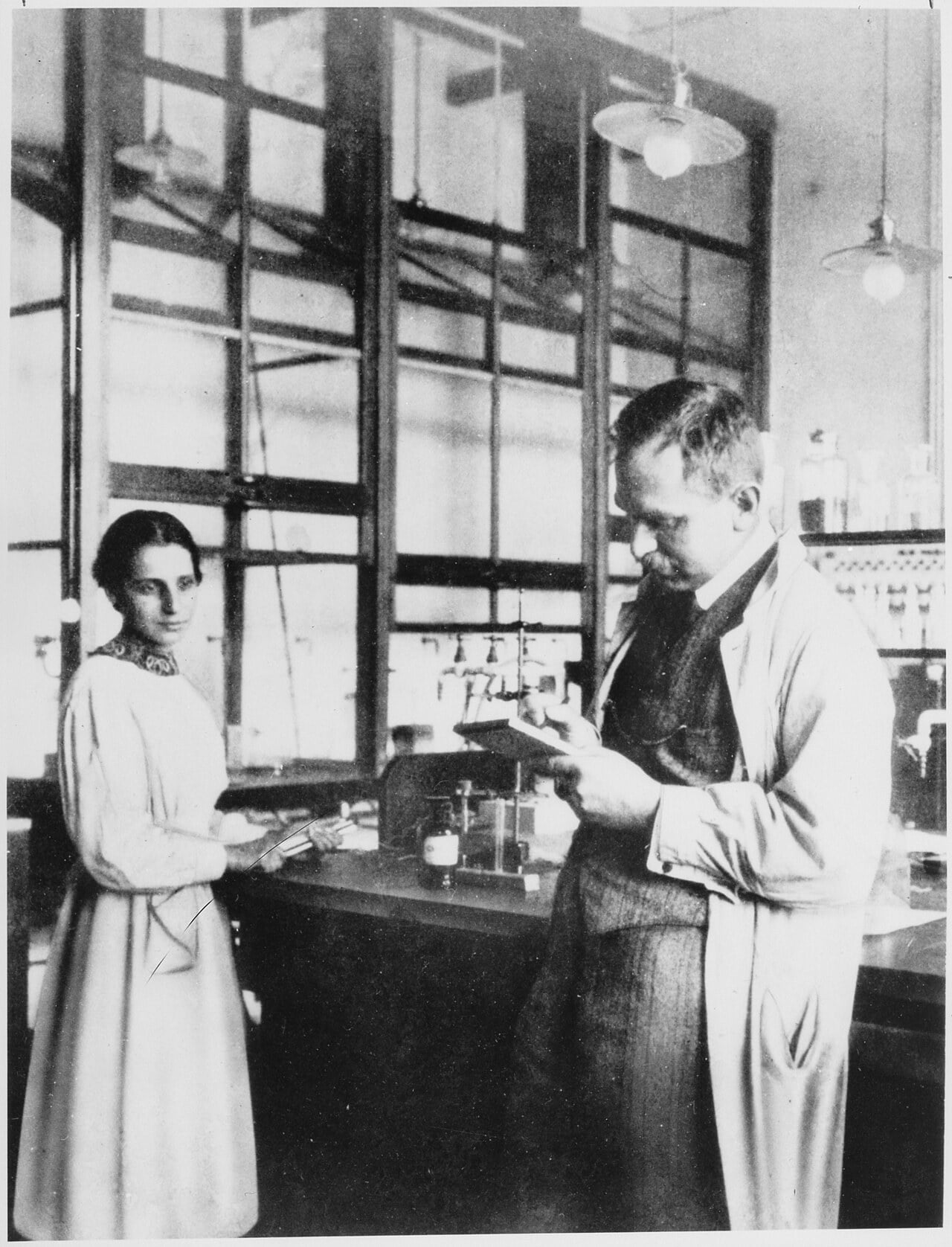
The whole story began with a puzzle in Berlin. In December 1938, chemists Otto Hahn and Fritz Strassmann bombarded uranium with neutrons and found barium, an element far lighter than uranium. Hahn wrote to Lise Meitner, his long-time colleague, who had fled Nazi Germany and was in Sweden.
Over Christmas 1938, Meitner and her nephew Otto Frisch worked out that the uranium nucleus had split roughly in half, and Meitner calculated the energy released at about 200 million electron volts. Frisch borrowed a word from biology, where cells divide by fission, and their explanation appeared in Nature in February 1939. We tell that story in full in Christmas 1938: The Atom Splits.
British Movietone newsreel of the launch of USS Nautilus, the first nuclear-powered submarine, in 1954.
Hahn received the 1944 Nobel Prize in Chemistry for the discovery; Meitner was not included. Four years after the discovery, Fermi’s pile went critical in Chicago. Less than twenty years after it, Nautilus passed under the North Pole.
The physics has not changed since that Swedish Christmas. A neutron strikes a heavy nucleus, the nucleus splits, a little mass becomes a lot of energy, and a few new neutrons carry the chain onwards. Control the neutrons and you can run a city, or push a supercarrier and its air wing across the oceans for half a century.
Sources: World Nuclear Association (Physics of Nuclear Energy; Safety of Nuclear Power Reactors), US Department of Energy Office of Nuclear Energy, US Navy aircraft carrier fact file, Naval History and Heritage Command (Nautilus DANFS), American Physical Society
Header photo: Argonne National Laboratory / Wikimedia Commons, CC BY-SA 2.0

0 Comments