
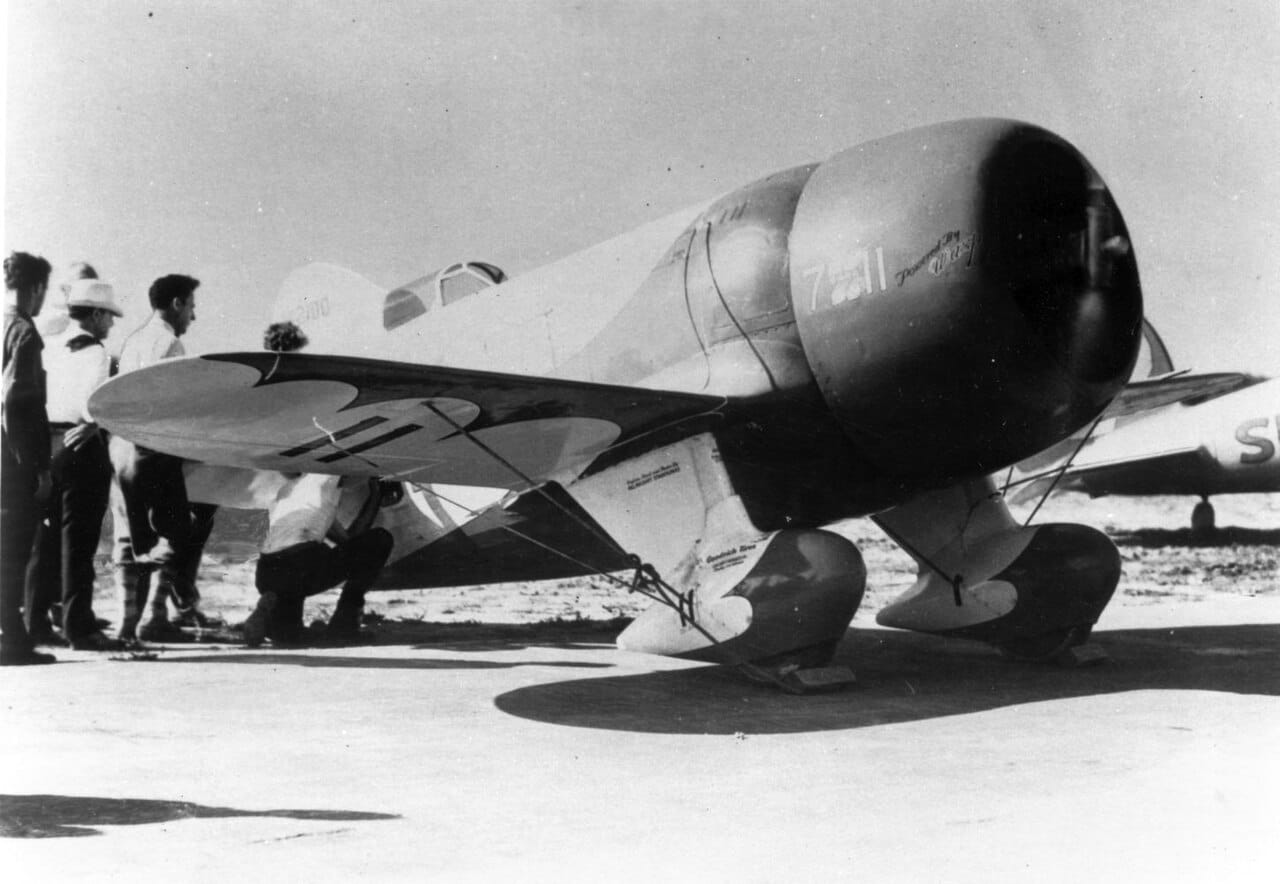
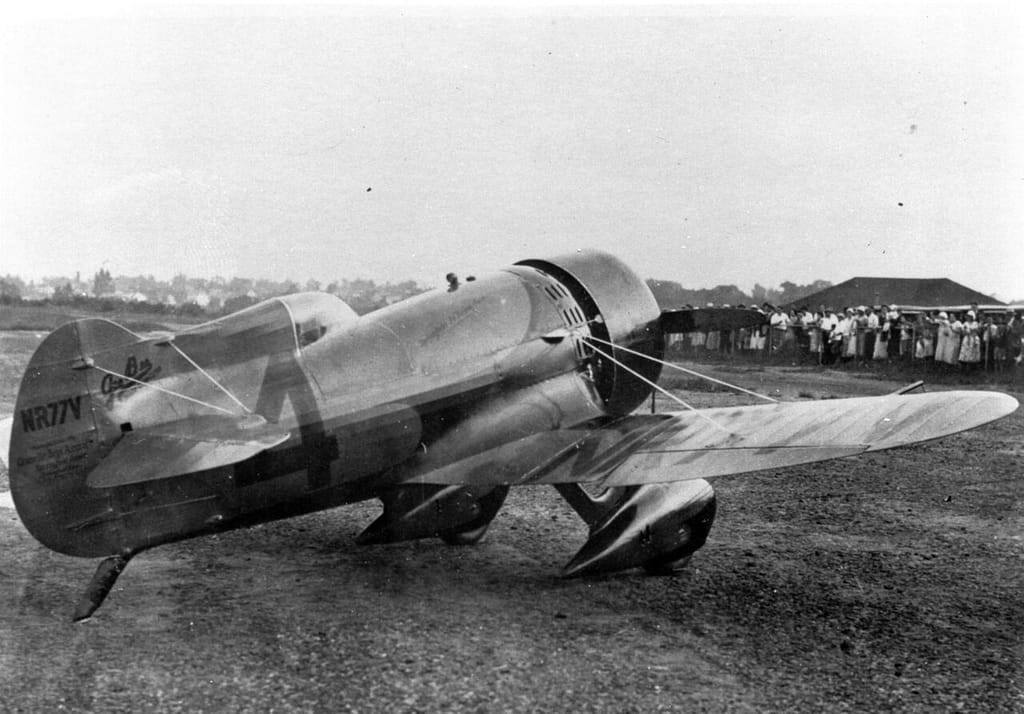
Look at it once and you understand why the legend stuck. The Gee Bee R-1 is a barrel with a propeller bolted to the front, a wing that looks borrowed from something half its weight, and a cockpit shoved so far back it is practically part of the tail. It looks like a joke about aeroplanes.
In September 1932 it was the fastest thing on wheels in America, and Jimmy Doolittle flew it to a world record. Within three years the family firm that built it was bankrupt, three pilots were dead in Gee Bees, and the name had become shorthand for a machine that killed the men who flew it.
Almost none of that reputation survives contact with the evidence.
Informazioni rapide
- Costruttore: Granville Brothers Aircraft, Springfield, Massachusetts
- Model R-1: First flown 1932; designers Zantford Granville and Howell “Pete” Miller
- Motore: Pratt & Whitney R-1340 Wasp, 730 hp (the designer’s own published figure)
- Area alare: 75 sq ft — wing loading roughly triple a modern light aircraft
- Stall speed: 90 mph
- Doolittle’s record: 294.42 mph, 3 September 1932 (FAI record file 8751)
- 1932 Thompson Trophy: Doolittle, 252.686 mph average, 5 September 1932
- Stressed for: 12 positive g on wings, gear and fuselage
Five brothers and a dance hall
The Granvilles were five brothers from a New Hampshire farm — Zantford, Thomas, Robert, Mark and Edward. Zantford, the eldest, traded engine repairs for flying lessons in the mid-1920s and got his licence that way. By 1929 the family was building aircraft in an abandoned dance pavilion on the edge of Springfield, Massachusetts.
In July 1931, broke and in the middle of the Depression, they decided to build a pure racer for that autumn’s Thompson Trophy. Local merchants bought shares to promote the city. The pilot, Lowell Bayles, put in $500 of his own money to secure the seat. The resulting Model Z was designed and built in under five weeks for under $5,000, and on 7 September 1931 Bayles won the Thompson at an average of 236.239 mph.
Three months later Bayles was dead. Re-engined for a speed record attempt at Detroit, the Z pitched up at over 300 mph and its right wing folded. The leading theory, from frame-by-frame analysis of newsreel film, is that the fuel filler cap tore loose, came through the windscreen and struck him. The exact cause has never been established.
That crash was filmed, and the film was played everywhere. The reputation was set before the R-1 existed.
The most over-engineered racer of its day
Here is the part the legend leaves out. Before a rivet was driven, Zantford Granville and his assistant chief engineer Howell “Pete” Miller spent three days running models in the wind tunnel at New York University under Professor Alexander Klemin. Almost nobody did that with a racer in 1932.
The airframe was stress-analysed for twelve positive g. It had counterbalanced ailerons specifically to damp flutter, a fully adjustable horizontal stabiliser and a controllable-pitch metal propeller. The fat fuselage that everyone laughs at is a deliberate streamlining decision: make the body wider than the radial engine at its widest point, and the drag penalty of that enormous cylinder head largely goes away.
Gilcreast is blunter still about where the myth came from: most of it, he says, is “essentially distilled newspaper reports written hastily at the time, and perpetuated as fact”, with no follow-up reporting assigning causes. He adds that Pete Miller resented the killer reputation until the day he died.
What Doolittle actually said
Doolittle got the R-1 seat almost by accident: Russell Boardman, who owned it, had spun a smaller Gee Bee into the ground weeks earlier and was unfit to fly. On 3 September 1932 Doolittle took the world landplane speed record at 294.42 mph, with a best single pass of 309.040 mph. Two days later he won the Thompson at 252.686 mph, having taped a book of ten matches to the instrument panel and moved one across per lap so he would not lose count.
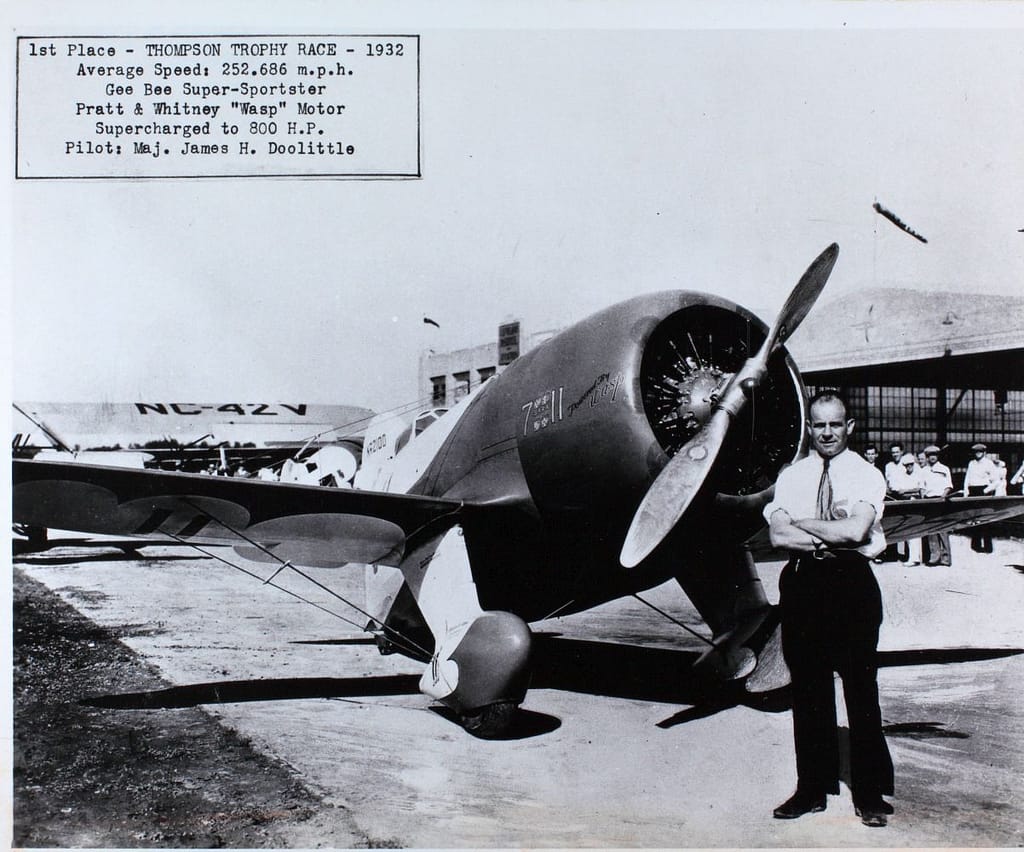
Immediately after the race he told the Springfield Union that she was “the sweetest ship I’ve ever flown”. Nearly sixty years later, in his autobiography, he was rather more candid.
He was right to be careful. Practising pylon turns, the R-1 snap-rolled on him twice before he could catch it. Doolittle retired from air racing shortly afterwards. Lee Gehlbach, who flew the R-2, later explained the decision in one sentence: “We believed that we had used up a considerable portion of our earthly share of luck.”
A 1990 documentary on the Granville brothers and the Gee Bees of Springfield.
Three aircraft, three deaths — and they are not the same aeroplane
The body count gets muddled in retellings, so it is worth separating. Lowell Bayles died in the Model Z in December 1931. Russell Boardman died after crashing the R-1 at Indianapolis on 1 July 1933, pulling up too soon from a heavily loaded Bendix departure and stalling inverted into the ground.
Cecil Allen died on 30 August 1935 in a third machine entirely: a hybrid built from R-1 and R-2 parts, which he had bought and substantially rebuilt with a new wing of different section and an added rear fuel tank. Pete Miller wrote to him warning him never to fill that rear tank, because it would push the centre of gravity dangerously aft. Allen took off at half past one in the morning with every tank full, flew into fog and crashed two miles beyond the runway.
Two of those three deaths involved modifications the original designers did not make and, in Allen’s case, explicitly warned against.
The wheat farmer who flew it for eleven hundred hours
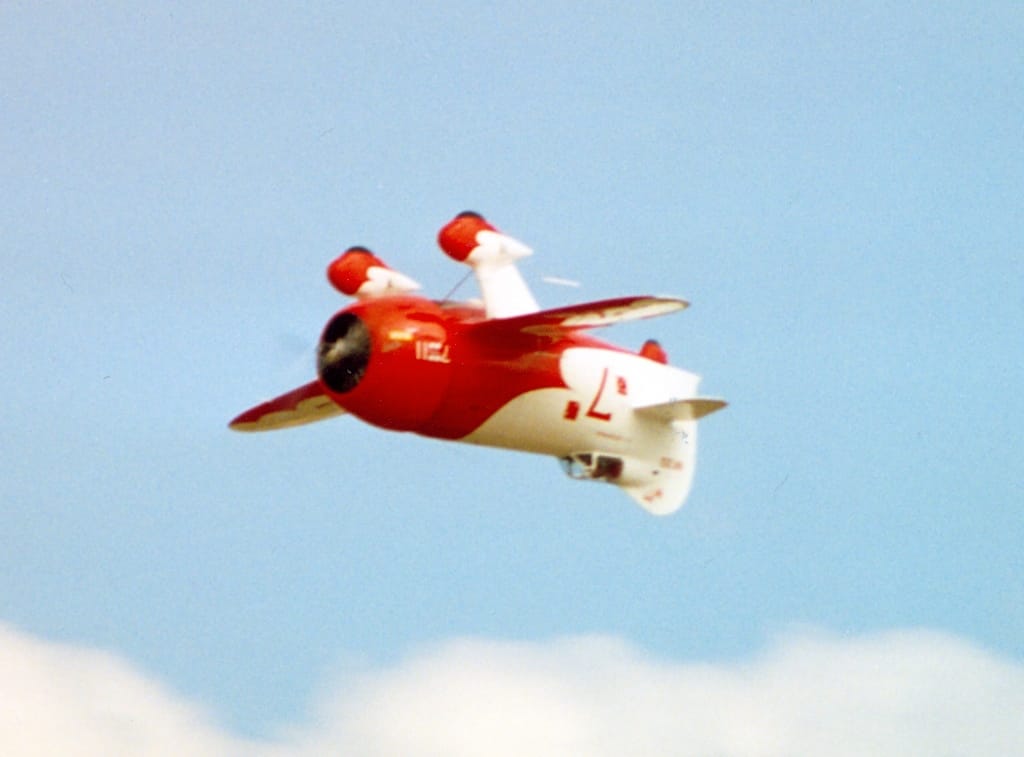
In 1991 a Montana wheat farmer named Delmar Benjamin built a flying R-2 replica with airshow constructor Steve Wolf, working from original plans. His first flight in it was a cross-country to an airshow, because he had loan payments to make.
Over the next eleven years he flew it at around a hundred airshows and accumulated more than 1,100 hours in the type — more than Doolittle, Gehlbach and everyone else combined. He rolled it, flew it inverted and put it through knife-edge passes, manoeuvres the original was assumed to be far too unstable to survive.
What he did not do is pronounce it docile. He confirmed every one of its vices in detail.
He also confirmed the trap that most likely killed the under-prepared: below roughly 110–120 mph the ailerons reverse. Move the stick sideways at 100 mph and the aircraft snap-rolls. Benjamin’s solution was to fix liftoff and touchdown at 120 mph and never, ever three-point it.
Il verdetto
The Gee Bee was not badly built. It was wind-tunnel tested, stressed to twelve g and fitted with anti-flutter measures its contemporaries lacked. What it was is a machine with an extremely narrow envelope, flown in an era with no simulators, no type conversion courses and no dual controls — by pilots who often had a handful of hours on type before a race.
Kermit Weeks, who flutter-tested a Model Z reproduction, found the problem sat “above 240 mph”. That is not a design failure so much as an era that was discovering aeroelasticity by killing people. The Granvilles were pushing into a region the science had not yet mapped.
Benjamin proved the aircraft could be flown, brilliantly, by someone who knew its numbers cold. The men who died were not fools either. They just did not have 1,100 hours to learn what the aeroplane would not forgive.
Delmar Benjamin flying the Gee Bee R-2 replica at Oshkosh in 2000.
Sources: Zantford Granville in Aero Digest (July 1933), Doolittle & Glines Non potrei mai più essere così fortunato, AVweb, HistoryNet, San Diego Air & Space Museum, Fantasy of Flight, FAI record files, This Day in Aviation


0 Commenti