
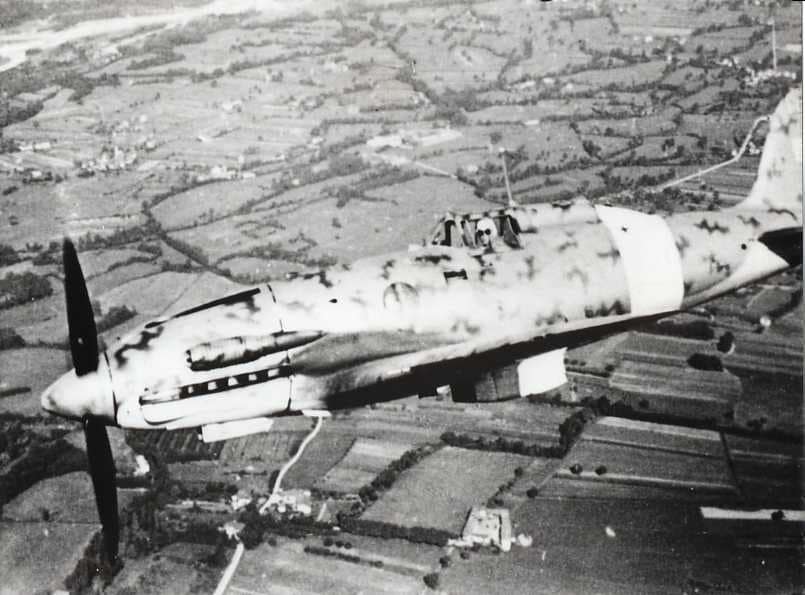
When people list the great fighters of the Second World War, they name the Spitfire, the Mustang, the Bf 109, the Zero. They rarely mention the Macchi C.202 Folgore — and that is an injustice. In the right hands the sleek Italian fighter could out-turn a Spitfire and outfly a P-40. It had only one serious weakness, and it was a fatal one: it barely had any guns.
Informazioni rapide
| Aeromobili | Macchi C.202 Folgore (“Thunderbolt”) |
| Designer | Mario Castoldi |
| Motore | Licence-built Daimler-Benz DB 601 (Alfa Romeo RA.1000) |
| Primo volo | 10 August 1940 |
| Configurazione | Single-engine, single-seat |
| Armamento | Just two 12.7 mm and two 7.7 mm machine guns |
| Costruito | Roughly 1,100–1,150 |
| Theatres | Malta, North Africa, the Mediterranean, the Eastern Front |
A German heart in an Italian airframe
Italy’s early-war fighters were nimble but slow, hamstrung by weak radial engines. The Folgore fixed that. Designer Mario Castoldi — the man behind Italy’s record-breaking Schneider Trophy racers — took the earlier radial-engined C.200 Saetta and re-engined it with a licence-built version of the same German Daimler-Benz DB 601 inline that powered the Messerschmitt Bf 109. The result, first flown in August 1940, was a transformation.

The Folgore was fast, beautifully balanced and a superb diver. Over Malta and North Africa its pilots found they could out-turn Hurricanes and P-40s and hold their own against the Spitfire, which had the edge mainly in the climb. In the summer of 1942, C.202 units in North Africa posted a kill-to-loss record that bettered even the Bf 109.
Those who fought against it came away respecting it.
Beautiful, deadly — and under-gunned
Here was the tragedy. For all its flying qualities, the C.202 carried a feeble punch: just two 12.7 mm machine guns and two rifle-calibre 7.7 mm guns, and no cannon at all. While Spitfires and Bf 109s were mounting 20 mm cannon that could tear an aircraft apart, Folgore pilots often found they could get onto an enemy’s tail and then simply lacked the firepower to finish the job.

It was also never available in the numbers Italy needed. Only around 1,100 to 1,150 were built, spread across three manufacturers, and Italian industry could not keep pace with the war. The definitive answer — a cannon-armed, more powerful development called the C.205 Veltro — arrived only in small numbers and too late to change anything.
The Folgore deserves to be remembered as one of the finest-flying fighters of its era, flown by nearly all of Italy’s great aces. Give it the cannon its rivals carried, and build it in the thousands, and the air war over the Mediterranean might have looked rather different. As it was, the Thunderbolt was a superb aircraft that was never quite allowed to be a great one.
Sources: Mike Spick; AvBuyer; Wikipedia.


0 Commenti