
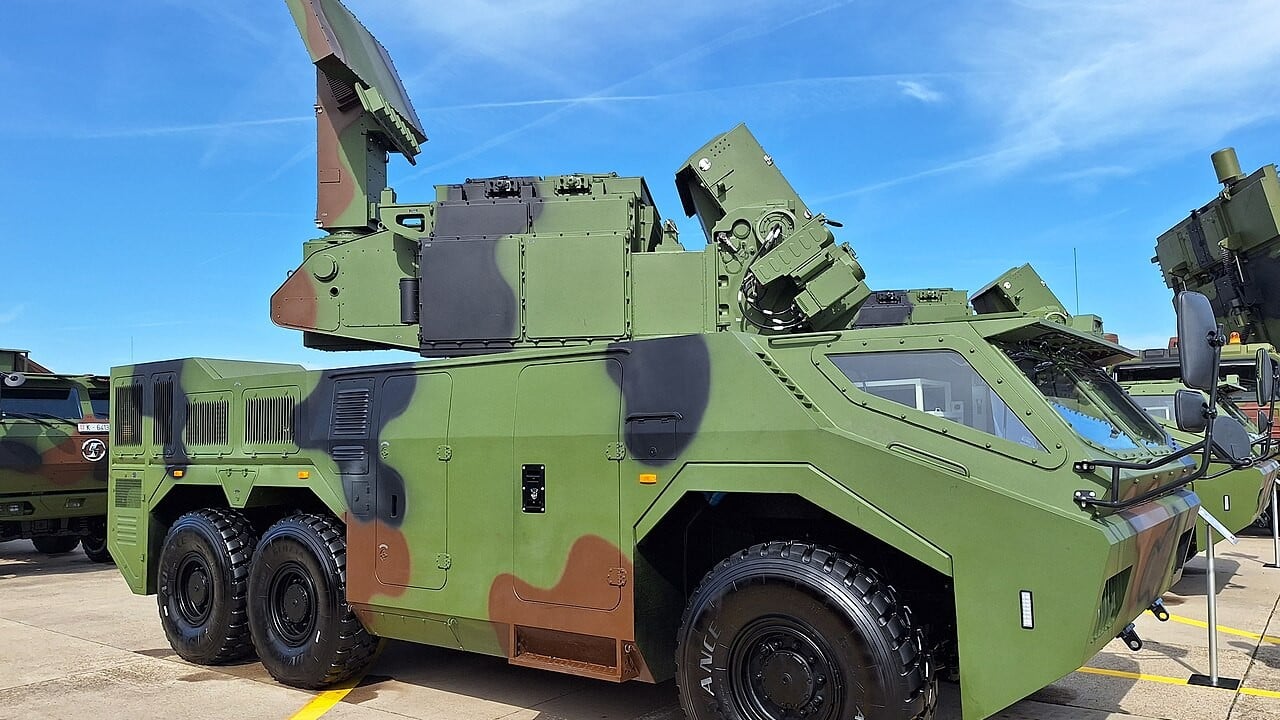
Just after midnight on Pakistan Air Force Day, the PAF posted a patriotic music video called Fizaon K Pasbaan — Guardians of the Skies. Around twenty-eight seconds in, a six-wheeled air-defence vehicle with a large rectangular radar array rolls past.
Pakistan did not name it. Pakistan has still not named it.
By Monday evening, Chinese state media had announced what it was, who made it, what it can do and why Pakistan needed it.
Quick Facts — What is actually established
The video: “Fizaon K Pasbaan”, posted by the PAF’s public relations account at 00:13 Pakistan time on 7 September 2026
The vehicle: Six-wheeled SAM system resembling the Chinese HQ-17A, roughly 28 seconds in
Pakistani confirmation: None. No type, contract, quantity, delivery date or unit has been announced
Who identified it: Bloomberg, hedged as “possible” and “resembles”
Who confirmed it: Chinese state and military media
The system’s origin: HQ-17 is derived from the Russian Tor-M1, after Russia refused China a production licence
Export variant: HQ-17AE, cleared for export March 2021
Confirmed operators: China, Saudi Arabia, Serbia, Tajikistan
The Careful Version and the Confident One
Bloomberg broke the story and was careful about it: the vehicle’s features resemble the HQ-17A, Pakistan did not identify it, and if Pakistan has acquired the system it would mark the first known sale of the type to the country.
IL Global Times version, published the same day, opens with the Pakistan Air Force having “unveiled” the HQ-17AE. From there it runs through the system’s radar, launch method, networking and target capacity, and explains that Pakistan “has become yet another international user” whose short-range gap the system will fill.
The gap between those two accounts is the story.
There is a further wrinkle. Chinese military media reportedly confirmed the model in its own post — meaning Beijing publicly identified a Pakistani air-defence system that Pakistan itself declined to name.
The Bit That Got Cropped Out
Here is what almost every non-Chinese outlet led with, and the Global Times did not mention at all.
The same video’s headline reveal was Turkish. It contained the first confirmation that Pakistan has inducted ASELSAN’s KORKUT — a twin 35 mm self-propelled anti-aircraft gun firing programmable airburst ammunition out to about four kilometres, designed for exactly the drone-swarm problem the Chinese commentary spends its length describing. The ASELSAN ŞAHİN 40 mm system also appeared.
That matters strategically. Pakistan signed a joint defence agreement with Saudi Arabia and Türkiye on 7 August 2026 and has bought Turkish Bayraktar drones. At the short-range tier, Pakistan is diversifying away from Chinese suppliers — which is not the story a Chinese state outlet is going to write about a Chinese vehicle in the same video.
It Is a Tor, and Russia Said No
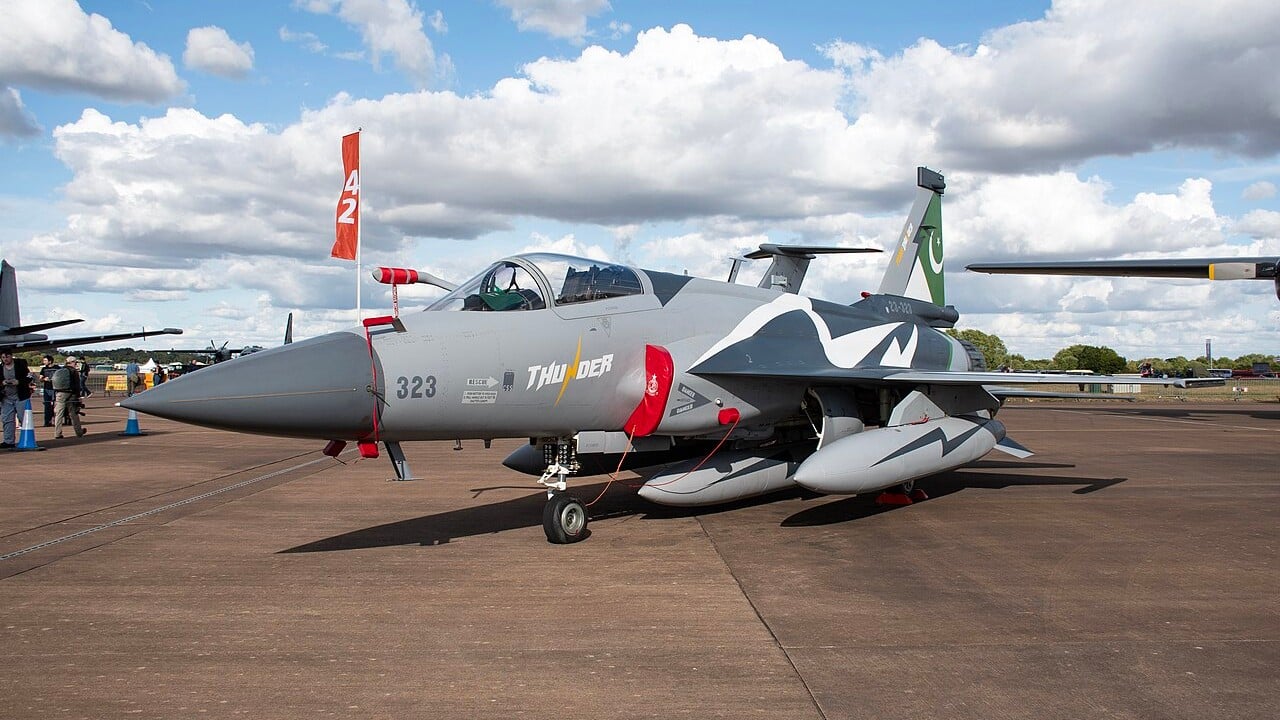
The HQ-17’s ancestry is the most interesting thing about it, and the Chinese account leaves it out entirely. The word Tor does not appear once.
China bought fourteen Russian Tor-M1 systems in 1996, delivered in 1997, then thirteen more in 1999. Around 2000 it asked Moscow for a licence to build the Tor-M1 domestically. Russia refused. China reverse-engineered it instead.
The HQ-17 entered PLA service around 2013 on a tracked chassis. The wheeled HQ-17A appeared publicly at the National Day parade on 1 October 2019. The HQ-17AE is the export version of that wheeled variant, cleared for export in March 2021 — not, as the Global Times states, first appearing at Airshow China in Zhuhai later that year. Its own article contradicts itself two paragraphs down by citing a CASIC statement from March.
The missile is near-identical to the Tor’s 9M331: about 165 kg, 2.9 metres long, with a 15 kg fragmentation warhead.
Which Numbers to Trust
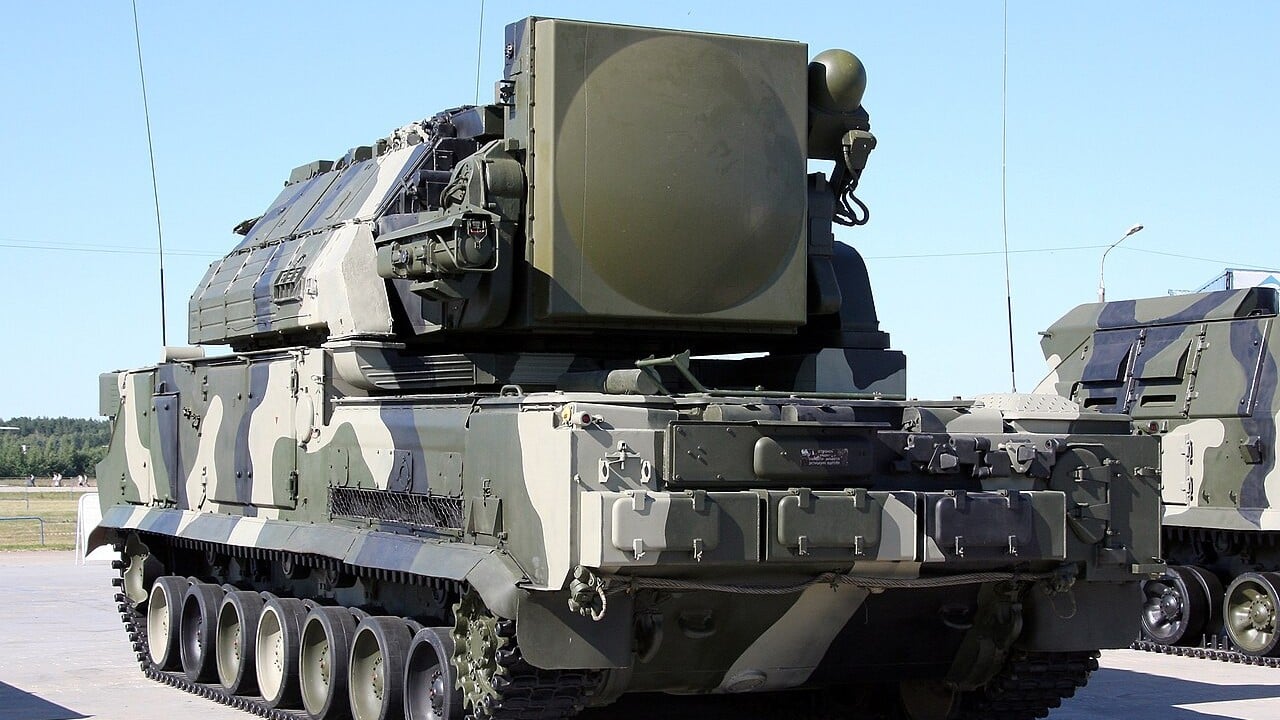
Some HQ-17AE figures are corroborated outside Chinese sources: the six-by-six wheeled chassis, eight missiles per vehicle, a slant range of roughly 1.5 to 15 kilometres, and development by CASIC’s Second Academy in Beijing.
Others are not. The claim that each vehicle can guide four missiles against four targets simultaneously traces only to CASIC and the outlets repeating its brochure. Independent references put the HQ-17 family at two simultaneous engagements, like the Tor-M1 it descends from. The all-solid-state phased array, the vertical cold launch, the “direct force fast turn system”, the rotatable tail wings, firing on the move and vehicle-to-vehicle networking are all manufacturer language, relayed without independent testing. When the South China Morning Post repeated some of it in 2021, it attributed the description explicitly to the Global Times.
One more thing worth naming. The Chinese article’s entire analytical spine rests on a single source described only as “a Chinese military affairs expert”. Wang Yunfei is a retired People’s Liberation Army Navy officer and a recurring named source for Chinese state media — a fact the article does not disclose while using him to assess a land-based short-range air-defence system for a foreign customer. He is also never quoted directly. Every attribution to him is paraphrase.
Pakistan’s Actual Problem
Strip away the framing and there is a real capability question underneath.
Pakistan has no unified joint air-defence system; it runs three service-level networks. The Army fields HQ-9/P at 125 km, LY-80 at 40 km and FM-90 at 15 km. The Air Force operates HQ-9BE out to 260 km, HQ-16FE, Spada 2000-Plus and Crotale. Independent analysis of that inventory identifies a genuine hole in the short-to-medium band.
That is the same conclusion the Chinese commentary reaches. It is simply better sourced.
The May 2025 clashes with India sharpened it. Carnegie India’s assessment records at least 125 fighters airborne at standoff ranges on the night of 6–7 May, and Pakistan firing volleys of small drones — over 600 in a single wave — largely to saturate and map Indian defences. The cost-effective counter turned out to be old guns with airburst ammunition, which is precisely what KORKUT is.
Serbia Did This Properly
For contrast, here is what an actual unveiling looks like. On 28 June 2024, at a static display of weapons and equipment in Kruševac for the Vidovdan state ceremony, Serbia’s then Prime Minister said so out loud.
Serbia named the system, named the seller and put its head of government behind it. Saudi Arabia paraded its HQ-17AE in August 2021. Tajikistan showed its own at an armed forces anniversary parade in March 2025.
Pakistan has done none of that. What exists is twenty-eight seconds of a music video, a hedged Bloomberg report, and a confident announcement from Beijing.
The hardware is probably real. The sale is probably real. But until Islamabad says so, the most concrete thing this episode demonstrates is how a Chinese arms export gets announced — by the seller, not the buyer.
The full PAF Air Force Day video. The vehicle in question appears around the 28-second mark.
Domande frequenti
Has Pakistan confirmed buying the HQ-17AE?
What is the HQ-17AE?
Is the HQ-17 based on a Russian system?
What else was revealed in the Pakistan Air Force video?
Which countries operate the HQ-17AE?
Can the HQ-17AE really engage four targets at once?
How dependent is Pakistan on Chinese weapons?
Sources: Pakistan Air Force (@DGPR_PAF and official YouTube channel); Bloomberg; Global Times; Janes; South China Morning Post; Serbian Ministry of Defence; Quwa; Carnegie India; SIPRI Trends in International Arms Transfers 2024; Defence Security Asia; Militarnyi; Army Recognition.

0 Commenti