
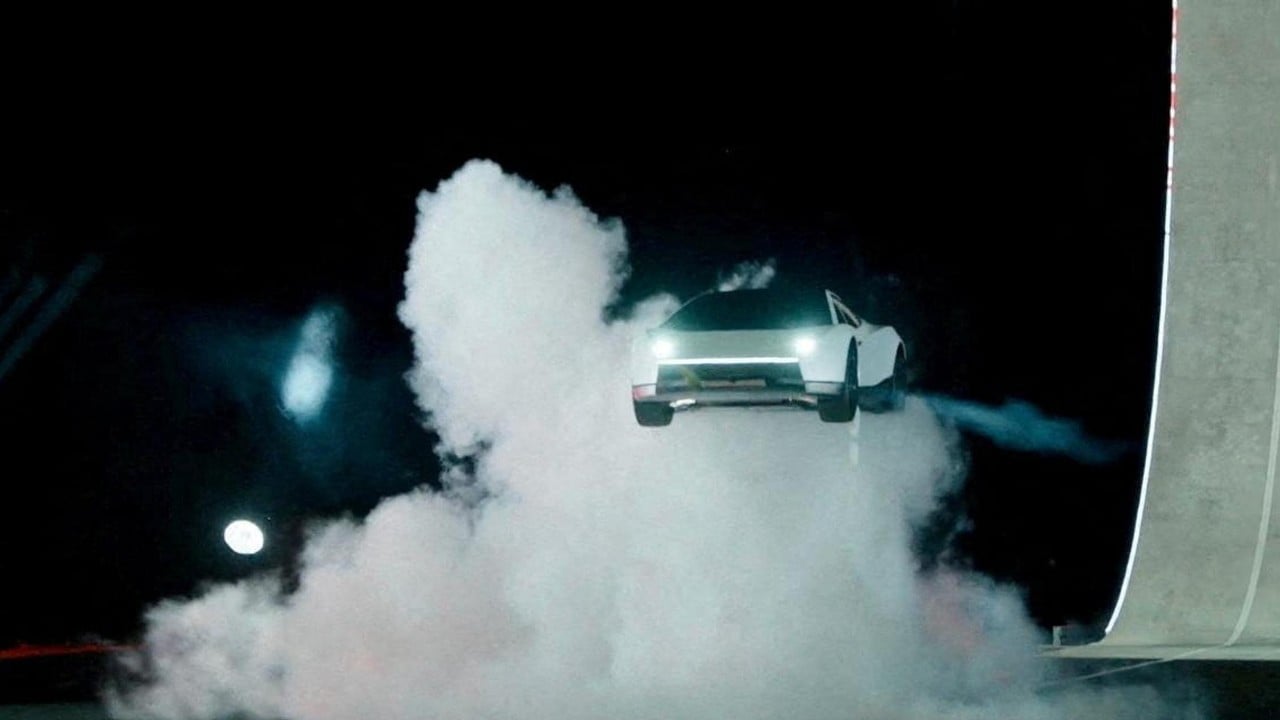
The car drove up a ramp that curled over until it was hanging upside down, stuck to the concrete by its own suction. Then it ran off the end into thin air, fired its thrusters, flipped itself upright and settled onto its wheels.
That was the opening act on 15 October at SpaceX's test site in McGregor, Texas, where Elon Musk unveiled Tesla's long-delayed second-generation Roadster and called it a flying car. Engineering-wise it is a spectacle. Aviation-wise, it raises a question nobody on stage answered: who, exactly, is going to let you fly it?
Informazioni rapide
- Che cosa: Tesla Roadster (second generation) with SpaceX-developed cold-gas thrusters
- Svelato: 15 October 2026, SpaceX test site, McGregor, Texas
- Thrust: More than 80 kN from the rear thrusters, according to Tesla
- Propellant: Compressed air, up to 600 litres or 250 kg, according to Tesla
- Claimed performance: 0 to 60 mph in under one second, top speed above 230 mph
- Produzione: Planned for 2028
- Demo: Flown autonomously, with no one on board
Thrusters, not wings
There are no wings, rotors or fans for lift. Tesla vehicle engineering chief Lars Moravy said the rear thrusters blast compressed gas faster than the speed of sound and produce more than 80 kilonewtons of thrust. For scale, that is in the same bracket as the roughly 79 kN that a General Electric F404-GE-402, the engine of later F/A-18 Hornet including Switzerland's, makes in full afterburner. The difference is that the Roadster can only keep it up for as long as its air lasts.
Musk described the propellant as a rechargeable, ultra-high-pressure air tank that needs no special fuel. Moravy said the car carries up to 600 litres, or 250 kilograms, of compressed air, fed through ten nozzles, and Tesla says every usable void in the car is packed with carbon-fibre-overwrapped pressure vessels of the kind SpaceX uses on its rockets. An underside fan system, rated by Moravy at up to two g of suction, is what let the car cling to the inverted ramp.
For the second trick, which designer Franz von Holzhausen called a kickflip, the Roadster accelerated towards a row of other Tesla vehicles, lit its underbelly thrusters and rolled over them before landing. Musk said a future demonstration might attempt Evel Knievel's Snake River Canyon jump.

A Blackbird on the design board
Tesla leaned hard into aviation for the styling too. The company said the new Roadster's design was inspired by the Lockheed SR-71 Blackbird e il F-35 Lightning II. Von Holzhausen said the car uses full steer-by-wire with a yoke, and Musk said the rear wing changes pitch automatically to manage downforce.
Musk was frank about the rest. He told the audience that success was not guaranteed, that the demonstration car was flown autonomously to make sure nobody got killed, and that the Roadster is not necessarily a safety-optimised car. He also said he was not sure it would be legal in all jurisdictions. Tesla's own website says the flying version is not approved for public roads.
Where the FAA comes in
Anything that flies with a person on board falls into the Federal Aviation Administration's world. As FLYING magazine pointed out, Tesla would need to show the car meets federal motor vehicle safety standards and obtain FAA authorisation, and owners would probably need some form of pilot certification. State law matters as well; FLYING notes that Minnesota and New Hampshire have passed laws treating roadable aircraft as motor vehicles, while other states have been slower.
The FAA did create a new category of aircraft recently, powered-lift, in 2024, the first new category since helicopters. But that rulebook was written for eVTOL air taxis such as those from Joby and Archer, which take off from vertiports, not for a sports car that hops off a public road on compressed air. Tesla has said production will start in 2028. Whether the thrusters will ever be lit outside a test site is a question for regulators, not engineers.
Sources: Tesla (live event and posts on X, 15 to 16 October 2026), FLYING Magazine, CBS News/AFP, USA Today
0 Comments