
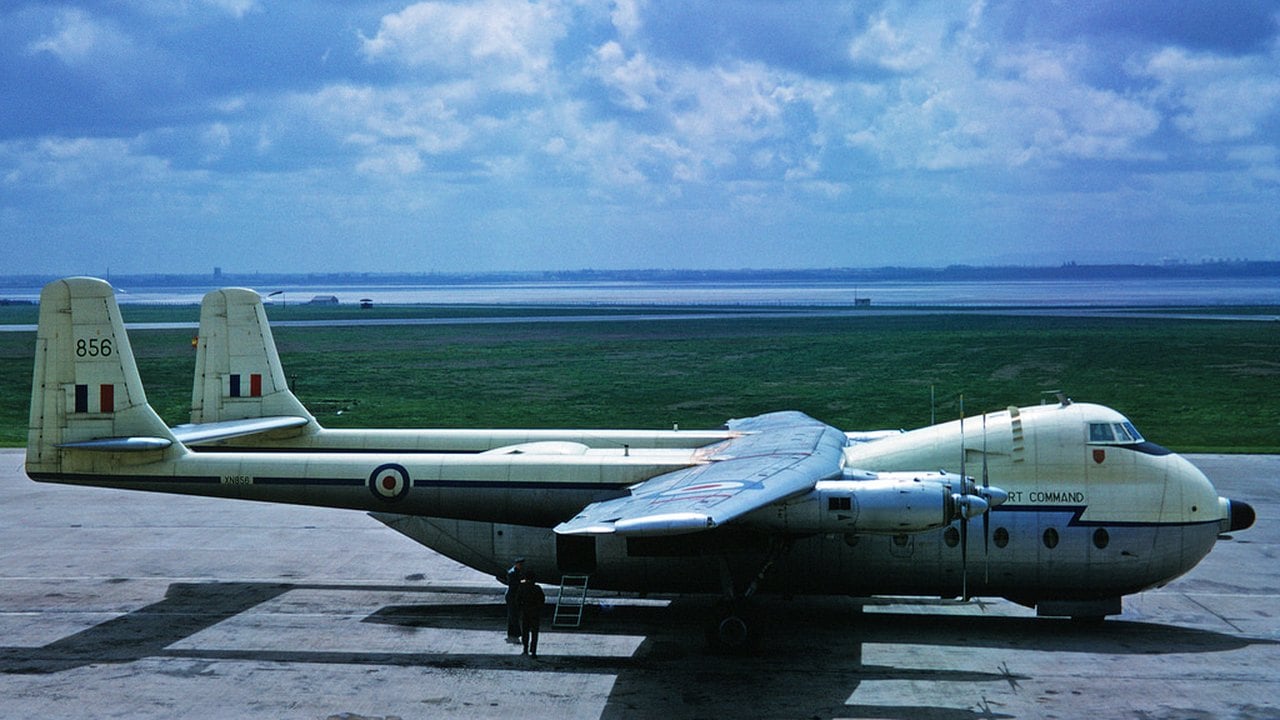
In November 1967, as Britain pulled out of Aden after more than a century, an ungainly white transport shuttled troops the 1,000 miles from Aden to Bahrain, the first leg of their journey home. One of those flights carried out the last 16 RAF staff from the closed Al-Mansura prison. The aircraft doing the work had a fat pod of a fuselage, two long tail booms and four shrieking turboprops.
This was the Armstrong Whitworth Argosy, the last aircraft the famous Coventry firm ever designed. Airline freight crews and RAF transport squadrons knew it by a less flattering name: the Whistling Wheelbarrow.
Informazioni rapide
- Aeromobili: Armstrong Whitworth AW.650 (civil) and AW.660 (military) Argosy
- Ruolo: Medium-range tactical transport and freighter
- Primo volo: 8 January 1959 (civil); 4 March 1961 (first RAF aircraft)
- Motori: Four Rolls-Royce Dart turboprops
- Costruito: 73 in total: 56 Argosy C.1 for the RAF and 17 civil
- Military loads: 54 paratroops, 48 stretcher cases, or vehicles and guns
- RAF service: 1962 to the mid-1970s as a transport; E.1 calibration aircraft until 1978
- Soprannome: The Whistling Wheelbarrow
A freighter nobody had built before
The Argosy began with a 1955 Air Ministry requirement for a medium-range military freighter. Armstrong Whitworth’s first answer, the twin-engined AW.66, ran out of money, but the company spotted something bigger. Nobody had yet built an aircraft purpose-designed for the booming short-haul air freight business in Europe and America, so it pressed on with a civil version as a private venture.
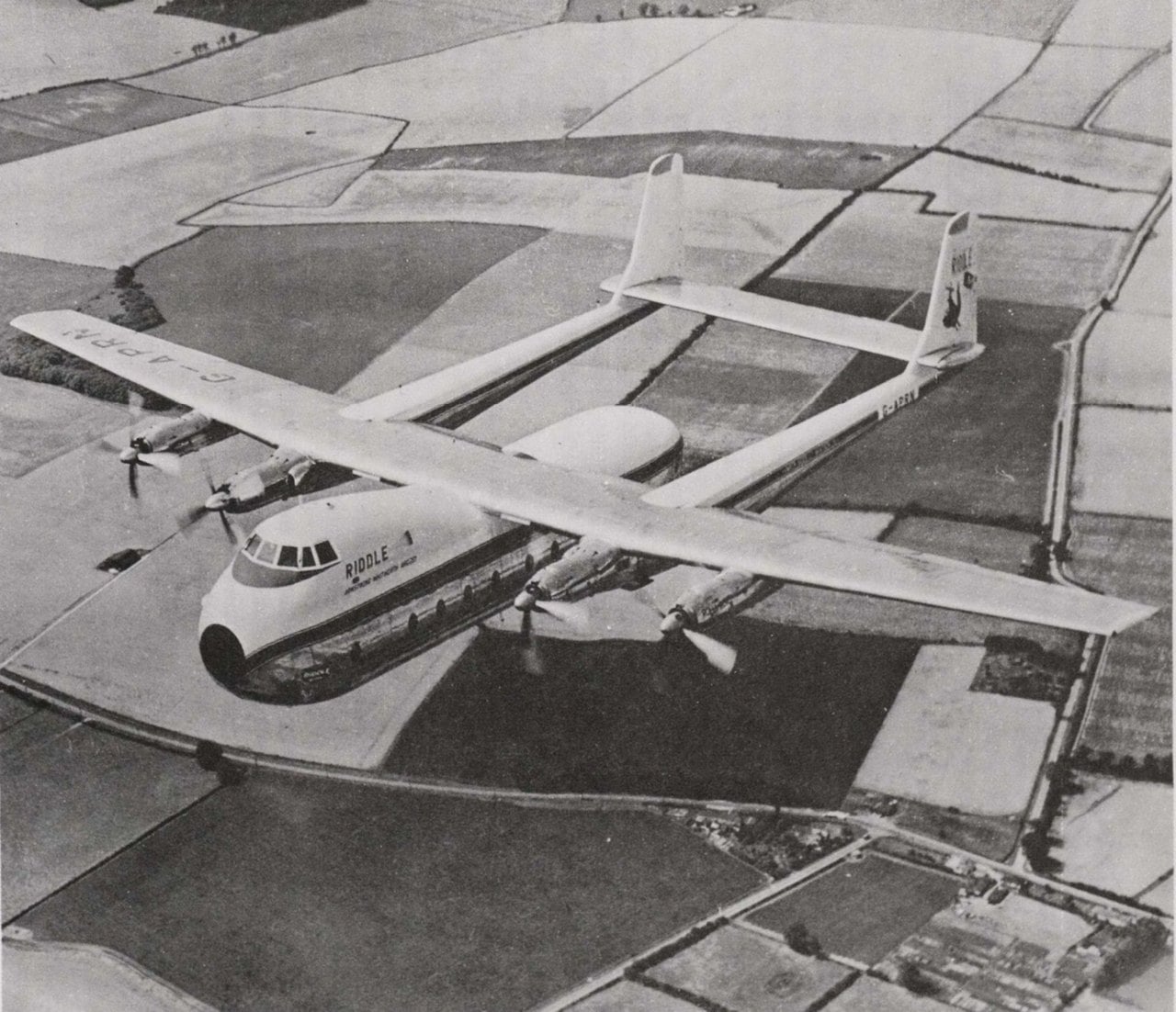
Redesigned around four Rolls-Royce Dart turboprops, the AW.650 Argosy made its first flight on 8 January 1959. Its layout was its selling point. The tailplane sat on twin booms running back from the inner engines, leaving the ends of the fuselage free for big doors. The flight deck perched above the hold, so freight could roll straight in through the nose or the tail on pallets and rollers, from the bed of an ordinary truck.
To save design costs, the wing drew on that of the Avro Shackleton maritime patrol aircraft, built by a sister company in the Hawker Siddeley group. The Dart engines, the same turboprops that powered the Vickers Viscount airliner, gave the Argosy its whistle. The pod-and-boom shape gave it the wheelbarrow.
Riddle, Logair and BEA
The first customer was Riddle Airlines in the United States, which won a US Air Force Logair contract to fly military cargo between American bases. Riddle struggled financially and handed its Argosies back in 1962, but other American freight carriers, among them Capitol, Zantop and Universal, took them on for the same work.
In Britain, British European Airways tried the type and found the original Series 100 could not carry enough to make money. Armstrong Whitworth designed a new, stronger and lighter fail-safe wing and enlarged the doors. The result, the Series 200, first flew on 11 March 1964, and BEA used it to fly freight around Europe.
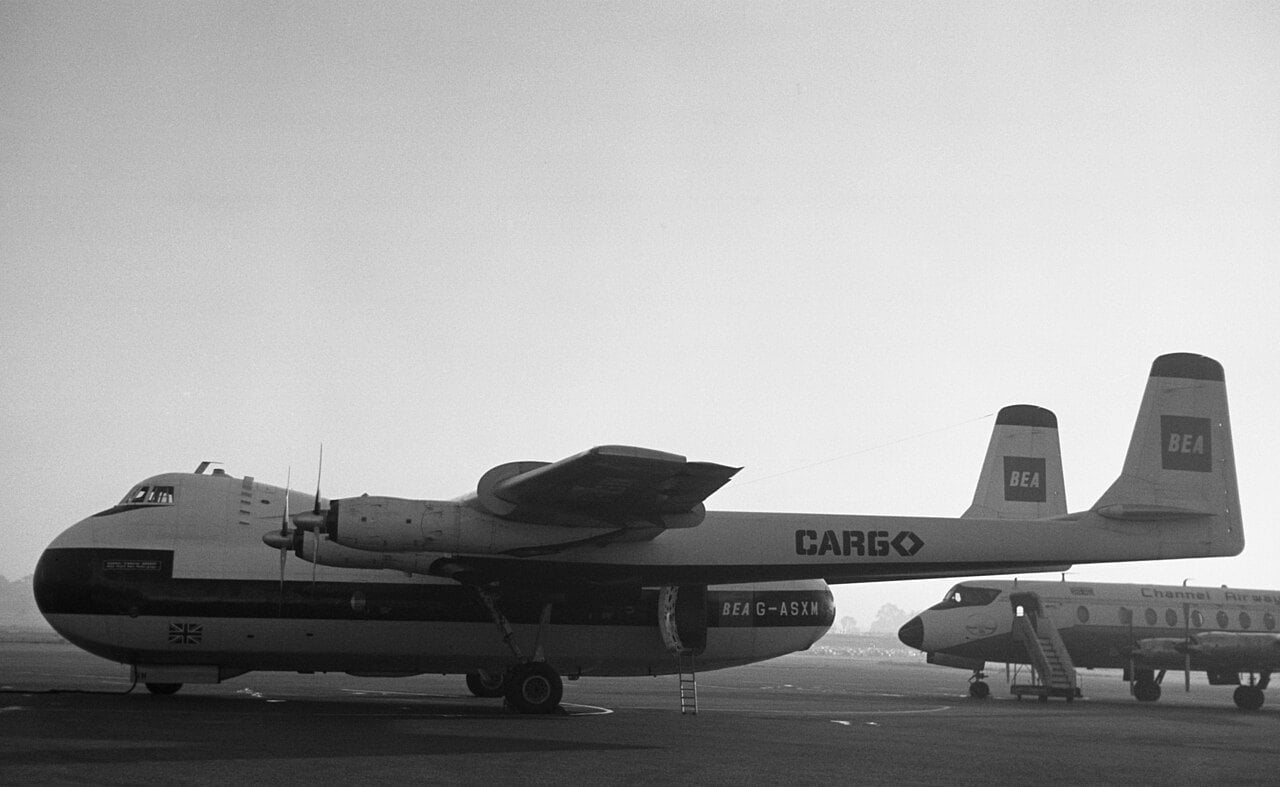
It was not enough. The long-haul jet age was flooding the market with retired piston airliners converted into cheap freighters, and only 17 civil Argosies were built. The airlines alone would never have kept the production line at Bitteswell busy.
The RAF version
The Royal Air Force saved the programme. It needed to replace its ageing piston transports, the Vickers Valetta and the Handley Page Hastings, and in 1959 the Air Ministry ordered a military Argosy, the AW.660. It was a substantially different aircraft: the nose door was sealed and replaced by a weather radar, the rear doors became clamshells with a built-in loading ramp, the floor was strengthened and side doors were added for paratroopers.
The first RAF Argosy flew on 4 March 1961. Armstrong Whitworth built 56 of them as the Argosy C.1, out of 73 Argosies in total. The C.1 could carry 54 paratroops or 48 stretcher cases, or vehicles and guns such as the Ferret armoured car and the 105 mm howitzer.
An Argosy landing at Hong Kong in 1966.
No 105 Squadron re-formed with Argosies at RAF Benson in June 1962, and within weeks it became the first unit to take the Argosy overseas, flying to Khormaksar in Aden, then the busiest RAF station in the world. Nos 114 and 267 Squadrons flew them from Benson, No 215 Squadron from Changi in Singapore, and No 70 Squadron from RAF Akrotiri in Cyprus.
From the Radfan to Borneo
The Argosy arrived in time for a busy decade. Aden-based aircraft supported the army in the fighting in the Radfan mountains in 1964, ferried troops to put down an army mutiny in Uganda, and airlifted fuel to Zambia after Rhodesia’s unilateral declaration of independence. Detachments flew to Singapore to drop supplies in Borneo during the Confrontation with Indonesia.
Borneo’s jungle valleys showed up its limits. The older Blackburn Beverley could turn inside the valley at Bario; the Argosy could not, as one helicopter commander supplied entirely by air later told a Royal Air Force Historical Society seminar.
There was even an experiment to turn it into a bomber. In 1963 an Argosy was fitted with a trial bomb installation at Bitteswell, and No 215 Squadron at Changi was briefed on the T3 bombsight early in the Confrontation. It never dropped a bomb in anger.
In September 1970, during the civil war in Jordan, No 70 Squadron Argosies flew medical teams and supplies from Cyprus to Amman at King Hussein’s request, painted with Red Cross markings and flown by crews in civilian clothes.
The butt of the jokes
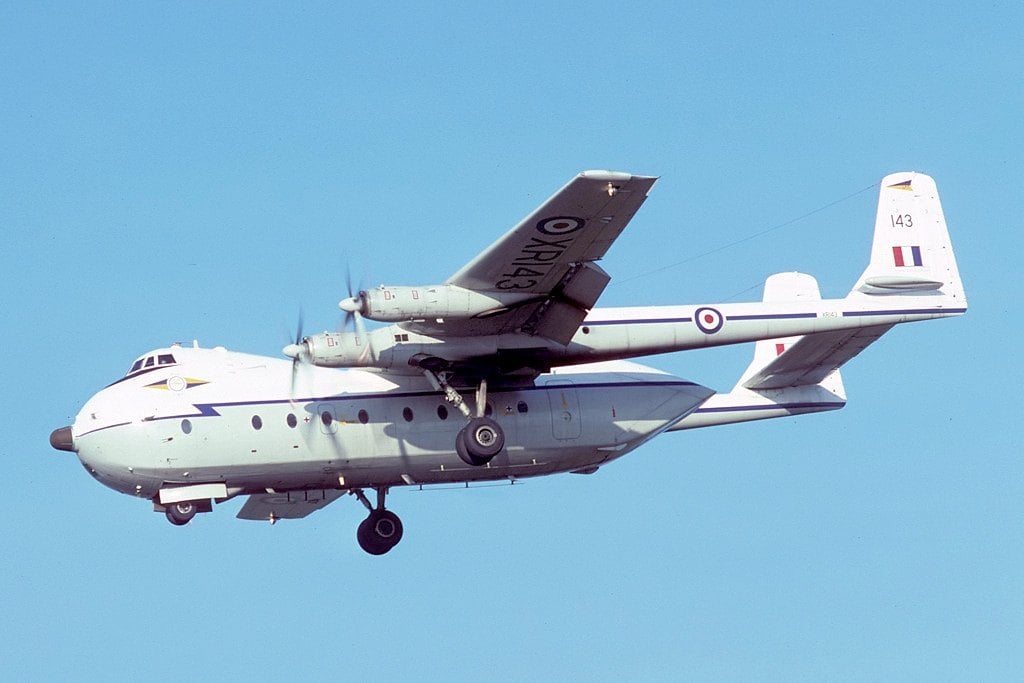
The Argosy never shook off its reputation. The RAF’s strengthened floor made it heavier than the civil freighter, and performance suffered. Crews joked that it could barely carry a verbal message. Yet the veteran transport pilot Group Captain Richard Bates argued that it deserved more credit than that.
He pointed to its advanced radios and navigation equipment, unheard of on the Beverley and Hastings, and to the hundreds of aircrew who learned their trade on it. When camouflage arrived, crews found that the front view reminded them of Dougal, the shaggy dog from The Magic Roundabout, and the nickname stuck.
Replaced by the Hercules
The aircraft that ended the Argosy’s RAF career was American. The Lockheed C-130 Hercules entered RAF service in 1967, and by the end of 1970 No 70 Squadron in Cyprus had started to re-equip with it. Defence cuts finished the job, and the Argosy left the transport role in the mid-1970s. A planned navigation trainer version, the T.2, was cancelled in 1975.
A few Argosy E.1s carried on with No 115 Squadron, flight-checking radars and landing aids at airfields across Britain, until the Hawker Siddeley Andover replaced them in 1978. Some ex-RAF airframes went on to second careers as civil freighters.
SAFE Air’s Argosy ZK-SAE makes its final landing at Woodbourne on 30 September 1990.
The longest-lived were in New Zealand, where SAFE Air flew Argosies as freighters and out to the remote Chatham Islands with a removable passenger capsule in the hold. The last flight to the Chathams was in September 1990, and ZK-SAE made the company’s final Argosy landing at Woodbourne that same month. It still stands there today.
In Britain, the RAF Museum at Cosford displays XP411, the Argosy that served in Aden, Bahrain and Cyprus and was the only one painted in red-and-white Training Command colours. The second prototype, G-APRL, is preserved at the Midland Air Museum near Coventry.
Inside G-APRL, the second prototype and oldest surviving Argosy, at the Midland Air Museum.
The Whistling Wheelbarrow was never beautiful and never fast. But for a decade it hauled the British Army in and out of the last outposts of empire, and Armstrong Whitworth could have chosen a far worse aircraft to end on.
Sources: Royal Air Force Museum (individual history of Argosy C.1 XP411, Andrew Simpson, 2017), Royal Air Force Historical Society (Journal 22, Seminar on Air Transport, 2000), Flight International, Argosy Trust (argosy.org.nz)
Domande frequenti
What was the Armstrong Whitworth Argosy?
Why was the Argosy called the Whistling Wheelbarrow?
How many Argosies were built?
Where did the RAF use the Argosy?
What replaced the Argosy in RAF service?
Where can I see an Argosy today?
Post correlati
Fairchild C-119 Flying Boxcar: The Airlifter That Caught a Satellite
Short Belfast: The Giant RAF Freighter Britain Retired Too Soon
Nord Noratlas: The Twin-Boom Transport That Linked France and Germany
Armstrong Whitworth AW52: il primo sistema di eiezione d'emergenza della Gran Bretagna
0 Comments