

On the evening of 14 October 1973, a C-5A Galaxy touched down at Lod airport outside Tel Aviv carrying 97 tons of 105 mm howitzer shells. Roughly a hundred miles to the south-west, the largest tank battle since Kursk was being fought, and the Israeli army was running out of ammunition to fight it with.
Over the following month the United States Air Force flew 567 missions and delivered something over 22,000 tons of materiel into a country at war, across an ocean, with almost every ally in Europe refusing to let the aircraft land.
The operation was called Nickel Grass. It changed the outcome of a war, triggered an oil crisis, and settled a long-running argument about whether the C-5 Galaxy had been worth building.
Informazioni rapide
| Operazione | Nickel Grass — US strategic airlift to Israel during the October 1973 Arab–Israeli War |
| Date | 14 October to 14 November 1973 — 32 days |
| Gestito da | Military Airlift Command, United States Air Force |
| Aeromobili | Lockheed C-141A Starlifter and Lockheed C-5A Galaxy. Both four-engined; neither could refuel in the air |
| Missioni | 567 in total — 422 by C-141, 145 by C-5. Around 18,400 flying hours |
| Tonnage | Roughly 22,300 tons. Published figures vary between 22,318 and 22,395 |
| The C-5’s share | About 48% of the tonnage on 26% of the missions, including 2,264 tons of outsize cargo nothing else could carry |
| Staging base | Lajes Field in the Azores — the only place in Europe the aircraft were allowed to stop |
| Safety record | No accidents. Abort rate under 2% |
Everybody said no
The hardest problem was not distance. It was diplomacy.
When President Nixon ordered the resupply, NATO allies across Western Europe declined to let American transports carrying weapons to Israel use their bases, their airspace, or in some cases even leave their territory with materiel already stockpiled there. Britain, West Germany, Italy, Greece, Turkey and Spain all refused in one form or another. Some American equipment sitting in Europe had to be flown back out via the Atlantic rather than east across the Mediterranean.
Only Portugal relented, and not enthusiastically. Lajes Field in the Azores — a mid-Atlantic rock with a runway — became the single hinge on which the entire operation turned. The first aircraft launched before clearance had actually been granted and received word mid-ocean.
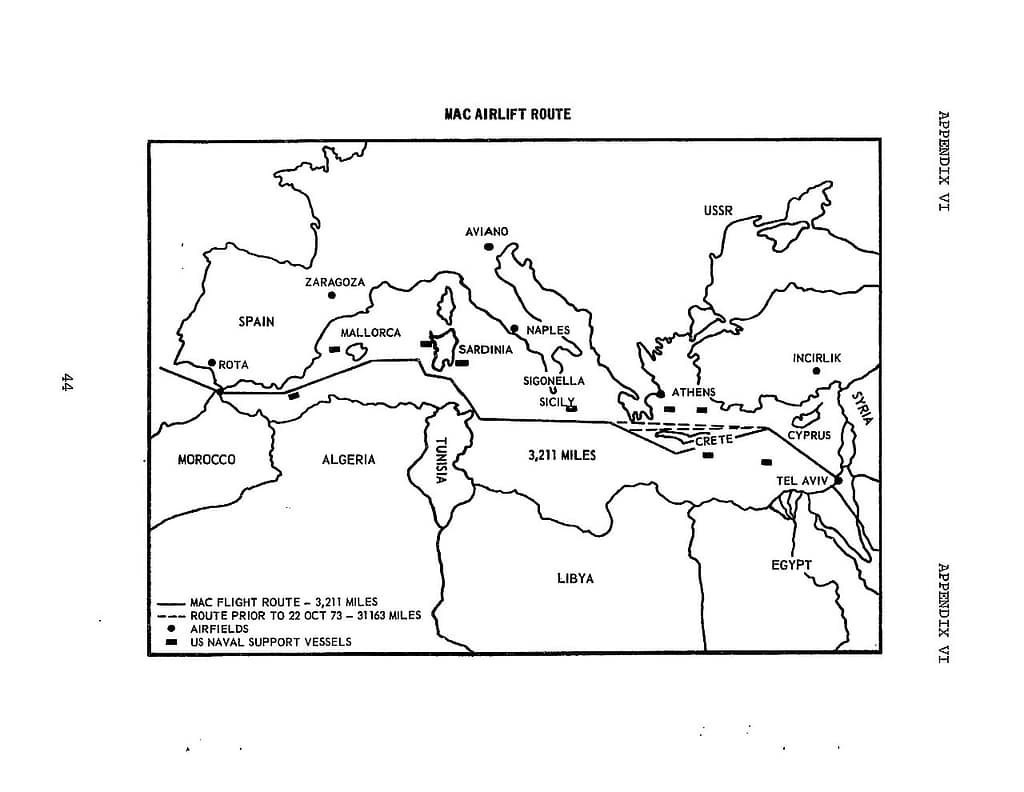
From the US East Coast to Lajes averaged 3,297 miles. From Lajes to Lod, another 3,163. Without that one airfield, the C-141A — which had no aerial refuelling capability whatsoever — simply could not have reached Israel.
The aeroplane nobody wanted
By 1973 the C-5A Galaxy had been in service three years and had a terrible reputation. It was late, wildly over budget, plagued by wing cracks, and had become a byword in Congress for defence procurement gone wrong.
Nickel Grass is where it earned its keep. The C-5 was the only aircraft in the inventory that could swallow outsize cargo — M60 Patton tanks, 155 mm howitzers, CH-53 helicopters, mobile ground radar. A C-141A could carry pallets and ammunition, roughly 28 tons at a time. A C-5 carried around 73 tons, and it could carry things that did not fit in anything else at all.
Over the operation the Galaxy managed an 81% reliability rate and the Starlifter 93%. Between them they flew 567 missions into a war zone without a single accident.
Moorer's remark, made by telephone to the commander of Military Airlift Command during the first frustrating hours, captures the political temperature. Nixon's own instruction had been blunter: send everything that can fly.
The initial delay was not bureaucratic. It was weather — 50-knot crosswinds at Lajes — which produced considerable fury in Washington that supplies had not somehow reached Israel already.

Flying down the middle of the Mediterranean
The route into Israel ran along the Flight Information Region boundary down the centre of the Mediterranean — a thin legal corridor between hostile airspace on both sides. The US Sixth Fleet provided cover for most of the transit, handing over to Israeli fighters somewhere between 150 and 200 miles out.
General Paul Carlton, who commanded Military Airlift Command, was acutely aware of how vulnerable a Galaxy is sitting on a ramp within artillery range of a shifting front line. Wherever possible, only one C-5 was on the ground at Lod at any moment.
At Lajes, meanwhile, 1,300 extra personnel were crammed into hastily reactivated Second World War barracks, four men to a room built for two.
What it cost, and what it changed
The bill arrived quickly. Arab oil producers, who had already agreed production cuts in principle, applied a full embargo against the United States. The 1973 oil crisis followed, and with it the end of the post-war era of cheap energy.
Inside the Air Force, the consequences were structural. The inability of the C-141A to reach Israel without a friendly runway in the middle of the Atlantic was judged intolerable, and the entire fleet was subsequently rebuilt as the C-141B — stretched by three pallet positions and, crucially, fitted for aerial refuelling. Air-refuellable transports went from a luxury to a requirement, and have been ever since.
Nickel Grass was not the largest airlift in history. Berlin was far bigger; Desert Shield bigger still. But it is the one that proved a strategic airlift could be improvised across an ocean, into a shooting war, over the objections of almost every ally — and it is the reason the C-5 Galaxy stopped being a scandal and started being indispensable.
Lt Col John Kolar, who flew the airlift, describing Nickel Grass from the cockpit.
The C-5 Galaxy’s wider story — the aircraft whose reputation Nickel Grass rescued.
A fuller account of how the airlift was organised and flown.
Sources: Walter J. Boyne, “Nickel Grass”, Air Force Magazine, December 1998; Air Mobility Command Museum; Wikipedia.
0 Commenti