Share this story In the early 1960s, a boxy little jet rose slowly off the ground at a Lockheed test site in Georgia, hung in the air, and set down again. On the face of it, the Lockheed XV-4 Hummingbird had done the impossible-looking thing: vertical take-off on...
Share this story On 3 July 1955, Western military attachés stood at the Soviet Aviation Day display at Tushino, near Moscow, and watched something that frightened them: wave after wave of big four-jet bombers thundering overhead. They counted, and re-counted,...
Share this story On 15 July 1941, a 28-year-old German pilot did something no one in the history of flight had done before: he shot down his hundredth aircraft. Werner Mölders had reached a number that once seemed impossible. Yet the record was not his most...
Share this story Tens of millions of people say his name every year without knowing whose it is. They say it at a check-in desk, on a boarding pass, in a taxi line in Chicago: O’Hare. Behind the world’s busiest departures board is a 27-year-old fighter...
Share this story On the grey afternoon of 12 February 1942, six ancient-looking biplanes lumbered off the runway at RAF Manston, near Dover, and turned out over a freezing sea. They were Fairey Swordfish — fabric-and-wire torpedo bombers with open cockpits and a...
Share this story The flies came first. On Malta in the baking summer of 1942, they swarmed everything, and they swarmed the thin slices of corned beef the fighter pilots of 249 Squadron ate between sorties. One newcomer had a trick. He would set his plate on the...
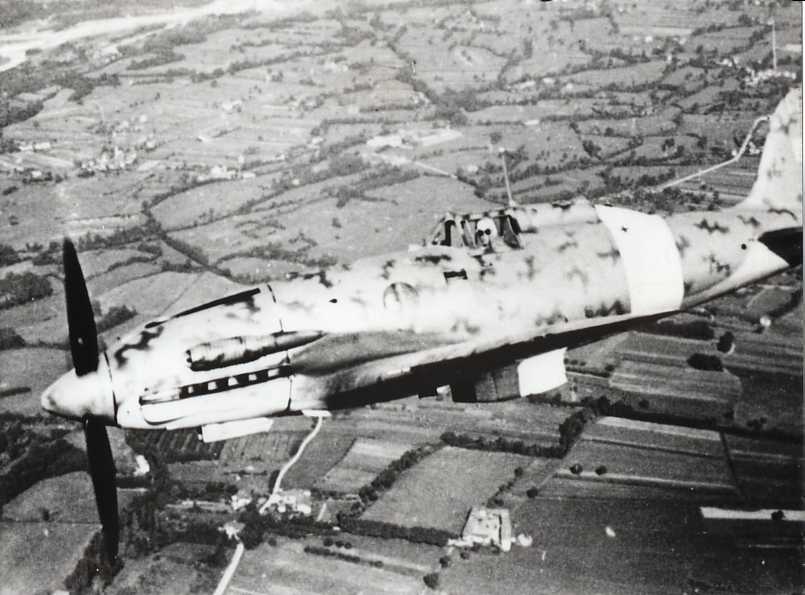
Share this story When people list the great fighters of the Second World War, they name the Spitfire, the Mustang, the Bf 109, the Zero. They rarely mention the Macchi C.202 Folgore — and that is an injustice. In the right hands the sleek Italian fighter could...
Share this story Every swing-wing jet that followed — the F-14 Tomcat, the F-111, the Tornado, the B-1 — owes a debt to one small, awkward and rather dangerous research aircraft from the early 1950s. The Bell X-5 was the first aeroplane in the world that...
Share this story When people picture the first practical helicopters, they usually think of Igor Sikorsky and wartime America. But years before Sikorsky’s machines matured, Nazi Germany built a genuinely usable transport helicopter — and in September 1945,...
Share this story In the mid-1930s, a French carpenter’s dream put aviation within reach of the ordinary man. Henri Mignet’s Flying Flea — the Pou-du-Ciel, or “Louse of the Sky” — was a tiny wooden aeroplane that anyone could build...
Share this story On the evening of 10 May 1941, the third most powerful man in Nazi Germany climbed into a Messerschmitt Bf 110 fighter, alone, and pointed it at Scotland. No orders. No co-pilot. No authorisation from Hitler. Just Rudolf Hess, the Deputy Führer,...
Share this story It was a hard-luck bomber nobody wanted — a battered B-17E scarred by oddball accidents and passed from unit to unit until its tail number gave it a new name: Old 666. A misfit pilot named Jay Zeamer requisitioned the wreck, rebuilt it into a...




Recent Comments